
Last Updated on February 24, 2026 by Admin
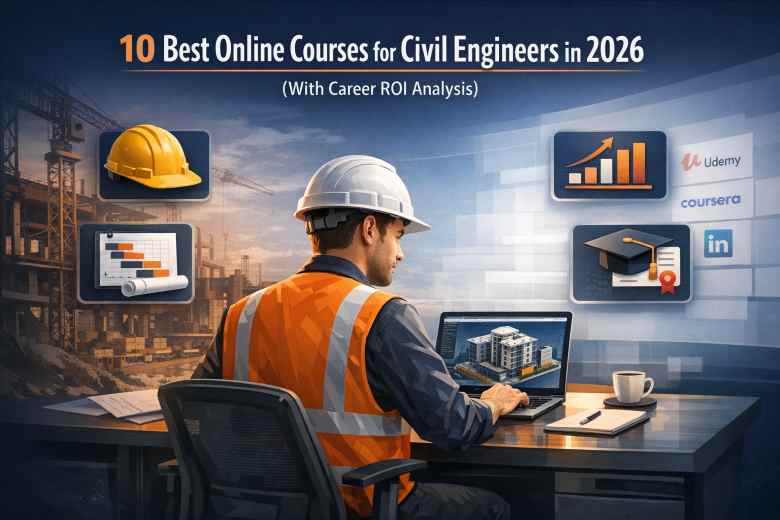
The civil engineering profession is changing faster in 2026 than at any point in its modern history. Automation, BIM mandates, AI-powered project controls, and a global infrastructure boom worth over $13 trillion by 2030 are reshaping what employers actually look for on a resume. A bachelor’s degree alone no longer guarantees career momentum — the engineers who advance fastest are those who continuously upskill through targeted online courses for civil engineers that deliver measurable career returns.
ConstructionCareerHub App is LIVE — built ONLY for construction careers. Don’t apply with a weak resume.
Get ATS-ready Resume Lab + Interview Copilot + Campus Placement Prep (resume screening, skill gaps, interview readiness) — in minutes & Other advanced features.
Explore Smarter Construction Career Tools →Quick check. Big impact. Start now.
Whether you are a fresh graduate looking for your first site role, a mid-career professional eyeing a shift into BIM or project management, or a senior engineer preparing for leadership, this guide breaks down the 10 best online courses for civil engineers in 2026. Each recommendation comes with a career ROI analysis so you can invest your time and money where the payoff is highest.
Before you dive in, it is worth assessing where you currently stand. The Digital Skills Gap Calculator gives you a personalized readiness score across BIM, scheduling, estimation, and more — so you know exactly which courses to prioritize.
Table of Contents
Why Online Courses Matter for Civil Engineers in 2026
The construction industry is no longer a “learn on the job and you’ll be fine” profession. According to the U.S. Bureau of Labor Statistics, employment for civil engineers is projected to grow steadily through 2032, but the nature of these jobs is shifting dramatically. Employers now expect proficiency in digital tools — BIM software, scheduling platforms, structural analysis programs, and data analytics — alongside traditional field knowledge.
A LinkedIn Workforce Report found that job postings for construction professionals with software skills grew by over 37% year-on-year, particularly for roles requiring BIM, scheduling tools, and clash detection. This is exactly why short-term civil engineering online courses and certificate programs have exploded in popularity — they let you build job-ready skills in weeks rather than years.
The career data tells a clear story: civil engineers who invest in targeted digital upskilling through platforms like Coursera, Udemy, and LinkedIn Learning command 25–40% higher salaries and receive up to three times more project leadership opportunities, according to industry salary benchmarks. If you are serious about advancing your career, the 2026 Construction Career Blueprint explains exactly which skills separate professionals who advance from those who stagnate.
The key advantage of civil engineering courses online in 2026 is flexibility. You can learn Revit BIM during weekday evenings, master Primavera P6 scheduling on weekends, or complete a full construction management specialization while working full-time on site. And the best part? Many of these courses issue industry-recognized certificates that directly strengthen your resume.
How We Ranked These Courses (ROI Methodology)
Not all civil engineering certificate courses deliver equal value. We evaluated over 50 courses across major platforms and ranked them using a five-factor Career ROI framework:
| ROI Factor | Weight | What We Measured |
|---|---|---|
| Salary Impact | 30% | Average salary increase after course completion, based on job market data |
| Job Demand | 25% | Number of active job postings mentioning the skill on LinkedIn, Naukri, and Indeed |
| Certificate Value | 20% | Employer recognition, ATS friendliness, and platform credibility |
| Course Quality | 15% | Student ratings, instructor expertise, hands-on project content |
| Time-to-Value | 10% | How quickly skills can be applied professionally after completing the course |
Each course below includes its ROI score (out of 10), estimated salary uplift, and the career paths it unlocks.
1. Autodesk Revit BIM Fundamentals for Engineers
Platform: Coursera (Autodesk) + Udemy alternatives
Duration: 30–40 hours
Cost: Free to audit on Coursera; $15–$85 on Udemy
Certificate: Yes — Coursera Verified Certificate / Autodesk Certified Professional pathway
Career ROI Score: ⭐ 9.5/10
If there is one course every civil engineer should complete in 2026, this is it. Over 70% of BIM job postings now list Autodesk Revit as a mandatory skill. A Revit BIM course teaches you to create intelligent 3D parametric models that integrate architectural, structural, and MEP disciplines — a skill set that forms the backbone of modern project delivery.
The course typically covers 3D modeling fundamentals, family creation, structural and architectural templates, coordination workflows, and clash detection using Navisworks. For civil engineers, this translates directly into roles like BIM Coordinator, BIM Modeler, and eventually BIM Manager — positions that command $65,000–$120,000+ annually depending on market and experience level.
Career ROI Analysis: Engineers with BIM fundamentals for engineers certification report an average salary uplift of 20–35% within 18 months. The demand for BIM skills is growing globally, driven by ISO 19650 mandates and government BIM requirements in markets like the UK, Singapore, Australia, and India. For a deep dive into BIM career trajectories and salary data, read the comprehensive BIM Career Opportunities Guide on ConstructionPlacements.
Who should take this: Fresh graduates, site engineers looking to transition to design/coordination, and any professional targeting roles in BIM job roles.
2. AutoCad Civil 3d 2026 Training Program
Platform: Udemy / LinkedIn Learning
Duration: 20–30 hours
Cost: $15–$50 on Udemy; included with LinkedIn Learning subscription
Certificate: Yes — Course completion certificate
Career ROI Score: ⭐ 8.8/10
While Revit dominates the BIM space, AutoCAD Civil 3D remains the go-to tool for transportation engineering, site grading, land development, and infrastructure design. This AutoCAD course for civil engineers covers surface modeling, corridor design, pipe networks, grading, and plan production — skills that are essential for highway, drainage, and site development projects.
A solid AutoCAD Civil 3D course takes you from basic 2D drafting concepts to advanced 3D surface and alignment workflows. The software is used extensively by transportation departments, land surveyors, and infrastructure design consultancies worldwide.
Career ROI Analysis: AutoCAD proficiency is one of the most universally requested skills across civil engineering job postings. Engineers with Civil 3D expertise are particularly sought after for highway design, site development, and surveying and mapping roles. The salary uplift is typically 15–25% for professionals who add Civil 3D specialization to their profile. For a comprehensive look at essential software, check the complete list of civil engineering software that every engineer should know.
Who should take this: Civil engineering students, beginners looking for online civil engineering courses, transportation engineers, and land surveyors.
3. Construction Management Specialization (Columbia University — Coursera)
Platform: Coursera
Duration: 4 courses, approximately 4–6 months
Cost: Free to audit; Coursera Plus or $49/month for certificate
Certificate: Yes — Coursera Specialization Certificate from Columbia University
Career ROI Score: ⭐ 9.2/10
This is arguably the best construction management course available online for civil engineers who want to transition from technical roles into project leadership. Taught by Professor Ibrahim Odeh at Columbia University, the four-course specialization covers project initiation, planning fundamentals, BIM concepts, Work Breakdown Structures, scheduling, cost estimating, and construction finance.
With over 35,000 learners from 188 countries enrolled, this civil engineering course on Coursera carries real weight on a resume. It is one of the few online programs that combines Ivy League credentials with practical, construction-specific content. The specialization also touches on project planning and scheduling, construction safety, and building codes and standards — making it a holistic career accelerator.
Career ROI Analysis: Construction managers in the USA earn a median salary of $106,900 according to the BLS, with experienced professionals exceeding $150,000. This course provides a credible pathway from site engineering into management. For further guidance on making this career move, read our detailed guide on the best degree options for construction managers and explore the top construction management online courses.
Who should take this: Mid-career civil engineers, aspiring project managers, and professionals targeting leadership roles in construction firms.
4. Structural Analysis and Design with ETABS & STAAD.Pro
Platform: Udemy
Duration: 25–40 hours (combined)
Cost: $15–$70 per course
Certificate: Yes — Udemy certificate of completion
Career ROI Score: ⭐ 8.5/10
For civil engineers passionate about structural engineering, mastering analysis and design software is non-negotiable. A comprehensive ETABS course teaches you to model multi-story buildings, perform seismic and wind analysis, design reinforced concrete and steel structures, and generate design reports — critical skills for any structural analysis course or structural design course on the market.
Similarly, a STAAD.Pro course covers 3D frame analysis, steel and concrete code checking, foundation design, and load combinations according to international codes (IS, ACI, Eurocode, and BS standards). Together, ETABS and STAAD.Pro form the backbone of structural design practice in consulting firms and EPC organizations worldwide.
Some courses also cover SAFE foundation design software, which pairs excellently with ETABS for complete building design workflows — from superstructure to substructure.
Career ROI Analysis: Structural engineers with software proficiency command premium salaries in consulting and EPC sectors. A structural design course combined with ETABS/STAAD.Pro skills can unlock salary increases of 20–30%, especially in markets with active infrastructure development like India, the Middle East, and the USA. To understand the full range of engineering software tools, see the top construction software skills to get hired in 2026.
Who should take this: Structural engineers, design consultants, and civil engineering graduates interested in the design specialization.
5. Primavera P6 — Project Planning & Scheduling
Platform: Udemy / LinkedIn Learning
Duration: 15–25 hours
Cost: $15–$50 on Udemy; LinkedIn Learning subscription
Certificate: Yes — Udemy/LinkedIn certificate + Oracle Certified Professional pathway
Career ROI Score: ⭐ 9.0/10
Planning engineers are among the highest-paid technical professionals in construction, and Primavera P6 is the industry-standard tool they depend on. A comprehensive Primavera P6 course covers project creation, WBS development, activity relationships, resource loading, S-curves, earned value analysis, time impact analysis, and delay claims documentation — all critical for project controls roles.
Many leading EPC firms and government agencies list “Primavera P6 Mandatory” directly in job descriptions for planning engineers and project control managers. This is complemented by an MS Project course for smaller projects and organizations that use the Microsoft ecosystem.
Career ROI Analysis: Planning engineers with Primavera P6 proficiency earn $60,000–$110,000+ annually depending on region and project complexity. In Gulf countries, where major infrastructure projects dominate, this skill alone can justify salaries 40–50% above general civil engineering roles. This course pairs perfectly with the top construction project management courses for engineers targeting leadership trajectories.
Who should take this: Planning engineers, project coordinators, cost engineers, and anyone targeting project controls careers. For related role details, explore the types of construction management professionals.
6. Quantity Surveying & Estimation Mastery: AutoCAD, Excel, BBS
Platform: Udemy
Duration: 20–35 hours
Cost: $15–$60
Certificate: Yes — Udemy certificate of completion
Career ROI Score: ⭐ 8.7/10
Quantity surveying sits at the intersection of engineering and finance — a combination that is incredibly valuable in the construction industry. The best quantity surveying courses on Udemy teach you BOQ preparation, bar bending schedules (BBS), rate analysis, billing processes, variation orders, and cost estimation from working drawings using AutoCAD and Excel.
These courses also cover blueprint reading and materials science fundamentals, equipping you to accurately take off quantities and prepare cost estimates for real projects. The practical, project-based approach means you can apply what you learn immediately on site or in a consultant’s office.
Career ROI Analysis: Quantity surveyors in developed markets (UK, Australia, USA, Middle East) command excellent salaries, often exceeding those of general civil engineers at equivalent experience levels. The RICS qualification pathway, which these courses help prepare for, is globally recognized and highly valued. For detailed career information, refer to the Quantity Surveyor job description and salary guide and explore dedicated quantity surveying courses.
Who should take this: Fresh graduates exploring commercial roles, billing engineers, cost engineers, and professionals preparing for quantity surveying interviews.
7. HSE (Health, Safety & Environment) Training for Construction
Platform: Udemy / Coursera / Alison
Duration: 10–25 hours
Cost: $15–$50 (Udemy); Free on Alison
Certificate: Yes — Course certificate + OSHA 30/NEBOSH preparation pathways
Career ROI Score: ⭐ 8.3/10
HSE (Health, Safety, Environment) training is a must-have credential in the global construction industry. Whether you are working on a high-rise project in Dubai, a highway expansion in Texas, or an industrial plant in Gujarat, safety compliance is non-negotiable. Online HSE courses cover hazard identification, risk assessment, incident investigation, OSHA regulations, permit-to-work systems, and environmental management systems.
More advanced pathways lead to NEBOSH International General Certificate and OSHA 30-Hour Construction Safety certifications — both of which are globally recognized and often mandatory for site leadership roles. These courses incorporate building codes and standards knowledge that strengthens your regulatory compliance skills.
Career ROI Analysis: HSE officers and managers earn strong salaries across all construction markets. In the Gulf region, HSE roles command $50,000–$90,000+ annually with additional benefits. The certification requirement creates a clear barrier to entry, which means those who invest in it enjoy lower competition for roles. For broader career planning, the comprehensive guide to 110 civil engineering career paths covers HSE career trajectories in detail.
Who should take this: All civil engineers (safety awareness is universally valuable), aspiring HSE officers, site supervisors, and professionals targeting Gulf or international projects.
8. Geographic Information Systems (GIS) Specialization
Platform: Udemy / Coursera (University of California, Davis)
Duration: 20–30 hours
Cost: $15–$50 on Udemy; Free to audit on Coursera
Certificate: Yes
Career ROI Score: ⭐ 7.8/10
Geographic Information Systems (GIS) are becoming integral to infrastructure planning, environmental impact assessments, urban development, and surveying and mapping in civil engineering. An ArcGIS/QGIS for civil engineers course teaches spatial analysis, map creation, terrain modeling, site suitability analysis, and data-driven decision-making for infrastructure projects.
While GIS might seem niche compared to BIM or structural software, it is a significant differentiator for civil engineers working in transportation, water resources, urban planning, and environmental consulting. QGIS being open-source makes it particularly accessible for professionals and students in developing markets.
Career ROI Analysis: GIS-proficient civil engineers are positioned for specialized, higher-paying roles in government agencies, environmental consultancies, and infrastructure planning firms. The skill is particularly valuable in countries with large-scale infrastructure programs. Civil engineers looking to diversify their technical toolkit should consider GIS alongside the essential computer skills every civil engineer needs.
Who should take this: Transportation engineers, environmental engineers, urban planners, and civil engineers in government infrastructure roles.
9. HEC-RAS & HEC-HMS — Hydraulics and Hydrology Modeling
Platform: Udemy / U.S. Army Corps of Engineers (free resources)
Duration: 15–25 hours
Cost: Free (USACE) to $50 (Udemy)
Certificate: Yes (Udemy); completion acknowledgment (USACE)
Career ROI Score: ⭐ 7.5/10
Water resources engineering is one of civil engineering’s most specialized and in-demand branches. HEC-RAS courses teach steady and unsteady flow analysis, floodplain mapping, bridge and culvert modeling, and sediment transport analysis. HEC-HMS courses cover watershed modeling, rainfall-runoff analysis, and hydrologic simulation — all essential for flood control, stormwater management, and drainage and hydraulics projects.
Both tools are developed by the U.S. Army Corps of Engineers and are freely available, making them accessible worldwide. The course content directly applies to infrastructure resilience projects, environmental compliance studies, and dam safety assessments.
Career ROI Analysis: Water resources engineers with HEC-RAS/HMS proficiency are in strong demand for government projects, environmental consultancies, and disaster mitigation programs. With climate change driving increased flooding events globally, this specialization offers excellent long-term career security. For professionals interested in the broader digital skill landscape, the guide to digital construction careers without coding explores 15 technology-enabled roles.
Who should take this: Water resources engineers, environmental engineers, municipal engineers, and graduates specializing in hydraulics.
10. Construction Project Management Professional Certificate (LinkedIn Learning)
Platform: LinkedIn Learning
Duration: 15–20 hours
Cost: Included with LinkedIn Premium ($29.99/month) or LinkedIn Learning subscription
Certificate: Yes — LinkedIn Certificate (displays directly on your LinkedIn profile)
Career ROI Score: ⭐ 8.0/10
LinkedIn Learning offers an excellent suite of civil engineering courses on LinkedIn Learning that cover construction project management fundamentals, Microsoft Project training, lean construction principles, construction contracts, and risk management. The platform advantage is direct integration with LinkedIn profiles — hiring managers and recruiters immediately see your completed certifications.
This is particularly valuable for short-term online courses for civil engineers who need quick, credible upskilling. The courses cover essential project management competencies including scope management, cost control, scheduling (both MS Project and Primavera P6 introductions), and stakeholder communication — all aligned with PMI standards.
Career ROI Analysis: The visibility advantage on LinkedIn cannot be overstated. Recruiters searching for construction professionals filter by skills and certifications — having these displayed on your profile significantly increases your chances of being discovered. Combined with practical digital skills for construction project managers, LinkedIn Learning courses can provide a rapid boost to your professional visibility.
Who should take this: Early-career engineers building their online professional presence, professionals transitioning into management, and anyone who benefits from the LinkedIn network effect.
Career ROI Comparison Table — All 10 Courses at a Glance
| Course | Platform | Duration | Cost | Salary Uplift | ROI Score |
|---|---|---|---|---|---|
| Revit BIM Fundamentals | Coursera / Udemy | 30–40 hrs | Free–$85 | 20–35% | ⭐ 9.5 |
| AutoCAD Civil 3D | Udemy / LinkedIn | 20–30 hrs | $15–$50 | 15–25% | ⭐ 8.8 |
| Construction Management (Columbia) | Coursera | 4–6 months | Free–$49/mo | 25–40% | ⭐ 9.2 |
| ETABS & STAAD.Pro | Udemy | 25–40 hrs | $15–$70 | 20–30% | ⭐ 8.5 |
| Primavera P6 Scheduling | Udemy / LinkedIn | 15–25 hrs | $15–$50 | 25–40% | ⭐ 9.0 |
| Quantity Surveying & Estimation | Udemy | 20–35 hrs | $15–$60 | 15–30% | ⭐ 8.7 |
| HSE Training (Safety) | Udemy / Alison | 10–25 hrs | Free–$50 | 15–25% | ⭐ 8.3 |
| ArcGIS / QGIS (GIS) | Udemy / Coursera | 20–30 hrs | Free–$50 | 10–20% | ⭐ 7.8 |
| HEC-RAS & HEC-HMS | Udemy / USACE | 15–25 hrs | Free–$50 | 15–25% | ⭐ 7.5 |
| Construction PM (LinkedIn Learning) | LinkedIn Learning | 15–20 hrs | $29.99/mo | 15–25% | ⭐ 8.0 |
How to Choose the Right Course for Your Career Stage
Not every course suits every engineer. The right choice depends on where you are in your career and where you want to go. Here is a quick decision framework:
For Fresh Graduates and Beginners
Start with AutoCAD Civil 3D (universal foundation skill) and Revit BIM Fundamentals (high-growth, high-demand). These two courses alone will make you significantly more employable than peers relying solely on their degree. If you are still exploring career directions, the AI Civil Engineering Career Simulator on ConstructionPlacements generates a personalized 5–10 year roadmap based on your profile.
For Mid-Career Professionals (3–8 Years Experience)
This is the ideal time to specialize. Choose between BIM coordination (Revit + Navisworks), project controls (Primavera P6 + MS Project), commercial management (Quantity Surveying + Estimation), or structural design (ETABS + STAAD.Pro) based on your target role. Pairing any course with the 2026 Construction Career Blueprint helps you stack skills strategically rather than collecting random certificates.
For Senior Engineers and Aspiring Leaders
Focus on the Columbia University Construction Management Specialization and LinkedIn Learning courses. At this stage, breadth matters more than depth — you need project management, commercial awareness, stakeholder management, and digital literacy. For understanding which skills employers value most, read about the 15 skills construction companies want in 2026 and beyond.
Do Online Certificates Actually Help in Hiring?
This is one of the most common questions engineers ask before investing in civil engineering online courses with certificates. The honest answer is nuanced.
Online certificates from recognized platforms (Coursera, LinkedIn Learning, Autodesk, and accredited universities) do carry weight — but primarily as supplements to your practical experience, not replacements for it. Recruiters and ATS (Applicant Tracking Systems) increasingly scan for keywords like “Revit,” “Primavera P6,” “ETABS,” and “BIM” on resumes. Having a verified certificate against these skills provides two critical advantages: it validates your claim and it populates ATS-friendly keywords that get your resume past automated screening.
However, the real value of any civil engineering online training lies in the portfolio projects and practical skills you develop during the course — not the certificate PDF itself. Engineers who complete a Revit course and can demonstrate a sample BIM model in their portfolio will always outperform those who simply list a certificate without evidence of applied skill.
To maximize the impact of your certificates on your job applications, use the Resume Lab on ConstructionCareerHub.com to optimize your resume with ATS-friendly formatting, proper keyword integration, and skill highlighting that recruiters actually look for.
Accelerate Your Career with ConstructionCareerHub
🚀 The Complete AI-Powered Career Platform for Construction Professionals
Completing the right online courses for civil engineers is only half the equation. Translating those skills into job offers, higher salaries, and career advancement requires the right career tools. That is exactly why we built ConstructionCareerHub.com — the first AI-powered career platform designed exclusively for construction students, job seekers, and working professionals worldwide.
Here is how ConstructionCareerHub’s tools accelerate your upskilling journey:
🔹 Resume Lab — Upload your resume and get instant AI-driven analysis with ATS-compatibility scoring, skill gap identification, and keyword optimization tailored to construction roles. The tool ensures that every course certificate and software skill you have earned is presented in the format hiring managers and automated systems look for.
🔹 Interview Copilot — Practice 15+ AI-generated technical and HR interview questions across Civil, BIM, QS, Planning, HSE, and Construction Management roles. Receive instant feedback, improved answer suggestions, a 7-day improvement plan, and a full PDF report. One free full interview session is included — no credit card required.
🔹 Career Planner — Get a personalized career roadmap based on your experience, skills, certifications, and goals. The AI analyzes your profile against current industry demand and recommends the optimal combination of courses, skills, and roles to target — so you are never wasting time on irrelevant certifications.
🔹 Salary Calculator — Access real-time construction salary data across roles, regions, and experience levels. Know your market value before negotiating, and understand exactly how each new certification or course translates into earning potential.
Whether you have just completed your first Udemy course or earned a Coursera specialization from Columbia University, the career tools on ConstructionCareerHub.com ensure your investment translates into tangible career results. Thousands of construction professionals across India, the USA, the Middle East, and beyond are already using these AI-powered tools to land better jobs and negotiate higher salaries.
Bonus: 5 Emerging Course Categories Worth Watching in 2026
Beyond the 10 core courses above, here are five emerging skill areas where civil engineering online training is gaining traction rapidly:
1. AI and Machine Learning for Construction — Courses covering AI-powered scheduling, computer vision for quality control, and generative design are appearing on all major platforms. Engineers who develop AI literacy alongside their domain expertise will be positioned for roles that are just now emerging. Read the detailed guide on civil engineering careers in the age of AI and AGI.
2. Drone Surveying and Reality Capture — LiDAR scanning, photogrammetry, and drone-based site surveys are becoming routine on complex projects. These skills feed directly into BIM and digital twin workflows.
3. Sustainability and Green Building Certifications — LEED, BREEAM, and WELL certifications are increasingly valued as ESG (Environmental, Social, Governance) mandates expand globally.
4. Data Analytics for Project Controls — Python, Power BI, and SQL skills applied to earned value management, cost forecasting, and project dashboards represent a high-growth niche.
5. Modular and Prefabricated Construction — As off-site construction methods gain market share, engineers who understand design for manufacturing and assembly (DfMA) principles will be in high demand.
For the full landscape of future-ready skills, explore the top skills you need to succeed in digital construction and understand how essential BIM skills serve as a career multiplier.
Frequently Asked Questions
Which is the best online course for civil engineers in 2026?
The Revit BIM Fundamentals course offers the highest career ROI for most civil engineers in 2026, given the global demand for BIM skills. However, the best course for you depends on your career stage and target role. A planning engineer benefits more from Primavera P6, while a structural engineer gains more from ETABS/STAAD.Pro training.
Are civil engineering online courses with certificates worth it?
Yes, when chosen strategically. Certificates from Coursera (university-backed), LinkedIn Learning (profile visibility), and Autodesk (industry standard) carry the most weight. The key is to supplement certificates with portfolio projects that demonstrate applied skill. Use ConstructionCareerHub’s Resume Lab to optimize how these certificates appear on your resume.
What are the best free online courses for civil engineers?
Coursera allows free auditing of courses from Columbia University, University of Michigan, and others — you only pay for the certificate. HEC-RAS and HEC-HMS resources from the U.S. Army Corps of Engineers are completely free. QGIS is open-source with free tutorials. Alison offers free HSE courses with optional certificates.
Can I get a job in civil engineering with only online courses?
Online courses are powerful supplements to a civil engineering degree, but they rarely replace formal qualifications for core engineering roles. They are most valuable for career acceleration — helping you specialize, switch sub-disciplines, or qualify for higher-paying roles. For a reality-based assessment, try the AI Civil Engineering Career Simulator.
Which civil engineering courses on Coursera are best?
The Construction Management Specialization from Columbia University is the standout civil engineering course on Coursera. Other excellent options include the Autodesk CAD/CAM specialization, GIS courses from UC Davis, and construction engineering and management programs from various universities.
What civil engineering courses on Udemy should I take?
Udemy excels at practical, software-focused training. The best civil engineering courses on Udemy include Revit Architecture and Structure, AutoCAD Civil 3D, ETABS and STAAD.Pro structural design, Primavera P6 scheduling, and Quantity Surveying with BBS and estimation. Look for courses with 4.5+ star ratings and 10,000+ enrollments.
How long does it take to learn BIM as a civil engineer?
Basic BIM proficiency (Revit modeling, understanding BIM workflows) takes 30–60 hours of focused learning. Becoming job-ready as a BIM Coordinator typically requires 3–6 months of combined learning and project practice. The guide to becoming a BIM Specialist outlines the full learning path.
What short-term courses add the most value for civil engineers?
Short-term online courses for civil engineers with the fastest career payoff include Primavera P6 (15–25 hours), AutoCAD Civil 3D (20–30 hours), and HSE safety training (10–25 hours). These can be completed in 2–4 weeks of part-time study and immediately strengthen your job applications.
Final Thoughts: Invest in Courses That Move Your Career Forward
The construction industry in 2026 rewards civil engineers who combine field experience with digital fluency. The 10 best online courses for civil engineers listed in this guide have been selected not just for course quality, but for their measurable impact on your salary, job prospects, and career trajectory.
The most successful engineers approach upskilling strategically: they identify their target role, understand the skill gaps between where they are and where they want to be, and then invest in 2–3 courses that build directly toward that goal. Random certifications dilute your value — focused skill stacking amplifies it.
Start by assessing your current skill level with the Digital Skills Gap Calculator, choose one or two courses from this list that align with your career direction, and then use the AI-powered tools on ConstructionCareerHub.com to translate your new skills into interviews, offers, and higher compensation.
Your next career move starts with the right course. Make it count.
For more career guides, industry insights, and job opportunities in the construction sector, explore ConstructionPlacements.com — your trusted resource for construction career growth since 2018.
Related Reading on ConstructionPlacements:
- A Guide to the Best Online Courses with Certificates [2026 Updated]
- BIM Career Opportunities: The Complete 2025 Guide
- Top Construction Software Skills to Get Hired in 2026
- 110 Career Paths with Civil Engineering
- Top 50 Civil Engineering Interview Questions and Answers
- Essential Construction Skills for Job Seekers
- Why BIM Is Becoming a Career Multiplier
- Top 10 Construction Courses On Udemy [2023 Updated]
- Top 10 Civil Engineering Courses on Udemy [2024 Updated]
- Construction Fleet Management Software: Optimize Operations for Maximum ROI
- Top 10 Free Construction Courses On Coursera [2025 Updated]
