

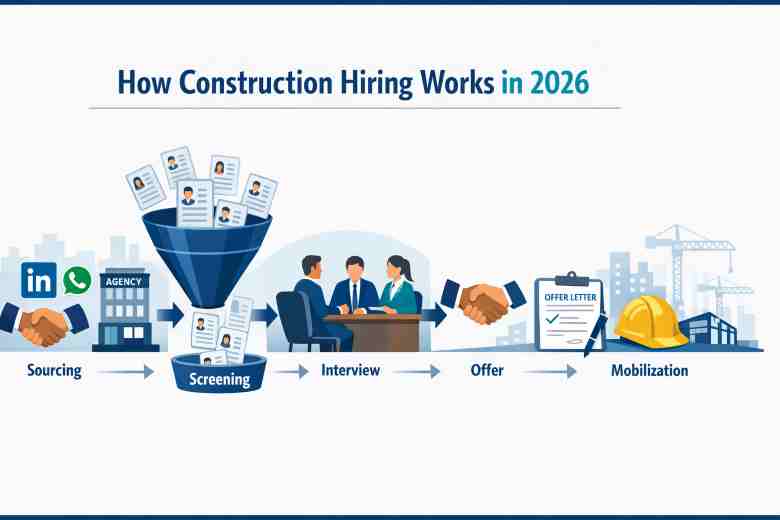
Last Updated on January 27, 2026 by Admin
Construction hiring doesn’t work like other industries—and that’s why most job seekers fail. While you’re submitting dozens of online applications, recruiters are filling positions through referrals, vendor networks, and WhatsApp groups before jobs ever get posted. In 2026, with over 439,000 additional workers needed, the opportunity is massive—but only if you understand how construction recruitment actually operates. This guide reveals the hidden hiring channels, ATS realities, role-wise strategies, and a practical 21-day system to help site engineers, planning engineers, QS, BIM, and safety professionals land their next construction job faster.
ConstructionCareerHub App is LIVE — built ONLY for construction careers. Don’t apply with a weak resume.
Get ATS-ready Resume Lab + Interview Copilot + Campus Placement Prep (resume screening, skill gaps, interview readiness) — in minutes & Other advanced features.
Explore Smarter Construction Career Tools →Quick check. Big impact. Start now.
Table of Contents
TL;DR Summary
Why blind applications fail: Over 90% of contractors report difficulty filling positions, yet job seekers keep applying in the same ineffective way. Construction hiring doesn’t work like other industries—it relies heavily on referrals (30-50% of hires), vendor networks, subcontractor relationships, and project-based mobilization drives.
What actually works in 2026:
- Building relationships through EPC/PMC networks before jobs are posted
- Targeting hidden channels: staffing agencies, WhatsApp groups, walk-in drives
- Creating role-specific portfolios (planning snapshots, BOQ samples, BIM models)
- Following a structured 21-day job search system instead of spray-and-pray applications
Key stats: The construction industry needs 439,000+ additional workers in 2025 on top of normal hiring. Licensed professionals command a 10-15% salary premium. Referral candidates are 4x more likely to be hired.
Why “Apply and Pray” Fails in Construction
Here’s the uncomfortable truth that no job portal will tell you: most construction jobs are filled before they’re ever posted online.
If you’ve been submitting dozens of applications on Naukri, Indeed, or LinkedIn with little response, you’re not alone—but you’re also not doing it right. The construction industry operates differently from IT, banking, or consulting. Site engineers, planning engineers, QS professionals, BIM coordinators, and safety officers are typically hired through:
- Internal referrals and vendor networks
- Project mobilization drives with tight deadlines
- Staffing agencies with pre-verified candidate databases
- WhatsApp/Telegram groups shared among recruiters
- Walk-in interviews at project offices
According to NCCER’s 2025 industry trends report, the construction industry will need to hire around 439,000 new workers on top of normal hiring to meet demand. Yet 83% of companies struggle to hire superintendents, and 81% face difficulty finding project managers. The talent shortage is real—but so is the disconnect between how candidates apply and how recruiters actually hire.
This guide will show you exactly how construction hiring works in 2026, which channels to target, what recruiters look for in each role, and a practical 21-day system to land your next construction job—whether you’re targeting India, the GCC, or global markets.
How Construction Hiring REALLY Works: The Pipeline Map
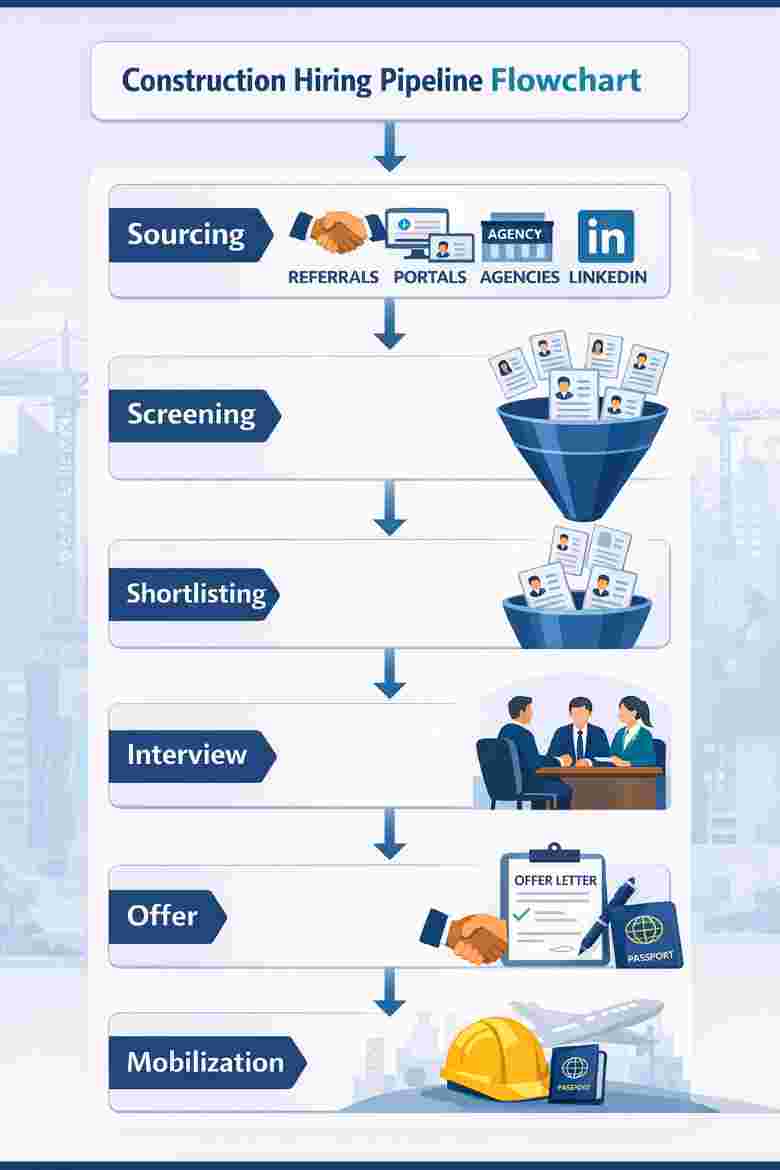
Understanding the hiring pipeline helps you position yourself at the right stage. Here’s how a typical construction hire moves from sourcing to mobilization:
The Construction Hiring Pipeline
| Stage | What Happens | Your Action |
|---|---|---|
| 1. Sourcing | HR/Project team identifies need through vendor lists, referrals, staffing agencies, job portals, LinkedIn | Get on vendor lists; activate referral networks; join relevant groups |
| 2. Screening | Resume review, keyword matching, initial shortlisting (may involve ATS in larger firms) | Use role-specific keywords; highlight relevant project experience |
| 3. Shortlisting | Technical screening call or questionnaire; 5-10 candidates selected | Prepare for screening questions; have project examples ready |
| 4. Interview | Technical + HR rounds; may include practical tests (for QS, BIM, Planning) | Practice role-specific questions; prepare portfolio samples |
| 5. Offer | Salary negotiation, background verification, reference checks | Know your market rate; have references prepared |
| 6. Mobilization | Documentation, visa processing (GCC), joining formalities | Keep documents ready; understand mobilization timelines |
What Each Role Is Tested On
| Role | Technical Tests | Portfolio Elements | Common Questions |
|---|---|---|---|
| Site Engineer | RCC knowledge, reading drawings, site execution | Site photos, progress reports | “How do you handle rebar inspection?” |
| Planning Engineer | Primavera P6, scheduling logic, delay analysis | Baseline schedule samples, S-curves | “Explain critical path methodology” |
| Quantity Surveyor | BOQ preparation, rate analysis, measurement | BOQ samples, cost reports | “How do you handle variation claims?” |
| BIM Engineer | Revit, Navisworks, clash detection | Model screenshots, coordination reports | “Describe your LOD 300 vs 400 approach” |
| QA/QC Engineer | ITP preparation, NCR handling, material testing | Checklists, inspection reports | “Walk me through your QC process” |
| HSE Officer | NEBOSH/IOSH knowledge, risk assessment | Safety plans, audit reports | “How do you conduct toolbox talks?” |
| MEP Engineer | HVAC/electrical systems, coordination | Shop drawings, equipment schedules | “Explain your coordination approach” |
For detailed interview preparation, explore the Construction Interviews Guide on ConstructionPlacements.
The Hidden Hiring Channels in Construction
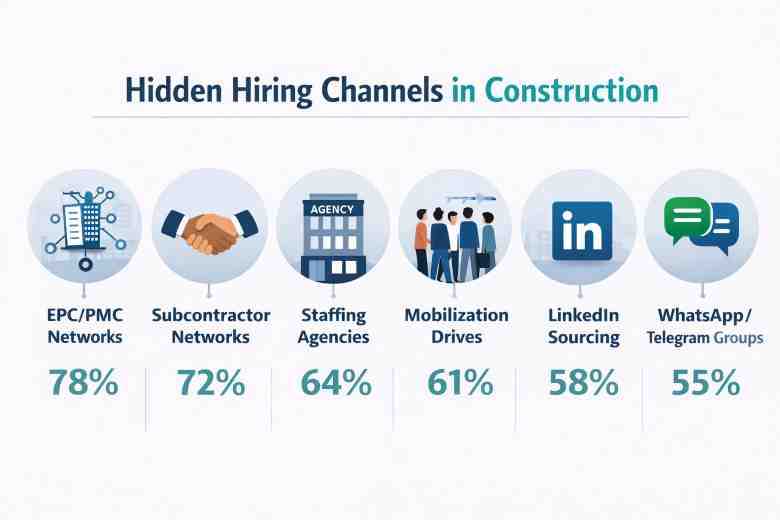
While job portals get all the attention, the most effective hiring channels in construction are often invisible to job seekers.
1. EPC/PMC Networks and Vendor Lists
Large EPC contractors (L&T, Shapoorji Pallonji, Tata Projects, Bechtel, Fluor) and PMC firms maintain approved vendor lists of subcontractors and staffing agencies. When a project needs engineers fast, the first call goes to these vendors.
How to access: Work with reputed staffing agencies who have EPC/PMC empanelment. Build relationships with HR teams at these organizations through LinkedIn. Once you’ve worked on one project successfully, you’re in the network.
2. Subcontractor and Supplier Networks
Subcontractors often need site engineers, supervisors, and QS professionals for specific packages. These jobs are rarely posted publicly—they’re filled through:
- Direct referrals from project teams
- WhatsApp groups for specific trades
- Walk-in drives at project offices
3. Staffing Agencies and Recruitment Partners
In construction, specialized staffing agencies play a much bigger role than in other industries. Agencies like TeamLease, Quess, and regional construction recruiters maintain databases of pre-verified candidates and can mobilize teams within days.
How to leverage: Register with 3-5 construction-focused staffing agencies. Keep your profile updated. Respond quickly when they call—speed matters in construction recruitment.
4. Project Mobilization Drives
When large projects kick off, contractors often conduct mobilization drives—sometimes interviewing 50-100 candidates in a single day. These are announced through:
- Walk-in interview announcements
- Company websites and social media
- Engineering college placement cells
- Industry WhatsApp groups
5. LinkedIn Sourcing (Done Right)
LinkedIn is powerful for construction hiring—but only if you understand how recruiters use it. They’re not browsing your profile casually; they’re using Boolean searches like:
"Planning Engineer" AND "Primavera P6" AND "EPC" AND "Dubai"Optimize for search: Your headline and About section must include role-specific keywords. Learn more in our LinkedIn Jobs Search 2026 Guide.
6. WhatsApp and Telegram Groups
This is where urgent requirements get posted first. Construction-specific groups for different regions and roles exist across platforms. Be active, helpful, and professional in these groups—recruiters notice.
Recruiter’s POV: “I post urgent requirements in WhatsApp groups before job portals. By the time it’s on Naukri, I’ve already shortlisted candidates from my network. If you’re not in these groups, you’re seeing jobs 3-5 days late.” — HR Manager, Tier-1 EPC Contractor
ATS vs. Human Hiring for Construction Roles
There’s a persistent myth that ATS (Applicant Tracking Systems) automatically reject 75% of resumes. Research shows this is largely inaccurate—ATS systems organize applications; humans make rejection decisions.
However, in construction hiring, the ATS picture is more nuanced:
When ATS Matters
- Large contractors and consultants: Companies like Bechtel, AECOM, and Jacobs use ATS systems to manage high application volumes
- Online applications: When you apply through company career portals
- Multinational firms: GCC-based employers with structured HR processes
When ATS Doesn’t Matter
- Walk-in interviews: Your resume goes directly to the hiring manager
- Referrals: Your CV is forwarded by someone internal
- Staffing agencies: They pre-screen and forward you directly
- Direct outreach: When you email the project team or HR
ATS-Proof Resume Checklist
Even when ATS is involved, the goal is ensuring your resume is parseable, not gaming the system:
✅ Use standard section headers (Work Experience, Education, Skills)
✅ Include keywords from the job description naturally
✅ Save as .docx or simple PDF (avoid fancy designs)
✅ List project types, tools, and certifications explicitly
✅ Include project values and team sizes with numbers
✅ Spell out acronyms at least once (Building Information Modeling (BIM))
✅ Avoid tables, columns, and graphics in the main body
✅ Include a LinkedIn profile link (candidates with LinkedIn get 71% more interviews)
For step-by-step resume guidance, read How to Write a Construction Resume that Stands Out.
The 2026 Construction Candidate Scorecard
Recruiters evaluate construction candidates on multiple dimensions beyond technical skills. Use this self-assessment rubric to identify your gaps:
Employability Score (Rate Yourself /100)
| Category | Weight | What Recruiters Look For | Your Score |
|---|---|---|---|
| Core Technical Skills | 25% | Role-specific knowledge, academic foundation | /25 |
| Tools Proficiency | 15% | Primavera, AutoCAD, Revit, MS Project, Excel | /15 |
| Project Exposure | 20% | Types (residential/commercial/industrial), scale, complexity | /20 |
| Portfolio/Proof | 10% | Work samples, certifications, documented achievements | /10 |
| Certifications | 10% | PMP, NEBOSH, Revit certification, trade certifications | /10 |
| Communication | 10% | Interview performance, email professionalism, presentation | /10 |
| Mobility/Relocation | 5% | Willingness to relocate, passport validity, visa status | /5 |
| Notice Period | 3% | Immediate joiners preferred; 30-60 days acceptable | /3 |
| References | 2% | Quality of professional references | /2 |
Scoring Guide:
- 80-100: Highly employable; multiple offers likely
- 60-79: Competitive; focus on interview preparation
- 40-59: Development needed; invest in upskilling
- Below 40: Significant gaps; structured learning required
Take the Construction Career Direction Tool for personalized career guidance.
Role-Wise Playbooks: What Recruiters Actually Want
Site Engineer / Project Engineer
Must-Have Skills:
- RCC fundamentals, reading structural drawings
- Knowledge of construction sequences and methods
- Basic AutoCAD, MS Excel
- Understanding of quality and safety procedures
Portfolio Proof:
- Photographs of completed work (with permission)
- Sample daily progress reports
- Material reconciliation sheets
Interview Patterns:
- Technical questions on RCC, formwork, shuttering
- Situational questions about site problems
- Basic scheduling and coordination scenarios
Common Rejection Reasons:
- Unable to explain site execution sequence
- No practical examples from internship/work
- Poor communication skills
Prepare with 50 Entry-Level Civil Engineering Interview Questions.
Planning Engineer
Must-Have Skills:
- Primavera P6 (mandatory for most roles)
- Understanding of CPM, baseline development, delay analysis
- Excel for reporting and data analysis
- Knowledge of EOT claims and schedule forensics
Portfolio Proof:
- Baseline schedule snapshot (anonymized)
- S-curve samples
- Delay analysis report excerpts
Interview Patterns:
- Live demonstration of P6 (some companies)
- Questions on critical path, float, LOE activities
- Scenario-based delay questions
Common Rejection Reasons:
- Cannot explain scheduling logic clearly
- No practical P6 experience beyond training
- Weak understanding of resource loading
Recommended Learning:
- Primavera P6 Project Planning Masterclass (Udemy)
- Advanced Planning & Scheduling with Primavera P6 (Udemy)
Quantity Surveyor (QS)
Must-Have Skills:
- BOQ preparation and measurement
- Rate analysis and cost estimation
- Knowledge of contract terms (FIDIC basics)
- Advanced Excel; familiarity with CostX or similar
Portfolio Proof:
- BOQ sample (anonymized)
- Rate analysis sheet
- Interim payment certificate example
Interview Patterns:
- Technical questions on measurement standards
- Variation and claims handling scenarios
- Contract administration questions
Common Rejection Reasons:
- Cannot prepare BOQ independently
- Weak rate analysis fundamentals
- Limited understanding of contract clauses
Explore Top 100 Quantity Surveying Interview Questions and Top Quantity Surveying Software.
BIM Engineer / BIM Coordinator
Must-Have Skills:
- Revit (Architecture/Structure/MEP depending on specialization)
- Navisworks for clash detection
- Understanding of LOD, BIM Execution Plans
- Coordination and collaboration workflows
Portfolio Proof:
- Model screenshots showing complexity
- Clash detection report samples
- Coordination meeting outputs
Interview Patterns:
- Software demonstration (common)
- Questions on LOD levels, model management
- Collaboration and coordination scenarios
Common Rejection Reasons:
- Limited software depth beyond basics
- Cannot explain coordination workflow
- No understanding of BIM standards (ISO 19650)
Recommended Learning:
- BIM Fundamentals for Engineers (Coursera – L&T EduTech)
- Building Smarter: BIM in Practice (Coursera Specialization)
- BIM Application for Engineers (Coursera – National Taiwan University)
Learn more about High-Demand BIM Careers.
QA/QC Engineer
Must-Have Skills:
- Inspection and Test Plans (ITP)
- NCR handling and closeout
- Material testing knowledge
- Quality management systems (ISO 9001 basics)
Portfolio Proof:
- ITP template
- NCR register sample
- Inspection checklist examples
Interview Patterns:
- Process-based questions on QC workflow
- Material testing and acceptance criteria
- Handling non-conformance scenarios
Common Rejection Reasons:
- Theoretical knowledge without practical application
- Cannot demonstrate ITP preparation
- Weak understanding of acceptance criteria
Safety Officer / HSE Engineer
Must-Have Skills:
- NEBOSH IGC or equivalent certification
- Risk assessment and JSA preparation
- Incident investigation methodology
- Knowledge of local regulations (BOCW Act for India, OSHA for US)
Portfolio Proof:
- Risk assessment samples
- Safety audit checklist
- Toolbox talk presentations
Interview Patterns:
- Scenario-based safety questions
- Emergency response procedures
- Regulatory compliance questions
Common Rejection Reasons:
- Certification-only; no site experience
- Cannot explain risk assessment process
- Poor understanding of practical implementation
MEP Engineer
Must-Have Skills:
- HVAC/Electrical/Plumbing systems knowledge
- Coordination with structural and architectural teams
- AutoCAD MEP or Revit MEP
- Understanding of codes and standards
Portfolio Proof:
- Shop drawing samples
- Equipment schedule excerpts
- Coordination markup examples
Interview Patterns:
- System-specific technical questions
- Coordination and installation sequence
- Energy efficiency considerations
Common Rejection Reasons:
- Limited to single MEP discipline
- Cannot explain coordination approach
- Weak software skills
A Practical 21-Day Job Search System
Instead of random applications, follow this structured approach:
Days 1-3: Foundation Building
Day 1: Resume Overhaul
- Update resume with quantified achievements
- Create role-specific versions (Site, Planning, QS, etc.)
- Save as both .docx and PDF
Day 2: LinkedIn Optimization
- Update headline with role + key skill + location target
- Write an About section with keywords
- Set profile to “Open to Work” (visible to recruiters only)
- Follow the LinkedIn Search Guide
Day 3: Target List Creation
- Identify 50 target companies (contractors, consultants, PMCs)
- List 10 staffing agencies to register with
- Join 5 relevant WhatsApp/LinkedIn groups
- Research ongoing projects in your target region
Days 4-10: Targeted Outreach
Daily Actions:
- Send 5 targeted applications (not mass applications)
- Connect with 10 recruiters/HR professionals on LinkedIn
- Send 3 personalized messages using templates below
- Follow up on 2 previous applications
- Apply for walk-in interviews in your area
LinkedIn DM Template:
Hi [Name],

I noticed [Company] is working on [Project Name/Type]. I'm a [Role] with [X] years in [Project Type] projects and expertise in [Key Skill].

I'd appreciate the opportunity to discuss any open positions. My background in [Specific Achievement] aligns with your team's requirements.

Available for a brief call at your convenience.

Best,
[Your Name]
Email to HR Template:
Subject: [Role] Application – [X] Years Experience in [Project Type]

Dear [Name],

I am writing to express interest in [Role] opportunities at [Company]. With [X] years of experience in [Project Types], I have:

- [Achievement 1 with numbers]
- [Achievement 2 with numbers]
- [Key certification/skill]

I am available to join within [Notice Period] and am open to relocation to [Target Location].

Attached is my resume for your review. I would welcome the opportunity to discuss how my experience can contribute to your projects.

Best regards,
[Your Name]
[Phone] | [LinkedIn]
Days 11-17: Interview Preparation and Portfolio Building
Portfolio Checklist:
- Resume (ATS-friendly version)
- Cover letter template (customizable)
- Work samples (anonymized project documents)
- Certification copies (NEBOSH, PMP, Revit, etc.)
- Reference list with contact details
- Educational certificates and transcripts
- Experience letters from previous employers
Interview Preparation:
- Review Basic Civil Engineering Interview Questions
- Practice technical questions for your specific role
- Prepare 3-5 project examples using STAR method
- Research companies thoroughly before each interview
Referral Request Template:
Hi [Name],

I hope you're doing well. I'm currently exploring opportunities as a [Role] and noticed that [Company] has some interesting projects.

Given your experience in the industry, I was wondering if you might know anyone at [Company] or similar organizations who might be open to a brief conversation.

Any guidance or connection would be greatly appreciated.

Thanks,
[Your Name]
Days 18-21: Negotiation and Offer Management
Availability Message Template:
Hi [Name],

Thank you for considering my profile. To confirm:

- Current Notice Period: [X days/Immediate]
- Expected Salary: [Range in INR/AED/USD]
- Willing to Relocate: Yes/Negotiable
- Passport Status: Valid until [Date]

Please let me know if you need any additional information.

Best regards,
[Your Name]
Walk-in Follow-up Template:
Subject: Follow-up – [Your Name] – [Role] Interview on [Date]

Dear [Interviewer Name/HR],

Thank you for the opportunity to interview for the [Role] position at the walk-in drive on [Date]. I enjoyed learning about [specific project/team detail discussed].

I remain very interested in this opportunity and am available to provide any additional information you may need. Looking forward to hearing from you.

Best regards,
[Your Name]
[Phone]
Portfolios That Win in Construction (Even for Freshers)
You don’t need years of experience to build a compelling portfolio. Here’s what works:
What to Include by Role
Planning Engineer Portfolio:
- Baseline schedule screenshot (academic project is fine)
- S-curve showing planned vs actual
- Sample delay analysis approach
QS Portfolio:
- BOQ for a small structure (academic exercise)
- Rate analysis worksheet
- Measurement sheet sample
BIM Portfolio:
- Revit model screenshots (LOD 200-300)
- Clash detection report
- Family creation examples
Site Engineer Portfolio:
- Internship project photos (with permission)
- Method statement draft
- Quality checklist sample
Safety Portfolio:
- Risk assessment matrix
- Safety audit checklist
- Toolbox talk presentation
Freshers Corner: Building a Portfolio Without Experience
Use Academic Projects:
- Final year project documentation
- Lab reports with practical applications
- Competition submissions
Create Sample Work:
- Prepare a BOQ for a hypothetical 2-story building
- Create a baseline schedule for a sample project
- Build a Revit model of a simple structure
Leverage Internships:
- Document everything during internships
- Take photos (with permission)
- Save reports you contributed to
Online Learning Projects:
- Many courses include project work
- Complete and save all assignments
- Build real deliverables
Portfolio Checklist Box
✅ 3-5 work samples demonstrating core skills
✅ Anonymized (remove company/client names)
✅ Clean formatting with clear labels
✅ Brief description of your contribution
✅ Results/outcomes where applicable
✅ Organized in a single PDF or folder
✅ Ready to share via email or interview
India vs. GCC Hiring Reality
The Gulf region remains a major destination for Indian construction professionals, but the hiring process differs significantly.
India Hiring Characteristics
- Timeline: 2-4 weeks from application to joining
- Notice Period: 30-90 days typically expected
- Documentation: Standard (resume, certificates, ID proof)
- Salary: Negotiable; varies widely by company size
- Interview Format: Often single-stage; walk-ins common
GCC Hiring Characteristics
- Timeline: 4-12 weeks including visa processing
- Trade Tests: Common for technical roles (especially skilled trades)
- Documentation: Attestation of degrees, police clearance, medical tests
- Visa Types: Employment visa through sponsor company
- Salary: Often includes housing, transport, flights
- Mobilization: Expect 2-4 weeks from offer to joining
GCC Documentation Checklist
- Passport (valid 6+ months)
- Attested educational certificates (from country of origin)
- Police clearance certificate
- Medical fitness certificate
- Passport-size photographs (white background)
- NOC from current employer (if applicable)
- Trade test certification (for technical roles)
- Professional certifications (NEBOSH, PMP, etc.)
For detailed guidance on Gulf opportunities, read The Gulf Construction Boom: Jobs Indians Should Target in 2026 and explore Top 10 In-Demand Construction Jobs in UAE.
Salary and Offer Evaluation Framework
Don’t evaluate offers by CTC alone. Use this framework:
Components to Evaluate
| Component | What to Check |
|---|---|
| Base Salary | Fixed monthly; basis for PF, gratuity |
| Allowances | HRA, site allowance, travel—are they taxable? |
| Variable Pay | Performance bonus—what are the criteria? |
| Overtime | Especially for site roles—how is it calculated? |
| Site Benefits | Accommodation, food, transport—cash or provided? |
| Insurance | Medical coverage—individual or family? |
| Leave Policy | Annual, sick, earned leave—encashment policy? |
| Notice Period | What’s required; is buyout possible? |
| Location | Metro vs. remote site—cost of living impact |
Red Flags in Offers
🚩 Vague variable pay criteria
🚩 No written offer letter
🚩 Salary significantly below market
🚩 Unclear reporting structure
🚩 No defined notice period
🚩 Pressure to join immediately without documentation
🚩 No mention of site allowances for site roles
🚩 “Salary will be discussed after joining”
GCC Salary Considerations
- Tax-Free: Most GCC countries have no income tax
- Total Package: Evaluate base + housing + transport + flights
- Contract Length: Typically 2-3 years; understand renewal terms
- End-of-Service: Gratuity calculation varies by country
- Savings Potential: Calculate take-home after expenses
Common Myths: Debunked
Myth 1: “Apply More = More Success”
Reality: Quality beats quantity. Referred candidates are 4x more likely to be hired. One targeted application with a referral beats 50 generic submissions.
Myth 2: “Only Big Brands Hire Good Engineers”
Reality: Tier-2 contractors and mid-sized firms often offer better learning opportunities, faster growth, and more responsibility. Many industry leaders built their careers at smaller firms.
Myth 3: “ATS Decides Everything”
Reality: 92% of recruiters still review resumes manually. ATS is an organization tool, not a gatekeeper. Most construction hiring involves human decision-making at every stage.
Myth 4: “Freshers Can’t Get Good Construction Jobs”
Reality: The industry is facing a talent shortage of 439,000+ workers. Companies are actively building training programs and hiring freshers. The key is demonstrating the right attitude and foundational knowledge.
Myth 5: “Certifications Don’t Matter”
Reality: Licensed and certified professionals earn 10-15% more than their uncertified peers. For safety roles, NEBOSH/IOSH is often mandatory.
Myth 6: “Once You Apply, Just Wait”
Reality: Follow-up increases your chances significantly. Recruiters appreciate proactive candidates who demonstrate genuine interest.
Comparison Table: Blind Applying vs. Targeted Hiring System
| Aspect | Blind Applying | Targeted Hiring System |
|---|---|---|
| Volume | 50+ applications/week | 15-20 targeted applications/week |
| Response Rate | 2-5% | 15-25% |
| Channels Used | Job portals only | Portals + referrals + direct outreach + agencies |
| Resume | One generic version | Role-specific versions |
| Research | Minimal | Company + project + interviewer research |
| Follow-up | None | Systematic follow-up schedule |
| Portfolio | None prepared | Role-specific samples ready |
| Networking | Passive | Active LinkedIn + groups |
| Time to Hire | 3-6 months | 4-8 weeks |
| Offer Quality | Accept first offer | Multiple offers to negotiate |
Before You Apply: Pre-Application Checklist
Use this checklist before submitting any application:
✅ Resume Updated: Role-specific keywords included
✅ LinkedIn Optimized: Headline matches target role
✅ Company Researched: Know their recent projects
✅ Job Requirements Matched: You meet 70%+ of requirements
✅ Cover Letter Customized: References specific company/project
✅ Portfolio Ready: Relevant samples prepared
✅ References Informed: They know they may be contacted
✅ Application Method: Direct > Referral > Portal
✅ Follow-up Scheduled: Calendar reminder set for 1 week
✅ Interview Preparation: Role-specific questions reviewed
Related Posts:
- How to create ATS Compliant Resume: A Quick Guide
- How Resume Writing Companies Can Help You Stand Out in a Competitive Job Market
- Construction Career Myths: Debunking Common Misconceptions
- A Comprehensive Guide to Civil Engineering and Interior Design
- Renovation vs Construction: Key Differences, Costs, and How to Choose the Right Option in 2026
- Construction Career Direction Tool: Find Your Ideal Career Path in 5 Minutes [Free Assessment]
Conclusion: Your Next Steps
Construction hiring in 2026 rewards those who understand how the industry actually works. Stop applying blindly and start:
- Building relationships before you need jobs
- Targeting hidden channels beyond job portals
- Creating role-specific portfolios that demonstrate your capabilities
- Following a structured system instead of spray-and-pray applications
The construction industry needs talent—439,000+ new workers in 2025 alone. Your challenge isn’t a lack of opportunities; it’s positioning yourself to capture them.
Recommended Next Steps
For Interview Preparation:
- Download the Civil Engineering Job Interview Guide with 300 Q&A for comprehensive preparation
- Explore the BIM Job Interview Preparation Guide for BIM-specific preparation
- Get the Civil Site Engineer Interview Guide for site-focused roles
- Review the Construction Management Job Interview Guide for management positions
For Skill Development:
- Construction Project Management – Columbia University on Coursera
- Building Smarter: BIM in Practice – L&T EduTech on Coursera
- Primavera P6 Project Planning Masterclass – Udemy
- FIDIC Contracts Practical Approach – Udemy
- Excel Business Intelligence & Power BI – Udemy
- Construction Management Professional Certificate – University of Maryland on edX
For Career Tools:
- Try the Construction Career Direction Tool for personalized guidance
- Explore ConstructionCareerHub for AI-powered career tools
Frequently Asked Questions (FAQs)
In India, the construction hiring process typically takes 2-4 weeks from application to joining for most roles. Walk-in interviews may result in same-week offers, while corporate roles at large contractors may take 4-6 weeks due to multiple interview rounds and background verification processes.
For GCC construction jobs, the most effective channels are: (1) specialized recruitment agencies with Middle East presence, (2) LinkedIn searches using location filters, (3) direct applications to contractor websites, and (4) referrals from colleagues already working in the region. Prepare for longer timelines due to visa processing requirements.
While formal certification isn’t always mandatory, practical P6 proficiency is essential for planning engineer roles. Most employers will test your skills during interviews. Consider completing an online Primavera P6 course and building sample schedules to demonstrate competency.
NEBOSH IGC is increasingly becoming the minimum qualification for HSE roles in both India and GCC markets. While some employers accept IOSH or local certifications, NEBOSH significantly improves employability and is often mandatory for GCC positions. The investment typically pays for itself through better job opportunities and higher salaries.
Yes, many contractors actively hire engineering freshers for site engineer roles, especially through campus placements and walk-in drives. Focus on demonstrating strong fundamentals, willingness to learn, and relevant internship experience. Review How to Face Civil Engineering Interview for preparation guidance.
In India, BIM Engineers with 3-5 years of experience typically earn ₹6-12 LPA depending on location and company size. In GCC countries, similar experience commands packages of $2,500-$4,500 per month (tax-free), often with additional housing and transport benefits. Explore High-Demand BIM Careers for detailed insights.
Employment gaps are common in construction due to project-based work. Be honest about the gap, briefly explain what you did during that time (upskilling, personal projects, family responsibilities), and focus on your readiness to contribute. Read How to Explain Employment Gaps on Your Construction Resume for detailed strategies.
While there’s significant overlap, QS roles traditionally focus on measurement, BOQ preparation, and contract administration (more common in Commonwealth countries), while Cost Engineers emphasize cost control, estimation, and earned value management (more common in EPC/US contexts). Many roles combine elements of both. Learn more in our Quantity Surveyor Guide.
Yes, particularly in India. Walk-in interviews remain highly effective for construction hiring because they allow employers to assess practical skills quickly and fill urgent positions. Check our Walk-in Interviews page for current opportunities.
Build genuine professional relationships before you need them. Stay connected with college alumni, former colleagues, and industry contacts. Be helpful to others in your network. When asking for referrals, be specific about the role and company, make it easy by providing your updated resume, and always follow up with thanks regardless of outcome.
Keep these ready: passport (valid 6+ months), attested educational certificates, police clearance certificate, passport-size photographs (white background), professional certifications, and experience letters from all previous employers. Start the attestation process early as it can take 2-4 weeks depending on your country.
Yes, if you choose courses strategically. Focus on practical skills that employers value: Construction Project Management (Coursera – Columbia University), BIM courses, and Excel for business analysis. These demonstrate commitment to professional development and provide tangible skills.
