
Last Updated on July 14, 2026 by Admin
External cladding specification has become one of the most technically demanding areas of UK construction practice. Post-Grenfell regulatory changes have tightened fire performance requirements significantly, while the growing demand for premium natural timber facades has expanded the range of species, profiles, and treatment systems that construction professionals need to understand and evaluate.
ConstructionCareerHub App is LIVE — built ONLY for construction careers. Don’t apply with a weak resume.
Get ATS-ready Resume Lab + Interview Copilot + Campus Placement Prep (resume screening, skill gaps, interview readiness) — in minutes & Other advanced features.
Explore Smarter Construction Career Tools →Quick check. Big impact. Start now.
Two areas dominate the current specification landscape: fire rated timber cladding treatment for buildings where compliance with Approved Document B is mandatory, and Siberian larch as the premium natural timber choice for projects where durability, aesthetics, and sustainability credentials all matter. Getting both right — understanding what the regulations actually require and selecting the material that best meets the project brief — is the foundation of competent building envelope specification in 2026.
Fire Rated Cladding: What the Regulations Actually Require
Approved Document B divides external cladding requirements by building height. For residential buildings above 18 metres, external wall systems must achieve Euroclass A2-s1,d0 — a classification that timber cannot achieve regardless of treatment, making it unavailable as the primary cladding material on these buildings. For buildings between 11 and 18 metres, Euroclass B-s1,d0 is the required standard. Factory pressure-impregnated fire retardant treatment can achieve this classification for most common timber species and profiles, making compliant timber cladding viable across a wide range of mid-rise applications.
The critical specification point that contractors and engineers must understand is that Euroclass B is a system classification, not a product classification. A board certified to Euroclass B in isolation does not guarantee that a wall assembly incorporating that board achieves the same rating. The substrate, insulation, cavity barrier specification, and fixing method all contribute to the system’s fire behaviour. Valid test evidence for the complete assembly — or a compliant engineered solution signed off by a fire engineer — is required for a building control submission to succeed.
Factory pressure-impregnation is the only treatment method that reliably achieves and certifies Euroclass B performance. On-site application of fire retardant — by brush, spray, or roller — does not produce the penetration depth or consistency required for certification and is not accepted by Building Control as evidence of compliance. This distinction matters enormously on projects where fire treatment is being specified late in the programme and site application might be proposed as a faster alternative.
For construction projects requiring factory-treated Euroclass B cladding, a specialist fire rated timber cladding treatment UK service can supply pressure-impregnated boards across all main species and profiles with full certification documentation — including EN 13501-1 test certificates, treatment system data sheets, and system assembly guidance — ready for building control submission. Engaging this service at RIBA Stage 2 or 3 ensures the fire compliance strategy is embedded in the design rather than bolted on at procurement.
Siberian Larch: The Natural Durability Choice for Premium Facades
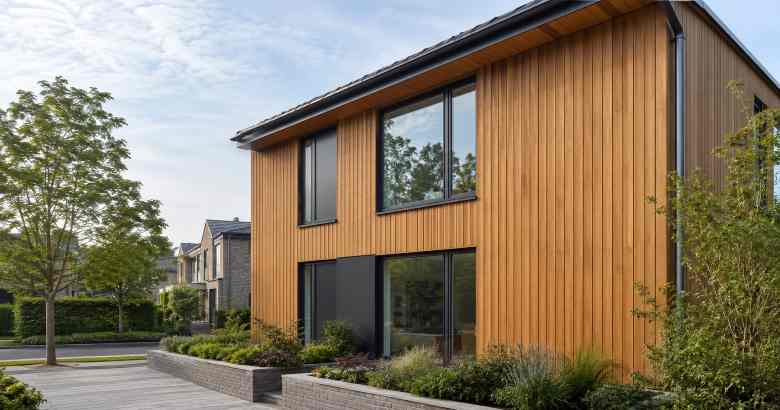
Siberian larch has established itself as the dominant premium natural timber cladding species in the UK construction market over the past decade, and for reasons that are well grounded in material science rather than fashion. The species grows slowly in the extreme cold of Siberia and northern Russia, producing timber with exceptionally tight growth rings — typically 10 to 15 per centimetre — a high resin content, and a density of approximately 590 kilograms per cubic metre. These characteristics translate directly into performance advantages that contractors and specifiers can rely on.
Durability Class 3 under BS EN 350 without any chemical treatment means Siberian larch has genuine natural resistance to biological decay that standard Nordic softwoods achieve only through preservative impregnation. Above ground in UK exposure conditions, correctly installed Siberian larch cladding has a service life of 25 to 30 years without preservative treatment and without the handling restrictions, disposal costs, or sustainability concerns that chemically treated alternatives introduce. For construction projects where environmental credentials are part of the specification brief — increasingly common on commercial and residential schemes — this is a significant practical advantage.
The material’s dimensional stability also matters in a construction context. Siberian larch’s tight growth ring structure reduces the moisture movement that causes cladding boards to cup, bow, or open at joints over seasonal cycles. For rainscreen and shadow gap profiles where dimensional movement creates visible joint variation, this stability advantage is directly relevant to the quality of the finished facade over its service life.
The full range of Siberian larch cladding UK supplier profiles — including shadow gap, tongue and groove, rainscreen, feather edge, shiplap, and batten systems — is available from UK stock in both AB grade and A grade. All profiles are supplied kiln-dried to a moisture content of 18 percent or below, ready for installation in a correctly detailed ventilated rainscreen system. Technical specifications, installation guidance, and fixing recommendations are available with every order.
Combining Fire Compliance with Premium Natural Timber
A question that arises regularly on mid-rise construction projects is whether Siberian larch can be specified where Euroclass B fire classification is required. The answer is yes — Siberian larch is compatible with factory fire retardant treatment and can achieve Euroclass B-s1,d0 as part of a complete tested wall assembly. This makes it viable for buildings between 11 and 18 metres where both premium aesthetics and fire compliance are part of the brief.
The specification process for fire treated Siberian larch should begin at Stage 2. The treatment specification, board dimensions, and cavity barrier strategy should all be confirmed before detailed design is completed — changes at Stage 4 or later are significantly more costly and disruptive than early-stage specification decisions. Contractors who engage with specialist suppliers early consistently deliver compliant, premium timber facades on programme and within budget.
Related posts:
- Sustainable Insulation Solutions for Modern Construction: Balancing Energy Efficiency and Environmental Impact
- Civil Design Engineer Job Description and Salary Details
- The Importance of Quality Control in Construction
- The Definitive Guide to Plank and Beam Construction: Building Strong and Stylish Structures
