
Last Updated on September 23, 2024 by Admin
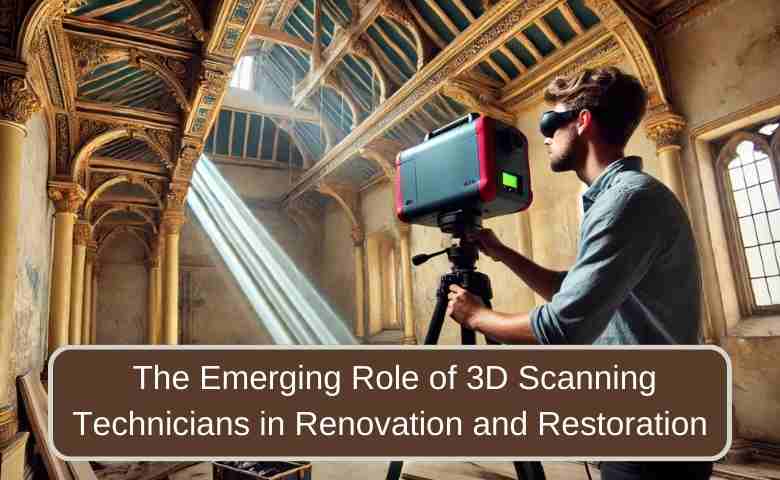
Thanks to technological advancements, the role of 3D scanning technicians is rapidly growing in the renovation and restoration sectors. These professionals use cutting-edge 3D scanning tools to capture precise building data, ensuring accuracy in every project. From historical restorations to modern renovations, 3D scanning technicians are essential for creating detailed digital models that architects and engineers rely on for successful outcomes. In this post, we’ll explore how these technicians are transforming the industry, the skills required, and how to embark on a career in this emerging field.
ConstructionCareerHub App is LIVE — built ONLY for construction careers. Don’t apply with a weak resume.
Get ATS-ready Resume Lab + Interview Copilot + Campus Placement Prep (resume screening, skill gaps, interview readiness) — in minutes & Other advanced features.
Explore Smarter Construction Career Tools →Quick check. Big impact. Start now.
Table of Contents
The Evolution of 3D Scanning in Construction
3D scanning originates in industries like automotive design and manufacturing, but it has gained immense traction in construction and architecture in the past decade. This is mainly due to the increasing demand for Building Information Modeling (BIM) and the need for highly accurate measurements during renovations. These technologies have transformed the renovation process by providing a more detailed, data-rich approach, which enhances accuracy and efficiency.
Key Applications of 3D Scanning in Renovation
3D scanning technologies are applied across various stages of the renovation process. Here are some of the key uses:
- Precise Measurements: Traditional methods of measuring buildings rely on tape measures and manual calculations. In contrast, 3D scanning can capture millions of data points within minutes, creating an accurate space model.
- Creating As-Built Models: Scanning existing buildings allows technicians to generate exact replicas of structures, which can then be compared with original plans or used to develop new renovation plans.
- Documentation of Heritage Buildings: Historic buildings require careful preservation of architectural details. 3D scanning ensures that every detail, from cornices to columns, is captured accurately.
- Minimizing Risk: Scanning provides a complete picture of a building’s current condition, revealing structural weaknesses, hazardous materials, or other issues that might pose a risk during renovation.
The Intersection of 3D Scanning and Building Information Modeling (BIM)
A significant advancement in modern construction has been the integration of 3D scanning with BIM. BIM is a process that allows professionals to manage and analyze information related to a building’s design, construction, and operation through digital modeling. 3D scanning plays a crucial role by offering accurate “as-built” data that can be used to update or verify BIM models, especially in renovating older structures.
Laser Scanning Technology, such as LiDAR (Light Detection and Ranging), is common in 3D scanning for BIM integration. LiDAR captures detailed, three-dimensional information about a building’s geometry, helping professionals develop accurate 3D models essential for successful renovations.
Case Study Example: Renovation projects in cities like London, where historical buildings are prevalent, rely heavily on 3D scanning to preserve structural integrity. Many of these projects involve detailed BIM models that enable architects to assess renovation needs without compromising historical value.
The Role of a 3D Scanning Technician
The role of a 3D scanning technician is multifaceted, combining expertise in both technology and construction. These professionals capture, process, and analyze 3D data to create digital representations of physical spaces. Their work is crucial in providing the foundation for renovations, restorations, and even new construction.
Key Responsibilities of a 3D Scanning Technician
- Data Capture: Using specialized scanning equipment like laser scanners or photogrammetry tools to capture detailed measurements and spatial data from buildings and structures.
- Data Processing: Once raw data is collected, it must be processed into usable formats such as point clouds or mesh models, which can then be integrated into architectural plans or BIM platforms.
- Creating As-Built Models: Technicians often convert 3D scan data into accurate digital models, which architects and engineers can use to plan renovations.
- Ensuring Accuracy: Data accuracy is paramount. Technicians must cross-check scanned data with existing blueprints and plans to provide the highest precision.
- Collaboration: It is essential to work closely with project managers, architects, and other stakeholders to ensure that the scanned data meets the project’s requirements.
Skills Required for 3D Scanning Technicians
To succeed as a 3D scanning technician, specific technical and soft skills are essential:
- Proficiency with Scanning Technologies: Familiarity with LiDAR, photogrammetry, and other scanning tools is essential.
- CAD/BIM Software Expertise: It is crucial to understand how to process and integrate 3D scans into AutoCAD, Revit, or other BIM software.
- Attention to Detail: The role requires meticulous attention to detail to ensure accuracy during the scanning and modeling.
- Problem Solving: Renovation and restoration projects often present unforeseen challenges. Technicians need strong problem-solving skills to adapt to changing project conditions.
- Communication: As part of a larger project team, 3D scanning technicians must communicate findings clearly and ensure that the data provided supports the project’s objectives.
Tools and Equipment Used by 3D Scanning Technicians
3D scanning technicians rely on advanced tools and software to perform their tasks. Some of the most common tools include:
- Laser Scanners: Devices like the Faro Focus 3D or Leica BLK360 are frequently used to scan spaces. They create highly accurate point clouds that map every inch of a structure.
- Drones: For large or complex structures, drones with LiDAR sensors or photogrammetry cameras can capture external and hard-to-reach areas.
- Software: Applications such as ReCap Pro (for 3D data processing), Revit (for BIM integration), and AutoCAD are indispensable for processing and utilizing 3D data.
How 3D Scanning Benefits Renovation and Restoration Projects
1. Enhanced Accuracy and Detail
One of the primary benefits of using 3D scanning in renovations is its ability to capture minute details with unparalleled precision. This is especially crucial when dealing with older buildings that may have undergone numerous changes. 3D scanning documents every architectural feature accurately, ensuring no critical detail is overlooked during restoration.
2. Cost Efficiency and Time Savings
Traditional renovation processes often involve significant time spent manually measuring and surveying buildings. 3D scanning dramatically reduces this time, providing rapid data collection and reducing overall project timelines. A report by McKinsey & Company highlights that digital technologies, including 3D scanning, can reduce renovation project costs by up to 15% and shorten project timelines by 20-30%.
3. Improved Safety
Renovating older buildings can pose safety hazards, especially when the structure’s condition is unknown. 3D scanning can identify areas of weakness, hazardous materials (such as asbestos), or other structural concerns before any work begins, allowing for more informed decision-making and improved worker safety.
In addition, drones equipped with 3D scanning technologies can access unsafe areas that would otherwise require scaffolding or ladders, further minimizing risk.
4. Preservation of Heritage Buildings
Historic building renovation is perhaps the area that benefits most from 3D scanning. These structures often require the preservation of their original details, and scanning ensures that every architectural feature is captured accurately. In some cases, 3D scans are used to create replicas of deteriorating parts, allowing for the restoration of elements that are too damaged to repair. This process ensures that a building’s historical integrity is maintained while making it safe and functional for modern use.
For example, 3D scanning was used in restoring Notre Dame Cathedral after the devastating 2019 fire. The detailed scans taken before the fire provided a roadmap for restoring the iconic structure to its former glory.
Career Pathways: How to Become a 3D Scanning Technician
As the demand for 3D scanning technology in the construction industry grows, so do the career opportunities in this field. For those looking to enter this career, it’s essential to understand the required education, training, and certification paths.
Educational Requirements
While there is no single, defined educational path to becoming a 3D scanning technician, most professionals in this field have a background in architecture, engineering, or a related field. Relevant degree programs include:
- Associate’s or Bachelor’s Degree in Architectural Technology
- Degree in Civil Engineering or Structural Engineering
- Courses in Geomatics or Surveying
Certifications and Training
Professional certification is becoming increasingly important for 3D scanning technicians. Some of the key certifications include:
- Certified Laser Scanning Professional (CLSP): Offered by the International Society for Photogrammetry and Remote Sensing (ISPRS), this certification provides a comprehensive understanding of 3D scanning technologies and their applications.
- BIM Certifications: Obtaining certification in Building Information Modeling (BIM) from providers such as Autodesk can significantly enhance job prospects, as BIM and 3D scanning are often integrated in construction projects.
- Drone Pilot Certification: Given the rise of drone technology in 3D scanning, many technicians also acquire a Part 107 Remote Pilot Certification from the Federal Aviation Administration (FAA).
Career Prospects
As 3D scanning technology becomes a standard practice in construction, the demand for skilled technicians is growing rapidly. According to the U.S. Bureau of Labor Statistics (BLS), jobs in surveying and mapping, including 3D scanning, are expected to grow by 6% through 2030. The average annual salary for a 3D scanning technician ranges from $50,000 to $70,000, depending on experience, location, and industry sector.
The Future of 3D Scanning in Renovation and Restoration
As 3D scanning technologies evolve, their renovation and restoration applications will only expand. 3D scanning offers the construction industry unparalleled accuracy, cost efficiency, and safety, making it an essential tool for modern-day renovation projects. For those looking to enter the field, the role of a 3D scanning technician offers a unique blend of technology and architecture, with promising career prospects and a significant impact on the future of construction.
Professionals in the construction industry are increasingly adopting 3D scanning and modeling technologies, which means now is the perfect time to explore this exciting career path. Whether you’re passionate about preserving historic buildings or streamlining modern renovations, a career as a 3D scanning technician offers endless possibilities.
For further insights on career opportunities in this evolving field, visit ConstructionPlacements and explore our latest resources on construction technologies and career development.
Related Posts:
- The Ultimate Guide to Scan to BIM Technology
- Point Cloud to BIM services creating 3D Revit Model: Challenges and Solutions
- The Importance of Building Restoration Services: A Comprehensive Guide
- 10 Best BIM Companies 2024 in USA Updated List
