
Last Updated on March 4, 2026 by Admin
If you are preparing for a construction interview in 2026, technical knowledge alone is not enough. Recruiters and hiring managers increasingly evaluate how clearly your resume communicates project impact and how well your portfolio proves your execution capability—especially for roles like Site Engineer, Planning Engineer, QA/QC, QS, BIM, Project Engineer, and Project Controls professionals.
ConstructionCareerHub App is LIVE — built ONLY for construction careers. Don’t apply with a weak resume.
Get ATS-ready Resume Lab + Interview Copilot + Campus Placement Prep (resume screening, skill gaps, interview readiness) — in minutes & Other advanced features.
Explore Smarter Construction Career Tools →Quick check. Big impact. Start now.
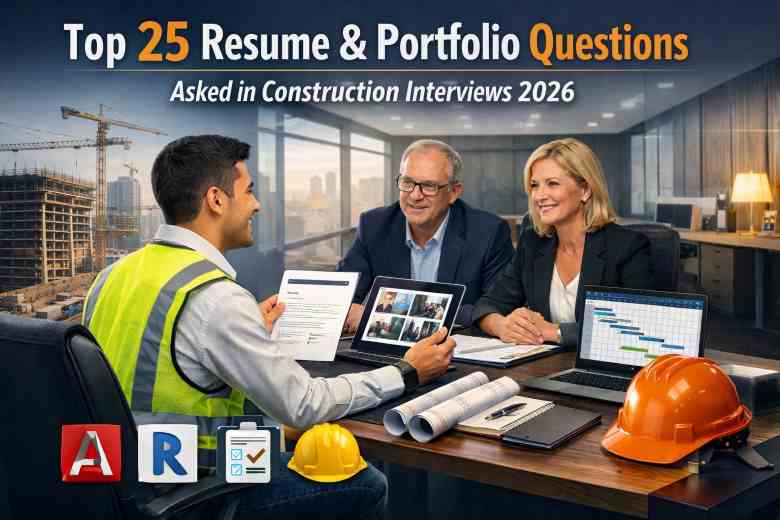
This guide covers the top 25 construction interview resume and portfolio questions that candidates are commonly asked, along with what interviewers actually want to assess and how to answer strategically.
Before you start, strengthen your preparation with these proven resources on ConstructionPlacements.com:
- The 20-Point Resume Checklist That Gets Shortlisted in EPC Companies (2026)
- Free Resume Builder for Construction Professionals
- AI Interview Copilot: Free Mock Interview Tool for Civil Engineers
- Top 50 Civil Site Engineer Interview Questions and Answers [2026]
Table of Contents
Why Resume & Portfolio Questions Matter More in Construction Interviews in 2026
Construction hiring is performance-driven. Employers want evidence that you can work with drawings, specifications, BOQs, schedules, site constraints, quality checks, safety standards, and multi-team coordination—not just claim that you can.
That is why interview panels often use resume and portfolio questions to test:
- Project ownership and role clarity
- Technical depth vs inflated claims
- Communication and reporting ability
- Problem-solving under real site conditions
- Software usage (AutoCAD, Revit, Civil 3D, Primavera P6, MS Project, etc.)
- Safety and compliance mindset
Construction remains a high-hazard industry, so interviewers also look closely at your safety awareness and compliance attitude. OSHA identifies construction as a high-hazard industry, and NIOSH’s construction program focuses on preventing work-related injury, illness, disability, and death. :contentReference[oaicite:0]{index=0}
How to Use This List (Important)
Do not memorize robotic answers. Instead, prepare each answer using this simple framework:
Context → Your Role → Action Taken → Tools/Standards Used → Outcome → Learning
This structure works especially well for:
- resume project description civil engineer
- portfolio case study presentation engineer
- problem solving interview questions engineer
- STAR method construction interview
Top 25 Resume & Portfolio Questions Asked in Construction Interviews [2026]
1) Walk me through your resume.
What they are checking: Clarity, confidence, relevance, communication structure.
How to answer: Don’t read line-by-line. Give a 60–90 second version focused on education, total experience, project types, key roles, tools, and your strongest outcomes (cost, time, quality, safety, coordination, productivity).
2) Which project in your resume best represents your strengths?
What they are checking: Self-awareness and project prioritization.
How to answer: Pick one project aligned to the job role (site execution, planning, QA/QC, QS, BIM, etc.) and explain why it is the best proof of your capability.
3) What exactly was your role in this project? (Not the team’s role)
What they are checking: Ownership vs exaggeration.
How to answer: Separate responsibilities clearly: “I handled weekly progress tracking and subcontractor coordination” is stronger than “We managed the project.”
4) Can you explain one challenging site problem mentioned in your resume and how you solved it?
What they are checking: Real problem-solving and site judgment.
How to answer: Use a STAR-style response. Include constraints (weather, access, material delay, drawing conflict, manpower shortage) and the corrective action.
5) You mentioned “project coordination” on your resume—what did that include in practice?
What they are checking: Practical understanding of project coordination interview questions.
How to answer: Mention coordination across client/consultant/PMC/contractor/subcontractors, RFIs, work fronts, approvals, sequencing, and reporting cadence.
6) What construction software have you actually used, and at what proficiency level?
What they are checking: Construction software interview questions, honesty, tool relevance.
How to answer: Be precise:
AutoCAD (2D drawings/markups), Revit (model review/family edits), Civil 3D (corridor/surface basics), Primavera P6 (baseline/update/look-ahead), MS Project (tracking/reporting), Excel (BOQ/progress trackers).
7) Can you show a portfolio sample and explain what it demonstrates?
What they are checking: Portfolio presentation questions for engineers.
How to answer: Choose a clean sample (drawing set, QA report, method statement, schedule snapshot, quantity takeoff, BIM model view, progress dashboard). Explain objective, scope, your contribution, and the result.
8) How do you ensure the projects in your resume are credible and verifiable?
What they are checking: Professional integrity.
How to answer: Mention documentation habits: project names, package scope, client/contractor, dates, role, tools used, and measurable outcomes. Do not share confidential drawings without permission.
9) Why have you listed these certifications, and how have they helped on-site?
What they are checking: Certification-to-job relevance.
How to answer: Connect each certification to workflow improvement (example: QA/QC documentation quality, safety compliance checks, scheduling discipline, BIM coordination).
10) Which item in your portfolio are you most proud of?
What they are checking: Quality benchmark and professional taste.
How to answer: Pick an item that shows decision-making, not just formatting. Example: resolving drawing/spec mismatch before execution.
11) Explain a drawing or model sheet from your portfolio in simple terms.
What they are checking: Engineering drawings and specifications interview ability.
How to answer: Demonstrate how you read plans, sections, elevations, dimensions, levels, notes, revisions, and coordination impacts.
12) Have you included any quantity takeoff / BOQ / billing-related work in your portfolio?
What they are checking: BOQ interview questions, estimation and billing interview questions relevance.
How to answer: If yes, explain methodology, item descriptions, measurements, assumptions, rate dependencies, and error control.
13) Tell us about one quality issue you identified and prevented.
What they are checking: QA QC construction interview questions.
How to answer: Mention inspection checkpoints, ITPs, tolerances, NCR observations (if applicable), corrective action, and prevention steps.
14) How do you represent safety compliance in your resume or portfolio?
What they are checking: Safety compliance interview questions construction.
How to answer: Add practical examples: toolbox talks, permits, JSA/JHA participation, PPE enforcement, barricading, housekeeping, hazard reporting, incident-free milestones.
15) Your resume mentions “planning/scheduling.” What was your actual involvement in Primavera P6 or MS Project?
What they are checking: Primavera P6 interview questions, MS Project interview questions construction.
How to answer: Clarify whether you created baseline schedules, updated actual progress, tracked slippages, generated look-ahead plans, resource/cost reports, or only reviewed outputs.
16) Can you explain a delay on your project and how it was tracked or mitigated?
What they are checking: Planning + coordination + reporting maturity.
How to answer: Mention critical activity impact, root cause, recovery plan, resequencing, resource addition, and communication with stakeholders.
17) What metrics or outcomes have you included in your resume to prove impact?
What they are checking: Resume quality and measurable results.
How to answer: Use measurable terms like:
“Reduced rework by X%,” “coordinated X subcontractors,” “tracked X lakh/sqft scope,” “closed X inspection points/week,” “improved reporting cycle time.”
18) How do you tailor your resume for a Site Engineer vs Planning Engineer vs QA/QC role?
What they are checking: Strategic job application readiness.
How to answer: Explain role-specific resume customization:
site execution keywords, scheduling keywords, QA/QC documentation, code compliance, software emphasis, project type relevance.
19) What project in your portfolio best shows contractor/subcontractor coordination?
What they are checking: Contractor coordination interview questions competence.
How to answer: Highlight sequence planning, work fronts, dependencies, and issue escalation.
20) How do you handle confidentiality while presenting your portfolio?
What they are checking: Professional ethics.
How to answer: Mention redacting client-sensitive information, sharing sample extracts, anonymizing data, and only presenting approved documents/screenshots.
21) What mistake in your resume have you corrected over time?
What they are checking: Learning mindset and maturity.
How to answer: Good examples: generic bullets, no metrics, no software context, unclear project scope, poor formatting, too much theory/no outcomes.
22) If we open your portfolio right now, what should we look at first?
What they are checking: Portfolio storytelling and prioritization.
How to answer: Start with your strongest case study relevant to the role, then a supporting sample (drawings/report/schedule/QA record).
23) Can you explain a material or method selection decision you were involved in?
What they are checking: Construction materials interview questions + practical reasoning.
How to answer: Discuss quality, availability, cost, constructability, specification requirements, and execution constraints.
24) What would your reporting manager say about the way your resume represents your work?
What they are checking: Authenticity and professionalism.
How to answer: Keep it factual and modest. Focus on reliability, reporting discipline, problem-solving, and teamwork.
25) If selected, how will you improve your resume and portfolio in the next 6 months?
What they are checking: Growth orientation.
How to answer: Mention project documentation quality, measurable achievements, software upgrades, certifications, and better portfolio case studies.
What Interviewers Want to See in a Strong Construction Resume (2026 Checklist)
Use this checklist before applying:
- Clear headline (role + years + specialization)
- Project types (buildings, roads, metro, industrial, EPC, data center, etc.)
- Scope and package value/size (where possible)
- Tools used (AutoCAD, Revit, Civil 3D, Primavera P6, MS Project, Excel, Navisworks, etc.)
- Certifications relevant to role
- Metrics and achievements (time/cost/quality/safety/productivity)
- Readable formatting and ATS-friendly keywords
- No inflated claims or copied job-description bullets
For a deeper resume optimization guide, read the verified 2026 resource:
EPC Resume Checklist (20 points).
What to Include in a Construction Portfolio (Even for Freshers)
Many candidates think portfolios are only for architects or designers. That’s no longer true. A construction portfolio can help freshers and experienced engineers stand out in interviews.
Freshers can include:
- Academic project summaries
- Internship work snapshots
- Drawing interpretation notes
- BOQ/sample estimation exercise
- Site visit observations (non-confidential)
- Software practice outputs (AutoCAD/Revit/Primavera P6)
Experienced professionals can include:
- Project case studies (1–2 pages each)
- Progress reports/dashboard snapshots
- QA/QC checklists, ITP-based examples
- Method statements / WIR-MIR documentation examples (sanitized)
- Look-ahead schedules and tracking reports
- Coordination issue-resolution examples
How to Prepare Better Answers (Use These ConstructionPlacements Resources)
To improve your construction job interview preparation, use these internal resources as supporting study material:
- Construction & Civil Engineering Interview Questions and Answers (Category)
- 31 Challenging Interview Questions Specific to the Construction Industry
- Civil Engineering Interview Questions PDF eBook Guide
- 50 Entry-Level Civil Engineering Interview Questions and Answers
- 25 Common Civil Engineering Questions for Campus Placements
Use ConstructionCareerHub.com to Practice Before the Real Interview
For serious interview preparation, resume improvement, and career readiness in the construction domain, candidates should also use ConstructionCareerHub.com.
It is especially useful for candidates who want to:
- Improve interview confidence
- Practice role-based mock questions
- Refine resume positioning for EPC/contractor/consultancy roles
- Prepare for site engineer, planning engineer, QA/QC, QS, and project roles
Recommended eBooks (DigitSlick) for Interview & Career Preparation
If you want deeper preparation beyond free articles, here are a few relevant eBooks from DigitSlick (Gumroad):
- A Comprehensive Civil Engineering Job Interview Guide
- Construction Jobs Interview: The Ultimate Guide
- Civil Engineering Interview Questions PDF eBOOK
- Construction Career Launchpad eBook
- Hidden Construction Careers That Pay More
Resources
To strengthen your practical interview answers with real standards and industry references, review these authoritative resources:
- OSHA Construction Industry Safety Resources (construction hazards, safety expectations)
- OSHA 29 CFR 1926 Construction Standards (useful for safety/compliance interview discussions)
- NIOSH Construction Program (CDC) (construction safety and health overview)
- Autodesk AEC Learning & Certifications (AutoCAD/Revit/Civil 3D skills roadmap)
- PMI Scheduling Best Practices Resource (for planning/scheduling interview context)
Relevant Courses Recommendations
If you want to strengthen your profile before interviews, here are a few relevant courses/programs:
- Coursera: Construction Project Management
- Coursera: Construction Management Specialization
- edX: Construction Management Professional Certificate
- Udemy: Primavera P6 Project Planning & Scheduling Masterclass
Final Interview Tip for 2026: Don’t Just “Have” a Resume—Defend It
The best candidates in 2026 are not the ones with the most pages in their resume or portfolio. They are the ones who can defend every line item with confidence, evidence, and results.
Use the 25 questions above to practice out loud. If possible, rehearse using a mock interviewer or AI-based practice tool, refine your project stories, and tailor your resume for each role.
If you do that consistently, your interview performance will improve dramatically—even in competitive construction hiring markets.
FAQs: Construction Interview Resume and Portfolio Questions
1) What are construction interview resume and portfolio questions?
These are interview questions that assess how well your resume and portfolio reflect your real construction experience, project contribution, technical skills, and problem-solving ability.
2) Are portfolio questions asked for site engineers and civil engineers?
Yes. Even if the role is not design-heavy, interviewers often ask for project examples, drawings, reports, schedules, QA/QC documentation, or execution case studies to verify practical experience.
3) How can freshers answer portfolio questions without job experience?
Freshers can use academic projects, internships, software practice files, quantity takeoff exercises, and site visit observations (without sharing confidential material).
4) What software skills should be clearly shown in a construction resume for 2026?
Commonly valued tools include AutoCAD, Revit, Civil 3D, Primavera P6, MS Project, Excel, and role-specific tools such as Navisworks, ETABS, STAAD Pro, or QS/estimation tools.
5) What is the biggest mistake candidates make in resume-based construction interviews?
The most common mistake is adding generic responsibilities without measurable outcomes, clear project scope, or proof of actual contribution.
Also Read: Explore more construction interview questions and answers and build a stronger interview-ready profile with ConstructionCareerHub.com.
Related Posts:
- A Comprehensive Guide to Civil Engineering and Interior Design
- Online Practice Test for QA/QC Engineer Job Profile
- BIM Jobs in 2026: What Recruiters Actually Screen For
- QA/QC Engineer: Salary, Job Description & Career Guide (2026)
- Property Asset Management Job Description and Salary
