
Last Updated on December 16, 2025 by Admin
The construction industry is experiencing its most significant transformation in decades. With an estimated 439,000 new workers needed in 2025 alone—rising to nearly half a million by 2026—the talent gap isn’t just about headcount anymore.
ConstructionCareerHub App is LIVE — built ONLY for construction careers. Don’t apply with a weak resume.
Get ATS-ready Resume Lab + Interview Copilot + Campus Placement Prep (resume screening, skill gaps, interview readiness) — in minutes & Other advanced features.
Explore Smarter Construction Career Tools →Quick check. Big impact. Start now.
It’s about skills.
According to Deloitte’s 2026 Engineering and Construction Industry Outlook, by 2031, 41% of construction workers are expected to retire, while only 10% of current workers are under 25. Meanwhile, professionals who combine field experience with digital fluency are commanding 15-25% higher salaries and faster promotions.
The question isn’t whether you need to upskill. The question is: where do you start?
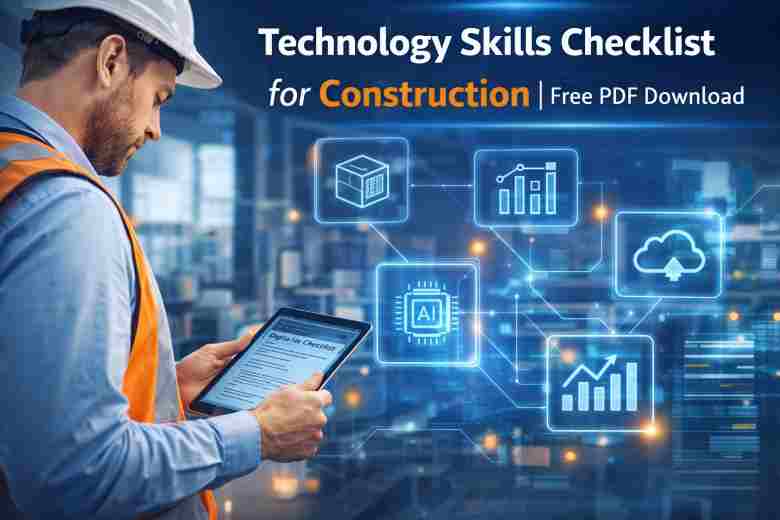
That’s exactly why I created the Technology Skills Checklist for Construction Professionals 2026—a practical, no-fluff self-assessment tool to help you identify gaps, prioritize learning, and stay employable in a rapidly evolving industry.
Table of Contents
Download Your Free Technology Skills Checklist
What’s Inside:
- ✅ 150+ technology skills mapped to real construction roles
- ✅ 5-level self-assessment system (No Exposure → Advanced)
- ✅ Role-based skill mapping for 6 key positions
- ✅ Global employability skills for international careers
- ✅ 90-day learning paths for beginners, mid-career professionals, and career switchers
- ✅ Fillable skill gap summary table
No spam. Just practical career resources for construction professionals.
Why Technology Skills Matter More Than Ever in Construction
Let me be direct with you.
I’ve been in this industry long enough to see trends come and go. But what’s happening now isn’t a trend—it’s a structural shift in how construction projects are planned, executed, and managed.
Here’s the reality:
The Numbers Don’t Lie
- $124 billion in construction output potentially lost due to unfilled positions (Deloitte, 2025)
- BIM specialists seeing 25-30% salary increases due to ESG-focused project demand
- Project managers with analytics experience commanding major premiums over traditional PMs
- Only 7% of potential job seekers currently consider construction as a career
- The AI market in construction expected to hit $4.51 billion by 2026
What This Means For Your Career
If you’re a site engineer still relying solely on field experience, you’re competing with candidates who can read drawings AND create Power BI dashboards from Primavera data.
If you’re a mid-career professional who hasn’t touched BIM software, you’re watching junior engineers get promoted ahead of you because they can coordinate clash detection workflows.
If you’re planning an international career—whether USA, the Middle East, Europe, or Australia—employers expect familiarity with ISO 19650, digital document control, and cloud-based collaboration tools as baseline requirements.
The checklist we’ve created addresses exactly these gaps.
What’s Inside the Technology Skills Checklist?
This isn’t another generic tech list copied from IT blogs. Every skill in this checklist is mapped to real construction job requirements and industry practices.
Section 1: How to Use This Checklist
A simple 5-level marking system:
- ☐ No Exposure
- ☐ Basic Awareness
- ☐ Working Knowledge
- ☐ Job-Ready
- ☐ Advanced / Specialist
Honest self-assessment is the first step to meaningful growth.
Section 2: Core Digital Skills (Mandatory for All Roles)
These are non-negotiable in 2026:
- Digital Literacy — File formats, software troubleshooting, keyboard shortcuts
- Cloud Tools — OneDrive, SharePoint, Google Drive with proper version control
- Excel Beyond Basics — VLOOKUP, pivot tables, conditional formatting, dashboards
- Digital Documentation — Teams, real-time collaboration, digital signatures
- Email & Reporting Hygiene — Professional communication, standardized templates
If you’re weak in any of these areas, start here before moving to specialized tools.
Section 3: Design, Modeling & Engineering Tools
- CAD Tools — AutoCAD, Civil 3D, MicroStation
- BIM Tools — Revit, Tekla, ArchiCAD
- 3D Coordination — Navisworks, BIM 360, Solibri
- Drawing Management — Bluebeam, PlanGrid, Aconex
- Quantity Take-Off — CostX, Cubit, PlanSwift
Section 4: Planning, Controls & Project Management
- Scheduling — Primavera P6, MS Project, Asta Powerproject
- Cost Control — Oracle Aconex, Procore Financials, SAP
- Progress Tracking — 4D BIM, visual progress systems
- Digital DPR & MIS — Automated dashboards, productivity tracking
Section 5: Site Execution & Field Technology
- Mobile Apps — Procore, PlanGrid, Fieldwire
- Digital Inspections — iAuditor, photo documentation, defect tracking
- QA/QC Software — Punch list management, NCR tracking
- Safety Tech — Digital permits, incident reporting, wearables
Section 6: Data, Automation & AI (2026-Critical)
This is where the future leaders separate themselves:
- AI Tools — ChatGPT/Claude for drafting, AI scheduling assistants
- Prompting Skills — Effective prompts for technical content, method statements
- Dashboards — Power BI, Tableau basics, KPI interpretation
- No-Code Automation — Power Automate, Zapier, Excel macros
Note: I’ve deliberately kept this section practical. No hype about robots replacing engineers. Focus on tools that actually increase your productivity today.
Section 7: Role-Based Skill Mapping
Mini-checklists for:
- Site Engineer
- Planning Engineer
- BIM Engineer
- Quantity Surveyor
- Project Engineer
- Construction Manager
Each role shows Must-Have, Good-to-Have, and Career Accelerator skills.
Section 8: Global Employability Skills
Essential for international careers:
- ISO 19650, FIDIC, NEC, AIA/AGC standards
- Remote collaboration tools
- Digital compliance awareness
- Cross-border project workflows
Section 9: Skill Gap Summary Table
A fillable worksheet to consolidate your assessment with Current Level, Target Level (2026), and Priority ratings.
Section 10: 90-Day Learning Paths
Three actionable paths:
- Path A: Beginners (Students & Fresh Graduates)
- Path B: Mid-Career Upgrade (5-15 Years Experience)
- Path C: Career Switchers (Entering Construction)
How Top Construction Professionals Are Using This Checklist
For Students & Fresh Graduates
Use it to understand what employers actually want—not what your curriculum covered. Identify the 3-4 tools you should master before your first interview.
For Site Engineers (0-5 Years)
Stop guessing what skills will get you promoted. This checklist shows exactly which technologies differentiate a site supervisor from someone stuck in the same role for years.
For Mid-Career Professionals
If you’re feeling stuck while watching juniors advance, this checklist reveals the gaps holding you back. Most mid-career professionals discover they’re weak in data/dashboards and AI tools—areas where a 90-day focused effort can change everything.
For International Career Seekers
Before applying to roles in UAE, USA, UK, or Australia, audit yourself against the Global Employability section. International employers have specific expectations around documentation standards and digital workflows.
Take Your Skills Further: Recommended Courses
The checklist tells you what to learn. But how do you actually learn it?
Here are my recommended courses for each major skill area:
Primavera P6 & Project Scheduling
The industry’s most demanded scheduling skill. Essential for planning engineers and anyone targeting project controls roles.
Recommended Courses:
- Primavera P6 Professional Masterclass (Udemy) — Complete live project training with S-curves and EVM
- Primavera P6 Construction Management Planning & Scheduling (Udemy) — Step-by-step baseline program creation
- Advanced Project Planning with Primavera P6 (Udemy) — Resource leveling, formwork analysis, KPI development
BIM & Revit
BIM specialists are seeing 25-30% salary increases. This is no longer optional for design and coordination roles.
Recommended Courses:
- Building Smarter: BIM in Practice Specialization (Coursera — L&T EduTech) — ISO 19650 workflows, 4D/5D BIM, Digital Twins
- BIM Fundamentals for Engineers (Coursera) — Foundation course covering Revit across disciplines
- Autodesk Revit: Beginner to Advanced (Udemy) — 11 projects, documentation, and coordination
- Revit MEP: Beginners to Advanced (Udemy) — For MEP engineers and BIM coordinators
Construction Project Management
Foundation skills that every construction professional needs.
Recommended Courses:
- Construction Project Management Specialization (Coursera — Columbia University) — Industry-leading program from Professor Ibrahim Odeh
- Construction Management Professional Certificate (edX — University of Maryland) — Comprehensive industry and profession coverage
- Project Delivery Methods and Contracts (edX) — Essential for understanding delivery lifecycles
Power BI & Data Analytics for Construction
The skill that separates modern project managers from traditional ones.
Recommended Courses:
- Microsoft Power BI for Construction Management (Udemy) — Built specifically for civil engineers and construction professionals
- Power BI for Project Planning and Control (Udemy) — Synoptic panels, AutoCAD integration
- Primavera & Power BI Integration (Udemy) — Connect P6 data to interactive dashboards
Excel for Construction Professionals
The foundational tool you’ll use every single day.
Recommended Courses:
- Microsoft Excel for Construction Management (Udemy) — The only course designed specifically for construction
- MS Excel for Project Managers (Udemy) — Gantt charts, pivot tables, financial analysis
AutoCAD & Civil Engineering Tools
Essential for site engineers and anyone working with drawings.
Recommended Courses:
- AutoCAD & Revit: 2D Floor Plans & 3D Models (Udemy) — Combined AutoCAD + Revit training
- Civil Engineering Courses (edX) — MIT and other top universities
Go Deeper: Premium Resources for Serious Career Growth
If you’re serious about accelerating your construction career, the free checklist is just the starting point.
Here are comprehensive resources designed for professionals who want structured guidance:
📘 Career Blueprint eBooks
- Construction Career Launchpad — Comprehensive job preparedness guide covering resume optimization, interview strategies, and career positioning for construction roles
- Planning Engineer Job Interview Guide — 255+ Q&A specifically for scheduling and planning roles with Primavera P6 scenarios
- BIM Job Interview Preparation Guide — 210+ interview questions covering Revit, Navisworks, coordination workflows, and BIM management
- Construction Project Coordinator Interview Guide — 200+ Q&A for PM support and coordination roles
- Quantity Surveyor Career Guide — BOQ preparation, cost estimation, and QS-specific career strategies
🎓 In-Depth Assessment Tools
- Construction Career Fit Assessment — Discover which construction career path aligns with your strengths
- Promotion Readiness Checker — Identify gaps preventing your next career move
- Construction Salary Calculator — Benchmark your compensation against industry standards by role, location, and experience
📊 Industry Intelligence
- Civil Engineering Online Courses Guide — Comprehensive comparison of available programs with certificates
- BIM Salary Guide 2026 — Current compensation data for BIM roles globally
- Data Center Construction Careers — Emerging high-growth sector guide
Your 2026 Career Action Plan
Here’s what I recommend:
Step 1: Download the free checklist and complete an honest self-assessment
Step 2: Identify your top 3 priority skill gaps using the Summary Table
Step 3: Choose ONE skill to focus on for the next 30 days
Step 4: Invest in proper training (see recommended courses above)
Step 5: Apply what you learn to a real project—even a personal one
Step 6: Revisit the checklist in 90 days and reassess
The professionals who will thrive in 2026 aren’t waiting to see what happens. They’re actively building the skills that make them indispensable.
Related Posts:
- The Essential Guide to Construction Checklists: Streamlining Your Projects
- Construction Quality Control Checklist: A Comprehensive List
- The Homeowner’s Essential Checklist for Annual Home Maintenance
- The Ultimate Construction Site Safety Checklist: Essential Tips for a Secure Worksite
Get Your Free Technology Skills Checklist Now
Technology Skills Checklist for Construction Professionals 2026
- 📄 12-page comprehensive assessment tool
- ✅ Print-ready PDF format
- 🎯 Role-based skill mapping
- 📈 90-day learning paths
Join 1000+ construction professionals who receive practical career resources from ConstructionPlacements.com
Frequently Asked Questions
Construction professionals at any career stage—students, fresh graduates, site engineers, mid-career professionals, those planning international careers, and career switchers entering construction.
Yes. While specific software preferences vary by region (Asta Powerproject in UK, Primavera P6 in Middle East, MS Project in smaller firms), the core skill categories apply globally. The Global Employability section specifically addresses international career requirements.
Quarterly. Technology evolves; your skills should too. Set a calendar reminder to reassess your progress every 90 days.
Start with the 90-Day Learning Path that matches your situation. Don’t try to learn everything at once. Depth in 3-4 tools beats shallow exposure to 20.
They help, but demonstrated application matters more. Hiring managers value professionals who can show project examples and practical experience over those with certificates but no real-world application.
AI is augmenting roles, not replacing them. The professionals who thrive will be those who use AI tools to increase productivity—drafting reports faster, analyzing data more effectively, optimizing schedules. The checklist includes practical AI skills you can start using today.
