

Last Updated on June 4, 2026 by Admin
Commercial buildings now consume roughly 35% of all electricity generated in the United States alone. With grid electricity prices rising steadily and climate mandates tightening worldwide, solar integration is no longer an optional sustainability add-on — it has become a core design and engineering decision for every commercial construction project in 2026.
ConstructionCareerHub App is LIVE — built ONLY for construction careers. Don’t apply with a weak resume.
Get ATS-ready Resume Lab + Interview Copilot + Campus Placement Prep (resume screening, skill gaps, interview readiness) — in minutes & Other advanced features.
Explore Smarter Construction Career Tools →Quick check. Big impact. Start now.
Whether you are designing a new office tower, retrofitting a warehouse, or planning a mixed-use development, understanding how to integrate photovoltaic (PV) systems into commercial structures is now essential knowledge. This guide covers everything — from system types and design considerations to career opportunities, costs, codes, and the latest technology trends — so you can plan, build, and manage solar-integrated commercial buildings with confidence.
Table of Contents
What Is Solar Integration in Commercial Construction?
Solar integration in commercial construction refers to the process of incorporating photovoltaic energy generation systems into the design, engineering, and construction of commercial buildings. Unlike simple rooftop solar retrofits, true solar integration considers PV systems as a fundamental building component from the earliest design stages — affecting structural loads, electrical design, building orientation, façade engineering, and MEP coordination.
The concept encompasses several approaches, ranging from conventional rooftop-mounted arrays to advanced building-integrated photovoltaics (BIPV) where solar cells are embedded directly into roofing materials, curtain walls, skylights, and even window glazing. In 2026, integrated solar is increasingly paired with battery energy storage systems (BESS), smart energy management platforms, and electric vehicle (EV) charging infrastructure to create self-sufficient commercial energy ecosystems.
For construction professionals looking to understand green building and green construction principles more broadly, solar integration represents one of the highest-impact sustainability strategies available today.
Why Solar Integration Matters for Commercial Projects in 2026
Several converging forces have made solar integration in commercial buildings more relevant than ever. Understanding these drivers is essential for project managers, developers, and engineers making investment decisions in 2026.
Rising Electricity Costs and Demand
Commercial electricity rates have risen significantly across most global markets, driven by aging grid infrastructure, increased demand from data centers and EV charging, and the electrification of heating and cooling systems. For building owners, on-site solar generation provides a hedge against volatile utility pricing and demand charges — the two largest controllable operating expenses in commercial real estate.
Regulatory Mandates and Building Codes
Many jurisdictions now require solar-readiness or active solar installations on new commercial buildings. California’s Title 24 energy code, the EU’s Energy Performance of Buildings Directive (EPBD) recast, and India’s Energy Conservation Building Code (ECBC) all include provisions that push commercial projects toward on-site renewable energy generation. The NEC 2026 code cycle has also introduced updated requirements for PV system interconnection, arc flash labeling, and bifacial module current calculations that directly affect commercial solar design.
Tax Credits and Financial Incentives
In the United States, commercial solar projects qualify for the Section 48E Investment Tax Credit (ITC), which can significantly reduce installed costs. Under the current legislative framework, projects that begin construction before mid-2026 retain favorable credit terms. Safe harboring strategies — both the 5% cost rule and the physical work test — remain available, though enforcement of continuity requirements has tightened. Internationally, similar incentive structures exist in the EU, India, Australia, and the Gulf Cooperation Council (GCC) countries, each with their own compliance timelines and eligibility criteria.
ESG and Green Certification Requirements
Environmental, Social, and Governance (ESG) reporting requirements are increasingly influencing commercial construction decisions. On-site solar generation directly contributes to LEED, BREEAM, GRIHA, and IGBC certification credits. For developers targeting LEED certification levels, solar energy can contribute points across multiple credit categories including Energy and Atmosphere, Innovation, and Regional Priority.
Energy Resilience and Operational Continuity
Grid reliability concerns have elevated energy resilience from a nice-to-have to a business-critical requirement. Solar-plus-storage systems enable commercial buildings to maintain operations during grid outages, reducing downtime costs for hospitals, data centers, manufacturing facilities, and retail operations. The growing deployment of virtual power plants (VPPs) — where distributed solar and storage assets can participate in wholesale energy markets — adds a potential revenue stream beyond simple cost savings.
Types of Solar Systems Used in Commercial Buildings
Choosing the right solar system type depends on building geometry, structural capacity, aesthetic requirements, and energy goals. Here are the primary approaches used in commercial construction today.
Rooftop-Mounted PV Arrays
The most common approach for commercial buildings, rooftop systems use racking or ballasted mounting systems to install standard PV modules on flat or low-slope roofs. They are relatively straightforward to design and install but require structural analysis to verify roof load capacity. Flat commercial roofs typically use tilted racking to optimize panel angle, and bifacial modules — which capture light reflected from the roof surface — have become the mainstream choice in 2026 for maximizing energy yield per square meter.
Building-Integrated Photovoltaics (BIPV)
BIPV systems replace conventional building materials with PV-active components. Solar roof tiles, PV curtain walls, solar-active glazing, and photovoltaic façade panels all fall into this category. BIPV eliminates the need for separate panel racking and can be particularly cost-effective when the solar component replaces materials that would otherwise need to be purchased anyway — such as premium façade cladding or specialty glazing. Transparent and semi-transparent solar panels that generate electricity while allowing natural light transmission are gaining traction in commercial office and retail projects.
Professionals working on BIPV projects benefit from understanding green building materials, as these systems sit at the intersection of building envelope design and renewable energy engineering.
Ground-Mounted and Carport Solar
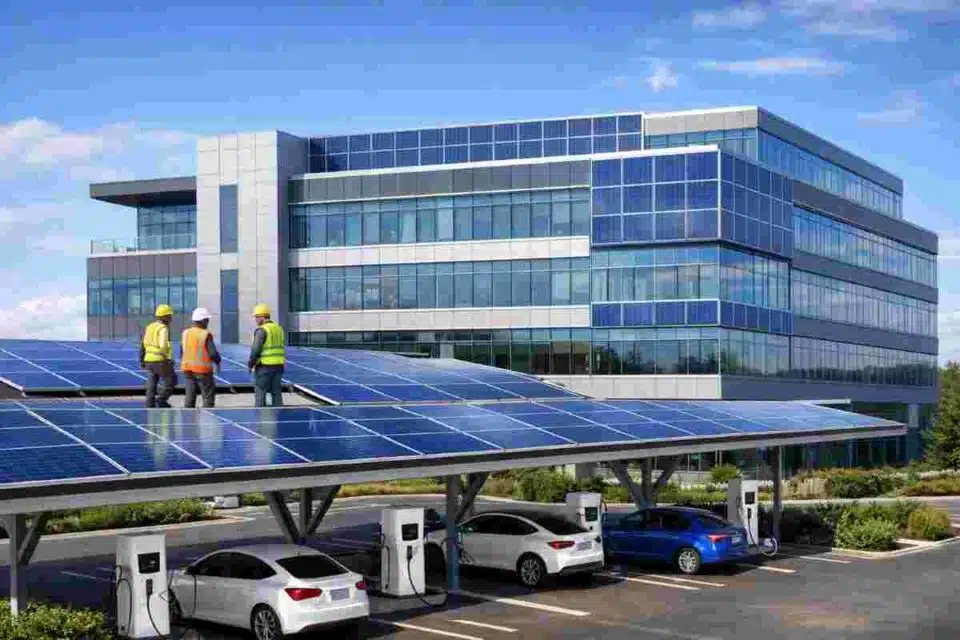
For commercial sites with significant open land or large parking areas, ground-mounted solar arrays and solar carport structures offer high-capacity generation. Solar carports serve a dual purpose — generating electricity while providing shaded, weather-protected parking. They are increasingly paired with EV charging stations, creating an integrated transportation energy hub. Warehouses, distribution centers, retail malls, and corporate campuses are prime candidates for these configurations.
Solar-Plus-Storage Systems
Pairing solar arrays with battery energy storage systems has become the industry standard for commercial projects in 2026. Liquid-cooled containerized BESS units extend battery operational lifespan and enable buildings to store daytime solar generation for evening use, shave peak demand charges, provide backup power during outages, and potentially participate in grid services or VPP programs. AI-driven energy management systems optimize charging and discharging cycles based on building load patterns, weather forecasts, and utility rate structures.
Key Design and Engineering Considerations
Solar integration in commercial construction requires coordination across multiple engineering disciplines. The following considerations are critical for successful project delivery.
Structural Engineering and Load Analysis
Every rooftop or BIPV solar installation adds dead load to the building structure. Structural engineers must verify that the existing or designed structural system can accommodate the weight of modules, racking, ballast (for flat roofs), and any concentrated loads from inverter and electrical equipment. Wind uplift analysis is particularly important for rooftop systems, and seismic considerations apply in many commercial markets. For new construction, designing the structural system with solar loads in mind from the outset avoids costly retrofits or reinforcement.
MEP Coordination and Electrical Design
Solar systems connect to the building’s electrical distribution system and must be coordinated with the overall MEP engineering design. Key electrical design decisions include inverter selection (string inverters vs. central inverters vs. microinverters), interconnection voltage (typically 480V three-phase for commercial systems), conduit routing from roof to electrical room, switchgear and overcurrent protection, and compliance with NEC 690 and 705 requirements.
MEP engineers play a central role in ensuring that solar system integration does not conflict with HVAC equipment placement, rooftop mechanical units, plumbing vents, or fire suppression systems. Clash detection using BIM in civil engineering workflows is essential for complex commercial projects.
Building Orientation and Solar Access
Passive solar design principles — orienting the building to maximize southern exposure (in the Northern Hemisphere), minimizing shading from adjacent structures, and incorporating daylighting strategies — should be considered during the earliest architectural planning stages. Solar access studies using tools like PVsyst, Helioscope, or Aurora Solar help quantify expected energy generation and identify optimal module placement.
Roof Condition and Warranty Coordination
Installing solar on a commercial roof that will need replacement within the PV system’s 25-30 year lifespan creates significant cost and disruption risk. Best practice is to ensure the roof membrane is new or recently replaced before solar installation, and to coordinate roofing and solar warranties so they do not conflict. Some manufacturers now offer integrated roof-and-solar warranty packages.
Fire Safety and Code Compliance
Commercial solar installations must comply with fire code requirements including setback distances from roof edges and fire access pathways, rapid shutdown provisions (NEC 690.12), module-level shutdown capabilities, and firefighter access corridors. Fire departments in many jurisdictions require specific labeling and documentation showing PV system layout, disconnect locations, and DC voltage hazards. The NEC 2026 code has expanded arc flash labeling requirements under Section 110.16, now mandating system voltage, arc flash boundary, incident energy or PPE category, and assessment date on commercial system labels.
Permitting and Utility Interconnection
Commercial solar projects typically require both building permits and electrical permits. Most US jurisdictions require a Professional Engineer (PE) stamp on both structural and electrical drawings for commercial installations. Utility interconnection applications must be filed early in the design process, as interconnection queue delays of 90-120 days are common and can impact tax credit eligibility timelines. Understanding the EPC contractor delivery model can help streamline the permitting and interconnection process.
Solar Integration Technologies and Trends for 2026
The solar technology landscape is evolving rapidly. These are the trends most relevant to commercial construction professionals in 2026.
Bifacial Modules as the New Standard
Bifacial solar modules — which generate electricity from both front and rear surfaces — have moved from a premium option to the mainstream commercial choice. By capturing light reflected from roof membranes, ground surfaces, or adjacent building elements, bifacial modules can increase energy yield by 10-25% compared to monofacial panels. NEC 2026 has introduced updated current calculation requirements under Section 690.8 to account for the additional rear-side generation.
Tandem and Perovskite Solar Cells
Tandem cells — which layer perovskite on top of silicon — are pushing commercial module efficiencies beyond the 30% barrier. While still in early commercial deployment, tandem technology promises to significantly increase energy generation per square meter of roof or façade area, making solar viable on buildings with limited installation space.
AI-Driven Energy Management
Artificial intelligence is becoming a core component of commercial solar energy systems. AI-driven building energy management systems (BEMS) optimize solar generation, battery storage dispatch, HVAC scheduling, and grid interaction in real time. These platforms analyze weather data, occupancy patterns, utility rate structures, and equipment performance to minimize energy costs and maximize self-consumption of on-site generation. Professionals interested in how AI is reshaping the construction industry should explore our guide on how civil engineers can thrive in the age of AI.
DC Microgrids
Solar panels produce direct current (DC) electricity, and many commercial loads — LED lighting, EV chargers, computers, and data equipment — can operate on DC power. DC microgrids eliminate the conversion losses (typically 3-8%) associated with multiple AC/DC conversion stages, improving overall system efficiency. In 2026, DC microgrid architecture is gaining adoption in data centers, office buildings, and EV-heavy commercial sites.
Vehicle-to-Building (V2B) Integration
As bidirectional EV charging technology matures, commercial buildings are beginning to use parked electric vehicles as dynamic energy storage assets. V2B-enabled vehicles can discharge power to support building loads during peak periods or grid instability, complementing fixed battery storage systems. This trend creates new design requirements for construction electricians and electrical engineers planning EV charging infrastructure.
Colored and Aesthetic PV Panels
For architecturally sensitive commercial projects, colored PV panels are now available in a wide spectrum of non-reflective finishes. These modules allow building façades to generate electricity while maintaining design intent — removing one of the traditional aesthetic objections to solar integration in premium commercial developments.
Costs, ROI, and Financial Analysis
Understanding the financial case for commercial solar is essential for project developers, owners, and estimation engineers involved in project budgeting.
Installed Cost Ranges
Commercial rooftop solar system costs in 2026 typically range from $1.50 to $3.00 per watt (DC) installed in the United States, depending on system size, complexity, location, and interconnection requirements. BIPV systems carry a premium but offset the cost of the building materials they replace. Ground-mounted and carport systems fall in the $2.00 to $4.00 per watt range due to additional civil and structural work. Battery storage adds approximately $300-600 per kWh of installed capacity.
Payback Period and ROI
With federal and state tax credits, commercial solar systems in favorable markets can achieve payback periods of 3-7 years, depending on local electricity rates, incentive availability, and system size. After payback, solar systems generate essentially free electricity for the remainder of their 25-30+ year operational life. Integrated solar-plus-storage systems can boost building energy self-sufficiency rates to 70-90%, dramatically reducing grid dependence and exposure to rate increases.
Impact on Property Value
Commercial properties with solar installations consistently command higher valuations and lease rates. Green construction adds value across all property types, and solar is one of the most tangible and quantifiable green features for prospective tenants and investors evaluating ESG criteria.
Career Opportunities in Solar-Integrated Commercial Construction
The growth of solar integration in commercial buildings is creating significant career opportunities across multiple disciplines. Here are the key roles driving this market.
Solar Design Engineer
Solar design engineers develop PV system layouts, perform energy modeling, create electrical single-line diagrams, and prepare permit-ready design packages. They work with tools like PVsyst, Helioscope, AutoCAD, and Revit. Mid-career solar design engineers in the US earn $75,000-$110,000 annually, with higher compensation in markets with strong solar mandates.
Renewable Energy Project Manager
Project managers overseeing solar integration on commercial construction sites coordinate between the general contractor, solar subcontractor, electrical engineer, structural engineer, and utility. PMP certification and experience with construction project management are highly valued. Salaries range from $85,000 to $140,000 depending on project scale and location.
BIM Coordinator — Solar and MEP Integration
As solar systems become integral building components, BIM coordinators who can model PV arrays, electrical conduit runs, inverter locations, and battery storage rooms within federated building models are in high demand. Professionals looking to build this skillset should explore BIM career opportunities and BIM careers in 2026 for salary data and global demand trends.
Energy Storage and Commissioning Specialist
With battery storage becoming standard in commercial solar projects, specialists who can design, install, test, and commission BESS systems are commanding premium salaries. This role sits at the intersection of electrical engineering, controls engineering, and construction management.
Sustainability Consultant — LEED AP and IGBC AP
Sustainability consultants advise building owners and developers on how to maximize green certification credits through solar integration, energy modeling, and lifecycle cost analysis. LEED AP and IGBC AP certifications are essential credentials. Our guide on kickstarting a green construction career covers the full range of entry points into this growing field.
Construction Electrician — Solar Specialist
Licensed electricians specializing in commercial solar installation, inverter commissioning, and NEC-compliant interconnection are among the highest-paid construction professionals in the US market. Specialized training in PV systems, battery storage, and rapid shutdown compliance is increasingly required.
For a comprehensive view of renewable energy career paths, see our detailed article on top green jobs for 2025 and beyond.
Step-by-Step: How to Plan Solar Integration on a Commercial Project
Follow this structured approach to integrate solar into a commercial construction project from concept through commissioning.
Step 1: Feasibility and Site Assessment
Evaluate roof area, structural capacity, solar access, shading, and local solar irradiance. Conduct a utility rate analysis and review applicable incentives, tax credits, and code requirements. Engage a qualified solar consultant or EPC contractor early in the pre-design phase.
Step 2: Energy Modeling and System Sizing
Use energy modeling software to determine optimal system size based on building energy consumption, available installation area, and financial targets. Model scenarios with and without battery storage to compare ROI outcomes.
Step 3: Design Integration with Architecture and MEP
Coordinate the solar system layout with the architect (roof plan, façade design), structural engineer (load analysis), and MEP team (electrical interconnection, conduit routing, equipment locations). Use BIM software for clash detection and coordination.
Step 4: Permitting, Interconnection, and Procurement
Submit permit applications and utility interconnection requests. Procure modules, inverters, racking, and storage components — paying attention to supply chain lead times and any applicable trade policy or FEOC compliance requirements.
Step 5: Construction and Installation
Install racking, modules, inverters, conduit, switchgear, and storage systems in coordination with the overall construction schedule. Quality control inspections should cover torque verification, grounding continuity, insulation resistance testing, and visual inspections of all electrical connections.
Step 6: Commissioning and Handover
Commission the PV and storage system with functional testing, performance verification, and utility witness testing. Prepare as-built documentation, O&M manuals, and warranty packages. Train building operations staff on system monitoring and maintenance.
Challenges and How to Overcome Them
Commercial solar integration is not without obstacles. Anticipating these challenges helps teams deliver successful projects.
Structural Limitations on Existing Buildings
Older commercial buildings may lack the structural capacity for rooftop PV. Solutions include lightweight frameless modules, reduced array density, structural reinforcement, or pivoting to carport or ground-mount systems.
Coordination Complexity
Solar adds another trade to an already complex commercial construction schedule. Early integration into the project timeline, dedicated solar coordination meetings, and BIM-based clash detection minimize conflicts. Professionals with experience in EPC project delivery are well-positioned to manage this complexity.
Supply Chain and Lead Time Risks
Module pricing, shipping timelines, and trade policy (including FEOC restrictions in the US) can affect procurement schedules. Building buffer time into procurement plans and maintaining relationships with multiple suppliers helps mitigate these risks.
Utility Interconnection Delays
Interconnection applications in congested utility service territories can take 90-120 days or longer. Treating interconnection as a design input — not a post-construction checkbox — is essential. Filing applications as early as possible in the design phase protects project timelines and tax credit eligibility.
Maintenance and Long-Term Performance
Commercial PV systems require periodic maintenance including module cleaning, inverter monitoring, electrical connection inspection, and vegetation management (for ground-mounted systems). Establishing a preventive maintenance program and monitoring platform at commissioning ensures systems perform at design capacity throughout their operating life.
Global Perspectives: Solar in Commercial Construction Worldwide
Solar integration trends vary by region, reflecting different regulatory environments, climate conditions, and market dynamics.
United States
The US commercial solar market is expected to grow at an average annual rate of approximately 3% from 2025 to 2030. California and Texas lead in project volume, and more than 86 GW of new power capacity — over half of it solar — is expected to come online in 2026. The ITC remains a powerful financial driver, though construction-start deadlines and FEOC compliance add complexity. Engineers seeking US opportunities should review our guide on getting a construction job in the USA as an international engineer.
India
India is one of the fastest-growing commercial solar markets globally. Over 24 lakh (2.4 million) homes have adopted rooftop solar under government schemes, and the commercial and industrial segment is scaling rapidly. Domestic module manufacturing capacity is projected to exceed 165 GW by 2027. The ECBC and Green Rating for Integrated Habitat Assessment (GRIHA) frameworks are driving adoption in commercial buildings. Professionals in India can explore opportunities with top EPC companies in India active in the renewable energy sector.
Europe and the UK
The EU’s EPBD recast is pushing all new commercial buildings toward near-zero energy performance, with on-site solar generation as a primary compliance pathway. Whole-life carbon assessments and sustainability certifications like BREEAM are accelerating adoption. The UK, Germany, and Spain are leading markets for commercial BIPV and rooftop systems.
Middle East and GCC
Despite abundant fossil fuel resources, GCC countries are investing heavily in commercial solar as part of economic diversification and sustainability strategies. High solar irradiance levels make the region exceptionally favorable for PV generation. Mega-projects in Saudi Arabia, the UAE, and Qatar increasingly include solar-integrated commercial and mixed-use developments.
Australia
Australia has one of the highest per-capita solar adoption rates globally, and commercial solar installations continue to grow strongly. Favorable economics (high electricity prices plus strong solar resource), supportive government incentives, and a maturing installer market make Australia a model for commercial solar integration.
Tools and Software for Solar Integration
These are the primary software tools used by professionals working on solar-integrated commercial construction projects:
- PVsyst: Industry-standard PV system design and energy simulation software used for commercial and utility-scale projects.
- Helioscope (by Aurora Solar): Web-based commercial solar design tool with shade analysis, energy modeling, and single-line diagram generation.
- Autodesk Revit: BIM platform for coordinating solar arrays with architectural, structural, and MEP models. Essential for BIM-driven project delivery.
- HOMER Pro: Microgrid and hybrid system optimization software for modeling solar-plus-storage configurations.
- EnergyPlus / DesignBuilder: Whole-building energy simulation for evaluating how solar integration affects overall building energy performance.
- AutoCAD Electrical: Detailed electrical design and documentation for PV system wiring diagrams, panel schedules, and conduit layouts.
- Procore / Primavera P6: Construction management platforms for scheduling and coordinating solar installation within the overall project timeline.
Certifications That Boost Your Career in Solar Construction
Earning the right certifications strengthens both your technical credibility and earning potential in solar-integrated commercial construction:
- NABCEP PV Installation Professional (PVIP): The gold standard certification for solar PV installers in North America.
- LEED Accredited Professional (LEED AP BD+C): Essential for professionals working on green-certified commercial buildings. See our detailed guide on LEED certification levels.
- Certified Energy Manager (CEM): Issued by the Association of Energy Engineers, this credential validates expertise in energy optimization — directly relevant to solar-plus-storage system design.
- PE License (Electrical or Structural): Required for stamping commercial solar permit drawings in most US jurisdictions. Explore the MEP engineer career guide for PE licensure details.
- PMP (Project Management Professional): Valuable for solar project managers overseeing multi-trade commercial installations.
- OSHA 30 (Construction): Required for site access on most commercial construction projects in the US.
How ConstructionCareerHub.com Can Help
If you are pursuing or advancing a career in solar-integrated commercial construction, ConstructionCareerHub.com offers AI-powered tools designed specifically for construction professionals:
- Resume Lab: Build an ATS-ready resume optimized for solar engineering, MEP, and green construction roles.
- Interview Copilot: Practice AI-generated technical and HR interview questions for renewable energy and commercial construction positions.
- Career Planner: Map your career trajectory from site engineer or solar installer to project director or sustainability consultant.
Recommended Courses
These online courses will strengthen your expertise in solar integration and commercial building energy systems:
- Solar Energy Basics – Coursera (University at Albany)
- Construction Project Management – Coursera (Columbia University)
- Buildings as Sustainable Energy Systems – edX (Delft University)
- Solar Energy System Design – Udemy
Recommended eBooks
For in-depth career guides and professional development resources in construction:
- The Civil Engineering Career eBook – Comprehensive career blueprint for civil engineers.
- Construction Career Bundle – Complete collection of career resources for construction professionals.
- Construction Interview Preparation Guide – Prepare for technical and HR interviews in construction and engineering roles.
- Remote Construction Jobs Guide – Explore remote and hybrid opportunities in the construction industry.
Frequently Asked Questions (FAQ)
What is solar integration in commercial construction?
Solar integration in commercial construction is the process of incorporating photovoltaic energy generation systems into the design, engineering, and construction of commercial buildings — treating solar as a core building component rather than an afterthought. It includes rooftop arrays, building-integrated photovoltaics (BIPV), solar carports, and paired battery storage systems.
How much does a commercial solar system cost in 2026?
Commercial rooftop solar systems in the US typically cost $1.50-$3.00 per watt (DC) installed, while carport and ground-mounted systems range from $2.00-$4.00 per watt. Battery storage adds approximately $300-600 per kWh. Total project costs depend on system size, complexity, location, and applicable incentives.
What is the payback period for commercial solar?
Most commercial solar projects in favorable markets achieve payback in 3-7 years when federal and local tax credits are applied. After payback, systems generate essentially free electricity for their remaining 25-30+ year lifespan.
What building codes apply to commercial solar installations?
In the US, commercial solar installations must comply with the National Electrical Code (NEC) — particularly Sections 690 (Solar Photovoltaic Systems) and 705 (Interconnection). The NEC 2026 cycle introduced updated requirements for arc flash labeling, bifacial module calculations, and supply-side interconnection. Local building codes, fire codes, and utility interconnection requirements also apply.
What is BIPV and how does it differ from traditional rooftop solar?
Building-Integrated Photovoltaics (BIPV) embeds solar cells directly into building materials — roof tiles, curtain walls, skylights, and façade panels — replacing conventional materials rather than mounting on top of them. BIPV offers superior aesthetics and can be cost-competitive when it offsets the materials it replaces.
What careers are available in solar commercial construction?
Key roles include solar design engineer, renewable energy project manager, BIM coordinator (solar/MEP integration), energy storage specialist, sustainability consultant (LEED AP), and construction electrician specializing in PV systems. Salaries range from $65,000 for entry-level positions to over $140,000 for experienced project managers and specialists.
How does solar integration contribute to LEED certification?
On-site solar generation contributes LEED points primarily under the Energy and Atmosphere credit category. Solar can also support Innovation and Regional Priority credits. Combined with energy efficiency measures and green materials, solar is one of the most impactful strategies for achieving LEED Gold or Platinum certification.
Is solar-plus-storage necessary for commercial buildings?
While not strictly required, solar-plus-storage has become the recommended configuration for commercial buildings in 2026. Storage enables peak demand shaving, backup power during outages, maximized self-consumption of solar generation, and potential participation in grid services markets — significantly improving the financial and operational case for solar investment.
What is a solar safe harbor and why does it matter?
Safe harboring allows commercial solar projects to lock in eligibility for specific tax credit levels by demonstrating that construction began before a regulatory deadline. In the US, both the 5% cost rule and the physical work test are available, but enforcement of continuity requirements has tightened in 2026. Early procurement and documented construction activity are essential for compliance.
Which countries are leading in commercial solar integration?
The United States, China, India, Germany, Australia, and the UAE are leading markets for commercial solar integration, each driven by different combinations of regulatory mandates, economic incentives, energy costs, and climate commitments.
Also Read:
- Green Building Techniques: Crafting Eco-Friendly Spaces
- Top 7 Green Building Materials for Sustainable Construction
- Green Architecture: How to Build Sustainable Infrastructure
- Latest Green Construction Projects and Trends
- Electrical Engineering Jobs in the Construction Industry
- High-Demand Careers: BIM, Tech Managers, and Drone Operators
- Top EPC Companies in USA (2026)
- Top 50 AEC Firms in the US
- Sustainable Green Home: All You Need to Know
- MEP Engineer Course: Choose the Best for 2026
