

Last Updated on February 24, 2026 by Admin
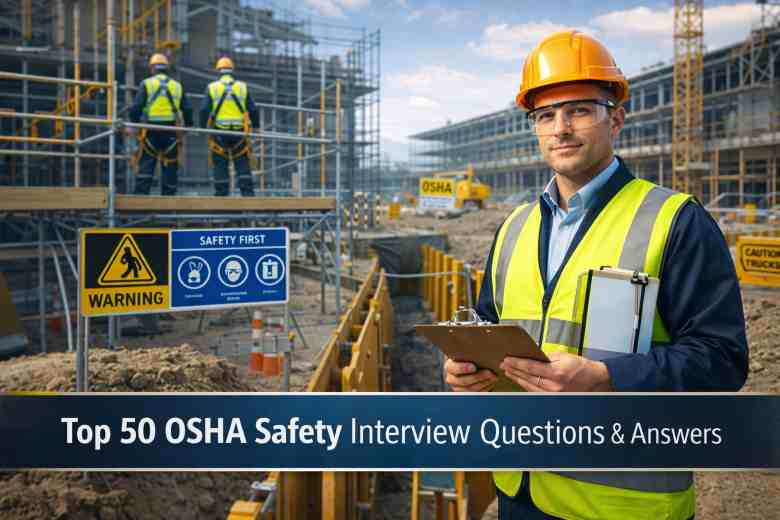
If you are preparing for a construction safety role in 2026, you need to know that OSHA interview questions construction professionals face today are more technical, scenario-driven, and regulation-heavy than ever before. Whether you are targeting a safety officer position, a safety manager role, or a senior HSE leadership job on a mega-project, your ability to articulate OSHA standards, demonstrate hazard identification skills, and explain real-world risk mitigation strategies will determine whether you get hired.
ConstructionCareerHub App is LIVE — built ONLY for construction careers. Don’t apply with a weak resume.
Get ATS-ready Resume Lab + Interview Copilot + Campus Placement Prep (resume screening, skill gaps, interview readiness) — in minutes & Other advanced features.
Explore Smarter Construction Career Tools →Quick check. Big impact. Start now.
The Occupational Safety and Health Administration (OSHA) reported that the construction industry continued to account for the highest number of workplace fatalities in the private sector, with the “Fatal Four” hazards — falls, struck-by, electrocution, and caught-in/between — responsible for the majority of construction deaths. This reality makes OSHA safety interview questions and answers one of the most critical preparation areas for anyone pursuing a career in construction safety.
This guide covers 50 expertly verified OSHA interview questions organized by category — from foundational OSHA knowledge and OSHA 30 interview topics to advanced scenario-based questions on fall protection, confined space entry, lockout/tagout (LOTO), incident investigation, and emergency response. Each answer is crafted to reflect the depth and specificity that top employers demand in 2026.
If you are also preparing for broader safety roles, you will find our detailed guide on 100+ construction safety officer interview questions and answers extremely useful for a comprehensive preparation strategy.
Bookmark this page right now. You will return to it before every safety interview you face this year.
Table of Contents
Why OSHA Interview Preparation Matters in 2026
Construction is one of the most regulated industries in the United States, and OSHA compliance is non-negotiable. Whether you are interviewing for a role with a general contractor, an EPC firm, or an owner organization, your interviewer will test your knowledge of OSHA 29 CFR 1926 (construction-specific standards), your ability to conduct job hazard analyses (JHA/JSA), your understanding of the hierarchy of controls, and your experience with incident investigation protocols.
According to the Bureau of Labor Statistics (BLS), construction added thousands of safety-related positions in 2025, and the trend has only accelerated. Employers are not just looking for candidates who can recite regulations — they want professionals who can apply those regulations in the field, lead safety culture initiatives, and reduce recordable incident rates.
For a deeper understanding of the construction safety landscape, career paths, and required certifications, explore our complete guide to Environment, Health, and Safety (EHS/HSE) career opportunities and courses.
How to Use This OSHA Interview Questions Guide
We have organized these 50 questions into seven practical categories that mirror how real construction safety interviews are structured:
- OSHA Fundamentals & Regulatory Knowledge (Questions 1–10)
- Hazard Identification & Risk Assessment (Questions 11–18)
- Fall Protection & PPE (Questions 19–26)
- Lockout/Tagout, Confined Space & Specialized Hazards (Questions 27–34)
- Incident Investigation & Recordkeeping (Questions 35–40)
- Safety Culture, Training & Leadership (Questions 41–46)
- OSHA Scenario-Based Interview Questions (Questions 47–50)
Read through all categories or jump directly to the section most relevant to your target role. For additional interview strategies across all construction disciplines, see our comprehensive construction interviews preparation guide.
Section 1: OSHA Fundamentals & Regulatory Knowledge (Questions 1–10)
These OSHA regulations interview questions test your foundational understanding of OSHA’s structure, the General Duty Clause, standards categories, and the enforcement framework. Every safety professional must demonstrate fluency in these basics.
Question 1: What is OSHA, and what is its primary purpose?
Answer: OSHA stands for the Occupational Safety and Health Administration, a federal agency under the U.S. Department of Labor established by the Occupational Safety and Health Act of 1970. Its primary purpose is to ensure safe and healthful working conditions for workers by setting and enforcing standards, providing training, outreach, education, and assistance. In the construction industry, OSHA enforces standards under 29 CFR 1926, which covers everything from excavation safety to fall protection and scaffolding requirements.
Question 2: What is the OSHA General Duty Clause, and why is it important?
Answer: The General Duty Clause is Section 5(a)(1) of the OSH Act, which requires employers to provide a workplace free from recognized hazards that are causing or are likely to cause death or serious physical harm. This clause is significant because it allows OSHA to cite employers for hazardous conditions even when no specific standard exists for that particular hazard. For example, if a construction site has an ergonomic hazard that no specific OSHA standard addresses, OSHA can still issue a citation under the General Duty Clause.
Question 3: What are the four main categories of OSHA standards?
Answer: OSHA standards are organized into four major categories: General Industry (29 CFR 1910), Construction (29 CFR 1926), Maritime (29 CFR 1915–1919), and Agriculture (29 CFR 1928). For construction professionals, 29 CFR 1926 is the primary reference and covers subparts from A through Z, addressing everything from general safety and health provisions to steel erection. Knowing the correct subpart for specific hazards — such as Subpart M for fall protection or Subpart P for excavations — demonstrates deep regulatory fluency to an interviewer.
Question 4: What is the difference between OSHA 10 and OSHA 30 certification?
Answer: OSHA 10 is a 10-hour training program designed for entry-level workers, providing basic awareness of common construction hazards, workers’ rights, and employer responsibilities. OSHA 30 is a more comprehensive 30-hour program targeted at supervisors, foremen, safety officers, and managers, covering hazard identification, avoidance, control, and prevention in greater depth. For an OSHA 30 interview, you should be prepared to discuss specific topics covered in the course, including fall protection, electrical safety, scaffolding, excavation, personal protective equipment, and the hierarchy of controls. Most employers now require OSHA 30 as a minimum qualification for any supervisory or safety role on a construction project.
Question 5: What are the “Fatal Four” hazards in construction?
Answer: The “Fatal Four” are the four leading causes of fatalities in the construction industry as identified by OSHA: falls (from height), struck-by (objects), electrocution, and caught-in/between (equipment or collapsing structures). Together, these four hazard categories account for more than 60% of all construction worker deaths annually. Eliminating or significantly reducing these hazards would save hundreds of lives each year. Demonstrating your understanding of each hazard and the corresponding prevention measures is critical in any OSHA safety officer interview.
Question 6: What types of OSHA violations exist, and what are the penalty ranges?
Answer: OSHA classifies violations into several categories. Other-Than-Serious violations are those directly related to job safety but unlikely to cause death or serious harm, with penalties up to $16,131 per violation (as of 2026 adjusted figures). Serious violations involve situations where the employer knew or should have known about a hazard that could cause death or serious harm, with penalties up to $16,131. Willful violations involve intentional disregard or plain indifference to OSHA requirements, carrying penalties of $11,524 to $161,323 per violation. Repeat violations apply when an employer has been previously cited for a substantially similar hazard, with penalties up to $161,323. Failure to Abate involves not correcting a previously cited hazard within the given timeframe, with penalties up to $16,131 per day. Understanding these categories shows the interviewer that you comprehend the enforcement side of OSHA compliance.
Question 7: What is a competent person under OSHA regulations?
Answer: OSHA defines a competent person as someone who is capable of identifying existing and predictable hazards in the surroundings or working conditions that are unsanitary, hazardous, or dangerous to employees, and who has the authority to take prompt corrective measures to eliminate them. In construction, OSHA requires a competent person for many activities, including scaffolding operations (Subpart L), excavation work (Subpart P), fall protection systems (Subpart M), and steel erection (Subpart R). Unlike a “qualified person” who has recognized credentials, a competent person must have both the knowledge and the authority to act.
Question 8: What is the multi-employer worksite citation policy?
Answer: OSHA’s multi-employer citation policy (CPL 02-00-124) classifies employers on construction sites into four categories: the Creating employer (who caused the hazard), the Exposing employer (whose employees are exposed to the hazard), the Correcting employer (responsible for correcting the hazard), and the Controlling employer (who has general supervisory authority over the worksite). Under this policy, more than one employer can be cited for the same hazard. For example, a general contractor as the controlling employer can be cited even if a subcontractor’s employees are the ones exposed to the hazard, provided the GC knew or should have known about the condition and failed to take reasonable steps to address it.
Question 9: What is the purpose of OSHA’s Voluntary Protection Programs (VPP)?
Answer: OSHA’s Voluntary Protection Programs recognize employers and workers who have implemented effective safety and health management systems and maintain injury and illness rates below national averages. VPP participants are classified into three tiers: Star (highest recognition), Merit (progressing toward Star), and Demonstration (testing innovative approaches). Construction sites that achieve VPP Star status are generally exempt from programmed OSHA inspections, which is a significant operational advantage. VPP participation demonstrates an organization’s genuine commitment to safety culture beyond minimum compliance.
Question 10: How do you stay current with OSHA standards and regulatory updates?
Answer: I stay current through multiple channels. I subscribe to OSHA’s official email updates and monitor the Federal Register for proposed and final rulemaking. I regularly review OSHA’s Letters of Interpretation and Standards Improvement Projects. I participate in continuing education through organizations like the American Society of Safety Professionals (ASSP) and attend industry conferences. I also follow OSHA’s National Emphasis Programs (NEPs) to understand current enforcement priorities. Practically, I review the OSHA construction news page weekly and maintain a personal reference library of key standards and guidance documents that I update annually.
For a broader overview of health and safety practices in the construction industry, including global regulatory frameworks, visit our detailed guide.
Section 2: Hazard Identification & Risk Assessment (Questions 11–18)
These OSHA hazard identification interview questions and OSHA risk assessment interview questions evaluate your ability to proactively identify hazards, assess risks, and implement control measures — the core skills every safety professional needs.
Question 11: What is the difference between a hazard and a risk?
Answer: A hazard is any source, situation, or act with the potential to cause harm — such as an unguarded floor opening, a chemical exposure, or energized electrical equipment. A risk is the likelihood that the hazard will actually cause harm, combined with the severity of the potential consequences. For example, a 20-foot-deep excavation is a hazard. The risk depends on factors such as soil type, proximity of workers, presence of protective systems, weather conditions, and the duration of exposure. Effective safety management requires both identifying hazards and quantifying risks so that resources are allocated to the most significant threats first.
Question 12: Explain the hierarchy of controls and how you apply it on a construction site.
Answer: The hierarchy of controls, endorsed by OSHA and NIOSH, ranks hazard control measures from most effective to least effective: Elimination (physically removing the hazard), Substitution (replacing the hazard with a less dangerous alternative), Engineering Controls (isolating people from the hazard through guardrails, ventilation, etc.), Administrative Controls (changing procedures, training, signage, rotating workers), and PPE (personal protective equipment as the last resort). On a construction site, I apply this by first asking whether the task can be redesigned to eliminate the hazard entirely. For example, prefabricating components on the ground eliminates the need for work at height. If elimination is not possible, I move down the hierarchy systematically.
Question 13: What is a Job Hazard Analysis (JHA), and how do you conduct one?
Answer: A Job Hazard Analysis — also called a Job Safety Analysis (JSA) — is a systematic process for identifying potential hazards associated with each step of a specific task and determining the best way to control those hazards. The process involves four steps: (1) selecting the job to be analyzed, prioritizing high-risk, new, or modified tasks; (2) breaking the job down into sequential steps; (3) identifying hazards at each step, considering what could go wrong; and (4) determining preventive measures using the hierarchy of controls. I conduct JHAs collaboratively with the crew performing the work because frontline workers often identify hazards that supervisors overlook. I review JHAs before each work shift, update them when conditions change, and keep completed JHAs on file for training and audit purposes.
Question 14: What is a risk assessment matrix, and how do you use it?
Answer: A risk assessment matrix is a tool that plots the likelihood of a hazard occurring against the severity of the potential consequence to produce a risk rating. Typically, both axes are scaled from 1 to 5, where 1 represents low likelihood or minor injury and 5 represents near-certain occurrence or fatality. The resulting score (likelihood × severity) categorizes risks as low (1–4), medium (5–12), or high (15–25). I use the matrix during pre-task planning, toolbox talks, and safety inspections. For scores in the high range, I ensure engineering controls or work stoppage are applied before the task proceeds. The matrix provides an objective, repeatable framework for decision-making and helps communicate risk levels clearly to workers and management alike.
Question 15: How do you conduct a site safety inspection?
Answer: I conduct site safety inspections following a structured approach. First, I review the inspection checklist tailored to the specific activities occurring that day, cross-referencing applicable OSHA subparts. I walk the site systematically — from perimeter fencing and access control to active work zones, material storage areas, and equipment staging. I observe worker behavior, verify PPE compliance, check fall protection systems, inspect scaffolding tags, verify excavation protection, and ensure fire extinguishers and first aid kits are accessible and current. I document findings with photographs, note both positive observations and deficiencies, assign corrective action owners with deadlines, and follow up to verify closure. I maintain inspection records as part of the project’s safety documentation, which also prepares the project for any unannounced OSHA inspection.
Question 16: What is a pre-task plan (PTP), and when do you use it?
Answer: A pre-task plan is a short, focused safety planning document completed by the work crew before beginning any task. It identifies the scope of work, associated hazards, required PPE, necessary permits (such as hot work or confined space), emergency procedures, and specific safety measures for that activity. PTPs are typically completed at the start of each shift or whenever the scope of work changes significantly. The value of a PTP lies in engaging workers in hazard identification at the point of activity — it is a living document, not a paperwork exercise. I ensure that every crew member signs the PTP, confirming they understand the hazards and controls before work begins.
Question 17: How do you identify and assess chemical hazards on a construction site?
Answer: I identify chemical hazards through the site’s Hazard Communication (HazCom) program, which is required under OSHA’s Hazard Communication Standard (29 CFR 1910.1200, applied to construction via 29 CFR 1926.59). This includes maintaining a current inventory of all hazardous chemicals on site, ensuring that Safety Data Sheets (SDS) are readily accessible to all workers, verifying that containers are properly labeled with GHS-compliant labels, and providing worker training on chemical hazards, safe handling procedures, and emergency response. I assess chemical hazards by reviewing SDS sections on exposure limits (PEL and TLV), routes of exposure, required PPE, and first aid measures, and then incorporate these into the project’s safety plan and JHAs.
Question 18: What is the role of safety audits in OSHA compliance?
Answer: Safety audits are systematic, independent evaluations of a project’s safety management system to verify compliance with OSHA standards, company policies, and contractual requirements. Unlike daily inspections that focus on physical conditions, audits evaluate programs, documentation, training records, incident trends, and management commitment. I conduct audits using a structured checklist that covers OSHA’s 29 CFR 1926 subparts applicable to the project, the company’s written safety programs (fall protection, HazCom, respiratory protection, etc.), and corrective action tracking. Audit findings are ranked by severity and reported to project leadership with recommended corrective actions and timelines. Regular audits proactively identify system gaps before OSHA does.
For more on how safety knowledge integrates into broader construction management roles, explore our construction safety manager job description and salary guide.
Section 3: Fall Protection & PPE (Questions 19–26)
Fall protection is the most frequently cited OSHA construction standard year after year. These OSHA PPE interview questions and fall protection questions are virtually guaranteed in any safety role interview.
Question 19: At what height does OSHA require fall protection in construction?
Answer: OSHA requires fall protection in construction at 6 feet (1.8 meters) above a lower level, as specified in 29 CFR 1926.501(b)(1). This is different from general industry, where the trigger height is 4 feet, and from shipyard employment, where it is 5 feet. There are specific additional requirements for certain activities: for example, workers on scaffolding must have fall protection at 10 feet (Subpart L), while workers on steel erection must have it at 15 feet with a controlled decking zone (Subpart R). Knowing these thresholds and their exceptions demonstrates thorough OSHA knowledge.
Question 20: What are the three primary fall protection systems recognized by OSHA?
Answer: OSHA recognizes three primary fall protection systems for construction: Guardrail systems (passive protection using top rails at 42 inches ±3 inches, mid-rails, and toeboards), Safety net systems (installed no more than 30 feet below the work surface with specific clearance requirements), and Personal fall arrest systems (PFAS) (consisting of an anchorage, connector, and full-body harness with a deceleration device). Each system has detailed OSHA requirements. For PFAS, the maximum arresting force on the body must not exceed 1,800 pounds, and the total free-fall distance must not exceed 6 feet. A competent person must inspect all fall protection systems before each use.
Question 21: What are the components of a personal fall arrest system (PFAS)?
Answer: A PFAS consists of three components: an anchorage capable of supporting at least 5,000 pounds per worker or designed by a qualified person with a safety factor of 2, a connector (such as a shock-absorbing lanyard or self-retracting lifeline), and a full-body harness (body belts are prohibited for fall arrest in construction). The system must be rigged so that a worker cannot free-fall more than 6 feet or contact any lower level. After a fall event, the entire PFAS must be removed from service and inspected by a competent person before any component can be reused. I also ensure workers are trained on proper donning, inspection, and use of each component.
Question 22: What is a leading edge, and what fall protection challenges does it present?
Answer: A leading edge is the unprotected side and edge of a floor, roof, or formwork where construction work is actively progressing. The challenge with leading edges is that conventional guardrail or safety net systems may not be feasible because the edge moves as work advances — for example, during concrete deck pours or roof decking. In these situations, OSHA permits the use of alternative fall protection methods as outlined in a site-specific Fall Protection Plan (29 CFR 1926.502(k)), which must be developed by a qualified person and supervised by a competent person. This plan must demonstrate why conventional systems are infeasible and describe the alternative measures being used.
Question 23: How do you select the right PPE for a specific construction task?
Answer: PPE selection follows a hazard assessment process as required by OSHA under 29 CFR 1926.95. I first identify the hazards present — impact, penetration, compression, chemical, heat, harmful dust, optical radiation, drowning, etc. Then I select PPE that matches the specific hazard type and severity. For head protection, ANSI/ISEA Z89.1 Class E helmets are standard for electrical environments. For eye protection, the choice between safety glasses, goggles, or face shields depends on the hazard — grinding requires a face shield over safety glasses, while chemical splash requires indirect-vent goggles. For respiratory protection, the selection depends on the contaminant type, concentration, and oxygen levels. I document the hazard assessment, PPE selection rationale, and worker training in writing.
Question 24: What are OSHA requirements for scaffolding safety?
Answer: OSHA’s scaffolding standard (29 CFR 1926.451–454) is one of the most frequently cited construction standards. Key requirements include: scaffolds must be designed by a qualified person and capable of supporting four times the maximum intended load; planking must be scaffold-grade or equivalent with no more than 1-inch gaps between planks; guardrails, mid-rails, and toeboards are required when work surfaces are 10 feet or more above a lower level; competent persons must inspect scaffolds before each work shift and after any event that could affect structural integrity; workers must receive training on hazards related to the type of scaffold being used; and cross braces cannot serve as top rails unless the crossing point meets the 38–45 inch height requirement. Fall protection for supported scaffolds is triggered at 10 feet, while suspended scaffolds require fall protection at all heights.
Question 25: When is respiratory protection required on a construction site?
Answer: Respiratory protection is required whenever engineering and administrative controls are insufficient to reduce airborne contaminant exposures below OSHA’s Permissible Exposure Limits (PELs). Common construction activities requiring respiratory protection include silica-generating tasks (cutting concrete, masonry, stone), abrasive blasting, painting with volatile compounds, welding in confined spaces, and working with asbestos or lead-containing materials. OSHA’s Respiratory Protection Standard (29 CFR 1910.134, referenced in construction) requires a written respiratory protection program, medical evaluations before respirator use, annual fit testing for tight-fitting respirators, and worker training. For construction silica specifically, OSHA’s 29 CFR 1926.1153 Table 1 provides engineering control options that, when followed, may reduce or eliminate the need for respiratory protection for certain tasks.
Question 26: How do you ensure workers comply with PPE requirements on site?
Answer: Compliance starts with a strong safety culture, not punishment. I first ensure workers understand why PPE is required through engaging training that includes real incident data and personal stories. I verify that the PPE provided fits properly, is comfortable, and is in good condition — workers are more likely to wear PPE that fits well. I incorporate PPE checks into daily pre-task plans and toolbox talks. During inspections, I address non-compliance immediately through positive engagement rather than punitive measures. For persistent non-compliance, I follow the company’s progressive discipline process. I also recognize and reward crews with excellent PPE compliance to reinforce the desired behavior. Ultimately, if workers see supervisors and managers consistently wearing PPE, compliance across the workforce improves dramatically.
These PPE and fall protection topics are also heavily tested in broader safety interviews. See our dedicated resource on top 25 interview questions for safety officers in construction for additional scenario-based questions.
Section 4: Lockout/Tagout, Confined Space & Specialized Hazards (Questions 27–34)
These OSHA technical interview questions cover critical specialized hazard areas that separate experienced safety professionals from those with only surface-level knowledge.
Question 27: What is lockout/tagout (LOTO), and when is it required?
Answer: Lockout/tagout is a set of procedures used to ensure that machines and equipment are properly shut down, de-energized, isolated, and locked out before any maintenance, repair, or servicing work is performed. OSHA’s LOTO standard (29 CFR 1910.147, applied to construction activities) requires LOTO whenever unexpected energization or start-up of machines/equipment, or the release of stored energy, could cause injury. In construction, LOTO applies to situations such as servicing concrete mixers, working on electrical panels, maintaining hoisting equipment, and repairing compressors. The procedure involves preparation, shutdown, isolation, application of lockout/tagout devices, verification of zero energy state, and a defined release process when work is complete.
Question 28: What are the OSHA requirements for confined space entry in construction?
Answer: OSHA’s construction-specific confined space standard (29 CFR 1926.1200–1213) defines a confined space as one that is large enough to enter and perform work, has limited means of entry or exit, and is not designed for continuous occupancy. A permit-required confined space additionally contains or has the potential to contain a hazardous atmosphere, engulfment hazard, converging walls/floors, or any other recognized serious safety hazard. Before entry, the employer must evaluate the space, provide atmospheric testing (oxygen 19.5–23.5%, flammable gases below 10% of LEL, toxic substances below PELs), develop a written permit, assign trained attendants, and ensure rescue services are available. Continuous atmospheric monitoring, ventilation, and communication between entrants and attendants are critical throughout the entry.
Question 29: How do you manage electrical safety hazards on a construction site?
Answer: Electrical safety on construction sites is governed by OSHA 29 CFR 1926 Subpart K. My approach includes ensuring all temporary wiring is protected by ground-fault circuit interrupters (GFCIs) or an assured equipment grounding conductor program, maintaining safe distances from overhead power lines (at least 10 feet for lines up to 50kV, with increased distances for higher voltages), ensuring only qualified persons work on electrical systems, verifying all electrical tools and cords are inspected and in good condition (with a color-coded inspection tagging system), and de-energizing circuits before work begins using proper LOTO procedures. I also ensure that all panel boards are labeled, access to electrical rooms is controlled, and arc flash hazard assessments are completed for energized work when de-energization is not feasible.
Question 30: What are the OSHA requirements for excavation and trenching safety?
Answer: OSHA’s excavation standard (29 CFR 1926 Subpart P) requires protective systems for all excavations 5 feet or deeper, unless the excavation is in stable rock. Protective systems include sloping or benching the excavation walls to a stable angle (determined by soil classification), shoring with timber, aluminum, or hydraulic systems, or shielding using trench boxes. A competent person must classify the soil type (Type A, B, or C), inspect the excavation daily and after any rain event, and have the authority to remove workers from hazardous conditions. Additional requirements include safe means of egress (ladder, ramp, or stairway) within 25 feet of any worker in an excavation 4 feet or deeper, keeping spoil piles at least 2 feet back from the edge, and locating underground utilities before digging (Call 811).
Question 31: What is a hot work permit, and when is it required?
Answer: A hot work permit is a written authorization to perform operations involving open flames, sparks, or heat-producing activities in areas where fire or explosion hazards may exist. This includes welding, cutting, brazing, grinding, and soldering. The permit process requires a fire watch during and for at least 30 minutes after the hot work is completed, removal or protection of combustible materials within 35 feet, testing for flammable atmospheres in spaces that could contain combustible gases, ensuring fire extinguishing equipment is immediately available, and verification that all required precautions are in place before work begins. The permit must be signed by an authorized supervisor and kept at the work location during the activity.
Question 32: How do you manage crane and rigging safety on a construction site?
Answer: Crane safety in construction is governed by OSHA 29 CFR 1926 Subpart CC. Key elements include ensuring all crane operators are certified under OSHA’s operator certification requirements, conducting pre-operation inspections (visual and functional), developing and reviewing lift plans for critical lifts (generally lifts exceeding 75% of the crane’s rated capacity or lifts over occupied areas), maintaining minimum clearance distances from power lines, verifying ground conditions for adequate crane support, using designated signal persons with standardized hand signals, and ensuring that rigging equipment (slings, shackles, hooks) is inspected, rated, and properly selected for the load. I also ensure annual inspections are current and that the crane’s load chart is accessible to the operator at all times.
Question 33: What are OSHA’s requirements for hazardous energy control beyond LOTO?
Answer: Beyond traditional LOTO, OSHA requires control of all forms of hazardous energy, including electrical, mechanical, hydraulic, pneumatic, thermal, chemical, and gravitational energy. In construction, this means addressing stored energy in pressurized lines, elevated loads, compressed springs, and capacitors. After applying LOTO devices, the competent person must verify zero energy state by attempting to restart the equipment, testing circuits with appropriate meters, visually confirming mechanical blocks and pins, and bleeding or venting residual pressure in hydraulic and pneumatic systems. When multiple trades are working on the same equipment, a group LOTO procedure must be used to ensure no single worker can be exposed while others are still working.
Question 34: How do you address noise exposure hazards in construction?
Answer: OSHA’s noise exposure standard sets a Permissible Exposure Limit of 90 dBA over an 8-hour TWA (time-weighted average) for construction workers (29 CFR 1926.52). When noise levels exceed 85 dBA, a hearing conservation program should be implemented as a best practice, even though the formal hearing conservation program under 29 CFR 1910.95 technically applies only to general industry. My approach starts with noise exposure assessments using calibrated dosimeters. I then apply engineering controls such as equipment barriers, dampening materials, or selecting quieter equipment. Administrative controls include rotating workers, scheduling noisy tasks during periods with fewer exposed workers, and limiting exposure duration. When controls are insufficient, appropriate hearing protection (rated NRR plugs or muffs) is required, and I ensure workers are trained on proper insertion and use.
Section 5: Incident Investigation & Recordkeeping (Questions 35–40)
These incident investigation questions and safety compliance interview questions test your ability to investigate events, identify root causes, and maintain OSHA-compliant records.
Question 35: What makes an incident OSHA-recordable?
Answer: Under OSHA’s recordkeeping standard (29 CFR 1904), a work-related injury or illness is recordable if it results in any of the following: death, days away from work, restricted work or job transfer, medical treatment beyond first aid, loss of consciousness, or a significant injury or illness diagnosed by a physician or licensed healthcare professional. Specific conditions are always recordable regardless of severity, including work-related cases of cancer, chronic irreversible disease, fractured or cracked bones, and punctured eardrums. First aid treatments — such as non-prescription medications, wound cleaning, application of bandages, tetanus shots, and use of finger guards — are specifically excluded from recordability.
Question 36: How do you conduct a root cause investigation after a construction site incident?
Answer: I follow a structured investigation methodology. Immediately after the incident, I secure the scene to preserve evidence and ensure no further harm. Then I gather facts through witness interviews, photographs, sketches, equipment inspections, and document review (permits, JHAs, training records). I analyze the information using root cause analysis techniques such as the “5 Whys” method, Fishbone (Ishikawa) diagrams, Fault Tree Analysis, or TapRoot depending on the severity. The goal is to identify systemic failures — not just the immediate cause but the underlying management system failures that allowed the incident to occur. My investigation report includes findings, root causes, contributing factors, and corrective actions with assigned owners and deadlines. I track corrective actions to completion and share lessons learned across the organization.
Question 37: When must you report an incident to OSHA?
Answer: OSHA requires employers to report work-related fatalities within 8 hours and work-related in-patient hospitalizations, amputations, or losses of an eye within 24 hours. Reports can be made by calling the nearest OSHA Area Office, calling the OSHA hotline at 1-800-321-OSHA (6742), or using OSHA’s online reporting system. The reporting clock starts when the employer learns of the event, not when it occurs. For fatalities, the time extends to 30 days after the incident if the death occurs after that initial period, the employer has 24 hours from the time they learn of the death to report it. I maintain OSHA’s contact numbers posted on the project safety board and ensure all supervisors know the reporting requirements and timelines.
Question 38: What OSHA records must be maintained on a construction site?
Answer: Construction employers with more than 10 employees at any time in the previous calendar year must maintain OSHA 300 Log (Log of Work-Related Injuries and Illnesses), OSHA 300A (Summary of Work-Related Injuries and Illnesses, which must be posted from February 1 through April 30 each year), and OSHA 301 (Injury and Illness Incident Report for each recordable case). Additionally, many construction projects require maintaining records of safety training, toolbox talks, equipment inspections, JHAs/JSAs, safety meeting minutes, LOTO procedures, confined space permits, crane inspection reports, scaffold inspection tags, and SDS sheets. I organize these records in both physical and digital formats for easy access during audits or OSHA inspections.
Question 39: How do you calculate and use safety performance metrics?
Answer: The two primary OSHA metrics are the Total Recordable Incident Rate (TRIR) and the Days Away, Restricted, or Transfer (DART) rate. Both are calculated using the formula: (Number of incidents × 200,000) ÷ Total hours worked. The 200,000 figure represents 100 full-time equivalent workers working 40 hours per week for 50 weeks. Beyond lagging indicators, I also track leading indicators such as safety observation rates, near-miss reports, training completion percentages, inspection completion rates, and corrective action closure rates. Leading indicators are predictive and actionable — they tell us where we are heading, while lagging indicators tell us where we have been. A balanced safety scorecard incorporating both types of metrics provides the clearest picture of site safety performance.
Question 40: How do you manage near-miss reporting on a construction project?
Answer: Near-miss reporting is one of the most valuable tools in a safety program because near-misses outnumber actual incidents by a significant ratio (often cited as 300:1 based on Heinrich’s Triangle research). I create a non-punitive reporting culture where workers feel safe reporting near-misses without fear of retaliation. I implement a simple, accessible reporting mechanism — both paper-based and mobile app-based — so workers can report quickly. Every near-miss is investigated with the same rigor as an actual incident, because the only difference between a near-miss and a fatality is luck. I analyze near-miss data for trends, share lessons learned through safety alerts and toolbox talks, and track corrective actions. Recognizing and thanking workers who report near-misses publicly reinforces the reporting culture.
Looking for more interview preparation resources? Our guide on HSE interview questions and answers covers incident investigation, environmental compliance, and health management topics in depth.
Section 6: Safety Culture, Training & Leadership (Questions 41–46)
These safety culture interview questions and safety manager OSHA interview questions assess your leadership ability, communication skills, and commitment to building a proactive safety environment.
Question 41: How do you define safety culture, and how do you build it on a construction project?
Answer: Safety culture is the shared set of beliefs, values, attitudes, and behaviors that determine how safety is prioritized and practiced within an organization. A strong safety culture exists when every worker — from the laborer to the project director — genuinely believes that every incident is preventable and that safety is a personal responsibility, not just a compliance requirement. I build safety culture through visible leadership commitment (management walking the job, participating in safety meetings), worker engagement and empowerment (involving workers in hazard identification and decision-making), consistent accountability at all levels, open communication channels, regular recognition of safe behaviors, investment in training and development, and a no-blame approach to reporting and learning from incidents. Culture change takes time, but the results — measured in reduced incidents and increased morale — are transformative.
Question 42: How do you conduct effective toolbox talks?
Answer: Effective toolbox talks are short (10–15 minutes), focused, interactive, and relevant to the day’s work. I prepare by identifying the topic based on current site activities, recent near-misses or incidents, weather conditions, or new tasks starting that day. I use real-world examples and photographs rather than reading from a script. I engage workers by asking questions, encouraging them to share their own experiences, and facilitating discussion. I vary the delivery — sometimes I ask a worker to lead the talk, which increases engagement and ownership. Every toolbox talk is documented with the topic, date, presenter, attendees (with signatures), and any action items. I keep a log of all talks conducted and rotate topics to ensure comprehensive coverage throughout the project.
Question 43: How do you handle resistance to safety procedures from workers or supervisors?
Answer: Resistance typically stems from misunderstanding, inconvenience, lack of resources, or cultural norms. My approach starts with listening — understanding why the resistance exists. If a worker resists wearing fall protection because the harness is uncomfortable, the solution is a better-fitting harness, not a disciplinary notice. If a supervisor pushes back because safety procedures slow production, I engage them in a conversation about incident costs versus prevention costs, using real data. I involve resistant individuals in the solution — people support what they help create. For persistent resistance, I escalate through the management chain while documenting the behavior. Ultimately, safety is non-negotiable, and I communicate this firmly but respectfully. The goal is to convert resistance into engagement through education, involvement, and genuine relationship-building.
Question 44: What makes a good safety training program for construction workers?
Answer: An effective safety training program is job-specific, competency-based, interactive, and delivered in the workers’ language (both literally and in terms of complexity). I design training programs based on a needs assessment that considers the project’s hazard profile, regulatory requirements (OSHA 10/30, competent person training, HAZWOPER, etc.), incident history, and workforce demographics. Good training includes hands-on components — workers should practice using fall arrest systems, fire extinguishers, and emergency equipment, not just watch a video. I assess comprehension through practical demonstrations, not just written tests. I provide refresher training at regular intervals and any time new hazards are introduced or incidents suggest a knowledge gap. Finally, I track all training in a database and ensure records are immediately accessible for audits.
Question 45: How do you manage subcontractor safety on a multi-employer construction site?
Answer: Subcontractor safety management begins during the prequalification process, where I evaluate potential subcontractors’ safety programs, EMR (Experience Modification Rate), TRIR, DART rates, and OSHA citation history. Once onsite, subcontractors are required to attend a project-specific safety orientation, submit their safety plans and JHAs for review, designate a competent person for each crew, and participate in all project safety meetings and inspections. I conduct joint inspections with subcontractor safety representatives, hold regular safety coordination meetings, and track subcontractor safety performance through a scorecard system. When deficiencies are identified, I issue formal notices with corrective action timelines. For repeat or willful violations, subcontractors can be removed from the project. Under OSHA’s multi-employer worksite policy, the general contractor has a responsibility to exercise reasonable diligence in identifying and correcting hazards created by subcontractors.
Question 46: How do you communicate safety performance to project leadership and stakeholders?
Answer: I communicate safety performance through structured reports that translate safety data into business-relevant language. My weekly safety dashboard includes TRIR and DART rates (with trending), leading indicator metrics (inspections completed, observations filed, training hours), open corrective actions with aging analysis, near-miss and good-catch highlights, and a narrative on current focus areas and emerging risks. For monthly management reviews, I provide deeper analysis including cost of incidents, workers’ compensation trends, and benchmarking against industry averages and project goals. I present this data in executive meetings using visual dashboards, and I always frame safety performance in terms of both human impact and business value. Clear, consistent communication ensures safety remains a leadership priority, not just a field-level activity.
For tips on showcasing leadership and communication skills during construction interviews, check out our resource on interview tips for construction professionals.
Section 7: OSHA Scenario-Based Interview Questions (Questions 47–50)
These OSHA scenario interview questions are the most challenging because they require you to apply regulatory knowledge, critical thinking, and practical experience simultaneously. Senior-level interviewers often rely heavily on scenario-based questions to differentiate candidates.
Question 47: A worker falls 12 feet from a scaffold and is hospitalized. Walk me through your response.
Answer: My immediate response follows a defined sequence. First, I ensure the injured worker receives medical attention — call 911, administer first aid if trained and it is safe to do so, and designate someone to direct emergency services to the location. Second, I secure the scene — cordon off the area, stop all work on and around the scaffold, and preserve evidence (do not move the scaffold or components). Third, I notify project management and the company’s safety leadership. Fourth, I assess whether this is an OSHA-reportable event — since the worker was hospitalized as an in-patient, I must report to OSHA within 24 hours. Fifth, I begin the investigation: photograph the scene, document scaffold configuration, check inspection records, interview witnesses, review the competent person’s most recent scaffold inspection, check the worker’s training records, and examine the fall protection measures (or lack thereof) that were in place. Sixth, I conduct root cause analysis, develop corrective actions, and implement them before any scaffold work resumes. Finally, I communicate lessons learned across the project and company.
Question 48: You discover that a subcontractor’s crew is working in a trench 7 feet deep with no protective system. What do you do?
Answer: This is an imminent danger situation. I immediately order all workers out of the trench — my authority to stop work when life safety is at risk overrides any production concerns. Once workers are safe, I secure the area to prevent re-entry. I document the violation with photographs showing the depth and absence of protective systems. I notify the subcontractor’s superintendent and safety representative of the violation, citing OSHA 29 CFR 1926.652, which requires protective systems for excavations 5 feet or deeper. I issue a formal safety notice requiring a corrective action plan before work can resume, which must include soil classification by a competent person, selection of an appropriate protective system (sloping, shoring, or shielding), and placement of a ladder within 25 feet of all workers. I also review whether the subcontractor’s competent person was present and whether this represents a systemic failure in their safety management. Under OSHA’s multi-employer policy, our company as the controlling employer could also be cited if we were aware of or should have been aware of this condition.
Question 49: An OSHA compliance officer arrives at your construction site for an unannounced inspection. How do you handle it?
Answer: I remain professional, cooperative, and organized. First, I greet the compliance officer, verify their credentials (OSHA ID and badge), and notify project management. I accompany the officer throughout the inspection — or designate a competent representative if I am unavailable. During the opening conference, I listen carefully to the inspection scope — whether it is a programmed inspection, complaint-driven, referral, or fatality/catastrophe investigation. During the walkaround, I take detailed notes parallel to the officer’s observations, photograph everything they photograph, and document any worker interviews. I answer questions honestly but do not volunteer information beyond what is asked. I ensure the officer has access to required records (OSHA 300 logs, training records, written safety programs). During the closing conference, I note all potential citations and ask for clarification on any corrective action expectations. After the inspection, I immediately address any hazards identified and prepare for potential citations with documented corrective actions and a timeline for abatement.
Question 50: Your project’s TRIR has increased over three consecutive months. How do you analyze the trend and develop a corrective action plan?
Answer: A rising TRIR demands both data analysis and operational investigation. First, I analyze the incident data to identify patterns: Are incidents concentrated in a specific trade, task, time of day, day of week, or body part? Are they predominantly first aid escalations or genuinely more severe? Is the increase driven by more hours worked (denominator) or more incidents (numerator)? Second, I review leading indicators for the same period — did inspection frequency drop? Did near-miss reports decline? Were there staffing changes, new subcontractors, or schedule pressure increases? Third, I conduct field observations — I spend time on the work fronts watching work patterns, worker engagement, supervisor presence, and hazard conditions. Based on this analysis, I develop targeted corrective actions, which might include additional training on specific hazard topics, increased supervisor safety engagement, revision of specific JHAs, enhanced inspection protocols, or a stand-down safety event to reset the team’s safety awareness. I present the analysis and plan to project leadership with measurable goals, a timeline, and a monitoring protocol to track improvement.
Bonus: Quick-Reference OSHA Interview Preparation Checklist
Before your next OSHA safety interview, ensure you can confidently address these areas:
- OSHA 29 CFR 1926 structure — Know key subparts (M for fall protection, P for excavations, L for scaffolding, K for electrical, CC for cranes)
- General Duty Clause — Explain when and how it applies
- Fatal Four — Cite statistics and prevention strategies for each
- Hierarchy of Controls — Apply it to real construction scenarios
- JHA/JSA methodology — Walk through a step-by-step example
- OSHA recordkeeping — Know the difference between recordable and reportable events
- Fall protection trigger heights — 6 feet general, 10 feet scaffolding, 15 feet steel erection
- Confined space entry — Atmospheric monitoring thresholds and permit requirements
- LOTO procedures — Step-by-step isolation and verification process
- Incident investigation methods — 5 Whys, Fishbone, Fault Tree
- TRIR and DART calculations — Know the formula and benchmarks
- Multi-employer worksite policy — Four employer categories and their responsibilities
Recommended Career Resources
Investing in the right resources can significantly accelerate your interview preparation and career growth. Here are some highly recommended tools and guides:
AI-Powered Career Tools
Use ConstructionCareerHub.com to access the Interview Copilot (practice OSHA and HSE interview scenarios with AI feedback), Resume Lab (create ATS-optimized safety resumes), Career Planner (map your progression from safety officer to HSE director), and Salary Calculator (benchmark your compensation against industry standards). These tools are purpose-built for construction professionals and give you a measurable edge.
eBooks for Construction Interview Preparation
These downloadable guides from our resource library provide deep-dive preparation material:
- Construction Jobs Interview: An Ultimate Interview Preparation Guide — Comprehensive preparation strategies, sample answers, and techniques for all construction roles including safety positions.
- A Comprehensive Civil Engineering Job Interview Guide with 300 Interview Q&A — 300 expertly curated questions covering technical, behavioral, and safety topics.
- Construction Career Launchpad: A Comprehensive eBook to Construction Job Preparedness — Complete career readiness guide covering resume building, interview skills, and industry navigation.
- Hidden Construction Careers That Pay More Than Engineering — Discover high-paying construction career paths including HSE management and safety consulting roles.
- Construction Career Mastery: The Essential 15 eBook Collection — The complete bundle for serious professionals looking to master every aspect of construction career development.
Related Interview Preparation Guides on ConstructionPlacements
Continue your preparation with these additional resources:
- 100+ Construction Safety Officer Interview Questions & Answers [2026]
- HSE Interview Questions and Answers for Construction
- Top 50 Construction Job Interview Questions and Answers
- 200 Construction Management Interview Questions and Answers
- 150 Construction Project Management Interview Questions
- Cracking Construction Jobs Interviews: Your Q&A Success Guide
- 31 Challenging Interview Questions Specific to the Construction Industry
Frequently Asked Questions (FAQs)
What OSHA topics are most commonly asked in construction safety interviews?
The most frequently tested topics include fall protection (OSHA Subpart M), the Fatal Four hazards, the hierarchy of controls, excavation safety, scaffolding requirements, lockout/tagout procedures, the General Duty Clause, recordkeeping (OSHA 300 logs), incident investigation methodology, and PPE selection and compliance. For OSHA 30 interview scenarios, expect questions on multi-employer worksites, competent person definitions, and confined space entry requirements.
How do I prepare for an OSHA 30 interview?
Focus on demonstrating that you can apply OSHA 30 content to real construction scenarios, not just recite definitions. Review all 29 CFR 1926 subparts covered in the course, practice answering scenario-based questions (like those in Section 7 of this guide), and be prepared to discuss how you have used OSHA 30 knowledge on actual projects. Interviewers value practical application over theoretical knowledge.
Is OSHA 30 certification required for safety officer positions?
While OSHA 30 is not a legal “license” to perform safety work, it is a de facto requirement for virtually all safety officer, safety manager, and HSE positions in construction. Many general contractors and project owners require OSHA 30 as a minimum qualification for supervisory roles. Having additional certifications such as CHST (Construction Health and Safety Technician) or ASP/CSP from the Board of Certified Safety Professionals (BCSP) significantly strengthens your candidacy.
What is the best way to answer scenario-based OSHA interview questions?
Use the STAR method (Situation, Task, Action, Result) to structure your response. Start by briefly describing the scenario, explain your role and responsibility, walk through the specific actions you would take (citing relevant OSHA standards), and conclude with the expected outcome. Always reference specific regulatory citations (e.g., “29 CFR 1926.501(b)(1) requires fall protection at 6 feet”) and demonstrate your understanding of both the technical and leadership dimensions of the situation.
How can I practice OSHA interview questions with AI tools?
The Interview Copilot on ConstructionCareerHub lets you simulate realistic safety interview rounds powered by AI. You can practice answering OSHA scenario questions, get instant feedback on your responses, receive a 7-day improvement plan, and download a comprehensive interview readiness report. It is the most targeted practice tool available for construction safety professionals in 2026.
Final Thoughts
Mastering OSHA interview questions construction employers ask in 2026 requires more than memorizing regulations — it requires the ability to apply those regulations to real-world scenarios, communicate your approach clearly, and demonstrate genuine leadership in safety. The 50 questions and answers in this guide cover the full spectrum of what top employers test, from foundational Occupational Safety and Health Administration interview questions to advanced OSHA scenario interview questions that separate good candidates from exceptional ones.
Your next step is clear: review these questions, practice your answers out loud, and use tools like the ConstructionCareerHub Interview Copilot to simulate real interview conditions. Combine this preparation with the downloadable eBooks and interview guides linked above, and you will walk into your next safety interview with the confidence and knowledge that employers are looking for.
Safety is not just a career — it is a responsibility. Prepare well, and protect the workers who depend on you.
About ConstructionPlacements.com: ConstructionPlacements.com is a leading construction career guidance platform serving professionals in India, the USA, the Middle East, and globally. We provide expert-curated interview preparation guides, career development resources, industry news, and job opportunities for construction, civil engineering, and infrastructure professionals.
Disclaimer: The information in this post is for educational and career preparation purposes only. OSHA regulations are subject to change, and readers should always verify current standards directly from OSHA.gov. This content does not constitute legal or professional compliance advice.
Related Posts:
- Building safer worksites through OSHA training courses for construction professionals
- Construction Equipment Operator Training: Complete 2026 U.S. Career Guide
- 5 Essential Certifications for a Career in Construction
- A Guide to Construction Site Safety and Your Rights After an Accident
