

Last Updated on May 13, 2026 by Admin
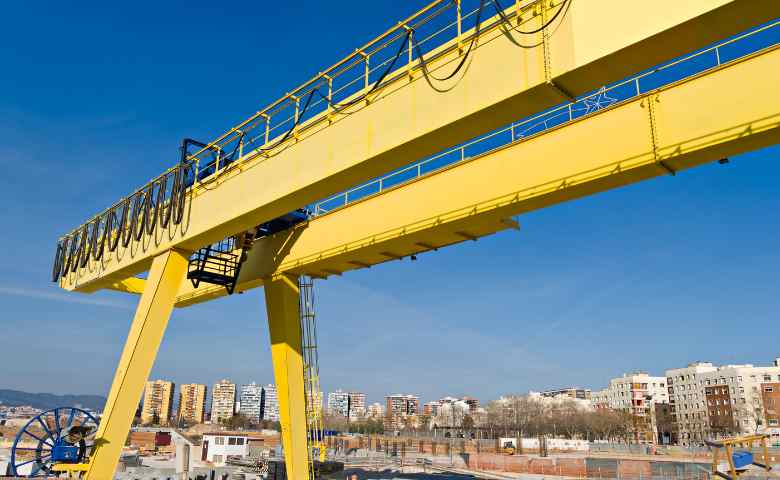
A gantry crane purchase starts with one question: where will it operate, and what will it lift? Prices range from $800 for a portable aluminum unit to over $120,000 for a heavy-duty outdoor steel crane. That gap exists because indoor workshop cranes and outdoor yard cranes are engineered to completely different structural standards. Picking the wrong one doesn’t just waste budget — it creates a compliance liability on day one.
ConstructionCareerHub App is LIVE — built ONLY for construction careers. Don’t apply with a weak resume.
Get ATS-ready Resume Lab + Interview Copilot + Campus Placement Prep (resume screening, skill gaps, interview readiness) — in minutes & Other advanced features.
Explore Smarter Construction Career Tools →Quick check. Big impact. Start now.
Most procurement teams run into the same problem: similar-looking products across a wide spec range, with no clear guidance on what actually separates them. This guide gives you the selection logic, a type comparison table, and the five specs that matter most.
Table of Contents
Gantry Crane Types & Price Benchmarks
| Type | Capacity | Environment | Indicative Price (FOB) |
| Portable Aluminum Gantry | 0.5 – 3 t | Indoor / Light Workshop | $800 – $5,000 |
| Adjustable Steel Gantry | 1 – 10 t | Indoor Workshop | $2,500 – $18,000 |
| Fixed Single-Girder Gantry | 5 – 20 t | Indoor / Semi-Outdoor | $12,000 – $45,000 |
| Fixed Double-Girder Gantry | 10 – 100 t | Outdoor Yard / Heavy Industry | $35,000 – $120,000+ |
Indicative market reference, FOB factory, Q1 2026. Excludes installation and civil works.
Looking for exact pricing on a specific model? Gantry crane prices vary based on span, hook height, duty class, and hoist configuration. Contact Voitto Crane with your capacity and site requirements — we’ll provide a detailed quotation within 24 hours.
Indoor vs. Outdoor: Why Environment Determines Structure
They Are Not the Same Product
Outdoor gantry cranes must be engineered for wind loads (up to 800 N/m² storm condition per EN 13001-2), C3–C5 corrosion protection (ISO 12944), and weatherproof electrical enclosures (minimum IP65). An indoor crane deployed outdoors — even occasionally — voids CE certification, invalidates the warranty, and creates direct regulatory exposure under EN 15011 or ASME B30.2.
If there is any outdoor use case in your plan, specify for outdoor conditions from the start. The price difference is far smaller than the compliance risk.
Portable vs. Fixed
Portable aluminum gantry cranes (0.5–3 t) can be repositioned in under 30 minutes — useful for multi-bay workshops. The trade-off is deflection: aluminum frames flex more under load than welded steel, and caster systems are rated for smooth indoor floors only.
Fixed steel gantry cranes deliver better structural rigidity, higher duty cycle ratings, and compatibility with heavier hoists. For any application above 5 t or more than 20 lift cycles per day, fixed steel is the correct starting point.
5 Specifications That Drive the Decision
1. Lifting Capacity (SWL)
Apply a minimum 25% margin above your heaviest anticipated load. If the heaviest lift is 8 t, specify a 10 t crane. This covers dynamic load factors during acceleration and deceleration as defined in EN 13001-2.
2. Span
Span is the center-to-center distance between rails. Add 1–1.5 m on each side of your widest load. Double-girder construction is required above approximately 20 m span or 10 t capacity to maintain deflection within L/1000 per EN 15011.
3. Hook Height
Confirm hook height against your tallest load, plus rigging assembly height, plus a 300 mm clearance buffer during travel. Getting this wrong means the crane physically cannot complete the lift.
4. Duty Class (FEM Classification)
Duty class defines the crane’s design life in lift cycles. A single-shift production facility running 15–25 cycles per day typically requires FEM 2m to 3m. Underspecifying duty class is the most common — and most expensive — gantry crane procurement error.
| FEM Class | Typical Use | Design Life |
| 1Am | Maintenance, occasional | Up to 12,500 cycles |
| 2m | Workshop, regular use | Up to 63,000 cycles |
| 3m | Production, daily use | Up to 250,000 cycles |
5. Hoist Type
Manual chain hoists suit infrequent lifts below 5 t. Electric chain hoists cover 0.5–10 t at moderate frequency. Electric wire rope hoists are required above 10 t or for high duty class applications. For outdoor cranes, variable frequency drive (VFD) control on hoist and travel motions is strongly recommended for load control in wind conditions.
Conclusion
Three inputs resolve most gantry crane selection decisions: your maximum load, your operating environment, and your daily lift frequency. Get these right, and the remaining specifications follow logically.
Voitto Crane supplies CE-certified gantry cranes from 0.5 t portable units to 100 t heavy-duty outdoor configurations, with full FEM classification documentation at delivery.
FAQ
Q1: Can I use an indoor gantry crane outdoors temporarily?
No. Indoor cranes are not designed for wind loads and are finished to C1–C2 corrosion standards only. Outdoor use — even occasional — voids CE certification and creates OSHA or EN compliance exposure. If outdoor use is possible, specify an outdoor-rated crane from the start.
Q2: What duty class do I need for a one-shift production facility?
Most single-shift facilities running 15–25 lifts per day fall in the FEM 2m–3m range. Provide your supplier with your actual daily cycle count and average load percentage, and ask them to document the FEM classification calculation. A supplier who cannot provide this has not engineered the crane to a standard.
Q3: What documentation should a supplier provide at delivery?
At minimum: CE Declaration of Conformity, factory load test certificate at 125% SWL, structural calculation with FEM classification, electrical schematic (IEC 60204), and an operator manual in your working language. Missing documentation means the crane is not EN 15011 or ASME B30.2 compliant, regardless of what the quotation states.
Related Posts:
- Elevate Your Operations: A Comprehensive Guide to Lifting Equipment Store USA Products You Need
- Innovations in Crane Lifting Equipment for Modern Construction Sites
- 20 Types of Bridges Explained: Designs, Examples & Photos (2026)
- Get Your Heavy Equipment Operator License in the USA
- Lifting Chains: Crucial Tools for Moving Heavy Equipment Globally
