

Last Updated on March 24, 2026 by Admin
The construction industry is at a tipping point. Buildings and construction together account for 37% of global CO₂ emissions, and the pressure to act has never been greater. Governments worldwide are mandating net-zero targets. Project owners are embedding carbon reduction clauses into tender documents. Construction professionals who understand embodied carbon are fast becoming the most sought-after talent in the market.
ConstructionCareerHub App is LIVE — built ONLY for construction careers. Don’t apply with a weak resume.
Get ATS-ready Resume Lab + Interview Copilot + Campus Placement Prep (resume screening, skill gaps, interview readiness) — in minutes & Other advanced features.
Explore Smarter Construction Career Tools →Quick check. Big impact. Start now.
Yet despite all this urgency, a staggering only 5% of new buildings were zero-carbon-ready as recently as 2020, according to the International Energy Agency. The gap between ambition and action is massive — and it represents both a challenge and an enormous opportunity for every civil engineer, project manager, architect, and sustainability specialist reading this today.
This complete 2026 guide breaks down everything you need to know about embodied carbon in construction — from the basics to global regulations, low-carbon materials, measurement tools, and the careers it is creating. Whether you are a seasoned professional or just starting your green construction journey, this is the resource you have been looking for.
Quick Summary: Embodied carbon refers to the greenhouse gas emissions produced during the manufacture, transport, installation, maintenance, and end-of-life disposal of building materials. Unlike operational carbon (from energy used to heat, cool, and power a building), embodied carbon is “locked in” the moment a building is constructed — making it a critical target for decarbonisation.
Table of Contents
What Is Embodied Carbon in Construction?
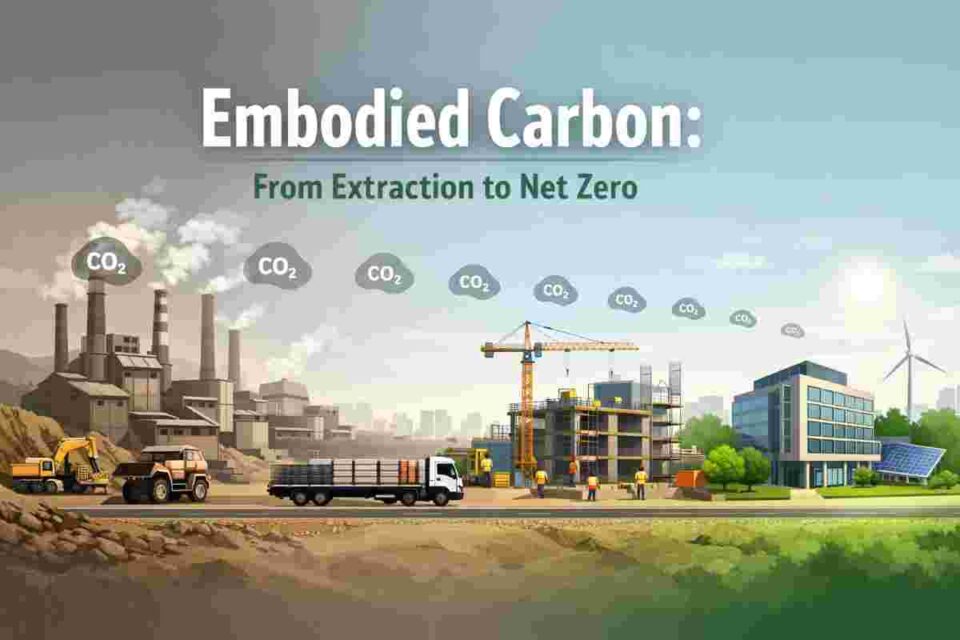
Embodied carbon in construction refers to all the greenhouse gas (GHG) emissions — primarily CO₂ — that are generated throughout the entire lifecycle of a building material, excluding the energy used to operate the building once it is occupied. It covers every stage from raw material extraction and manufacturing to transportation, on-site installation, maintenance and repair, and final demolition or disposal.
In technical terms, embodied carbon is measured in kilograms of CO₂ equivalent (kgCO₂e) and is captured through a process called Life Cycle Assessment (LCA). It is divided into lifecycle stages according to international standards such as EN 15978 and ISO 21931:
- A1–A3 (Product stage): Raw material extraction, transport to manufacturer, manufacturing process — often called “upfront carbon.”
- A4–A5 (Construction process stage): Transport to site, installation, and construction activities.
- B1–B7 (Use stage): Maintenance, repair, replacement, and operational energy use.
- C1–C4 (End-of-life stage): Deconstruction, transport, waste processing, and disposal.
- D (Beyond boundary): Reuse, recovery, and recycling potential.
The A1–A3 “upfront” phase is where the majority of embodied carbon is concentrated — and where the greatest potential for reduction lies. That is why leading sustainability frameworks and global regulations are increasingly focused on cutting emissions at the design and procurement stage, before a single brick is laid.
To understand this in the wider context of sustainable building, read our complete guide to green building and green construction, which covers the broader principles underpinning low-carbon building design.
Embodied Carbon vs. Operational Carbon: Key Differences
One of the most common points of confusion in sustainable construction is the difference between embodied carbon and operational carbon. Understanding this distinction is foundational to any decarbonisation strategy.
| Factor | Embodied Carbon | Operational Carbon |
|---|---|---|
| Definition | Emissions from materials and construction processes | Emissions from energy use in the occupied building |
| When it occurs | Before and during construction (and at end of life) | During the building’s operational life (years to decades) |
| Primary sources | Cement, steel, aluminium, glass, insulation | Heating, cooling, lighting, appliances |
| Can it be undone? | No — it is “locked in” once built | Yes — can be reduced over time via retrofits, renewable energy |
| Proportion of building lifecycle emissions | ~28–49% (higher in low-energy buildings) | ~51–72% (higher in older, energy-inefficient buildings) |
| Industry focus (historically) | Under-addressed | Well-addressed via energy efficiency standards |
As buildings become more energy-efficient through better insulation, heat pumps, and renewable energy — operational carbon is falling. This means embodied carbon is now proportionally the bigger problem. For a Passivhaus or net-zero-energy building, embodied carbon can represent up to 80–90% of its entire lifecycle emissions.
This shift in balance is exactly why the global construction industry must pivot its focus. The carbon battle is now being fought in the materials specification sheet, not the energy meter — which brings us to why 2026 is such a pivotal year.
Why Embodied Carbon Matters More Than Ever in 2026
Several powerful forces are converging in 2026 to push embodied carbon to the very top of the global construction agenda. Here is what is driving the urgency:
The 1.5°C Climate Deadline
The UN’s Intergovernmental Panel on Climate Change (IPCC) has made clear that to limit global warming to 1.5°C, global emissions must halve by 2030. With buildings responsible for 34% of global energy-related CO₂ emissions (per the UNEP Global Status Report for Buildings and Construction 2024/2025), the sector cannot sit on the sidelines.
The Green Building Materials Market Explosion
The global sustainable construction materials market was valued at USD 484 billion in 2025 and is projected to reach USD 2.16 trillion by 2037. This is not a niche trend — it is a structural shift in how the world builds. Contractors, manufacturers, and investors who ignore it will be left behind.
Policy and Procurement Pressure
From the EU’s Level(s) framework and the UK’s mandatory whole life carbon assessments to the US Infrastructure Bill’s Buy Clean provisions, governments are writing carbon limits into law and procurement requirements. Builders who cannot demonstrate low-carbon credentials will increasingly lose bids.
The Net Zero 2030 Target for Buildings
The IEA’s Breakthrough Agenda Report 2025 calls for all new and retrofitted buildings to be zero-carbon-ready by 2030. That is less than four years away. The window for inaction has closed.
The Rise of Embodied Carbon as a Career Differentiator
Sustainability consultants, LCA specialists, and net zero project managers are among the fastest-growing roles in global construction. If you are mapping your career, understanding embodied carbon is no longer optional — it is a competitive advantage. We explore this fully in Section 9.
Explore how the broader digital transformation of the industry intersects with sustainability in our look at modern construction technologies that make building faster and greener.
The 5 Biggest Sources of Embodied Carbon in Buildings
Reducing embodied carbon starts with knowing where it comes from. The following five materials and processes are responsible for the overwhelming majority of upfront carbon in most building projects:
1. Cement and Concrete (~8% of Global CO₂)
Concrete is the most widely used construction material on Earth, and cement production alone accounts for approximately 7–8% of all global CO₂ emissions. The culprit is the “calcination” process — burning limestone to produce clinker — which releases CO₂ as an inherent chemical reaction, regardless of the fuel used. Every tonne of traditional Portland cement produced releases roughly 820–900 kg of CO₂.
2. Steel (~8% of Global CO₂)
Steel is the second-largest contributor. Conventional blast furnace steelmaking uses coking coal as both a fuel and a reducing agent, making it extraordinarily carbon-intensive. The structural steel for a single commercial high-rise can carry a carbon footprint of thousands of tonnes of CO₂e. Low-carbon “green steel” produced using hydrogen direct reduction (H-DRI) is emerging as a solution, but at scale, it is still in its early stages.
3. Aluminium
Aluminium requires enormous amounts of electricity for smelting via the Hall-Héroult process. Unless powered by renewable energy, the carbon footprint of primary aluminium is very high. However, recycled aluminium uses up to 95% less energy than primary production — making specification choices critical.
4. Glass and Insulation
While relatively lower in volume, glass manufacturing is energy-intensive. Similarly, some common insulation materials (notably EPS, XPS, and spray polyurethane foam) carry significant embodied carbon from both their fossil-fuel-based feedstock and the blowing agents used in production. Bio-based alternatives like sheep’s wool and hemp are increasingly competitive.
5. Transport and On-Site Construction Activities
The A4–A5 construction stage — hauling materials to site and operating plant and machinery — contributes a meaningful share of project-level embodied carbon. Long supply chains, diesel-powered cranes, excavators, and concrete pumps all add up. Modular and prefabricated construction, which moves more work into factory settings, can dramatically reduce on-site emissions. Explore how this links to career opportunities in our guide to modular construction jobs: the fastest-growing career in 2025-26.
What Is a Whole Life Carbon Assessment?
A Whole Life Carbon (WLC) Assessment is a comprehensive evaluation of all carbon emissions associated with a building across its entire lifecycle — from design and construction through decades of operation to eventual demolition and disposal. It combines both embodied carbon (A1–A5, B1–B7, C1–C4) and operational carbon (B6 energy use) into a single, holistic picture.
Why does this matter? Because optimising for just one type of carbon can inadvertently worsen the other. For example, adding extra insulation reduces operational energy but increases embodied carbon from the insulation material. A WLC approach ensures decisions are based on total lifecycle impact, not just one variable.
Key Steps in a Whole Life Carbon Assessment
- Define the scope: Agree which lifecycle stages (A1–D) will be included, based on client requirements or regulatory frameworks.
- Gather material quantities: Use BIM models or traditional quantity surveying to compile a bill of materials.
- Apply carbon factors: Use Environmental Product Declarations (EPDs) or generic database factors for each material to calculate kgCO₂e per unit.
- Model operational energy: Calculate B6 (energy use in operation) using dynamic energy simulation or benchmarks.
- Aggregate and analyse: Sum all stages to get a total WLC figure, then identify hotspots for reduction.
- Benchmark and report: Compare against targets (e.g., LETI, RIBA 2030 Climate Challenge benchmarks) and report to the client or authority.
Understanding BIM’s role in this process is crucial — and our comprehensive guide to BIM as a great construction career explains how Building Information Modelling has become the engine of carbon-conscious design. Meanwhile, the latest generation of AI-powered tools is automating much of this work, as explored in our article on AI-to-BIM: the future of automated construction modeling.
Low-Carbon Building Materials Transforming Global Construction
The good news: the materials science and construction technology communities are rising to the embodied carbon challenge with impressive speed. Here are the most impactful low-carbon alternatives now available to construction teams globally.
1. Supplementary Cementitious Materials (SCMs) — Low-Carbon Concrete
Green concrete replaces a portion of Portland cement clinker with supplementary cementitious materials (SCMs) such as fly ash, ground granulated blast-furnace slag (GGBS), silica fume, and calcined clay. These by-products of industrial processes carry significantly lower embodied carbon. A mix using 50% GGBS replacement can reduce the embodied carbon of the concrete by 40–60% with no compromise in structural performance.
See how these innovations feature in our overview of top 25 eco-friendly technologies in construction for 2025.
2. Mass Timber — Cross-Laminated Timber (CLT) and Glulam
Mass timber is having a renaissance. Cross-Laminated Timber (CLT) and glulam beams are being used in multi-storey structures once only possible with steel and concrete. The carbon story is compelling: timber is a carbon sink — trees absorb CO₂ as they grow, and that carbon is stored in the wood even after it is harvested. Well-managed timber can deliver a net negative embodied carbon when assessed over its full lifecycle, with biogenic carbon sequestration accounted for.
3. Geopolymer Cement
Geopolymer cement uses industrial by-products — typically fly ash or slag — activated with alkaline solutions to create a binder that can replace Portland cement entirely. It produces up to 80% less CO₂ than conventional cement and offers excellent durability and fire resistance. Scale-up is still in progress, but numerous commercial projects globally have already used it successfully.
4. Green Steel (Hydrogen Direct Reduction)
Traditional blast furnace steel is being challenged by hydrogen direct reduction (H-DRI) steel, where green hydrogen replaces coking coal as the reducing agent. The resulting “green steel” carries a fraction of the carbon footprint of its conventional counterpart. Swedish steelmaker SSAB delivered the world’s first fossil-free steel as early as 2021, and global green steel capacity is scaling rapidly.
5. Bio-Based and Recycled Materials
Hempcrete, straw bale, mycelium composites, and recycled aggregate concrete are gaining traction in low-carbon construction. These materials often carry negative embodied carbon when biogenic carbon sequestration is counted. For a deep dive into the full landscape, see our comprehensive complete green building materials list for 2025 and our guide to the top 7 green building materials for sustainable construction.
6. Carbon-Absorbing Concrete
In a remarkable development, researchers have created a novel enzymatic structural material (ESM) — a construction material produced through a bioinspired, low-energy process that uses an enzyme to convert atmospheric CO₂ directly into solid mineral particles. If scaled, this could turn concrete from carbon emitter to carbon absorber.
These innovations are covered in broader context in our article on 12 innovations in green construction technology happening today.
How to Measure Embodied Carbon: Top LCA Tools for Construction Professionals
Knowing that you need to reduce embodied carbon and knowing how much carbon you are dealing with are two different things. Accurate measurement requires Life Cycle Assessment (LCA) software and access to Environmental Product Declarations (EPDs) — verified, third-party-assessed carbon data sheets for building materials.
Here are the industry-leading tools you need to know:
1. One Click LCA
One Click LCA is the world’s most widely used embodied carbon software, with users in over 170 countries. It integrates directly with BIM tools (Revit, ArchiCAD, IFC), offers over 500,000 verified EPD data points, and supports compliance with LEED, BREEAM, DGNB, and other certification frameworks. It also offers a free concrete carbon tool for teams just starting out.
2. EC3 (Embodied Carbon in Construction Calculator)
Developed by Building Transparency, EC3 is a free, open-access database and comparison tool for building material EPDs. It allows designers and specifiers to compare the carbon footprint of different products side by side — making low-carbon procurement decisions fast and evidence-based. EC3 and One Click LCA are integrated, giving teams the best of both platforms.
3. Tally (Autodesk/KT Innovations)
Tally is a Revit plugin that performs whole-building LCA directly within the BIM environment, pulling from the GaBi and ecoinvent databases. It is particularly popular among architects and structural engineers working in the US and Europe who want carbon assessments embedded in their design workflow.
4. RICS Whole Life Carbon Assessment Tool
The Royal Institution of Chartered Surveyors (RICS) has developed a standardised whole life carbon assessment methodology aligned with its Professional Statement (2nd edition). The associated toolkits are widely used in the UK and internationally for benchmarking and reporting.
Proficiency in these tools is rapidly becoming a core competency expected by top-tier construction employers. Pair this with the skills outlined in our guide on essential BIM skills and career insights for 2025, and you have a powerful and future-proof skillset.
Global Embodied Carbon Regulations in 2026
Regulatory pressure is the most powerful accelerant of change in any industry. Here is how the legislative landscape for embodied carbon looks across the world’s major construction markets in 2026:
United Kingdom
The UK is a global leader in embodied carbon policy. The RICS Whole Life Carbon Assessment Professional Statement (2nd Ed., 2023) mandates standardised reporting for most new buildings. The London Plan requires whole life-cycle carbon assessments for major developments. The government’s Future Homes Standard roadmap includes tightening embodied carbon limits through to 2030.
European Union
The EU’s Level(s) framework — a voluntary but increasingly referenced set of sustainability metrics for buildings — includes whole life carbon as a core indicator. The EU Taxonomy for Sustainable Finance also requires buildings to demonstrate low embodied carbon to qualify as sustainable investments. Meanwhile, the Construction Products Regulation (CPR) revision is expected to require EPDs for key building products across all 27 member states.
United States
The Buy Clean provisions of the Inflation Reduction Act (IRA) and the Infrastructure Investment and Jobs Act are driving low-carbon material procurement for federally funded projects. States including California, Colorado, and New York have enacted or are developing Buy Clean legislation at state level, requiring maximum embodied carbon limits for steel, glass, concrete, and other materials.
Singapore
Singapore’s Green Building Masterplan targets 80% of buildings to be green-certified by 2030. The Building and Construction Authority (BCA) now includes embodied carbon in its Green Mark certification criteria, and the country has been a pioneer in requiring Environmental Product Declarations for major structural materials.
Australia
The Australian Green Infrastructure Council (AGIC) and Infrastructure Australia are actively developing embodied carbon reporting frameworks for infrastructure projects. Several state governments have already adopted voluntary carbon reporting requirements for large public buildings, with mandatory thresholds expected before 2028.
India
India is a growing market for green buildings, with the Green Rating for Integrated Habitat Assessment (GRIHA) and LEED India certifications increasing rapidly. Embodied carbon is still largely voluntary in India but is increasingly demanded by multinational developers and institutional investors. Read more about green building certification in India: LEED, GRIHA & career opportunities in 2026.
For professionals working across markets, LEED certification is still the most globally recognised credential. Our guide to understanding LEED certification levels is an essential read.
Career Opportunities in Embodied Carbon & Net Zero Construction
The global shift to low-carbon construction is not just transforming how buildings are built — it is reshaping the jobs market. Specialist digital roles such as VDC/BIM Management and Net Zero Carbon Consultancy currently offer the highest salary premiums in the industry, particularly on multinational projects. If you are planning your next career move, embodied carbon expertise should be front and centre.
1. Embodied Carbon Consultant / Low Carbon Design Specialist
These professionals lead whole life carbon assessments, advise on material specifications, and deliver carbon reporting for planning submissions. Typically employed by engineering consultancies, architectural practices, or specialist sustainability firms. Salary range: £45,000–£85,000 (UK) / $70,000–$130,000 (US).
2. Sustainability Manager (Construction)
Sustainability Managers oversee the environmental performance of construction projects from procurement through handover. They manage BREEAM/LEED/WELL certifications, track carbon data, and report to clients and regulators. See our full overview of top 7 promising sustainability careers in the construction industry.
3. LCA (Life Cycle Assessment) Specialist
LCA Specialists are technical experts proficient in tools like One Click LCA, Tally, and SimaPro. They conduct detailed material-level carbon assessments and help procurement teams select the lowest-carbon compliant products. Demand for this role is surging as government Buy Clean policies require evidence-based EPD analysis.
4. BIM Sustainability Coordinator
The convergence of BIM and carbon accounting is creating a new hybrid role: the BIM Sustainability Coordinator, who integrates carbon data directly into 3D building models using 6D BIM workflows. For BIM salary data, explore our detailed breakdown of BIM job roles and their latest salary trends.
5. Net Zero Carbon Project Manager
Senior construction project managers with net zero expertise are in fierce demand from developers, government agencies, and infrastructure owners. They set carbon budgets, manage supply chain decarbonisation, and ensure project delivery meets regulatory carbon standards. Our guide on zero-waste construction careers explores the broader landscape of circular economy roles.
6. Green Infrastructure Specialist
From urban greening and natural capital accounting to biodiversity net gain and carbon offsetting, Green Infrastructure Specialists are shaping the built environment of the future. Explore green infrastructure specialist roles in 2025 for a comprehensive career breakdown.
💼 Ready to start your green construction career?
Visit ConstructionCareerHub.com — a dedicated platform connecting construction professionals with the best green building, net zero, BIM, and sustainability roles globally. Whether you are a fresh graduate looking for your first sustainability role or a senior professional seeking your next leadership opportunity, ConstructionCareerHub is your gateway to the future of construction careers.
Also explore our broader roundups: What are green jobs? A guide to green careers for 2026 and the top 30 green jobs for 2026 and beyond. If you are starting, do not miss our comprehensive guide to kickstarting your green construction career.
Want to know which skills are commanding the highest salaries in 2026? Read our data-backed guide on 15 skills that construction companies want in 2026.
Top Courses to Learn Embodied Carbon and Sustainable Construction
Whether you are looking to build foundational knowledge or pursue a professional certification, the following courses are among the best available globally for construction professionals wanting to upskill in embodied carbon and sustainable construction.
1. Sustainable Construction in a Circular Economy — Coursera
Offered by Parsons School of Design, The New School, this course covers circularity, embodied carbon reduction strategies, and sustainable material systems. It is a highly practical programme ideal for architects, engineers, and project managers.
👉 Enrol on Coursera
2. Sustainable Construction: Building a Greener Future — Udemy
This practical Udemy course covers the principles, strategies, and international standards of eco-friendly design and construction decarbonisation. It is particularly accessible for construction professionals who want a self-paced introduction to the field.
👉 Enrol on Udemy
3. Buildings as Sustainable Energy Systems Professional Certificate — edX (DelftX)
This professional certificate from Delft University of Technology on edX covers energy-efficient building design, whole life carbon assessment, and zero-energy building technology. It is one of the most rigorous academic programmes available online for built environment professionals.
👉 Enrol on edX
4. Sustainable Engineering Design Professional Certificate — edX (DelftX)
Another high-quality DelftX programme on edX, this certificate teaches circular economy principles for design engineers — directly applicable to the low-carbon materials selection and whole life carbon optimisation workflows described in this guide.
👉 Enrol on edX
For a wider selection of construction learning resources, browse our curated list of the top 15 online construction courses in 2026 for career growth and our comprehensive roundup of the best online construction courses.
Free eBooks & Resources for Construction Professionals
Alongside formal courses, these practical eBooks and resources are invaluable companions for construction professionals preparing for roles in sustainable construction, net zero delivery, and green building careers.
Career Preparation eBooks from DigitSlick
The team at DigitSlick has produced some of the most practical interview preparation and career resources available for civil engineering and construction professionals:
- Comprehensive Civil Engineering Job Interview Guide — 300 Q&A PDF eBook
This in-depth guide covers geotechnical engineering, structural engineering, transportation, environmental engineering, and construction management. If you are targeting a sustainability or net zero role, the construction management and environmental engineering sections are directly relevant. - Civil Engineering Interview Questions and Answers PDF eBook
A focused set of 102 researched technical questions covering all major areas of civil engineering. Ideal for graduates and early-career professionals entering the green construction sector.
Authoritative Free Reports
- World Green Building Council — Embodied Carbon Resources Hub — The definitive free resource library from the WGBC, including their landmark “Bringing Embodied Carbon Upfront” report and ongoing policy guidance.
- UNEP Global Status Report for Buildings and Construction 2024/2025 — Comprehensive data on global building sector emissions, progress, and policy recommendations.
- Carbon Leadership Forum — Tools for Measuring Embodied Carbon — An excellent open-access guide to the full suite of LCA tools, EPD databases, and benchmarking resources used by industry leaders.
Frequently Asked Questions About Embodied Carbon in Construction
What is embodied carbon in construction?
Embodied carbon in construction refers to the greenhouse gas emissions generated throughout the lifecycle of building materials — including raw material extraction, manufacturing, transportation, installation, maintenance, and end-of-life disposal — but not including the energy used to operate the building itself.
What is the difference between embodied carbon and operational carbon?
Embodied carbon covers emissions from building materials and the construction process. Operational carbon covers emissions from the energy used to heat, cool, light, and power a building during its occupied life. As buildings become more energy-efficient, embodied carbon is proportionally increasing in importance — in highly efficient buildings, it can represent over 80% of total lifecycle emissions.
How can construction teams reduce embodied carbon?
Key strategies include: using low-carbon materials (green concrete with SCMs, mass timber, recycled/green steel); optimising structural design to minimise material quantities; selecting locally sourced materials to cut transport emissions; specifying products with verified EPDs; and adopting modular/prefabricated construction. Early engagement in design is critical — over 80% of a building’s embodied carbon is determined in the first 20% of the design process.
What is a whole life carbon assessment?
A Whole Life Carbon Assessment evaluates all GHG emissions associated with a building across its entire lifecycle — including embodied carbon (stages A1–C4) and operational carbon (stage B6). It gives teams a complete picture to make genuinely low-carbon decisions rather than simply shifting carbon from one stage to another.
What tools are used to measure embodied carbon?
The most widely used tools are One Click LCA (170+ countries), EC3 by Building Transparency (free and open access), Tally (Revit plugin), and the RICS Whole Life Carbon Assessment toolkit.
Is embodied carbon regulated globally?
Yes, and regulation is accelerating. The UK requires WLC assessments for major developments; the EU’s Level(s) framework and CPR revision mandate EPD adoption; the US Buy Clean provisions cover federal procurement; Singapore’s Green Mark scheme includes embodied carbon criteria; and Australia is developing mandatory frameworks before 2028.
What careers are available in embodied carbon and net zero construction?
Growing roles include Embodied Carbon Consultant, LCA Specialist, Sustainability Manager, BIM Sustainability Coordinator, Net Zero Carbon Project Manager, and Green Infrastructure Specialist. These roles offer some of the highest salary premiums in global construction. Start your search at ConstructionCareerHub.com.
Conclusion: Embodied Carbon Is the Defining Challenge — and Opportunity — of 2026
The construction industry is responsible for over a third of global CO₂ emissions. And as operational energy efficiency improves, embodied carbon is rapidly becoming the dominant battleground in the net zero fight. The materials we specify, the tools we use to measure carbon, the supply chains we build, and the skills we develop — all of these are being reshaped by the embodied carbon agenda.
The professionals who get ahead of this curve will not just be doing the right thing for the planet. They will be the most in-demand, best-paid, and most future-proof people in the industry. From mastering LCA tools and low-carbon material specifications to understanding global regulations and landing roles at the frontier of sustainable construction, the pathway is clear.
Your next steps:
- Explore green building techniques and sustainable building materials and techniques to deepen your technical knowledge.
- Understand how AI and digital tools are transforming the field in our guide on how civil engineers can thrive in the age of AI and AGI.
- Browse the latest green construction and net zero roles at ConstructionCareerHub.com.
- Download your interview preparation resources from DigitSlick’s 300 Q&A Civil Engineering Interview Guide.
- Net-Zero Construction Roadmap 2026 – Standards, Tools & Practical Steps
- The Rise of Zero Energy Buildings in Modern Construction
- What are the Latest “Green” Construction Projects?
The future of construction is low-carbon. And the professionals who lead that future will be the ones who start learning today.
📬 Stay Ahead of the Green Construction Curve
Get the latest insights on sustainable construction, embodied carbon regulations, and green building careers delivered straight to your inbox.
👉 Explore more at ConstructionPlacements.com | Find your next role at ConstructionCareerHub.com
Last updated: March 2026. All salary figures, market data, and regulatory information are sourced from current industry reports and are intended as general guidance. Salary ranges vary by location, experience, and organisation. Always verify regulatory requirements with the relevant authority in your jurisdiction.
