
Last Updated on December 17, 2025 by Admin
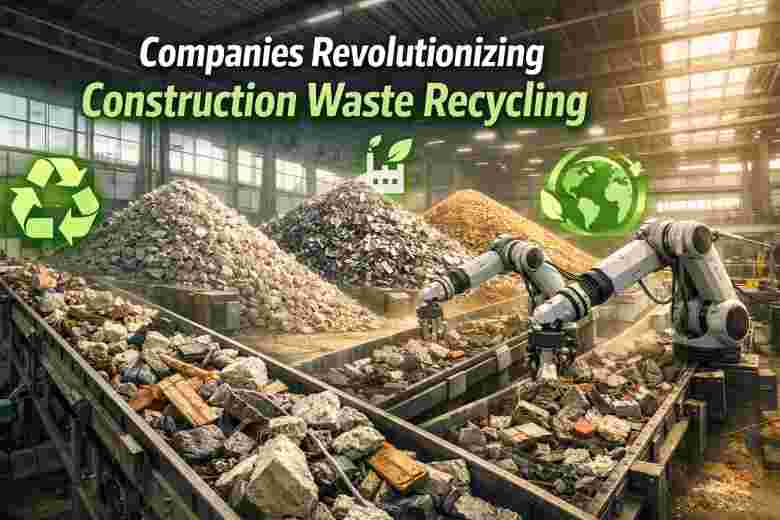
The United States generates over 600 million tons of construction and demolition debris every year—more than twice its municipal solid waste. While this presents a serious environmental challenge, it’s also driving remarkable innovation. Leading construction waste recycling companies are now transforming demolition rubble into valuable resources using AI-powered sorting, patented concrete recycling technology, and circular economy solutions. In this guide, we spotlight 10 companies revolutionizing how the industry handles waste—and creating new career opportunities in the process.
ConstructionCareerHub App is LIVE — built ONLY for construction careers. Don’t apply with a weak resume.
Get ATS-ready Resume Lab + Interview Copilot + Campus Placement Prep (resume screening, skill gaps, interview readiness) — in minutes & Other advanced features.
Explore Smarter Construction Career Tools →Quick check. Big impact. Start now.
Table of Contents
The Construction Waste Crisis and the Companies Solving It
The construction industry faces an environmental reckoning. According to the U.S. Environmental Protection Agency, America generates over 600 million tons of construction and demolition debris annually—more than twice the nation’s municipal solid waste. Globally, the built environment produces over 2 billion tonnes of waste each year, accounting for 30-40% of total solid waste worldwide.
But here’s the opportunity: this crisis has sparked a wave of innovation. Forward-thinking companies are transforming demolition rubble into valuable construction materials, deploying AI-powered sorting systems, and pioneering circular economy solutions that could reshape how we build. For construction professionals exploring sustainable construction careers, understanding these industry leaders is essential.
The global construction and demolition waste management market reached $209 billion in 2024 and is projected to grow to $308 billion by 2030. This growth is creating unprecedented opportunities for companies that can turn waste streams into revenue streams—and for professionals who understand this transformation.
Why Construction Waste Recycling Is Critical
Environmental Impact
The environmental stakes couldn’t be higher. The UN Environment Programme’s Global Status Report for Buildings and Construction 2024-2025 reveals that the construction sector contributes 34% of global energy-related CO₂ emissions and consumes 60% of raw materials worldwide. With global natural aggregate demand projected to exceed 50 billion tons by 2025, virgin material extraction is becoming unsustainable.
Construction waste that ends up in landfills doesn’t just occupy space—it represents embodied energy and resources that could be recovered. Understanding construction and demolition waste management fundamentals is increasingly critical for every construction professional.
Cost Savings and Regulatory Compliance
The business case for construction waste recycling has never been stronger. Landfill tipping fees continue to rise, while recycled materials often cost less than virgin alternatives. The Texas Department of Transportation documented $12.6 million in savings through recycled concrete aggregate use alone.
Regulatory pressure is intensifying. California’s CalGreen Building Standards mandate 65% minimum recycling for non-hazardous C&D debris and 100% recycling for excavated soil. Los Angeles County increased requirements in 2024 from 50% to 70% recycling with third-party certification. San Francisco prohibits any C&D debris from landfill or incinerator. Currently, 38 states use recycled concrete aggregate per Federal Highway Administration data.
ESG Requirements and Green Certifications
ESG disclosure requirements from the SEC and EU regulations are driving construction companies to track and report waste diversion metrics. LEED certification requirements award points for construction waste management—1 point for 50% diversion and 2 points for 75% diversion across multiple material streams. Companies seeking a competitive advantage increasingly prioritize waste recycling as part of their sustainability strategy.
Job Creation and Career Opportunities
The International Labour Organisation projects that the circular economy transition will create 29 million new jobs globally. For professionals interested in green construction careers, the waste recycling sector offers compelling opportunities with salaries ranging from $65,000 for entry-level positions to over $160,000 for senior sustainability directors.
10 Companies Revolutionizing Construction Waste Recycling
1. Waste Management Inc. — North America’s Recycling Giant
Company Overview: Founded in 1968 and headquartered in Houston, Texas, Waste Management (WM) is North America’s largest integrated waste management company with approximately 61,700 employees and trailing 12-month revenue of $24.8 billion.
What Makes Them Innovative: WM operates the continent’s most extensive recycling infrastructure: 337 transfer stations, 254 landfill sites, and 97 recycling plants across all 50 states, Canada, and Puerto Rico. Their ISO 9001 and 14001 certified sustainability services include the proprietary DART (Diversion And Recycling Tracking) web-based system and AI-enabled trucks with cameras for obstacle detection and recycling compliance.
Key Technologies: AI-powered sorting systems, advanced material recovery facilities, and the largest landfill gas-to-energy platform in North America generating 56+ million MMBtus of renewable energy annually.
Geographic Presence: All 50 U.S. states, Canada, and Puerto Rico.
Real-World Impact: In 2024, WM recovered more than 15 million tons of material and added 875,000 tons of recycling capacity. The company has invested $3 billion in sustainability growth projects between 2022-2026 and targets increasing material recovery to 25 million tons annually by 2030.
2. Republic Services — Polymer Circularity Pioneer
Company Overview: Headquartered in Phoenix, Arizona, Republic Services employs over 40,000 people and generates approximately $16.4 billion in annual revenue, making it the second-largest U.S. integrated solid waste provider.
What Makes Them Innovative: Republic’s Polymer Center network represents the nation’s first integrated plastics recycling facilities. Their Newby Island Resource Recovery Park in San Jose is the world’s largest material recovery facility, achieving 80%+ material recovery rates at 110 tons per hour.
Key Technologies: Advanced optical sorting, polymer processing technology, and 71 recycling centers processing 5 million tons annually.
Geographic Presence: Operates 208 active landfills and 248 transfer stations serving 13+ million customers across the United States.
Real-World Impact: Republic was the first waste company to have emissions targets approved by the Science Based Targets initiative (SBTi). The Las Vegas Polymer Center won the NWRA 2023 Sustainability Game Changer Award.
3. Veolia — Global Environmental Services Leader
Company Overview: Founded in 1853 and now headquartered in Paris (with North American headquarters in Boston), Veolia is the world’s largest waste management company with 215,000 employees operating in 56 countries. The company reported €44.7 billion in global revenue for 2024.
What Makes Them Innovative: Veolia operates a Quebec City facility unique in North America for processing difficult-to-recycle C&D streams. Their Hubgrade AI-powered management platform uses machine learning and augmented reality for waste optimization.
Key Technologies: Industrial dismantling services for aircraft, ships, and oil platforms; AI-powered sorting and management systems; advanced material recovery processes.
Geographic Presence: 56 countries globally with significant North American operations generating $5.4 billion in revenue.
Real-World Impact: In 2024, Veolia treated 65 million tonnes of waste globally. Their GreenUp strategic program (2024-2027) targets decarbonizing 18 million tons of CO₂ and depolluting 10 million tons of hazardous waste by 2027.
4. Rubicon Technologies — The Digital Disruptor
Company Overview: Founded in 2008, Rubicon operates as a technology platform rather than traditional hauler—essentially ‘Uber for waste management.’ Now headquartered in Atlanta with approximately 340 employees, Rubicon’s cloud-based RUBICONConnect platform connects waste generators with 8,000+ vendor and hauler partners serving 2.6+ million service locations worldwide.
What Makes Them Innovative: Rubicon’s most groundbreaking C&D solution is their mycoremediation program—a pioneering partnership using fungi to break down asphalt shingles into reusable byproducts. A 2023 pilot diverted shingles from 214 homes that would have gone to landfill.
Key Technologies: Cloud-based waste management platform, mobile concrete crushers for on-site processing, and biological recycling through mycoremediation.
Geographic Presence: Headquartered in Atlanta, serving clients across North America through their network of partners.
Real-World Impact: Rubicon is a Certified B Corporation and has attracted investment from Goldman Sachs and prominent investors. In 2022 alone, the company diverted 141,745 tons of material from landfills with just one major supermarket chain client.
5. Heidelberg Materials — Patented Concrete Recycling Technology
Company Overview: Founded in 1873 and headquartered in Heidelberg, Germany (U.S. headquarters in Irving, Texas), Heidelberg Materials employs approximately 51,000 people globally and reported €21.2 billion in 2024 revenue. The company rebranded from HeidelbergCement in 2022 to reflect its broader sustainability mission.
What Makes Them Innovative: Heidelberg’s revolutionary contribution is the patented ReConcrete process, which breaks down demolition concrete into its original constituents—recovering sand and gravel meeting virgin-quality standards, plus Recycled Concrete Paste (RCP) that can replace limestone in clinker production and serve as a carbon sink.
Key Technologies: ReConcrete patented recycling process, selective separation of demolition concrete, and carbon capture integration. Their technology enables the production of recycled building materials that meet virgin-quality specifications.
Geographic Presence: Global operations with significant U.S. expansion through acquisitions including Highway Materials (Philadelphia), Aaron Materials (Texas), and Giant Cement Holding ($600 million, 2025).
Real-World Impact: In July 2024, the company inaugurated the first-of-its-kind recycling plant in Katowice, Poland, capable of processing 100 tonnes per hour. Heidelberg targets offering circular alternatives for 50% of concrete products by 2030.
6. CDE Global — Wet Processing World Leader
Company Overview: Founded in 1992 in Northern Ireland by Tony Convery, CDE Global is the world leader in wet processing technology for C&D waste recycling. The family-owned company employs 500-565 people globally, including 120+ engineers, with U.S. headquarters in Cleburne, Texas established in 2018.
What Makes Them Innovative: CDE’s proprietary systems—including the M-Series Modular Wash Plants, EvoWash Sand Wash System, and AggMax Logwasher—remove contaminants from C&D waste to produce certified, sellable sand and aggregates meeting virgin-quality specifications.
Key Technologies: Wet processing wash plants, hydrocyclone separation, and integrated water treatment systems that enable closed-loop water recycling.
Geographic Presence: 2,000+ wet processing projects in 100+ countries, with growing U.S. presence including installations in Long Island (150tph) and Maryland (250tph).
Real-World Impact: CDE technology diverts over 30 million tonnes of C&D waste from landfills annually. The company has won the Deloitte Best Managed Companies Award for 16 consecutive years (2008-2024)—only four companies globally have achieved this distinction.
7. Clean Earth — Contaminated Materials Specialist
Company Overview: Founded in 1990 and headquartered in King of Prussia, Pennsylvania, Clean Earth (now part of Enviri Corporation) employs 1,001-5,000 workers across approximately 90 facilities nationwide, generating approximately $750 million in annual revenue.
What Makes Them Innovative: Clean Earth specializes in the most challenging C&D waste streams: contaminated soils, historic fill, and hazardous materials from construction sites. Their expertise in treating difficult materials fills a critical gap in the recycling ecosystem.
Key Technologies: PFAS treatment technology (operating one of the first large-scale plants since 2019), foam fractionation for emerging contaminants, and the Fullcircle™ Program for beneficial reuse alternatives.
Geographic Presence: The largest TSDF (Treatment, Storage, Disposal Facility) network in the United States with approximately 90 facilities.
Real-World Impact: Clean Earth’s Hagerstown, Maryland facility crushes and screens rubble to produce aggregate, then mixes with treated soil and binding agents to create pavement sub-base and structural fill. Over 30 years of experience serving the construction industry.
8. Renewi — European Circular Economy Champion
Company Overview: Founded in 1880 and rebranded as Renewi in 2017, this European leader employs approximately 8,000+ people and processes 10+ million tonnes of waste annually at 150 sites across the Netherlands, Belgium, France, and Portugal. In June 2025, Renewi was acquired in a take-private deal valued at £707 million ($957 million).
What Makes Them Innovative: Renewi produces certified concrete granulate and sand from demolition rubble for high-value reuse—not just foundation material. In November 2025, the company partnered with Holcim to produce Basalton concrete columns with sand 100% derived from crushed concrete.
Key Technologies: Infrared recognition sorting achieving 95% purity for PP and PE plastics, advanced aggregate processing, and integrated waste-to-product systems that align with circular economy principles in construction.
Geographic Presence: Netherlands, Belgium, France, and Portugal with 150 operational sites.
Real-World Impact: Renewi achieves a 63.2% overall recycling rate with a target of 75% by 2030, reintroducing 6.6 million tonnes of circular materials annually and preventing 2.5 million tonnes of CO₂ emissions.
9. Van Dyk Recycling Solutions — AI-Powered Sorting Systems
Company Overview: Founded in the late 1980s and headquartered in Norwalk, Connecticut, Van Dyk Recycling Solutions is the leading designer and integrator of recycling systems in North America with 2,400+ installations operating and 340+ Material Recovery Facility (MRF) projects completed.
What Makes Them Innovative: Van Dyk integrates best-in-class technologies including TOMRA sensor-based optical sorting, Bollegraaf screening systems, and Lubo waterbath separators to create turnkey C&D recycling facilities with minimal manual sorting requirements.
Key Technologies: Optical sorting, screening systems, density separation, and automation systems achieving 30-100 tonnes per hour throughput. These represent some of the most advanced eco-friendly technologies in construction waste processing.
Geographic Presence: Primarily North America with installations for major waste companies including WM facilities in Washington, Ohio, Wisconsin, Pennsylvania, and Arizona.
Real-World Impact: The Western Placer Waste Management Authority facility processes 120,000+ lbs/hour with a 65% recovery rate. Van Dyk’s focus on automation reduces labor costs and improves safety while achieving the industry’s lowest processing cost per ton.
10. AMP Robotics — AI Sorting Innovation Leader
Company Overview: AMP Robotics has emerged as the technology pioneer transforming recycling facility efficiency through artificial intelligence. The company has deployed over 300 robotic sorting systems in North America, Europe, and Asia.
What Makes Them Innovative: AMP’s Cortex AI platform has logged over 10 billion item detections globally by mid-2024. Their deep learning systems use spectral imaging, near-infrared spectroscopy, 3D imaging, and computer vision to identify and separate materials—capabilities increasingly adapted for C&D waste streams.
Key Technologies: Computer vision, deep learning algorithms, robotic sorting arms, and multi-sensor fusion combining thermal imaging with NIR spectroscopy.
Geographic Presence: North America, Europe, and Asia with rapidly expanding deployment.
Real-World Impact: AMP systems achieve recovery rates exceeding 90% for specific materials. According to the Environmental Research & Education Foundation, U.S. facilities using AI sorting have boosted efficiency by up to 50%. The waste sorting robotics market reached $2.75 billion in 2024 and is projected to reach $16.90 billion by 2033.
Trends Driving Construction Waste Recycling
AI, Automation, and Smart Sorting
Artificial intelligence is revolutionizing C&D waste recycling. Companies like ZenRobotics report 40% increases in throughput and 28% reductions in contamination through AI-powered sorting. Fourth-generation waste sorting robots launched in 2024 use convolutional neural networks and multi-sensory fusion combining thermal imaging, NIR spectroscopy, and computer vision.
However, challenges persist. According to the Institute of Materials, Minerals and Mining, only 12% of global plastic waste is effectively identifiable by current sensors. Imperial College London found untrained AI models misclassified new packaging types at rates of 40-60% in 2023—highlighting the need for continuous algorithm improvement.
Recycled Aggregates and Materials Innovation
Recycled construction materials have achieved mainstream acceptance. Concrete and asphalt now achieve over 95% recovery rates due to established markets for recycled aggregate. Metals reach 90-95% recycling rates—the American Institute of Steel Construction reports that 98% of structural steel in C&D projects gets recycled. These advances support the broader adoption of sustainable building materials and techniques across the industry.
U.S. Regulations and Government Incentives
California leads U.S. regulation with CalGreen Building Standards mandating 65% minimum recycling for non-hazardous C&D debris. Los Angeles County increased requirements in August 2024 from 50% to 70% mixed C&D recycling with third-party certification. San Francisco prohibits any C&D debris from landfill or incinerator, requiring 65% minimum for most projects and 75% for full demolition.
Federal legislation including the Inflation Reduction Act and Infrastructure Investment and Jobs Act is driving demand for recycled materials. The EU is implementing Digital Product Passports (mandatory by 2026) requiring material composition, environmental footprint, and recyclability data for construction products—a trend likely to influence U.S. markets.
Circular Economy Adoption in Construction
The U.S. circular economy in construction materials market exceeded $9.1 billion in 2024 with projected 11.7% annual growth through 2034. Circular economy applications have reduced landfill waste by up to 70% and raw material consumption by 35% in participating projects. Understanding the state of sustainable construction in 2024 helps professionals position themselves for this transformation.
Career and Job Opportunities in Construction Waste Recycling
Emerging Roles
The Bureau of Labor Statistics projects construction manager positions to grow 9% from 2024-2034—triple the 3% average for all occupations. Key sustainability roles and salary ranges include:
| Role | Entry-Level Salary | Senior Salary |
| Sustainability Manager/Director | $59,000 – $81,000 | $115,000 – $163,000 |
| Environmental Compliance Specialist | $49,000 – $66,000 | $100,000 – $173,000 |
| Green Building Consultant | $50,000 – $70,000 | $130,000 – $191,000 |
| Recycling Operations/MRF Manager | $65,000 | $90,000 – $120,000+ |
| Waste Management Coordinator | $42,000 – $46,000 | $77,000 – $95,000 |
Geographic premiums range 20-30% above national averages in coastal states, with the District of Columbia ($138,490), California ($137,964), and Massachusetts ($136,126) paying highest for sustainability managers.
Skills Required
LEED credentials add $5,000-$15,000 to base salary—over 203,000 professionals globally hold LEED certifications. Technical skills in demand include BIM proficiency, energy modeling (ASHRAE 90.1), life cycle assessment analysis, and knowledge of EPA, OSHA, and DOT regulations. Professionals interested in waste management careers should focus on developing these competencies.
Educational requirements range from high school diploma for operational roles to bachelor’s degrees in Environmental Science, Construction Management, or Civil Engineering for professional positions. Advanced degrees can add 30-50% salary increase potential.
Why Job Seekers Should Care
The construction industry needs 439,000 additional workers in 2025 according to Associated Builders and Contractors, with 80% of contractors reporting difficulty filling skilled positions. The International Labour Organisation projects the circular economy transition will create 29 million new jobs globally (net gain of 7 million after linear job displacement).
Federal legislation including the Inflation Reduction Act and Infrastructure Investment and Jobs Act is driving demand, as is the data center construction boom (demand tripling by 2030) and EV infrastructure buildout requiring 26-35 million charging ports by 2030. Construction waste recycling sits at the intersection of these growth trends.
The Future of Construction Waste Recycling
The construction waste recycling industry stands at an inflection point where technology, regulation, and market forces converge to create unprecedented opportunity. The $209+ billion global market is projected to grow significantly through 2030, driven by AI-powered sorting achieving 90%+ recovery rates, tightening state mandates requiring 65-75% diversion, and circular economy principles transforming waste from liability to valuable resource.
The ten companies profiled represent different approaches to this challenge: integrated giants like WM and Republic Services leveraging scale; technology disruptors like Rubicon and AMP Robotics applying AI and digital platforms; materials innovators like Heidelberg Materials with patented recycling processes; and specialized players like CDE Global and Van Dyk providing the equipment enabling transformation.
For professionals, this transformation creates robust career opportunities with 9% job growth projected for construction managers, salary premiums of $5,000-$15,000 for LEED credentials, and emerging roles in circular economy implementation that didn’t exist a decade ago. The construction industry’s 600 million tons of annual U.S. debris represents not just an environmental challenge—it’s the feedstock for a sustainable future.
Whether you’re a contractor looking to reduce costs and meet compliance requirements, an engineer interested in innovative recycling technologies, or a job seeker exploring sustainability careers—the companies and trends covered here point toward where the industry is heading. The question isn’t whether construction will embrace waste recycling, but how quickly professionals will position themselves to lead this transformation.
Related Posts:
- The Types of Flooring Suitable for Industrial Areas
- How to Manage Construction Waste Effectively
- Affordable Construction Dumpster Rental: A Complete Guide to Saving on Jobsite Waste Management
- The Complete Guide to Waste Management Services: Transforming How We Handle Waste
