


Last Updated on August 20, 2025 by Admin
The difference between carpet area and built up area has become critically important in Indian real estate following RERA implementation, with significant implications for homebuyers, investors, and the broader market. This research reveals that loading factors across India’s top 7 cities have increased from 31% in 2019 to 40% in Q1 2025, meaning homebuyers now receive only 60% usable space of what they pay for. RERA has fundamentally transformed property measurement practices, mandating carpet area-based pricing and establishing robust consumer protection mechanisms.
ConstructionCareerHub App is LIVE — built ONLY for construction careers. Don’t apply with a weak resume.
Get ATS-ready Resume Lab + Interview Copilot + Campus Placement Prep (resume screening, skill gaps, interview readiness) — in minutes & Other advanced features.
Explore Smarter Construction Career Tools →Quick check. Big impact. Start now.
Table of Contents
Current RERA Legal Framework and Definitions
RERA’s Standardized Definitions (2025)
RERA Carpet Area [Section 2(k)]: “Net usable floor area of an apartment, excluding external walls, service shafts, exclusive balconies/verandahs, and exclusive terraces, but includes internal partition walls.”
Key Mathematical Relationship: RERA Carpet Area is typically 5% more than General Carpet Area. If General Carpet Area = 1,153 sq ft, then RERA Carpet Area = 1,211 sq ft.
Built-up Area Formula: Carpet Area + Wall Areas + Terrace + Balcony + Exclusive Corridor (typically 10-20% more than carpet area)
Super Built-up Area Calculation: Built-up Area + Proportionate Common Area, or Carpet Area × (1 + Loading Factor)
RERA Compliance Requirements
- Mandatory Registration: Projects >500 sq m or >8 units must register before marketing
- Carpet Area Disclosure: All advertisements must mention carpet area with the RERA registration number
- Escrow Protection: 70% of project funds held in separate accounts
- Area Variation Limits: If carpet area decreases, developers must refund excess with interest within 60 days; if increases >3%, developers cannot demand additional payment
Legal Penalties and Enforcement
Developer Penalties:
- Non-registration: Up to 10% of project cost OR 3 years imprisonment
- False information: 5% of the project cost
- Non-compliance: ₹10,000/day, extending to 5% of project cost
Consumer Protection: Three-tier grievance system (RERA Authority → Appellate Tribunal → High Court) with 60-90 day resolution periods versus 2-3 years in civil courts.
Market Statistics and Regional Variations (2024-2025)
The difference between carpet area and built up area matters because carpet area covers the usable floor space inside the walls, while built up area includes the carpet area plus the thickness of walls and attached balconies.
Loading Factor Escalation by City
| City | 2019 Loading Factor | Q1 2025 Loading Factor | Increase |
|---|---|---|---|
| Mumbai (MMR) | 33% | 43% (highest) | +10pp |
| Bengaluru | 30% | 41% (largest increase) | +11pp |
| Hyderabad | 30% | 38% | +8pp |
| Delhi NCR | 32% | 37% | +5pp |
| Pune | 29% | 35% | +6pp |
| Chennai | 28% | 31% (lowest) | +3pp |
| Kolkata | 30% | 34% | +4pp |
Market Performance Indicators
When calculating EMIs or price per square foot, knowing the difference between carpet area and built up area prevents overestimating usable space.
- Sales Volume 2024: 350,612 housing units sold across top 8 cities (12-year high).
- Premium Segment: 46% of sales comprised units >₹1 crore
- Market Value: ₹482 billion in 2024, projected ₹1,184 billion by 2033 (10.5% CAGR)
Regional Price Growth (2024):
- NCR: 30% YoY increase (₹7,550 per sq ft)
- Bengaluru: 28% growth (₹8,380 per sq ft)
- Mumbai: 21% growth (₹16,600 per sq ft – most expensive)
- Hyderabad: 24% growth (₹5,750 per sq ft)
RERA Impact Statistics
- Projects Registered: 124,740 real estate projects under RERA
- Agents Registered: 71,500 real estate agents
- Consumer Preference: 72.5% favor carpet area calculations over super built-up area (Gujarat study 2024)
- Investment Impact: 58.8% acknowledge carpet area influence on investment decisions
Technical Calculation Methods and Examples
Understanding the difference between carpet area and built up area helps homebuyers compare properties fairly.
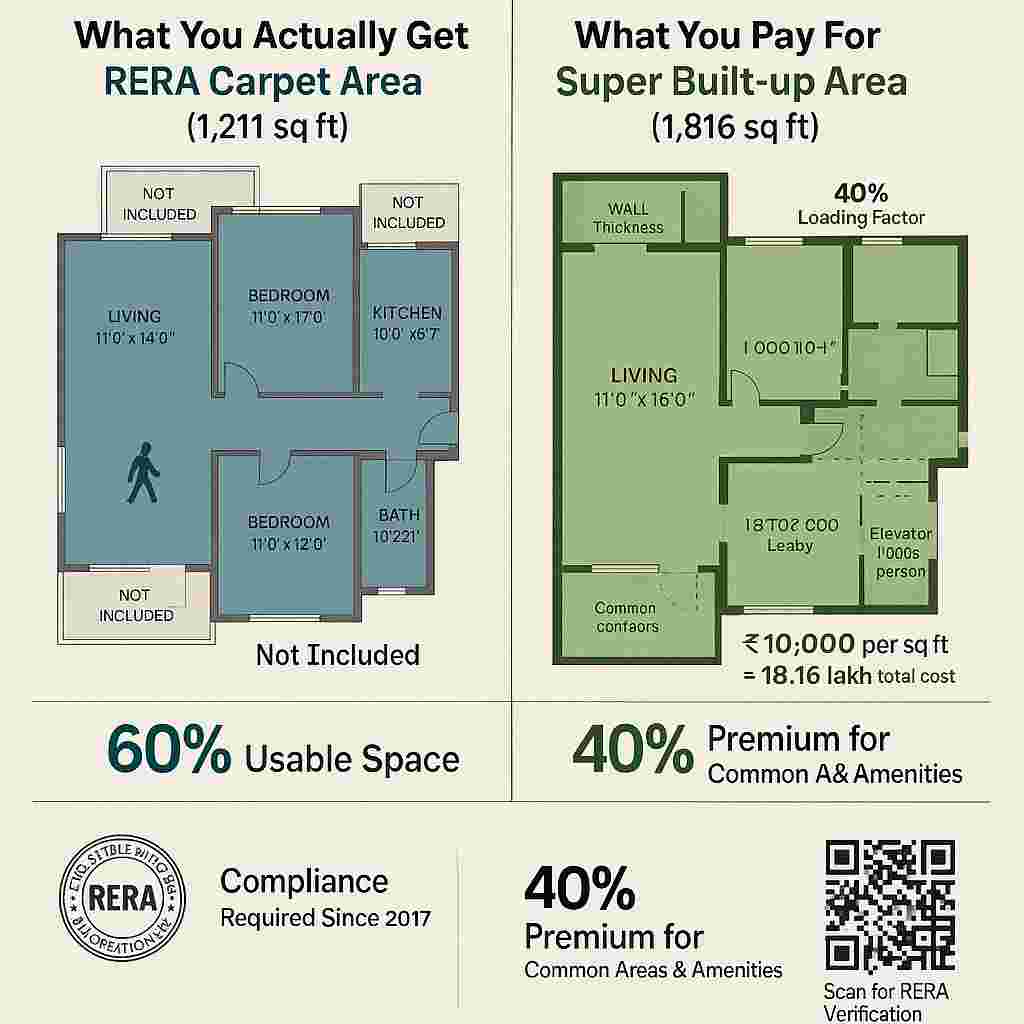
Real-World Calculation Example
Builders often advertise built up figures, so always ask for both to see the real difference between carpet area and built up area.
Given Property Data:
- Built-up Area: 1,393 sq ft
- General Carpet Area: 82.8% of built-up = 1,153 sq ft
- RERA Carpet Area: 1,153 × 1.05 = 1,211 sq ft
- Super Built-up Area (50% loading): 1,211 × 1.5 = 1,816 sq ft
Loading Factor Analysis
Formula: Loading Factor = (Super Built-up Area – Carpet Area) / Carpet Area
Property Type Variations:
- Budget Properties: 20-30%
- Mid-segment: 25-40%
- Luxury Properties: 40-60%
- Commercial: 30-50%
Expert Recommendation: Loading factors below 30% considered ideal for residential properties; above 50% indicates significantly less usable space.
Technology Solutions for Verification
Professional Apps:
- Mapulator: GPS-based measurement with Google/Apple Maps integration
- GPS Fields Area Measure: Manual and walking GPS modes with multiple export formats
- SatQuote/SatMeasure: AI-generated calculations from high-resolution aerial imagery
- CubiCasa: Smartphone-based property scanning with ANSI compliance
Hardware Solutions: Laser measurement devices (Bosch, Leica, Trimble) with ±2mm accuracy and Bluetooth connectivity.
International Comparison Standards
RICS (Royal Institution of Chartered Surveyors)
- Global standard used in Great Britain and internationally
- Focus on professional valuation and investment analysis
- More comprehensive than Indian carpet area approach
BOMA (Building Owners and Managers Association)
- US commercial real estate standard
- Load Factor Range: 1.2-1.5 for offices, 1.3-1.7 for retail
- Formula: Rentable SF = Usable SF × Load Factor
Key Difference: Indian emphasis on usable space (carpet area) vs. international focus on total building efficiency. Indian residential loading factors (25-60%) are significantly higher than international commercial standards (10-25%).
Industry Expert Insights and Case Studies
Legal Precedents
Landmark Case – Ghaste vs Dialani Developers:
- Bought flat: 760 sq ft stated carpet area for ₹25 lakh
- Actual measurement: 713.39 sq ft (46.61 sq ft shortfall)
- NCDRC Ruling: Builder refunded ₹1,53,388 for deficient area plus ₹7,669 stamp duty, both with 9% interest
- Legal Precedent: “Area under internal and external walls cannot be included in carpet area”
Banking and Financial Institution Impact
IDFC First Bank Perspective: “When evaluating loan applications, most lenders want to know carpet area. However, it gets tricky because different lenders have different guidelines for measuring carpet area.”
Bajaj Finserv: “We use built-up area to calculate loan amount, making it an essential metric for Property Loans.”
Bank Assessment: ICICI Bank recommends buyers verify carpet area claims with bank’s technical assessment expert during loan processing.
Common Misconceptions and Buyer Pitfalls
Critical Misconceptions Identified
- Super Built-up Area Confusion: Pre-RERA developers marketed using super built-up terms, making properties seem cheaper per sq ft than actual carpet area pricing
- Wall Thickness Errors: Buyers often assume wall areas are included in carpet area calculations
- Balcony Inclusion Mistakes: Under RERA, balconies are excluded from carpet area (unlike previous practices)
- Loading Factor Misunderstanding: Many buyers don’t realize loading factors of 20-30% mean they pay for 20-30% more area than they can actually use
A quick tip: to evaluate actual livable space, focus on the difference between carpet area and built up area before signing any agreement.
Expert Recommendations for First-Time Buyers
Nemmadi Legal Insights: “Understanding these legalities is crucial for buyers to ensure they are not overcharged and for sellers to comply with the law.”
LegalKart Success Story: Customer avoided losing ₹80 lakh on problematic property through professional verification: “Based on the finding I avoided buying the property and losing 80 Lakh.”
Regional Variations in Implementation
State-Specific Approaches
Maharashtra (MahaRERA):
- Coexistence with the Maharashtra Ownership Flats Act (MOFA)
- MOFA may include balconies/terraces in the carpet area (less standardized)
- Stamp duty based on the super built-up area requires conversion formulas
Haryana (HRERA):
- April 2021 directive: Sales only based on carpet area
- Super area-based sales deemed “fraudulent”
- Zero tolerance policy with penal proceedings
Karnataka:
- Government-provided carpet area to super built-up converter for stamp duty
- Mandatory architect/engineer certification for carpet area statements
- Detailed area variation provisions in agreements
Gujarat:
- 85% complaint resolution rate (vs 65% national average)
- First state with fully digital compliance system
- Comprehensive project information portal
Technology and Future Trends
Digital Transformation
PropTech Integration: AI-driven analytics for market predictions and blockchain for secure transactions, revolutionizing property measurement and verification.
Market Projections (2025-2030):
- 6.5% price appreciation expected in 2025, 7.5% in 2026
- Further loading factor increases are expected as amenity demand grows
- Potential regulatory caps on loading factors under consideration
RERA 2.0 Developments
Enhanced Features (2024-2025):
- Higher compensation rates for project delays
- Mandatory third-party escrow audits
- Suo moto action capability for authorities
- AI and blockchain implementation planned
- Online dispute resolution platforms are operational
Impact on Property Pricing and Investment Decisions
Financial Implications
Gujarat Study Findings (2024):
- 72.5% of respondents favor carpet area calculations
- 58.8% acknowledge carpet area influence on investment decisions
- Transition to carpet area pricing expected to stabilize at ₹18,000-19,000 per sq ft
Loading Factor Economics
Real Impact: With a 40% average loading factor, buyers pay for 1,400 sq ft but receive only 1,000 sq ft usable space. At ₹10,000 per sq ft, this represents ₹4 lakh in common area charges for premium amenities.
Investment Analysis Framework
ROI Considerations:
- Compare properties based on carpet area pricing, not super built-up area
- Calculate actual cost per usable sq ft, including loading factor
- Factor maintenance charges based on the super built-up area
- Consider resale value based on carpet area market trends
Consumer Protection and Buyer Rights
RERA Safeguards
Financial Protection:
- Maximum 10% advance payment before agreement
- 5-year defect liability period post-possession
- Mandatory compensation for delays at SBI MCLR + 2%
- Direct recovery through District Collector for non-compliance
Grievance Redressal Success
Resolution Statistics:
- Over 1 lakh consumer disputes settled across 27 states and 8 union territories
- 60-90 day resolution periods vs 2-3 years in civil courts
- Cost-effective with minimal filing fees and no mandatory legal representation
Buyer Success Stories
Compensation Cases:
- Capital Heights: ₹4,00,000 compensation for possession delays
- Parsvanath Developers: ₹4,00,000 compensation plus delayed possession remedy
- Professional verification prevented ₹80 lakh losses in problematic properties
Professional Verification and Due Diligence
Expert Verification Checklist
- RERA Registration Verification: Confirm project registration status
- Independent Measurement: Professional survey for high-value properties
- Documentation Review: Sale agreements for area calculation methodology
- Bank Valuation Cross-check: Ensure alignment with developer claims
- Loading Factor Analysis: Verify reasonableness of common area charges
Red Flags for Buyers
- Loading factors above 60% for residential properties
- Inconsistent measurements between documents
- Reluctance to provide detailed area breakdowns
- Significant variations from market norms
- Unregistered projects still advertising/selling
Technology-Assisted Verification
Buyer-Accessible Tools:
- Google Earth Pro for basic area verification
- Smartphone GPS measurement apps
- Online RERA carpet area calculators
- Professional digital measurement services
Investment in Verification: “For properties valued in lakhs and crores, spending a few thousand on verification is a wise decision ensuring investment security.”
Actionable Recommendations
For First-Time Homebuyers
- Always compare properties based on carpet area pricing, not super built-up area
- Verify RERA registration before making any payments
- Calculate the actual usable space percentage using the loading factor analysis
- Demand detailed area breakdowns with architect certification
- Consider professional verification for investments >₹50 lakh
For Property Investors
- Analyze loading factor trends in target locations for future appreciation
- Factor maintenance costs based on super built-up area calculations
- Evaluate rental yields based on actual carpet area returns
- Monitor RERA compliance for legal security and resale value
For Real Estate Professionals
- Stay updated with state-specific RERA implementations
- Provide carpet area-based pricing for all client communications
- Educate clients about loading factor implications
- Utilize technology tools for accurate measurement and verification
- Maintain RERA compliance documentation for all transactions
Future Market Evolution
Standardization Trends
Expected Developments:
- Greater uniformity in area calculation methods across states
- Technology integration for automated measurement verification
- Potential loading factor caps to protect consumer interests
- Enhanced penalty structures for non-compliant developers
Market Maturity Indicators
Positive Trends:
- Increased buyer awareness of area calculation differences
- Developer shift toward transparency and RERA compliance
- Technology adoption for measurement accuracy
- Improved dispute resolution mechanisms
Challenges Remaining:
- Regional variations in implementation
- Complex conversion requirements for stamp duty
- Education gaps among rural and first-time buyers
- Enforcement consistency across different states
Related Posts:
- The Role of Identity Verification in Real Estate Transactions
- How to Calculate Cost of Construction per sq ft in India (Easy Guide)
- RERA Act: Everything you need to know about
- What is the best carpet type for stairs and hallways?
- Is Carpet Cleaning Service Included In Spring Cleaning Service?
