

Last Updated on March 12, 2026 by Admin
Most people think construction careers begin and end with engineering degrees. That belief is now outdated — and costly.
ConstructionCareerHub App is LIVE — built ONLY for construction careers. Don’t apply with a weak resume.
Get ATS-ready Resume Lab + Interview Copilot + Campus Placement Prep (resume screening, skill gaps, interview readiness) — in minutes & Other advanced features.
Explore Smarter Construction Career Tools →Quick check. Big impact. Start now.
Across the world, electricians, plumbers, HVAC technicians, carpenters, pipefitters, welders, and equipment operators are becoming some of the most critical, highest-demand professionals in the global economy.
As countries race to build:
- housing for growing populations
- data centers powering AI and cloud computing
- renewable energy infrastructure
- transport networks and smart cities
The construction industry is facing a reality no automation can solve:
There aren’t enough skilled trade workers to keep up.
Governments, contractors, and employers are now openly warning of a global skilled trades shortage — one that is reshaping wages, migration policies, and career pathways worldwide.
This guide explains why skilled trades are entering a golden era in 2026 and beyond, how much they earn globally, which certifications matter most, and why these careers are becoming more future-proof than many white-collar roles.
Table of Contents
The Global Construction Boom & the Skilled Trades Shortage
Construction spending is rising worldwide due to:
1. Infrastructure Modernization
Countries are investing billions in highways, bridges, rail networks, and airports.
- USA: The $1.2 trillion Infrastructure Investment and Jobs Act is driving unprecedented demand for skilled construction workers
- India: Gati Shakti, smart cities, metro expansion
- Middle East: Saudi Vision 2030 mega-projects in Saudi Arabia, UAE, and Qatar
- Europe: Green transition & energy-efficient retrofits
- Australia: Housing and transport megaprojects
2. Data Centers & Industrial Growth
Every cloud service, AI tool, and streaming app fuels demand for data centers—each requiring electricians, HVAC techs, pipefitters, and specialized trades.
3. Housing Shortages
Major markets like the US, UK, India, Canada, and Australia face housing deficits. Skilled trades are essential to catch up.
4. Renewable Energy Explosion
Solar, wind, EV charging, and hydrogen plants require certified electricians and technicians.
5. Retiring Workforce
A massive portion of the global skilled trades workforce is aged 48+, especially in North America, Europe, and Australia.
➡️ Result: Demand is rising while supply is shrinking.
According to the Associated Builders and Contractors (ABC), the construction industry needs 439,000 new workers in 2025 alone. Global construction organizations estimate this gap will grow to 3–5 million unfilled trade jobs by 2030.
Top Skilled Trades in Demand Worldwide
Each skilled trade plays a unique, irreplaceable role in the built environment. Let’s break down the ones facing the highest global demand:
1. Electrician
Electricians are among the top three most in-demand trades globally.
Why?
Because modern buildings—homes, hospitals, data centers, EV chargers—run on increasingly complex electrical systems.
Strong demand in:
- USA
- Canada
- Australia
- Middle East
- UK
- Germany
- Singapore & Japan
The U.S. Bureau of Labor Statistics projects 9% employment growth for electricians through 2034, creating approximately 81,000 job openings each year.
2. Plumber
Plumbers are essential in everything from tiny apartments to billion-dollar industrial complexes.
Key reasons for demand:
- Housing construction
- Aging water infrastructure
- Firefighting systems in commercial buildings
- Green plumbing and water-saving systems
3. HVAC Technician
HVAC (Heating, Ventilation, and Air Conditioning) is booming due to:
- Data center cooling systems
- Industrial climate control
- Rising global temperatures
- Growing commercial real-estate
- Energy-efficient retrofits
- Heat pumps replacing traditional heating
According to the construction labor shortage reports, HVAC skills are globally portable, making these workers internationally mobile.
4. Carpenter
Carpenters are needed across residential, commercial, and industrial projects.
High demand is driven by:
- Massive housing shortages
- Interior finishing boom
- Data center infrastructure
- Modular construction
- Prefab building systems
5. Pipefitter / Steamfitter
Critical for:
- Oil & gas
- Petrochemical plants
- Power generation
- Shipyards
- Heavy industry
- Firefighting systems
Countries like UAE, Saudi, USA, Canada, and Australia regularly hire pipefitters from abroad.
6. Welder
Welders with certifications (6G, TIG, MIG) are especially sought-after in:
- Shipbuilding
- Structural steel
- Heavy industry
- Pipeline construction
- Offshore oil rigs
7. Heavy Equipment Operator
Operators of cranes, excavators, bulldozers, boom lifts, and graders are always in demand—especially in India, the US, and the Middle East megaprojects.
Global Salary Comparison for Skilled Trades (2026 Estimates)
Below is a snapshot of average annual salaries for core trades:
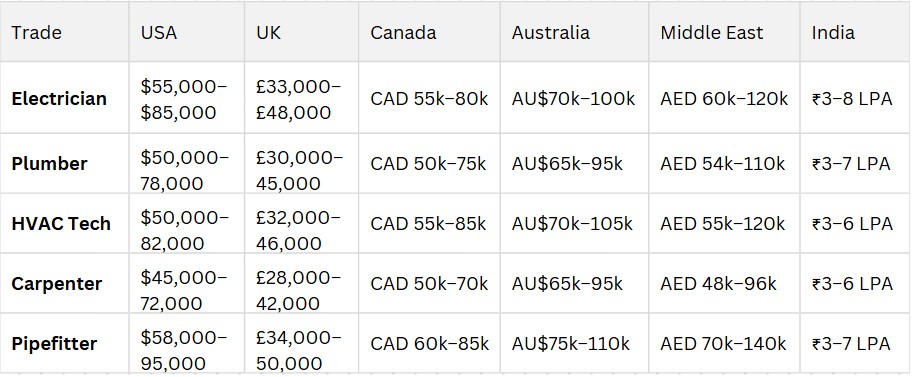
Salaries vary by project type, certifications, and experience—but globally:
Skilled trades consistently pay above-average wages and offer fast career progression.
Essential Skills Required in Each Trade
While each trade is unique, the following skills are universally valued:
Technical Skills
- Blueprint reading
- Electrical codes & standards
- Piping & welding knowledge
- HVAC diagnostics
- Plumbing system design
- Carpentry tools & frameworks
- Safety & compliance
Soft Skills
- Problem-solving
- Communication
- Team coordination
- Time management
- Precision & attention to detail
Digital Skills (increasingly important)
- IoT-enabled tools
- Building management systems
- BIM coordination awareness
- Digital reporting platforms
Best Certifications for Skilled Trades (Region-wise)
USA
- OSHA 10 / OSHA 30
- Journeyman/Master Electrician license
- EPA 608 (HVAC)
- NCCER Certification
- Welding AWS Certification
Canada
- Red Seal Program
- Provincial trade certifications
UK & Europe
- City & Guilds
- NVQ Level 2/3
- CSCS Card
Australia
- Cert III in Carpentry / Plumbing / Electrotechnology
- White Card
- ARCtick for HVAC
Middle East
- Trade Test certifications
- Safety certificates (NEBOSH/IOSH)
- Gulf trade licenses
India
- ITI (Industrial Training Institute)
- NCVT Certification
- Apprenticeship programs (NAPS/NATS)
Future Trends Reshaping Skilled Trades
The next decade will revolutionize how tradespeople work.
1. Smart Homes & Automation
Electricians and HVAC techs increasingly work with IoT devices, sensors, and energy systems.
2. Green Construction
Plumbers and pipefitters are integrating sustainable water systems.
3. EV Charging Infrastructure
Electricians are essential for the rapid rollout worldwide.
4. Modular Construction & Pre-Fab
Carpenters, welders, and fitters now work in factory environments.
5. Data Centers
This is the fastest-growing sector requiring electricians and HVAC specialists.
Career Growth Pathways: From Apprentice to Expert
Trade careers offer predictable, structured progress:
Step 1: Apprentice
Work under supervision while learning the trade.
Step 2: Journeyman / Certified Technician
Independently execute tasks, earn higher wages.
Step 3: Specialist / Senior Technician
Focus on high-paying niches:
- Data center HVAC
- Industrial electrification
- Medical gas plumbing
- Process piping
Step 4: Supervisor or Foreman
Lead teams and manage projects.
Step 5: Independent Contractor or Business Owner
One of the fastest wealth-building paths:
- Electrical contracting
- Plumbing firms
- HVAC service companies
- Carpentry and renovation businesses
The average income of successful trade contractors often exceeds $150,000–$250,000/year in developed economies.
Why Skilled Trades Travel Well (Global Mobility)
Skilled trades are globally portable because:
- Skills are hands-on and universally applicable
- Most countries face shortages
- Certification pathways are recognized internationally
- Sponsorship visas are widely offered (USA, Canada, Australia, Europe, the Middle East)
Countries actively recruiting tradespeople include:
- Canada (Express Entry pathways)
- Australia & New Zealand
- UAE, Saudi Arabia, Qatar
- Germany & Scandinavia
- UK construction & housing sector
For many, a skilled trade becomes a passport to global income and life opportunities for skilled labourers.
Final Thoughts
Skilled trades are the lifeblood of construction. Engineers design structures—but electricians, plumbers, HVAC techs, carpenters, welders, and pipefitters bring them to life.
As the world accelerates housing development, infrastructure expansion, renewable energy rollouts, and data center construction, the demand for skilled trades is skyrocketing.
In 2026 and beyond, skilled trades will offer some of the most stable, high-paying, globally mobile careers in the world.
If you are a student, job seeker, or professional considering your next move, there has never been a better time to join the skilled trades workforce.
Frequently Asked Questions (FAQs)
Electricians, plumbers, HVAC technicians, carpenters, pipefitters, welders, and heavy equipment operators.
USA, Canada, Australia, UAE/Saudi Arabia, Germany, and UK.
No. Most require certifications, apprenticeships, or technical training. Learn more about construction worker job requirements.
Yes. Many countries have visa pathways specifically for trade workers.
No. Automation assists — but cannot replace human precision required on job sites.
Through a paid apprenticeship program, which typically takes 4 years. Read our complete guide on becoming an electrician.
Absolutely. Skilled trades offer excellent entry points with competitive pay and clear advancement pathways. Explore our guide on best construction careers for beginners.
Construction managers, electrical contractors, pipefitters, and specialized HVAC technicians are among the top earners. Check our comprehensive list of highest paying construction jobs.
