

Last Updated on January 5, 2026 by Admin
Looking to make a career move or land your dream job in 2026? Crafting the perfect sample message asking for a job opportunity is your first step toward making a lasting impression on potential employers.
Here’s a reality check: According to recent research, 85% of jobs are filled through networking rather than traditional applications. Yet most job seekers still rely solely on submitting applications through job boards, where response rates have dropped to just 4-5% on platforms like LinkedIn and Indeed.
The difference between candidates who land interviews and those who hear nothing often comes down to one thing: how they reach out.
In this comprehensive guide, we’ve compiled 35 proven sample messages for asking about job opportunities across every platform—email, LinkedIn, WhatsApp, and more. Each template is backed by 2025-2026 job market data and optimized to help you stand out in today’s competitive landscape.
Quick Stats You Need to Know (2025-2026):
- LinkedIn messages achieve a 10.3% response rate vs. 5.1% for cold emails
- Personalized messages get 30-50% higher responses than generic templates
- Average job search now takes 5 months with 32-200+ applications
- 75% of resumes are rejected by ATS before a human sees them
- Following up increases response rates by 50% or more
Whether you’re a fresh graduate, experienced professional, or exploring emerging digital construction careers, these message templates will help you effectively communicate your value and increase your chances of landing that coveted interview.
Table of Contents
Why Your Job Inquiry Message Matters More Than Ever in 2026
The job market has fundamentally changed. With AI screening applications before human eyes see them, your message is often your only chance to make a genuine connection with decision-makers.
Consider these eye-opening statistics from recent job market research:
- 52% of candidates wait 3 months or longer to receive any response from job applications
- The average corporate job posting receives 250 resumes, with only 5 candidates selected for interviews (2% success rate)
- 99% of Fortune 500 companies use Applicant Tracking Systems (ATS) to filter applications
- Recruiters spend just 6-8 seconds reviewing a resume on initial scan
- 70% of jobs are never advertised publicly—they go to people already known to the hiring team
This is why direct outreach through personalized messages has become essential. When you reach out directly to hiring managers and recruiters, you bypass the ATS gatekeepers and create a human connection that can fast-track your application.
The Platforms That Drive Results
Not all platforms deliver equal results. Here’s what the 2025 data reveals about response rates:
| Platform | Average Response Rate | Best Use Case |
|---|---|---|
| Google Jobs (Direct Apply) | 9.3-11.2% | Applying through company career pages |
| LinkedIn DMs | 10.3% | Professional networking & recruiter outreach |
| LinkedIn InMail (Personalized) | 18-25% | Cold outreach to hiring managers |
| Email (Personalized) | 5-10% | Formal job inquiries & follow-ups |
| LinkedIn Job Applications | ~4% | Discovery of openings (combine with DM) |
| Indeed | ~4% | High-volume job browsing |
Key Insight: LinkedIn messages now perform 101% better than cold emails, making it the most effective platform for professional job outreach in 2026.
How to Craft the Perfect Job Inquiry Message: A Step-by-Step Guide
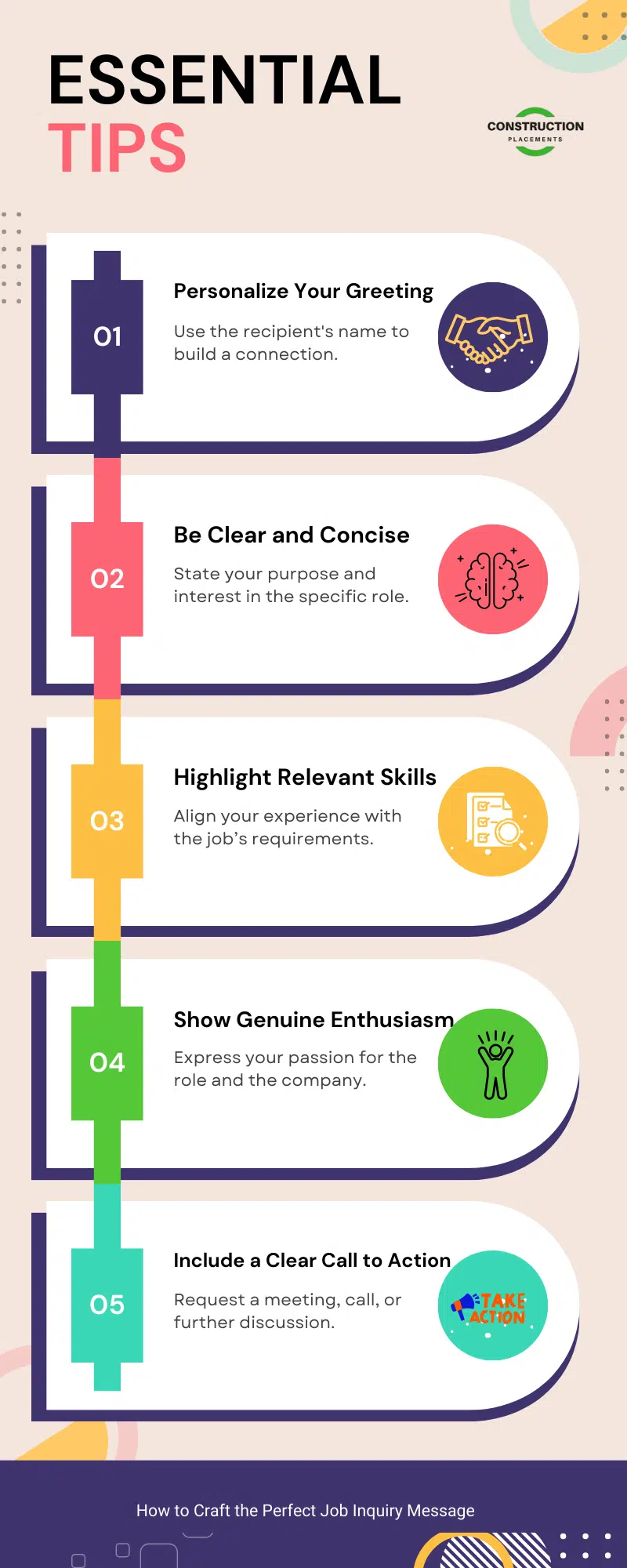
Before diving into the templates, let’s understand what makes a job inquiry message actually work. Research shows that messages with these elements achieve significantly higher response rates.
Essential Elements of High-Converting Job Messages
1. Personalized Opening (Critical)
Messages with personalized connection requests see a 9.36% reply rate compared to just 5.44% for generic messages. Always include:
- The recipient’s name
- A reference to their work, company, or recent post
- How you found them or why you’re reaching out specifically to them
2. Clear Value Proposition
State what you bring to the table within the first 2-3 sentences. Be specific about:
- Relevant skills that match the role
- Quantifiable achievements (e.g., “increased project efficiency by 25%”)
- Industry-specific certifications or experience
If you’re sending a construction worker resume, emphasize specific certifications, safety training, and hands-on experience that match the job posting.
3. Specific Role Reference
Mention the exact job title or department you’re interested in. This shows you’ve done your research and aren’t mass-messaging.
4. Concise Format
Keep your message under 150 words. LinkedIn data shows shorter, focused messages get higher engagement than lengthy pitches.
5. Clear Call-to-Action
End with a specific, low-commitment ask such as:
- “Would you be open to a 15-minute call this week?”
- “May I send you my resume for consideration?”
- “Could we connect to discuss this opportunity further?”
Platform-Specific Best Practices
| Platform | Tone | Length | Best Day to Send |
|---|---|---|---|
| Formal, professional | 150-200 words | Tuesday-Thursday AM | |
| Professional but conversational | Under 300 characters ideal | Tuesday (6.90% reply rate) | |
| Professional but friendly | Brief, 2-3 paragraphs | Weekday business hours |
35 Best Sample Messages Asking for a Job Opportunity
These templates are organized by platform and purpose. Each can be easily customized for your specific situation. Remember: personalization is key—research shows tailored messages achieve 2.1× higher interview conversion rates.
These sample messages are versatile and can be adapted for emails, LinkedIn, WhatsApp, and other platforms. Adjust the tone based on the platform—more formal for email and LinkedIn, slightly more relaxed for WhatsApp.
General Job Inquiry Messages (Templates 1-10)
These templates work across all platforms and can be adapted for various industries.
1. The Direct Approach
Hi [Contact Name], I hope you’re doing well! I noticed your company has an opening for a [Job Title]. With my [X years] experience in [Relevant Field] and proven track record in [Specific Achievement], I believe I’d be a strong fit for your team. Would you be open to a brief conversation about the opportunity?
2. The Mutual Connection Reference
Hello [Contact Name], [Mutual Connection Name] suggested I reach out to you regarding the [Job Title] position at [Company]. My background in [Relevant Skills/Experience] aligns well with your team’s work in [Specific Area]. I’d love to discuss how I could contribute to your current projects.
3. The Company Admirer
Greetings [Contact Name], I’ve followed [Company Name]’s innovative work in [Industry/Project], particularly your recent [Specific Initiative]. When I saw the opening for [Job Title], I knew I had to reach out. My experience in [Relevant Skills] would allow me to contribute meaningfully to your team’s mission.
4. The Skill Matcher
Hi [Contact Name], I saw your job posting for [Job Title] and was excited to see how closely my qualifications match your requirements. I bring [X years] of experience in [Key Skill 1] and [Key Skill 2], with a track record of [Specific Achievement]. Could we schedule a time to discuss how I might contribute to [Company Name]?
5. The Career Transition Message
Hello [Contact Name], I’m currently transitioning from [Previous Industry/Role] to [Target Industry/Role] and was drawn to [Company Name]’s reputation for [Specific Quality]. My transferable skills in [Relevant Skills] and passion for [Industry/Field] make me confident I can add value to your team. May we connect to explore potential opportunities?
6. The Fresh Graduate Approach
Hi [Contact Name], I recently graduated from [University] with a degree in [Field] and am eager to begin my career in [Industry]. Your company’s work on [Specific Project] particularly inspires me. I’d welcome the opportunity to discuss entry-level positions where my [Skills/Internship Experience] could contribute to your team’s success.
7. The Experienced Professional
Dear [Contact Name], With over [X years] in [Industry], I’ve developed expertise in [Key Skills] that I believe would benefit [Company Name]. I’m particularly interested in how your team approaches [Specific Challenge/Area], and I’d value the opportunity to discuss how my experience could support your goals.
8. The Problem Solver
Hi [Contact Name], I noticed [Company Name] is expanding its [Department/Service] team, and I’ve helped similar organizations solve [Specific Challenge] by [Solution/Achievement]. I’d love to learn more about your current priorities and discuss how I might contribute.
9. The Internal Opportunity Seeker
Hi [Contact Name], I’m currently in [Current Department] and am interested in transitioning to [Target Department] for the [Job Title] position. Over the past [X years], I’ve developed skills in [Relevant Areas] and contributed to [Specific Achievement]. Would you have time to discuss this opportunity and how my background might fit?
10. The Referral Request
Hello [Contact Name], I’m exploring opportunities in [Industry/Role] and understand you work at [Company Name]. Given your experience there, I’d greatly value any insights you could share about the company culture or hiring process. If you feel comfortable, I’d also appreciate an introduction to the appropriate hiring manager.
Related Post:
LinkedIn Message Templates (Templates 11-20)
LinkedIn messages get 10.3% average response rate—double that of cold emails. Keep these concise and professional.
11. Connection Request with Purpose
Hi [Name], I came across your profile while researching [Industry/Company]. Your work on [Specific Project/Post] caught my attention. I’m exploring [Job Type] opportunities and would love to connect and learn more about your team’s work at [Company].
12. Post-Connection Follow-Up
Thanks for connecting, [Name]! I noticed [Company] is hiring for [Role]. With my background in [Skill], I believe I could contribute to your team’s success. Would you be open to a quick chat about the position?
13. To a Recruiter
Hi [Recruiter Name], I’m [Your Name], a [Your Role] with [X years] experience in [Industry]. I’m actively exploring new opportunities aligned with [Specific Area]. If any roles match my background, I’d appreciate the chance to connect and discuss further.
14. To a Hiring Manager
Hello [Name], I applied for the [Job Title] position and wanted to express my genuine interest in joining [Company]. My experience with [Specific Skill] directly relates to your team’s work on [Project/Initiative]. I’d welcome any opportunity to discuss my qualifications further.
For more specialized LinkedIn outreach, see our guide on 15 Sample Messages to Connect with Hiring Managers on LinkedIn.
15. Industry Peer Networking
Hi [Name], I noticed your journey from [Previous Role] to [Current Role]—very inspiring! I’m exploring similar career paths in [Industry] and would value any insights you’re open to sharing. Would you be willing to connect?
16. After Engaging with Their Content
Hi [Name], Your recent post about [Topic] really resonated with me—especially your point about [Specific Insight]. I’m a [Your Role] looking to grow in [Area], and I’d love to connect and learn from your experience at [Company].
17. The Company Transition Message
Hi [Name], Congratulations on your role at [Company]! I’ve been following the company’s growth in [Area] and am interested in opportunities there. With my experience in [Skill], I believe I could contribute meaningfully. Would you be open to a brief conversation?
18. Alumni Network Connection
Hi [Name], I noticed we’re both [University] alumni! I’m currently exploring [Job Type] opportunities and saw that [Company] is hiring. Would you have a few minutes to share your experience working there? Any insights would be greatly appreciated.
19. The Informational Interview Request
Hello [Name], I’m researching career paths in [Industry] and admire the work you’ve done at [Company]. Would you be willing to share 15-20 minutes for an informational conversation? I’d love to learn about your journey and any advice for someone entering the field.
20. The Subtle Job Inquiry
Hi [Name], I’ve been impressed by [Company]’s work in [Specific Area] and am curious about the team culture and growth opportunities. As someone with experience in [Your Skill], I’m exploring companies where I could make a meaningful impact. Would you be open to connecting?
Email Templates for Job Inquiries (Templates 21-27)
Email remains essential for formal job inquiries. Use clear subject lines and professional formatting.
21. General Job Inquiry Email
Subject Line: Experienced [Your Title] Interested in [Job Title] – [Your Name]
Dear [Hiring Manager’s Name], I am writing to express my interest in potential opportunities within [Company Name]. With [X years] of experience in [Your Field], I have developed expertise in [Key Skills] that align with your company’s mission of [Company Mission/Value]. In my current role at [Current Company], I [Key Achievement with metrics]. I am particularly drawn to [Company Name]’s work in [Specific Area] and believe my background in [Relevant Experience] would allow me to contribute meaningfully to your team. I have attached my resume for your consideration and would welcome the opportunity to discuss how my skills could benefit [Company Name]. Thank you for your time and consideration. Warm regards,
[Your Full Name]
[Phone Number] | [LinkedIn Profile URL]
22. Post-Networking Event Follow-Up
Subject Line: Great Connecting at [Event Name] – Following Up on [Topic]
Hello [Name], It was a pleasure meeting you at [Event Name]. Our conversation about [Specific Topic] really inspired me to learn more about opportunities at [Company Name]. As I mentioned, I have [X years] experience in [Field] and am particularly interested in contributing my expertise in [Specific Area] to your team. I’ve attached my resume and would appreciate any guidance on the best way to pursue opportunities with [Company]. Thank you for your time, and I look forward to staying connected. Best regards,
[Your Name]
23. Cold Email to Hiring Manager
Subject Line: [Specific Skill] Professional – Inquiry About [Department] Opportunities
Dear [Hiring Manager’s Name], I recently learned about [Company Name]’s expansion in [Area/Department] and wanted to introduce myself as a potential candidate who could contribute to your team’s success. With a background in [Your Field] and specific experience in [Relevant Skills], I have [Key Achievement]. I’m impressed by [Company]’s approach to [Specific Initiative] and believe my skills would align well with your team’s objectives. Would you have 15 minutes this week or next for a brief call? I’d love to learn more about your team’s priorities and explore how I might contribute. Thank you for considering my inquiry. Sincerely,
[Your Name]
[Contact Information]
24. Follow-Up to Closed Job Posting
Subject Line: Continued Interest in [Job Title] at [Company Name]
Dear [Hiring Manager], I recently came across the listing for [Job Title] at your company, but noticed the application window has closed. I remain very interested in being part of [Company Name] and would appreciate being considered for any upcoming roles that align with my experience in [Industry/Field]. My background includes [Brief Summary of Qualifications], and I am confident I could contribute value to your team. I have attached my resume for your reference. Thank you for any consideration, and please feel free to reach out if suitable opportunities arise. Best regards,
[Your Name]
25. Speculative Application Email
Subject Line: Exploring Opportunities at [Company Name] – [Your Specialty]
Dear [Hiring Manager/HR Team], Although I don’t see a current opening that matches my profile, I wanted to introduce myself as a [Your Title] with strong interest in joining [Company Name]. I’ve followed your company’s work in [Specific Area] and am impressed by [Specific Achievement/Project]. With my experience in [Key Skills], I could contribute to similar initiatives and help [Specific Value You’d Add]. I would welcome the opportunity to discuss future openings or be kept on file for relevant positions. My resume is attached for your review. Thank you for your time. Sincerely,
[Your Name]
26. Referral Email
Subject Line: Referred by [Referrer’s Name] – Application for [Job Title]
Dear [Hiring Manager’s Name], [Referrer’s Full Name] suggested I reach out regarding the [Job Title] position at [Company Name]. After speaking with [Referrer] about your team’s work and culture, I’m confident my background would be a strong fit. I bring [X years] of experience in [Field], with particular strengths in [Key Skills]. At [Previous Company], I [Specific Achievement with metrics]. I have attached my resume and would be happy to provide additional information. I look forward to the opportunity to discuss how I can contribute to your team. Thank you for your consideration. Best regards,
[Your Name]
27. Industry-Specific Email (Construction/Engineering)
Subject Line: Certified [Your Specialty] – Interest in [Company] Projects
Dear [Hiring Manager’s Name], As a [Certification]-certified professional with [X years] in [Construction/Engineering specialty], I was excited to learn about [Company Name]’s involvement in [Specific Project Type]. My experience includes managing [Type of Projects] valued at [Dollar Amount], with a proven track record of [Safety Record/Project Delivery Achievement]. I am proficient in [Relevant Software/Technologies] and hold current [Relevant Certifications]. I would welcome the opportunity to discuss how my expertise could support your upcoming projects. My resume is attached for your review. Best regards,
[Your Name]
[Professional Certifications]
[Contact Information]
For more guidance on construction industry communications, explore our resource on Project Management Communication Plans.
WhatsApp Job Request Templates (Templates 28-32)
WhatsApp is effective for local markets and industries where informal communication is common. Keep messages professional but conversational.
28. Message to Known Contact
Hello [Sir/Madam/Name], I hope you’re doing well. I’m currently exploring opportunities in [Industry/Job Role] and wanted to check if there are any openings or referrals you might be aware of at [Company Name]. I have [X years] experience in [Field] and am particularly skilled in [Key Areas]. I’d greatly appreciate any guidance you could provide. I’ve attached my resume for reference. Thank you for your time! Best regards,
[Your Name]
29. Referral Request via WhatsApp
Hi [Name], I hope this message finds you well! I came across a job opening at [Company Name] for [Job Title] and noticed you work there. Would you be able to guide me regarding the application process, or would you consider referring me? I’ve been working in [Field] for [X years] and believe my skills match the role well. I’ve shared my resume here. Please let me know if you need any additional information. Thanks so much!
30. To a Recruiter (WhatsApp)
Hello [Recruiter Name], I found your contact through [Source] and am reaching out regarding opportunities in [Industry/Role]. I have [X years] experience and am currently seeking new challenges. May I send you my resume for consideration? I’m available for immediate joining and flexible on location. Thank you for your time. [Your Name]
[Phone/Email]
31. Following Up on a Job Application
Hi [Name], I hope you’re well. I recently applied for the [Job Title] position at [Company] and wanted to follow up on my application status. I remain very interested in the opportunity and would be happy to provide any additional information needed. Please let me know if there are any updates. Thank you!
[Your Name]
32. Job Inquiry from Social Media
Hello [Name], I saw your post about [Job Opportunity] on [Platform] and am very interested. I have relevant experience in [Key Skills] and would love to know more about the role. Could you share details on how to apply, or should I send my resume here? Looking forward to hearing from you. Thanks,
[Your Name]
Industry-Specific Templates: Construction & Engineering (Templates 33-35)
For professionals in construction, engineering, and related industries, these specialized templates address industry-specific requirements.
33. Project Manager/Site Engineer Inquiry
Dear [Contact Name], I am a [Certification] Project Manager with [X years] of experience delivering commercial and infrastructure projects valued at [Dollar Range]. I’m currently seeking new opportunities and was impressed by [Company Name]’s portfolio, particularly the [Specific Project]. My expertise includes [Key Areas: e.g., BIM implementation, lean construction, safety management], and I have consistently achieved [Specific Metrics: on-time delivery rate, safety record]. I would welcome the opportunity to discuss how my project leadership skills could contribute to your upcoming projects. Best regards,
[Your Name]
[Professional Certifications: PMP, LEED, OSHA]
For more on construction industry roles, see our comprehensive guide on Construction Job Titles and Descriptions.
34. BIM Coordinator/Manager Inquiry
Hello [Contact Name], As a BIM professional with expertise in [Software: Revit, Navisworks, AutoCAD] and [X years] of experience, I’m interested in BIM coordination opportunities at [Company Name]. I have successfully implemented BIM workflows that [Specific Achievement: reduced coordination issues by X%, improved design efficiency]. My experience spans [Project Types] and I hold [Relevant Certifications]. Could we discuss how my technical expertise might support your digital construction initiatives? Best regards,
[Your Name]
Learn more about digital construction careers in our article on Connected Construction Sites.
35. International Construction Opportunity Inquiry
Dear [Contact Name], I am a [Your Title] with [X years] of international construction experience, including projects in [Countries/Regions]. I’m seeking opportunities in [Target Region: Gulf/Middle East/USA] and was impressed by [Company Name]’s global presence. My qualifications include [Key Certifications], and I have experience with [Relevant Standards: international building codes, safety regulations]. I am [Visa Status: open to relocation, work permit holder]. I would appreciate the opportunity to discuss positions that align with my experience. Best regards,
[Your Name]
[Languages Spoken]
[Professional Certifications]
For English language resources for international opportunities, check out our English for Construction and Engineering Free Online Course.

How to Follow Up Without Being Pushy
Research shows that follow-ups increase reply rates by 50% or more, yet most people give up after just one message. Here’s how to follow up effectively:
Timing Your Follow-Up
- Email: Wait 5-7 business days before following up
- LinkedIn: Follow up after 3-5 business days
- WhatsApp: Wait at least 3 days unless you have an existing relationship
Key Insight: 65% of LinkedIn InMail responses arrive within 24 hours, and 90% within one week. If you haven’t heard back after a week, a follow-up is appropriate—not annoying.
Sample Follow-Up Messages
First Follow-Up (5-7 days):
Hi [Contact Name], I hope you’re well. I’m following up on my message regarding the [Job Title] position. I remain very interested and would love to discuss how my experience in [Key Skill] could contribute to your team. If you have any questions or need additional information, please let me know. Thank you for your time!
Second Follow-Up (10-14 days):
Hello [Contact Name], I wanted to check in once more regarding my interest in [Job Title/Company]. I understand you’re busy, and I don’t want to take too much of your time. If the timing isn’t right or the position has been filled, I’d appreciate a brief update. Either way, thank you for your consideration, and I hope we can connect in the future.
Common Mistakes That Kill Your Response Rate
Avoid these critical errors that significantly reduce your chances of getting a response:
1. Sending Generic, Template-Like Messages
Problem: Hiring managers can spot copy-paste messages instantly. With 30+ different LinkedIn automation tools in the market, recipients have developed a mental filter for template messages.
Solution: Include at least one specific reference to the recipient, their company, or their recent work.
2. Writing Messages That Are Too Long
Problem: Lengthy messages get skimmed or ignored. Recruiters spend only 6-8 seconds on initial review.
Solution: Keep messages under 150 words. Get to the point in the first two sentences.
3. Missing a Clear Call-to-Action
Problem: If you don’t ask for something specific, the recipient doesn’t know what to do next.
Solution: End with a simple, low-commitment ask: a call, a meeting, or permission to send your resume.
4. Poor Timing
Problem: Sending messages on weekends or late at night often means they get buried.
Solution: Send on Tuesday or Wednesday mornings in the recipient’s time zone for best results.
5. Not Proofreading
Problem: 54% of recruiters reject candidates based on typos and errors.
Solution: Always proofread your message before sending. Use grammar tools if needed.
6. Forgetting to Research
Problem: 47% of candidates fail interviews due to a lack of company knowledge—this starts with your initial message.
Solution: Spend 5 minutes researching the company and the recipient before reaching out.
Leveraging AI Tools in Your 2026 Job Search
AI is transforming how job seekers craft messages and manage their search. Here’s how to use it effectively:
How AI Can Help
- Message Drafting: AI can help personalize templates, but never send AI-generated messages without editing them to add your voice
- Research Assistance: Use AI to quickly summarize company information and recent news
- Grammar and Tone: AI tools can check your message for errors and appropriate tone
- Follow-up Scheduling: AI-powered tools can remind you when to follow up
What the Data Shows
- AI-assisted messaging increases quality of hires by 9%
- Recruiters using AI save about 20% of their weekly time
- AI-driven first messages result in higher response rates (4.19% vs. 2.60% for non-AI)
- However, only 26% of candidates trust AI to evaluate them fairly
Best Practice: Use AI as a starting point, but always personalize and humanize your messages. Recipients can often detect fully AI-generated messages, which can hurt your credibility.
Additional Resources for Your Job Search
Enhance your job search process with these related resources:
Related Guides:
- Construction Job Titles and Descriptions In The Construction Industry
- 15 Sample Messages to Connect with Hiring Managers on LinkedIn
- 10 Ways to Improve Construction Site Communication
- Job Titles for Mechanical Engineers: From Freshers to Experienced Professionals
- How to Use Google for Job Search
Industry Insights:
- The Rising Role of Intellectual Property In The Construction Industry
- Connected Construction Sites: The Future In Construction Technology
- 9 Really Obvious Ways to Redesign Your Construction Logo
For personalized career guidance, consider connecting with an executive search firm dedicated to helping you find the perfect opportunity, or explore resources for those becoming a realtors in the real estate industry.
Final Thoughts: Your Message Is Your First Interview
In 2026’s competitive job market, your initial message is often your only chance to make an impression. With 85% of jobs filled through networking and 70% never publicly advertised, direct outreach isn’t just an option—it’s essential.
Remember these key takeaways:
- Personalization wins: Tailored messages achieve 30-50% higher response rates than generic templates
- Platform matters: LinkedIn messages outperform cold emails by 101%
- Follow-up is crucial: Multi-step sequences boost response rates by 50% or more
- Timing is strategic: Tuesday messages get the highest response rates
- Quality over quantity: One personalized message beats ten generic ones
Use these 35 sample messages as starting points, but always customize them to reflect your unique experience, the specific role, and the recipient you’re contacting. Your authenticity and genuine interest will shine through—and that’s what ultimately gets responses.
Now it’s your turn. Choose a template, personalize it, and take that first step toward your next career opportunity. Your dream job may be just one well-crafted message away.
Happy job hunting!
Related Posts:
- Job Inquiry Email Templates for Construction Jobs: For Freshers and Experienced Candidates
- 5 Email Templates to Land Your Dream Job in Civil Engineering and Construction
- Bridging Industries: How Legal and Construction Firms Can Harness Digital Marketing for Growth
- Top 15 Digital Construction Careers Without Coding Skills [2026 Guide]
FAQs
To write a message for a job opportunity, clearly express your interest in the position, highlight your relevant skills and experience, and maintain a polite and professional tone.
LinkedIn direct messages achieve an average response rate of 10.3% in 2025, which is double the 5.1% rate for cold emails. Well-crafted InMail messages to first-degree connections can achieve 16-25% response rates when properly personalized. HR and talent acquisition professionals show the highest response rates at 12.08%.
In 2025-2026, job seekers submit 32 to 200+ applications on average before receiving an offer, with most online applications resulting in a 0.1%–2% success rate. However, 85% of jobs are filled through networking, and 70% of positions are never publicly advertised. This makes direct outreach messages significantly more effective than traditional applications.
Yes, messaging hiring managers directly is effective. HR and talent acquisition professionals have the highest LinkedIn reply rate at 12.08%. Always personalize your message by referencing the specific role, company initiatives, or their recent posts. Warm up your connection first by engaging with their content before sending a direct message.
Tuesday has the highest LinkedIn reply rates at 6.90%, followed closely by Monday at 6.85%. Response rates drop significantly on weekends (6.40% on Saturday). The best time to send is mid-morning (9-11 AM) in the recipient’s time zone. Weekday messages typically receive responses within 22 hours, while weekend messages may take 48 hours or longer.
Keep WhatsApp job messages professional but slightly less formal than email. Include a polite greeting, briefly introduce yourself and your experience, state the position you’re interested in, mention how you found the contact, and offer to share your resume. Always ask permission before sending large attachments. Avoid excessive emojis and maintain a professional tone even in casual exchanges.
Wait 5-7 business days before following up on email inquiries, and 3-5 days for LinkedIn messages. Research shows that 65% of LinkedIn InMail responses arrive within 24 hours, and 90% within one week. If you haven’t heard back after a week, a polite follow-up is appropriate—not annoying. Multi-step follow-up sequences can increase your response rate by 50% or more.
While the core message can be adapted across platforms, you should adjust the tone and format for each. Email messages should be more formal with a clear subject line and a professional sign-off. LinkedIn messages can be professional but conversational, ideally under 300 characters. WhatsApp messages should remain professional but can be slightly more friendly if you have an existing relationship with the recipient.
