

Last Updated on December 12, 2024 by Admin
In urban construction zones, safety and efficiency are paramount. Concrete barriers for roads have emerged as a popular choice for these areas, offering robust protection and versatile applications. These sturdy structures provide a physical barrier between workers and traffic, significantly reducing the risk of accidents and injuries in busy city environments.
ConstructionCareerHub App is LIVE — built ONLY for construction careers. Don’t apply with a weak resume.
Get ATS-ready Resume Lab + Interview Copilot + Campus Placement Prep (resume screening, skill gaps, interview readiness) — in minutes & Other advanced features.
Explore Smarter Construction Career Tools →Quick check. Big impact. Start now.
Concrete barriers excel in traffic management, effectively guiding vehicles through complex construction layouts. Their durability allows them to withstand impacts and harsh weather conditions, making them a reliable option for long-term projects. Moreover, their modular design enables quick installation and reconfiguration as construction needs evolve.
Urban planners and construction managers appreciate concrete barriers for their multifaceted benefits. Beyond safety, these barriers can serve as noise reducers, helping to minimize disruption to nearby residents and businesses. Their adaptability also allows for integration with other urban design elements, contributing to a cohesive city landscape even during ongoing construction work.
Key Takeaways
- Concrete barriers provide essential safety for workers and drivers in urban construction zones.
- Their durability and versatility make them ideal for various traffic management applications.
- These barriers offer additional benefits like noise reduction and seamless integration with urban design.
Benefits of Concrete Barriers in Construction Zones
Concrete barriers offer significant advantages in urban construction zones. They provide robust protection, long-lasting durability, and cost-effective solutions for ensuring safety and managing traffic flow.
Enhancing Safety and Protection
Concrete barriers serve as crucial safety features in construction zones. They create a solid barrier between workers and moving traffic, significantly reducing the risk of accidents and injuries. These barriers effectively redirect vehicles, preventing them from entering work areas.
Temporary concrete barriers, such as Jersey barriers or F-shape barriers, are particularly useful for short-term projects. They can be quickly deployed and rearranged as needed, adapting to changing site conditions.
For pedestrian safety, concrete barriers create protected walkways, separating foot traffic from construction activities and vehicles. This is especially important in busy urban areas with high pedestrian volumes.
Ensuring Durability and Stability
Concrete barriers excel in durability and stability. Their substantial weight and robust construction make them highly resistant to movement, even when impacted by vehicles.
The strength of concrete barriers allows them to withstand repeated impacts without significant damage. This longevity makes them ideal for both temporary and permanent roadway applications.
In addition to traffic control, concrete barriers are effective for flood control. Their water-resistant properties and weight make them suitable for creating temporary flood barriers in urban areas prone to flooding.
Cost-Effectiveness and Maintenance
Concrete barriers offer a cost-effective solution for construction zone safety. Their durability translates to lower replacement costs over time compared to less robust alternatives.
Maintenance requirements for concrete barriers are minimal. They resist weathering, corrosion, and decay, reducing the need for frequent repairs or replacements.
The versatility of concrete barriers allows for their reuse across multiple projects. This reusability factor contributes to their overall cost-effectiveness, as they can be easily transported and repurposed for different construction sites or applications.
Applications and Types of Concrete Barriers
Concrete barriers serve crucial functions in urban construction zones, offering versatile protection and traffic management solutions. These robust structures come in various forms to suit different needs and environments.
Diverse Applications in Urban Settings
Concrete barriers find widespread use in urban construction zones. They protect workers from oncoming traffic and separate vehicular lanes during roadwork. In temporary situations, these barriers redirect traffic flow around construction sites.
Urban planners utilize concrete barriers for crowd control during events or in high-foot-traffic areas. They also serve as effective noise barriers, reducing sound pollution from busy roads in residential areas.
Military installations employ concrete barriers for perimeter security. State transportation agencies rely on them for long-term traffic management on highways and bridges.
Exploring Various Barrier Types
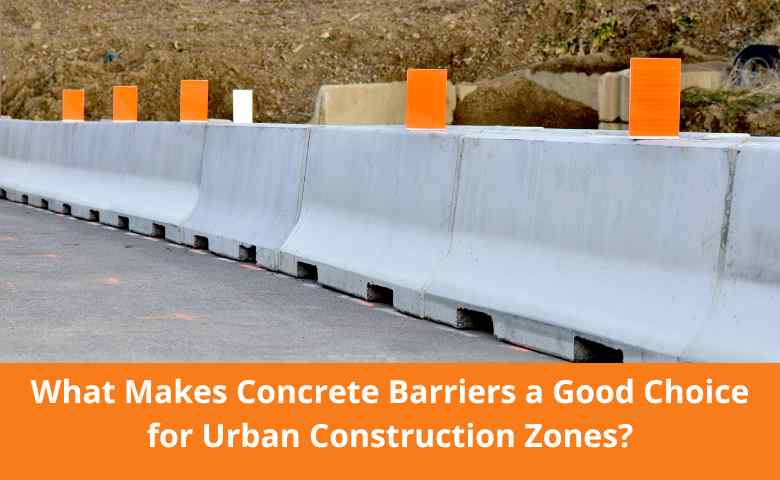
New Jersey barriers, characterized by their distinctive sloped design, are common on highways. They minimize vehicle damage and redirect cars back onto the road during collisions.
Temporary concrete barriers, often precast, allow for quick installation and removal in construction zones. These portable units provide flexibility for changing project needs.
F-shape barriers offer improved safety features compared to traditional designs. They reduce the likelihood of vehicle rollover during impacts.
Constant slope barriers maintain a uniform angle from base to top, providing consistent protection across their entire height.
Concrete safety shaped barriers combine aesthetics with functionality, often used in urban settings where appearance matters alongside safety considerations.
Conclusion
Concrete barriers are a reliable choice for urban construction zones. They provide robust protection for workers and pedestrians while effectively managing traffic flow. Their versatility allows for adaptable designs suited to various urban environments and project requirements.
These barriers offer significant safety benefits, reducing accidents and minimizing potential hazards in busy city areas. Their durability ensures long-lasting performance, making them a cost-effective solution for urban infrastructure projects.
Related Posts
- Best Civil Engineering Software Updated List 2024
- Why your Business could benefit from a Mezzanine floor
- Exploring Insulation Solutions for Different Climate Zones
- Safety and Aesthetics: Balancing Function and Style with Glass Railings
- 8 Must-Have Tools for Concrete Contractors
