

Last Updated on April 30, 2026 by Admin
For most of construction history, the staircase has been treated as a settled element of building design, a structural and regulatory item with a known footprint, a known geometry, and very little reason to be questioned. That assumption is no longer holding up under the pressures of modern urban construction, and for civil engineers, BIM specialists and early-career project managers entering the industry, compact staircase engineering is becoming a small but increasingly visible specialisation worth understanding.
ConstructionCareerHub App is LIVE — built ONLY for construction careers. Don’t apply with a weak resume.
Get ATS-ready Resume Lab + Interview Copilot + Campus Placement Prep (resume screening, skill gaps, interview readiness) — in minutes & Other advanced features.
Explore Smarter Construction Career Tools →Quick check. Big impact. Start now.
The reason is straightforward. Floor plates on urban projects are getting smaller. Loft conversions, mezzanine fit-outs, co-working insertions and compact residential schemes are growing as a share of the construction pipeline. And every square metre of usable area on these projects carries commercial weight that traditional staircase designs were never optimised against. Engineers who can specify, model and install compact vertical circulation are increasingly useful to the firms hiring them.
This article walks through what compact staircase engineering involves, using the patented 1m² staircase from EeStairs. It is the most fully developed product in this category in the UK market, and the engineering behind it illustrates the principles that apply more broadly.
Table of Contents
The structural problem to solve
The brief sounds simple, deliver a full storey rise within a one-square-metre footprint of floor and ceiling opening. The structural challenge is harder than it appears. A strictly vertical spiral staircase can be made to fit a small plan area, but the treads end up too narrow to function as a primary or even comfortable secondary stair which is why fixed ladders, not spiral staircases, have historically been the fallback for very tight openings.
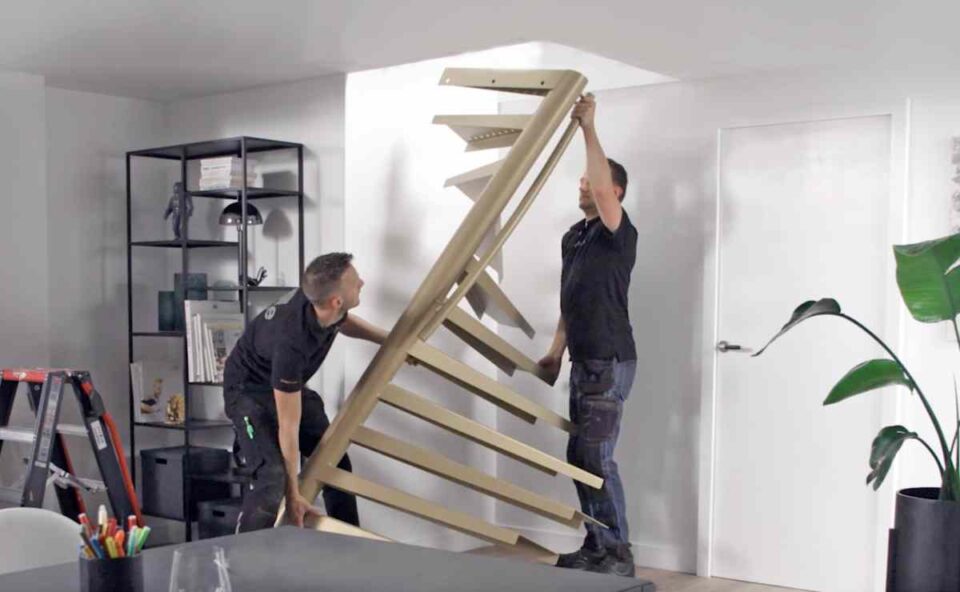
The 1m² design solves this with a subtly slanted central column. That slight angle is the structural device that allows a square spiral configuration to deliver wider treads than a vertical spiral would permit, without breaching the one-square-metre plan envelope. The result reads, looks and performs as a proper staircase rather than a ladder substitute. For an engineer studying the design, the slanted column is the detail worth understanding, it is what carries the constraint.
Oliver Schneider, Director of EeStairs UK, describes the design intent in functional terms: “The 1m² staircase has been carefully engineered to solve a very real issue in modern interiors: how to move between floors without sacrificing too much of the room below.”
Materials, load and compliance
Construction is in high-strength steel, with a tested load capacity of up to 300 kg. The unit complies with UK building regulations for secondary access stairs, which is the relevant regulatory category for loft conversions, mezzanines and similar applications.
The compliance position is the practical point for early-career professionals to internalise. A compact staircase that meets the secondary access regulations without project-specific approvals removes a layer of risk and delay that bespoke alternatives often carry into building control conversations. When you are working under a project manager whose programme depends on predictable approvals, knowing which products have settled regulatory positions and which do not is a useful piece of professional knowledge.
It is also worth noting that secondary access is not a euphemism for lower standard. It is a defined regulatory category covering specific use cases, typically routes to lofts, mezzanines and similar non-primary spaces with its own performance, geometry and load criteria. The 1m² staircase has been engineered against those criteria, not around them.
Specification through digital configuration
One of the more instructive aspects of the product, from a construction-process perspective, is how it is specified. Rather than commissioning bespoke drawings for what is, by design, a standardised envelope, the 1m² is specified through an online configurator. Architects, designers and experienced installers can enter dimensions, generate a 3D model and produce a costed quotation in a single working session. A technical drawing is then issued for approval, and delivery or installation typically follows within around five weeks.
For BIM specialists and digital construction professionals, this is a useful example of how product manufacturers are folding configurator workflows into the early specification stages of a project. It shortens the design-to-procurement loop in a way that bespoke staircase commissions, which can run to weeks of drawing iteration, simply cannot match.
The configurator also accommodates over 200 RAL colours and finishes, alongside clockwise or anticlockwise configuration. As staircase design specialist Oliver Schneider puts it, the goal is to allow clients to visualise and personalise the staircase without compromising technical accuracy, a useful design principle for any engineer thinking about how digital tools should serve specification, not the other way around.
Installation as a design factor
The installation profile is where the engineering of the product translates most directly into site work. Two trained installers can assemble the staircase in under two hours using standard tools, with no cranes, no mechanical lifting and no structural intervention beyond the prepared floor opening.
For a junior site engineer or a project coordinator, this is the kind of practical detail that quickly becomes useful to know. Compact circulation solutions that require heavy lifting equipment or structural intervention often get ruled out at design stage on occupied buildings, finished shells, or sequenced residential programmes. A unit that can be installed in two hours by two people with hand tools is feasible in environments where most alternatives are not.
It is also why the product’s relevance now reaches beyond residential conversions into the wider fit-out, refurbishment and small-commercial segments, a useful pattern to recognise. Products that win specification at the small end of the market often do so because they remove site logistics constraints, not because they are cheaper or more elegant than alternatives.
What this means for early-career professionals
Compact staircase engineering is a narrow specialisation, but it sits at the intersection of several broader shifts that civil engineers, BIM professionals and construction managers will encounter throughout their careers; densification, the commercial pressure on usable floor area, the move towards configurator-driven specification, and the growing weight given to installation logistics in product selection.
For students and early-career professionals studying real-world examples of how engineering responds to constraint, the 1m² staircase is a clean case study. It was designed from the constraint outward one square metre, full storey rise, code-compliant, two-person install and every detail of the engineering, from the slanted central column to the configurator workflow, can be traced back to one of those starting conditions.
That kind of constraint-led engineering is increasingly the default brief on urban and high-density projects, not a niche requirement. Recognising it, understanding the principles behind it, and being able to specify or model products built on those principles is a practical piece of professional knowledge worth carrying into the industry.
Related Posts:
- Civil Design Engineer Job Description and Salary Details
- 4 Things You Need To Know About Compact Construction Equipment
- Compact Excavators for Rent: Everything You Need to Know
- Compact Track Loader: Small Size, Big Impact on Construction Sites
- Top 5 Innovations That Are Rapidly Changing the Construction Industry
