

Last Updated on December 1, 2025 by Admin
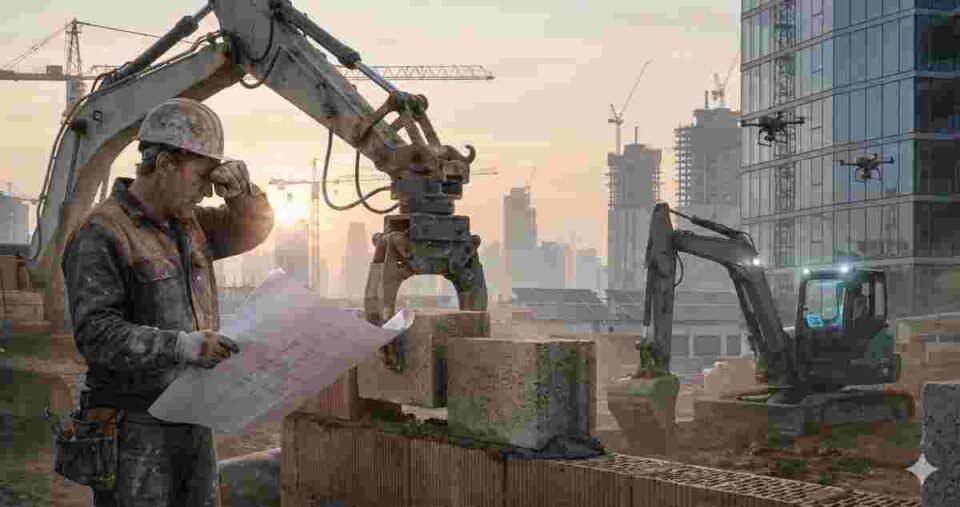
The construction sector is entering a historic transformation. After decades of heavy manual labour, the industry is adopting automation in construction through AI, robotics, drones and digital fabrication. While the sector still needs hundreds of thousands of workers, automation is changing how work gets done. The International Federation of Robotics reports that India, now the world’s sixth‑largest installer of industrial robots, installed more than 9,100 robots in 2024 and its robot stock climbed to 52,570 units by 2024, signalling rapid adoption across industries.
ConstructionCareerHub App is LIVE — built ONLY for construction careers. Don’t apply with a weak resume.
Get ATS-ready Resume Lab + Interview Copilot + Campus Placement Prep (resume screening, skill gaps, interview readiness) — in minutes & Other advanced features.
Explore Smarter Construction Career Tools →Quick check. Big impact. Start now.
Globally, analysts expect activities that account for up to 30% of hours worked to be automated by 2030. In construction, this does not mean jobs vanish. Demand for infrastructure and housing will still require people. However, specific tasks will be performed by machines, shifting the skills workers need. Below, we examine the forces driving automation and spotlight the top 10 construction jobs that will see significant automation by 2030, along with guidance on how to prepare.
Table of Contents
What Is Driving Automation in Construction?
AI, Robotics, and Autonomous Equipment
Robots are no longer limited to factories. Autonomous earth‑moving vehicles such as driverless excavators and bulldozers can dig foundations using sensors and GPS. Bricklaying machines construct walls with precision, and rebar‑tying robots autonomously tie steel reinforcement at rates exceeding 1,200 ties per hour, working day or night with 99% accuracy. These advances reduce back‑breaking manual work and allow humans to supervise rather than perform repetitive tasks.
Prefabrication and Modular Construction
Manufacturing building components in controlled factories means more automation. Modular construction pioneers report that robots now perform heavy lifting and assembly tasks in modular plants, attracting younger workers and reducing injuries. 3D‑printing robots have produced two‑storey commercial buildings and highway sound barriers. Off‑site manufacturing shortens schedules and minimises waste while requiring operators who can program and maintain robots.
Drones and BIM
Drones perform surveys and inspections faster and more safely than humans. They can navigate hard‑to‑reach areas, produce detailed 3D models, and reduce surveying time by about 60%. Building Information Modelling (BIM) integrates digital design with on‑site robotics; for example, “field printers” draw full‑scale layouts on floors so crews know exactly where posts, walls, and services should go.
Labour Shortages and Cost/Safety Pressures
The construction industry faces acute labour shortages. In the U.S., nearly 439,000 additional workers will be needed in 2025, while India has a shortage of skilled workers and is launching training centres to address it. Automation mitigates these shortages by handling repetitive tasks, reducing physical strain and improving safety. Drywall finishing robots, for example, cut schedules by 60% and labour requirements by approximately 40% while reducing musculoskeletal injuries. Robot adoption is further driven by cost savings; Mordor Intelligence market report estimates the construction‑robot market will double from USD 442 million in 2025 to USD 909 million by 2030 (15.5% CAGR).
10 Top Construction Jobs Likely to Be Automated by 2030
Automation does not eliminate roles; it changes them. The jobs below will shift from manual execution to supervision, programming, and maintenance of machines. The timeline column reflects when automation is expected to move from pilot projects to mainstream use. “Risk” is relative—high means a large portion of tasks can be automated, not that every position will vanish.
| Job Role | Why At Risk | Automation Technology | Timeline | Risk Level |
|---|---|---|---|---|
| 1. Bricklayer/Mason | Repetitive, rule-based laying; robots excel at precision and speed | SAM100, Hadrian X, Construction Robotics machines | 2025–2028 | High |
| 2. Rebar Worker | Tying steel reinforcement is repetitive and physically demanding | TyBOT by Advanced Construction Robotics | 2024–2027 | High |
| 3. Site Surveyor | Drones & scanners capture data faster with higher accuracy | Drones, LiDAR, photogrammetry, AI processing | 2023–2026 | Medium-High |
| 4. Layout Technician | Field printers automate floor layout markings at scale | Dusty Robotics FieldPrinter, BIM-linked robots | 2024–2028 | High |
| 5. Demolition Worker | Hazardous environment; robots improve safety dramatically | Remote-controlled demolition robots (Brokk, Husqvarna) | 2023–2027 | Medium |
| 6. Drywall Finisher | Repetitive sanding/taping; robots achieve consistency | Canvas (Universal Robots), finishing automation | 2025–2029 | High |
| 7. Heavy Equipment Operator | Autonomous excavators and graders reduce the need for operators | Built Robotics, Caterpillar autonomous vehicles | 2025–2030 | Medium |
| 8. Painter (Interior/Exterior) | Consistent spray patterns; robots minimize waste and time | Robotic spray painters (ABB, KUKA) | 2026–2030 | Medium |
| 9. Concrete Worker | Pouring, leveling, and finishing can be handled by machines | 3D concrete printers, automated screeding robots | 2024–2029 | Medium-High |
| 10. Material Handler/Forklift Operator | Repetitive transportation; autonomous vehicles excel here | Autonomous forklifts, material-carrying drones | 2024–2028 | Medium-High |
Why These Roles Are at Risk
- Repetitive, rule‑based tasks are easy for robots. Robots never tire and can work day or night, rain or shine.
- Hazardous or physically demanding work (demolition, heavy lifting, high‑reach finishing) is being automated to improve safety.
- Precision and speed: Robots deliver consistent quality and can complete tasks faster than humans—drywall finishing robots reduce schedules by 60%.
Are These Jobs Gone or Just Changing?
Jobs are evolving, not disappearing. Bricklayers will transition into robot operators and finishers, ensuring aesthetic quality and solving problems that robots cannot. Rebar workers become robot supervisors monitoring TyBOT and handling exceptions. Layout technicians will integrate BIM models with drones and field printers. These jobs require upskilling in programming, data interpretation, and AI‑assisted decision‑making.
New Roles Will Replace Eliminated Tasks
- Robot Supervisors and Technicians: oversee and maintain fleets of construction robots
- BIM Managers/Coordinators: manage 3D models and integrate them with robotic equipment
- Construction Data Analysts: interpret data from drones and robots to improve productivity and safety
- AI Safety Officers: ensure safe deployment of autonomous machines and protect workers
- Automation Technicians: maintain and program equipment in modular factories
High‑Demand Construction Careers After Automation
Instead of fearing automation, workers should prepare for high‑growth roles created by technology adoption. Demand will grow for:
- Robotics Supervisors: monitor, troubleshoot and schedule robots across job sites
- BIM Managers/Coordinators: integrate design models with on‑site robots and manage digital twins
- Construction Data Analysts: analyse sensor, drone and scanner data to optimise schedules and safety
- AI & Cyber‑Safety Officers: oversee AI systems, protect data and ensure robots operate safely
- Automation Technicians: install and maintain robots in modular plants and on site
These roles combine construction knowledge with digital skills and pay well, making them attractive to young professionals entering the future of construction.
How Indian Workers Can Future‑Proof Their Careers
India’s construction industry is poised for growth; it is expected to become the third‑largest construction market by 2025. Technological advances such as BIM, robotics and drones are transforming Indian sites. At the same time, the sector faces a skilled‑labour shortage, prompting both government and private organisations to expand training centres.
To Stay Ahead:
1. Pursue courses in robotics and BIM
Institutions like the National Skill Development Corporation (NSDC) and IITs offer certifications in BIM, drone operations and robotics. International online platforms provide robotics programming and AI safety courses.
2. Develop digital literacy
Learn to interpret 3D models, read sensor data and use project‑management software. Understanding construction technology trends is essential for modern construction professionals.
3. Gain field experience with technology
Seek internships or positions with firms adopting drones, field printers or modular construction to build practical skills.
4. Embrace lifelong learning
The labour market is evolving; continuous upskilling is essential for long‑term employability. Consider pursuing BIM certifications and staying updated with emerging technologies.
5. Explore global opportunities
With Asia‑Pacific projected to be the fastest‑growing market for construction robots, skilled Indian workers can pursue roles abroad.
Conclusion and Career Action Plan
Automation is rapidly transforming construction by enhancing productivity, safety and quality. Robots lay bricks, tie rebar, survey sites and finish interiors. Drones and BIM streamline planning, while modular factories harness robots for mass housing. These technologies address labour shortages and create safer, more efficient job sites. As 30% of tasks across the economy may be automated by 2030, the skills demanded in construction will change, but the need for people remains.
The opportunity is clear: embrace technology rather than resist it. Workers should cultivate digital skills, pursue training in robotics and BIM, and pivot into roles that design, operate and manage automation. India’s rapid adoption of robots and massive construction growth make this especially urgent. By upskilling now, professionals, students and job seekers can secure rewarding careers in a future where automation is a tool—not a threat.
Start Learning Automation‑Ready Skills Today
Enrol in a BIM or robotics course, seek internships with tech‑forward construction firms, and stay updated on construction technology trends. Adaptability is the new career currency; those who embrace change will build the cities of tomorrow.
Related Articles
- What is Construction Robotics and its Applications
- Robots & Automation: Transforming the Future of Construction
- BIM Career Guide: Your Gateway to High-Demand Construction Roles
- How Smart Construction Technology is Transforming the Industry
- Top 27 Emerging Trends in Construction Technology for 2025
- Job Opportunities in Construction Robotics: A Complete Guide
- How Civil Engineers Can Thrive in the Age of AI and AGI
- Smart Site Engineer: Top Tech Skills for 2025
- 15 Construction Robotics Companies Disrupting the Industry for 2026
- Future-Proof Construction: Essential 2030 Skills
