

Last Updated on March 17, 2026 by Admin
Every cold storage operator managing a portfolio of facilities understands the fundamental challenge: no two sites are identical. One location runs an ammonia refrigeration system installed in 1998. Another relies on CO₂ cascade technology commissioned five years ago. A third operates with a leased compressor plant managed by the landlord, not the tenant. A fourth has variable frequency drives retrofitted to aging Frick equipment. Multiply that variation across 20, 50, or 100 facilities, and the operational picture becomes impossible to navigate with traditional site-by-site management approaches.
ConstructionCareerHub App is LIVE — built ONLY for construction careers. Don’t apply with a weak resume.
Get ATS-ready Resume Lab + Interview Copilot + Campus Placement Prep (resume screening, skill gaps, interview readiness) — in minutes & Other advanced features.
Explore Smarter Construction Career Tools →Quick check. Big impact. Start now.
According to the Global Cold Chain Alliance, the cold storage industry operates with a mixture of facility ages and technological baselines that resists standardization. Managing these disparate sites as a unified portfolio is not a simple scaling problem. It is a fundamentally different operational challenge that demands a different approach to visibility, control, and performance management.
Table of Contents
The Legacy of Unplanned Portfolio Construction
Most large cold storage portfolios were not designed as integrated systems. They accumulated through acquisition, lease agreements, and organic expansion over decades. Research from NAIOP’s 2023 Cold Storage Conference on I.CON emphasized that portfolio fragmentation remains one of the defining challenges in multi-site cold storage management, particularly as facilities range from pre-2000 construction to state-of-the-art designs built in the past five years.
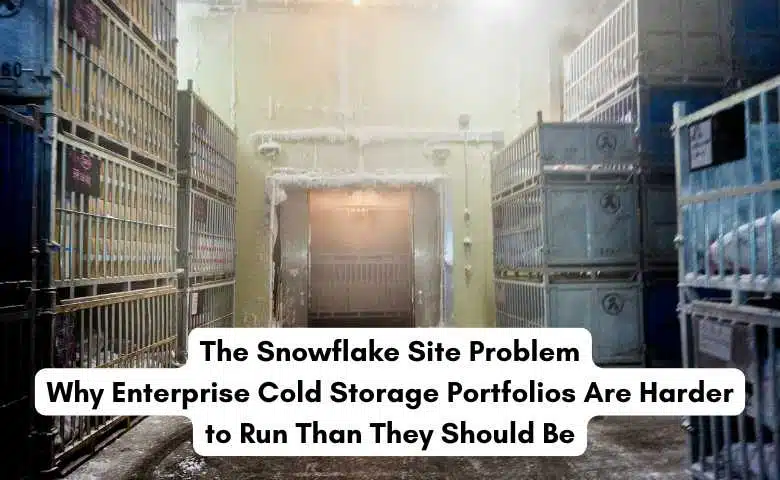
This fragmentation creates what experienced operators call the snowflake problem: each facility is unique in ways that matter operationally. Refrigerant types differ. Control architectures vary. Compressor designs range from reciprocating models to modern screw units. Monitoring capabilities span from manual log sheets to real-time telemetry. Alarm thresholds and response protocols are site-specific. The result is that institutional knowledge cannot transfer across the portfolio. A technician trained at one facility cannot assume the procedures at another will match.
When an operator oversees 30 or more sites, this diversity becomes unmanageable through conventional means. The operator cannot maintain consistent operational standards because no unified operational language exists across the portfolio. Each site runs on its own terms, with its own history, its own documentation gaps, and its own informal maintenance practices.
Why Portfolio-Level Visibility Becomes Critical
The core challenge is that portfolio-level intelligence requires aggregating data from disparate, non-standardized sources into actionable insight. What makes this tractable at scale is enterprise industrial control automation that integrates site-level operational data from non-standardized control systems into a unified monitoring layer, enabling real-time cross-portfolio benchmarking and anomaly detection that managing sites individually cannot provide. Without this integration layer, an operator managing 30 sites receives 30 independent streams of alerts, reports, and performance data with no mechanism to prioritize or contextualize them.
A single-site operator with a well-instrumented facility can see every compressor’s performance trend, every condenser’s fouling trajectory, and every thermal load’s seasonal pattern. That operator makes decisions based on integrated, real-time information. A portfolio operator managing 30 sites through disconnected legacy systems sees only site-level summaries, manual reports, and monthly utility bills. The data exists somewhere in the portfolio, but there is no common platform to access it, compare it, or act on it simultaneously across multiple locations.
Recent industry analyses, including the 2024 cold storage market research by Cushman & Wakefield, highlight that energy efficiency, operational consistency, and technology integration have become mandatory priorities for operators competing on cost and reliability. Facilities averaging 40 years in age cannot achieve those outcomes through manual, site-by-site operations.
| The Aging Infrastructure Gap According to the Global Cold Chain Alliance data, more than 60 percent of operating cold storage capacity in North America was constructed before 2000, with an average facility age of 42 years. This aging infrastructure creates a fragmented operational landscape where legacy control systems, diverse refrigerant types, and varying equipment vintages make portfolio-level standardization technically and economically impractical. Source: Global Cold Chain Alliance, Cold Storage Capacity Report. |
The Operational Cost of Fragmented Visibility
Inefficient resource allocation
When each site generates its own alerts and operates independently, portfolio operators lose the ability to prioritize intelligently. A minor refrigerant charge issue triggering a low-efficiency alarm at a leased cold storage facility gets the same response attention as a critical compressor fault at a flagship distribution center. Without portfolio-level context, response is driven by loudness and urgency, not business impact.
Invisible energy performance drift
Energy represents 10 to 18 percent of cold storage operating costs, making it the second-largest expense category after labor. Industrial Refrigeration Pros documented that equipment-level efficiency degradation accumulates gradually through refrigerant charge drift, condenser fouling, compressor wear, and control calibration drift. Without portfolio-wide cross-site benchmarking, an individual facility running 10 to 15 percent above its design efficiency baseline can do so invisibly for years. The operator sees no anomaly because there is no comparative baseline across similar facilities.
Institutional knowledge loss at transition
Cold storage facilities, like all industrial infrastructure, depend on accumulated operational knowledge. When staff turnover occurs, that knowledge is often undocumented and lost. At portfolio scale, this problem multiplies. An operator with 30 sites loses critical maintenance procedures, undocumented equipment modifications, and informal operational best practices faster than they can be recorded and transferred.
From Site-Level Triage to Portfolio-Level Management
The solution is not replacing legacy systems at each site, which is economically prohibitive. It is establishing a data integration layer that creates operational equivalence across diverse infrastructure. This means translating the outputs of each site’s unique systems— control logic, alarm thresholds, monitoring equipment, refrigerant type— into a common operational language.
The industry trajectory is clear. Cold Summit’s 2026 industry outlook identifies centralized monitoring and AI-driven anomaly detection as the defining operational trends for the next two years. Operators who implement portfolio-level visibility platforms now gain a structural advantage over competitors still managing each snowflake individually.
Effective portfolio management requires four capabilities that site-by-site operations cannot deliver. First, a common data model that normalizes diverse site-level inputs into comparable formats. Second, real-time visibility across all sites simultaneously, showing which facilities are deviating from established baselines. Third, cross-site benchmarking that exposes outliers and performance gaps before they become emergencies. Fourth, intelligent alarm prioritization that reflects portfolio-level business risk, not just site-level technical thresholds.
The Competitive Advantage in Portfolio Clarity
The cold storage operators building portfolio-level visibility today are creating a structural competitive advantage. They can optimize energy performance across 30 sites faster than competitors can fix inefficiency at a single location. They can predict maintenance needs before equipment fails. They can allocate labor and resources to the facilities with the greatest operational or financial impact, not based on which alarm fired first.
The snowflake problem does not disappear. Individual facilities will remain operationally diverse for decades. But diversity does not require opacity. The technology to bring clarity to a fragmented portfolio exists today. The operators who implement it first will be the ones managing portfolios as integrated units, not collections of independent sites.
Related Posts
- Top 25 Resume & Portfolio Questions Asked in Construction Interviews [2026]
- 8 Helpful Tips for Managing Plumbing Emergencies at Home
- Optimizing Transload Logistics: Digital Tools, Real-Time Visibility & Supply Chain Integration
- Exploring Insulation Solutions for Different Climate Zones
- Various Business Domain where a Civil Engineer can find Employment
