

Last Updated on January 9, 2026 by Admin
In this article, we have explained the difference between an EPC and a Turnkey project. What is EPC, and what are the Turnkey projects? Find here all you want to know about EPC and Turnkey Projects.
ConstructionCareerHub App is LIVE — built ONLY for construction careers. Don’t apply with a weak resume.
Get ATS-ready Resume Lab + Interview Copilot + Campus Placement Prep (resume screening, skill gaps, interview readiness) — in minutes & Other advanced features.
Explore Smarter Construction Career Tools →Quick check. Big impact. Start now.
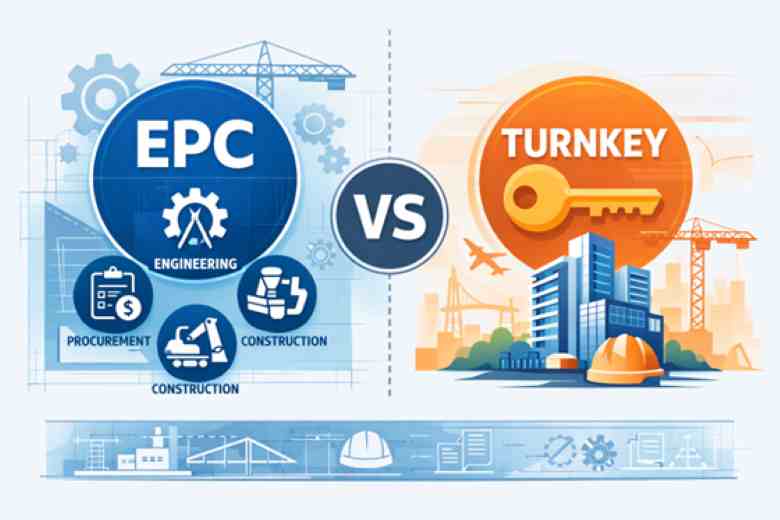
Engineering‑Procurement‑Construction (EPC) and turnkey contracts are common ways to deliver complex infrastructure and industrial projects. An EPC agreement requires the contractor to design, procure and construct a facility before handing it over to the client. Turnkey agreements go further by providing a ready‑to‑operate facility so the client can simply “turn the key”. Choosing the right model affects cost, risk allocation, schedule, and project outcomes.
Table of Contents
What Is an EPC Contract?
EPC Project
EPC stands for Engineering, Procurement, and Construction. Under this model, a single contractor is responsible for designing the project, purchasing all materials and equipment, constructing the facility and delivering it to the client. The contractor takes full responsibility for performance and quality standards.
Key points include:
- Scope: The contractor handles the entire project life cycle — from detailed design and procurement through construction and commissioning.
- Project management: The EPC contractor manages scheduling, coordination, and supervision of all project activities.
- Design responsibility: The contractor provides the detailed engineering and technical specifications.
- Procurement: The contractor purchases all materials and equipment required for the project.
- Pricing: EPC contracts may be lump‑sum or cost‑reimbursable. Pricing often reflects details. engineering and specified materials.
- Risk allocation: The contractor bears significant design, procurement, and construction risk.
Because the EPC contractor assumes most of the risk, this model offers certainty and reduces the client’s management burden. However, obtaining full EPC “wraps” in 2026 is increasingly difficult because contractors are reluctant to take on the entire burden of delivery under a fixed‑price arrangement. In volatile markets, purchasers sometimes adopt EPCm (engineering, procurement, and construction management), which shifts more responsibility to the owner.
What is EPC mode in construction?
EPC stands for Engineering, Procurement, and Construction. This is used in the construction industry to ensure a project is completed on time and within budget.
It involves allocating resources wisely, coordinating efforts between different parts of the construction team, and maintaining communication between all stakeholders.
EPC can help to improve the quality of a project as well as reduce costs. EPC mode in construction includes all the steps necessary to design, build, and maintain a project.
A civil works EPC contract is a legal agreement between a client and contractor in which the contractor agrees to design, finance, build, and operate an infrastructure project.
The key difference between a civil works EPC contract and other contracts is that the contractor takes on more risk under an EPC contract. This means that the contractor is responsible for any cost overruns or schedule delays that occur during the project.
What are the EPC Project Examples
Many power plants, oil & gas facilities, and chemical plants are delivered via EPC contracts. For example, the EPC contractor designs the plant, procures major equipment such as turbines or reactors and constructs the facility. This model is popular in energy projects where performance guarantees and compliance with industry standards are critical.
Here are some of the Prominent EPC Companies:
- TechnipFMC Plc, United Kingdom
- McDermott International, Inc., USA
- Saipem, Italy
- Worley, Australia
- Samsung Engineering India Pvt Ltd., India
- Linde Engineering India Pvt. Ltd. Vadodara
What Is a Turnkey Project?
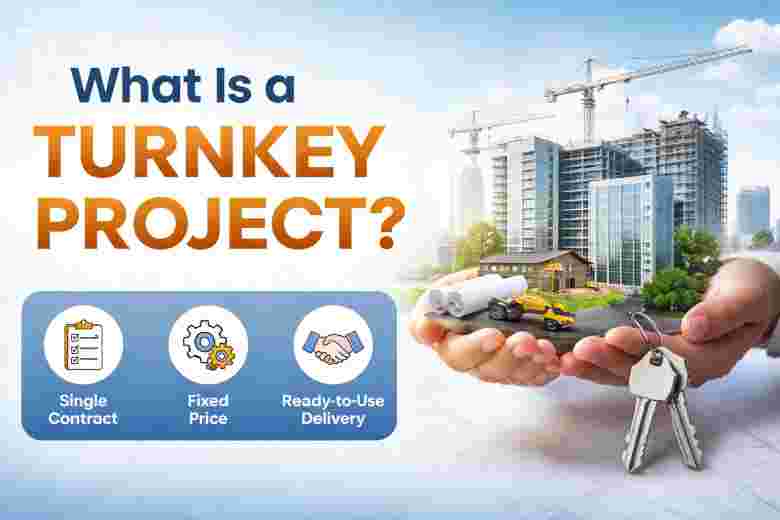
A turnkey contract delivers a facility that is fully designed, built, equipped, and ready for immediate operation. The term reflects the idea that the client can literally “turn the key” and start using the facility. Notable features include:
- Scope: The contractor takes complete responsibility for design, procurement, construction, commissioning and validation
- Client input: The client usually provides only basic technical requirements; the contractor prepares and executes the detailed design
- Risk: The contractor assumes nearly all risk for cost, schedule and performance
- Lump‑sum pricing: Turnkey contracts are often fixed‑price (lump sum), giving cost certainty
- Commissioning & warranty: Turnkey contracts typically include longer warranties and post‑commissioning support
Turnkey projects are common for airports, ports, bridges and large industrial plants. They suit owners who want a single point of responsibility and minimal involvement in day‑to‑day decisions.
One of the unique modes of carrying out international business is a turnkey project. Turnkey projects mean a contract under which a firm agrees to fully design, construct and equip a manufacturing/ business/ service facility and turn the project over to the purchaser when it is ready for remuneration.
The term turnkey project (Turn-key delivery) describes a project (or the delivery of such) in which the supplier or provider is responsible to the client for the total result of the project and presents it to the client, finished and ready to use.
The term turnkey project is a turnkey solution, turnkey delivery, or ready-to-use. The client should be able “just to turn the key.” The turnkey project supplier is the general contractor (leading supplier, direct supplier, or main contractor).
Turnkey projects in practice: In a turnkey project, the supplier takes on complete responsibility for the adherence to delivery dates, the scope, and the cost of the entire delivery subject to the customer.
Thus, the customer is not affected by any risks inside the project, and the project result is covered by one agreement.
Also, turnkey project management means having a team that can handle all aspects of a project from start to finish. This allows for a more streamlined process and eliminates the need for multiple vendors.
Turnkey Projects examples
Airports, ports, and major bridges are often delivered as turnkey projects. The contractor designs the infrastructure, procures all materials, constructs the facility, and hands over a fully operational system. Turnkey is also common in information‑technology systems, where the provider installs hardware and software that are ready to use.
What is a Lump Sum Turnkey Contract
A lump sum turnkey contract is a construction contract in which the contractor agrees to provide all labor, materials, and equipment necessary to complete the project.
The owner pays a lump sum price for the entire project, and the contractor is responsible for ensuring that the project is completed according to the agreed-upon specifications. This type of contract is often used for large construction projects, such as building a new factory or office complex.
What is meant by Turnkey Contract?
A turnkey contract is a contract where the contractor provides all the necessary resources and personnel to complete the project.
This means that the contractor has complete control over what is done on the project. The contractor may also provide pre-determined specifications or guidelines for how the project should be completed.
Related Posts:
- Unlocking the Potential of Turnkey Project Contractors in the Construction Industry
- 151 Most Important Construction Terms To Know
- 177 Common Terms Used in Civil Engineering and Their Full Forms
- Top 100 Common Terms and Abbreviations Used in Construction and Civil Engineering
What is an EPC Turnkey Contract?
EPC Turnkey Contract is a contract that is typically used by businesses to provide services such as construction, engineering, and procurement. Under this contract, the business will contract with an EPC firm to provide these services on a project-by-project basis.
This means that the EPC firm will be responsible for all aspects of the project, from beginning to end. This includes managing the project team, overseeing the work being done, and ensuring that the deadline is met.
What is the difference between an EPC and a Turnkey Project?
Here are some of the common differences between the EPC and Turnkey projects.
EPC vs Turnkey: Key Differences
|
Aspect |
EPC Contract |
Turnkey Contract |
|
Scope of work |
Contractor handles design, procurement, construction, and commissioning |
Contractor delivers a fully operational facility; client only provides basic requirements |
|
Design responsibility |
Contractor provides detailed engineering based on the client’s basic design |
Contractor prepares both basic and detailed design |
|
Procurement |
Contractor purchases all materials and equipment |
Contractor handles procurement and equipment integration |
|
Pricing |
Lump‑sum or cost‑plus pricing based on detailed engineering |
Usually a lump‑sum (fixed‑price) that includes all design and construction |
|
Risk allocation |
Contractor bears most risks; client provides basic design and may share commissioning risk |
Contractor assumes nearly all design, cost, and schedule risks |
|
Client involvement |
Clients contribute to basic design and key decisions; more oversight |
Clients provide minimal input; contractor manages all activities |
|
Completion time |
Depends on project complexity; may be longer due to client involvement |
Often faster because the contractor streamlines design and construction |
|
Change orders |
Changes are accommodated through formal change orders |
Change orders are more challenging once the scope is agreed upon |
|
Maintenance & warranty |
Limited warranty and maintenance are transferred to the client after completion |
Longer warranty and maintenance support included |
EPC Project
EPC = Engineering Procurement and Construction.
These engineering, procurement, and construction jobs are helpful but can involve some significant differences. It is good to see what differences between EPC and turnkey contracting.
The first thing involves the depth of the project that is being handled. An EPC project will include a contractor working with basic engineering procedures. This can help ensure that a business will be set up correctly with the right engineering plans for unique needs.
A turnkey project will involve more specific rules for technical procedures. This is often used to help make it a little easier for a person to handle more controls without an issue getting in the way of things.
The next difference involves who is responsible for getting a design for EPC and turnkey contracting ready. An EPC plan will include the contractor getting a complete system design ready to be more effective and easier to read.
Meanwhile, a turnkey process will involve a contractor dealing with special considerations for handling property and designing things based solely on the type of specifications that come with the property.
There is also the point about the contractor having to work with assigning the right people for the construction process.
An EPC process will involve the contractor working on getting another party to get the startup construction process. The turnkey process will include the contractor being fully responsible for every part of what is happening here.
This is often used to help make it a little easier for a property to be arranged as carefully as possible to prepare engineering plans.
The interesting point about getting EPC and turnkey contracting plans going is how they both work with different kinds of procedures to work with varying costs in mind.
However, the total cost of getting EPC and turnkey projects contracting in India should be the same regardless of the type of control being handled in the process. This fascinating point makes it a little easier for anyone to handle contracting functions for all kinds of business purposes around India.
The differences between EPC and turnkey project contracting are great points that must be seen when trying to find ways to get different kinds of procedures handled.
This is used as a means of helping to see how it works and whether or not a person will be controlled as well as it can for the best possible needs that a business will have.
From the role & responsibility point of view
Turnkey Projects: You can turn the key and start using the facility. So it indicates the contractor scope includes all the activities and facilities required to start operation on a single-point responsible basis.
EPC: EPC indicates a contractor is responsible for the Engineering, procurement, and construction of a particular facility/work awarded to them.
Example: A hotel project awarded on a turnkey basis means the contractor is responsible for completing all activities leading to the final operation level (handing over to the operation team).
You can’t divide this project into different activities like Civil, MEP, etc., and award it on a turnkey basis to various contractors. On an EPC, you can award only MEP works on the EPC or Sewage Treatment Plant (STP) work on the EPC.
From the risk point of view
Turnkey Projects: An Employer can do engineering & procurement (full or partial) and appoint a contractor to execute the work on a turnkey basis. Here, the Employer can decide to take more risks in engineering, procurement, or both.
EPC: An employer doesn’t want to take any risk regarding a particular work (like the Sewage Treatment Plant example given above). So he wants to keep all three components within the scope of a single contractor.
Any engineering, procurement, or construction failure will rest with the contractor. Also, variations to the Contract will be minimal for an EPC contract.
From an execution point of view
Turnkey Projects are preferred where several activities are involved. The single-party system reduces coordination efforts with many contractors that are required otherwise.
EPC: is preferred where complex engineering or proprietary technology is involved, like in oil & gas and process plants.
An EPC project is the same as a turnkey project, collectively called an EPC turnkey project.
An EPC contract encompasses the E (Engineering/Design), P (Procurement), and C (Construction), which is the entire project from concept to commissioning (turnkey).
However, EPC is an extended and sometimes wrongly used term. Some projects may be EPCM, where only the design, procurement, and construction management ( not the actual construction part, just its management).
Sometimes, even individual portions of a project, like engineering, procurement, or construction, may be handed to a particular company. Thus, if all components E, P & C are awarded to the same company, it is, in essence, an EPC turnkey project.
Additional considerations
- EPC Turnkey contract: In practice, many projects are delivered under EPC Turnkey (sometimes called LSTK — lump‑sum turnkey). This hybrid approach combines the EPC model with the turnkey obligation to deliver a ready‑to‑operate facility.
- EPCM & PMC: Owners may engage an EPCM (Engineering, Procurement, and Construction Management) contractor to manage design and procurement while multiple contractors handle construction. A PMC (Project Management Contractor) can oversee several EPC/EPCM packages on behalf of the owner.
Which Model Should You Choose?
Selecting between EPC and turnkey depends on project size, complexity, risk appetite, and the client’s desire for control. EPC models offer more flexibility and allow the client to retain some oversight of design and commissioning.
They can be suitable for process plants where proprietary technology or complex engineering is required. Turnkey models reduce management burden and provide cost certainty, making them ideal for facilities like hotels, hospitals, or manufacturing plants where the client wants a single point of responsibility.
According to construction lawyers, obtaining a full turnkey “wrap” is becoming harder because contractors are reluctant to take on the entire risk under a fixed‑price contract.
Owners sometimes pivot to EPCm contracts, which offer greater flexibility but shift more risk to the purchaser. In any case, understanding the benefits and risks of each model is essential before negotiating your contract.
Recommended Courses & Certifications
To deepen your understanding of EPC and turnkey contracts, consider these high‑impact online courses. Each link should be updated with your affiliate parameters (e.g., ?aff=yourcode).
- Project Delivery Methods and Contracts in Construction Management – University of Maryland (edX) – Learn how owners choose between EPC, turnkey, and EPCM delivery models and understand contract clauses, risk allocation, and pricing.
- EPC Contract in Oil and Gas Construction Projects – Udemy – A comprehensive course that teaches the structure and clauses of EPC contracts, negotiation strategies, and risk mitigation.
- Construction Project Management – Columbia University (Coursera) – This course covers project initiation, planning, scheduling, and cost control, with modules on different contract types, including EPC and turnkey (add your affiliate parameters).
- Certified Construction Manager (CCM) – CMAA – A respected certification focusing on cost control, risk management, contract administration, and project lifecycle management. It helps engineers formalise their knowledge and advance into management roles.
Related Posts:
- Where to start with choosing an industrial lifting company
- The Ultimate Guide to EPC Contractors: Meaning, Role, and How They Shape Modern Construction
- Should You Join a Small Construction Company or a Big EPC Giant as a Fresher?
- EPC Professionals in Demand: Top Construction Career Opportunities & Tips
FAQs
An EPC contract is a construction contract in which a single entity takes on the responsibility for the design and construction of a project. This arrangement is often used for large-scale projects, such as constructing a new power plant or factory.
A turnkey contract is an agreement between a business and a contractor in which the contractor agrees to complete a project or task according to pre-determined specifications, and the business agrees to pay for the work. The word “turnkey” comes from the fact that once the work is completed, all the business has to do is “turn the key” and start using the new product or service.
The key difference lies in responsibility and scope. In EPC contracts, the contractor delivers engineering, procurement and construction but the client may provide the basic design and share commissioning responsibilities. Turnkey contracts require the contractor to deliver a fully operational facility and take on nearly all risks, including detailed design, procurement, construction, commissioning and validation.
LSTK contracts provide cost certainty because the price is fixed. The contractor manages all aspects of the project and delivers a ready‑to‑operate facility. However, contractors assume high risk, making such contracts harder to secure in volatile markets.
EPC contracts typically provide shorter warranty periods and transfer maintenance responsibilities to the client after completion. Turnkey contracts often include longer warranties and maintenance support.
EPCM (Engineering, Procurement and Construction Management) contracts leave construction to multiple contractors while an EPCM firm provides design and procurement management. Owners retain more control and bear more risk compared with EPC or turnkey models.
