

Last Updated on December 23, 2025 by Admin
If you’re honest with yourself, you already know this feeling.
ConstructionCareerHub App is LIVE — built ONLY for construction careers. Don’t apply with a weak resume.
Get ATS-ready Resume Lab + Interview Copilot + Campus Placement Prep (resume screening, skill gaps, interview readiness) — in minutes & Other advanced features.
Explore Smarter Construction Career Tools →Quick check. Big impact. Start now.
You’ve gained experience.
You’ve handled tougher projects.
You’ve solved site problems, managed pressure, and delivered outcomes.
Yet when you look at your payslip, nothing has moved in years.
This isn’t laziness.
It isn’t a motivation issue.
This is salary stagnation—and in construction careers, it silently holds back thousands of capable professionals.
This guide gives you a realistic, construction-specific 12-month pay raise plan, supported by practical tools that help you measure, benchmark, and execute—not guess.
Table of Contents
What Salary Stagnation Really Means in Construction
Salary stagnation in construction occurs when your experience increases, but your market value does not.
You may be:
- Working on larger projects
- Managing teams or packages
- Carrying more responsibility
But your role positioning and compensation remain flat.
In construction, time does not increase pay.
Only measurable value, scarcity, and market positioning do.
That’s exactly why the first step is not “working harder,” but knowing where you stand in the market.
Step Zero (Most People Skip This): Know Your Market Salary
Before planning any raise, you must answer one question clearly:
Am I actually underpaid—or just uncomfortable?
Most professionals rely on:
- Office gossip
- Old offer letters
- Random LinkedIn posts
That’s unreliable.
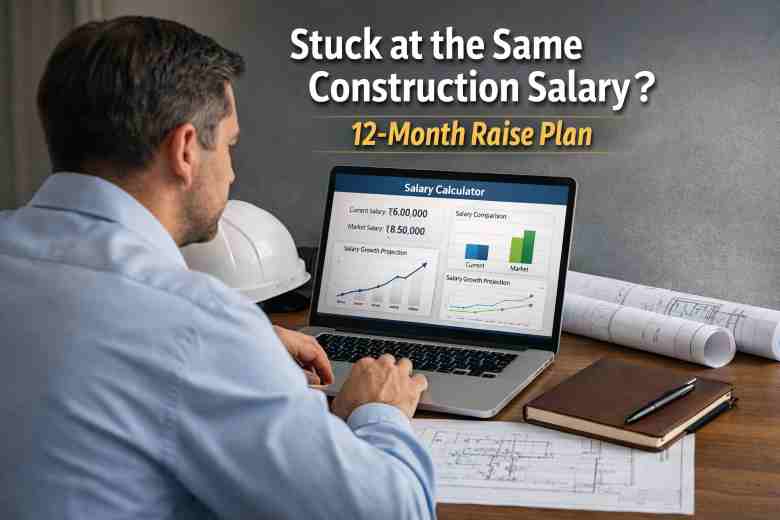
Instead, start with a data-backed benchmark using the Construction Salary Calculator:
This tool helps you:
- Benchmark your salary by role, experience, location, and skill set
- See how far you are from market-aligned pay
- Identify whether stagnation is real—or perception-driven
Without this clarity, every career decision becomes emotional instead of strategic.
Why Construction Professionals Get Stuck at the Same Salary
Here are the real reasons, not polite explanations.
1. Role Plateau Without Value Expansion
Doing the same site activities year after year signals stability—not growth.
2. Being Busy Instead of Revenue-Relevant
Companies pay more for:
- Cost control
- Time reduction
- Risk mitigation
- Claims avoidance
Effort alone doesn’t move the salary needle.
3. No Commercial or Strategic Visibility
If your work doesn’t influence cost, planning, or decisions, you remain replaceable.
4. Weak Market Signaling
An outdated CV or vague LinkedIn profile hides your real value.
Use tools like:
- AI Resume Review & Optimizer (Construction-focused)
- Career Role Fit Analyzer
to fix how the market sees you—not just how you perform.
5. Loyalty Without Leverage
Staying too long without renegotiation removes urgency for employers.
Quick Career Assessment: Are You Truly Underpaid?
Ask yourself:
- Has my salary grown meaningfully in the last 2–3 years?
- Does my pay match what the salary calculator shows for my role?
- Do recruiters approach me with better opportunities?
- Can I clearly show how my work saves time or money?
- Would replacing me disrupt projects?
If more than two answers are uncomfortable, salary stagnation is real—and fixable.
The 12-Month Pay Raise Plan (With Tools That Actually Help)
This is not a theory. It’s a four-quarter execution plan.
Months 1–3: Career & Salary Reality Check
Focus: Awareness and positioning
Actions:
- Benchmark your salary using the Salary Calculator
- Audit your current role vs market demand
- Identify gaps in tools, exposure, and decision-making
Helpful tools:
Outcome:
You stop guessing and start planning.
Months 4–6: Skill Stacking That Raises Pay (Not Workload)
Focus: Scarcity creation
Choose one or two high-value skill areas:
- Planning & scheduling
- Commercial management
- BIM coordination
- Claims & contracts
- Digital reporting & dashboards
Support this phase with:
Outcome:
You become harder—and more expensive—to replace.
Months 7–9: Visibility, Proof & Market Readiness
Focus: Making value visible
Actions:
- Rewrite your CV using quantified achievements
- Optimize LinkedIn for recruiter searches
- Document project impact clearly
Use:
Outcome:
The market starts responding differently to you.
Months 10–12: Convert Leverage Into Income
Focus: Pay correction
Now you choose between:
- Internal renegotiation
- Role upgrade
- Strategic company switch
At this stage, you’re not asking for a raise—you’re justifying a price correction using:
- Market salary benchmarks
- Documented project value
- In-demand skill proof
Internal Raise or External Switch: What Works Better?
Internal raises succeed when:
- You impact cost, time, or risk
- Management sees retention risk
- Your role has evolved beyond its title
External switches work when:
- Market demand > internal recognition
- The salary gap is structurally large
- Your skills are portable
The salary calculator helps you decide objectively—not emotionally.
Mistakes That Keep Construction Salaries Frozen
- Waiting for appraisals to fix everything
- Accepting titles without scope
- Collecting certificates without an application
- Avoiding salary conversations
- Not tracking market value annually
- Your salary doesn’t freeze overnight.
It freezes when a strategy is absent.
Final Thought: Treat Salary Growth Like a Project
In construction, everything improves with:
- Planning
- Measurement
- Execution
Your career is no different.
Your salary is not your worth—it’s a signal.
And signals can be changed within 12 focused months, when backed by the right tools.
Start with clarity.
Benchmark honestly.
Build leverage deliberately.
Begin with the Construction Salary Calculator
Related Posts:
- Steps to Starting to a Construction Company
- Construction KPIs: A Comprehensive Guide
- Raise the roof, not your exposure!
- Staying Updated with Construction Tech & Materials: A Comprehensive Guide
