

Last Updated on April 2, 2026 by Admin
If you work on construction sites, you have probably noticed a major shift in head protection over the past two years. The traditional hard hat — that iconic plastic dome that has been a jobsite staple since the 1960s — is rapidly being replaced by a newer, more advanced piece of PPE: the safety helmet. But what exactly is the difference between a safety helmet and a hard hat? And what does OSHA say about this transition in 2026?
ConstructionCareerHub App is LIVE — built ONLY for construction careers. Don’t apply with a weak resume.
Get ATS-ready Resume Lab + Interview Copilot + Campus Placement Prep (resume screening, skill gaps, interview readiness) — in minutes & Other advanced features.
Explore Smarter Construction Career Tools →Quick check. Big impact. Start now.
This guide breaks down everything construction professionals, safety officers, and site managers need to know about the safety helmet vs hard hat debate — including OSHA regulations, ANSI/ISEA Z89.1 classification, real-world protection differences, cost implications, and which option best fits your jobsite in 2026.
ConstructionCareerHub App is LIVE — built ONLY for construction careers. Get your ATS-ready Resume Lab + Interview Copilot + Career Planner — in minutes.
Table of Contents
What Is a Hard Hat?
A hard hat is a rigid head protection device, typically made from high-density polyethylene (HDPE), designed primarily to protect the wearer from impacts to the top of the head. Hard hats have been the standard form of industrial head protection for over six decades.
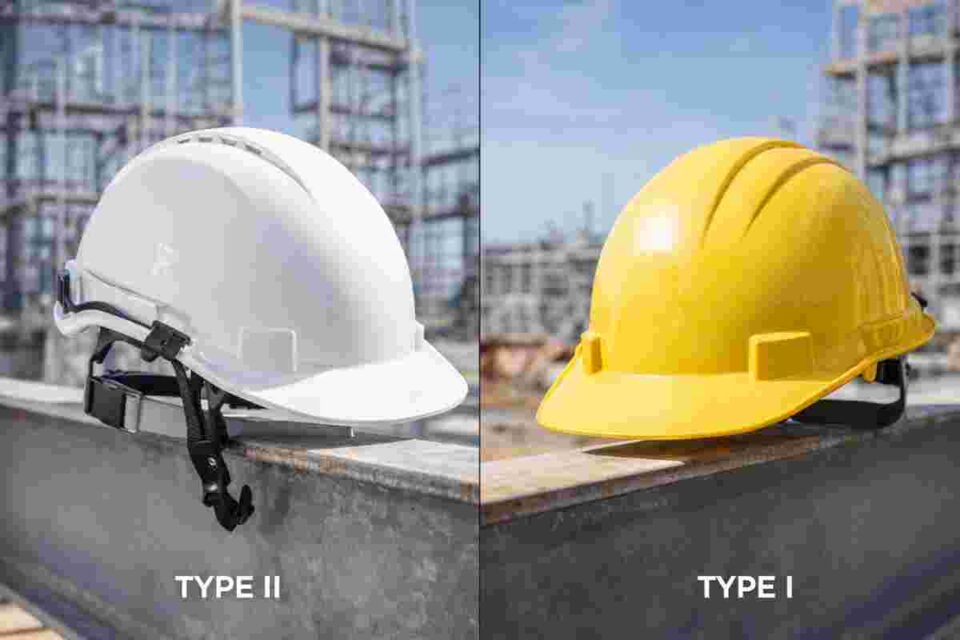
Most traditional hard hats are classified as Type I under the ANSI/ISEA Z89.1 standard, meaning they are tested and rated for impact absorption only from the crown (top) of the head. They feature a suspension system inside the shell that creates a gap between the head and the outer surface, helping to distribute the force of a downward blow.
Hard hats generally do not come with chin straps as a standard feature. This means they can fall off during slips, trips, or falls — one of the most significant limitations when compared to modern safety helmets.
What Is a Safety Helmet?
A safety helmet — sometimes called a climbing-style helmet or industrial safety helmet — is an advanced form of head protection that covers more of the skull, including the sides, front, and back. Safety helmets are inspired by designs used in mountaineering, search and rescue, and high-angle work environments.
Most modern safety helmets are classified as Type II under ANSI/ISEA Z89.1, meaning they provide multi-directional impact protection — not just from the top, but also from lateral, frontal, and rear impacts. They typically include a four-point chin strap, internal foam padding or an advanced suspension system, and a low-profile, close-fitting design that improves stability during dynamic movement.
Safety helmets are also designed to integrate easily with accessories such as face shields, goggles, earmuffs, headlamps, and communication systems — making them a modular solution for complex work environments.
Safety Helmet vs Hard Hat: Key Differences at a Glance
| Feature | Traditional Hard Hat | Modern Safety Helmet |
|---|---|---|
| Impact Protection Type | Type I (top only) | Type II (top + sides + front + rear) |
| Chin Strap | Usually not included | 4-point chin strap (standard) |
| Fit & Stability | Loose, sits above the head | Snug, close-fitting, helmet-style |
| Weight | 300–400 g typically | 350–500 g (with added padding/features) |
| Accessory Integration | Limited | Modular (face shields, goggles, comms, earmuffs) |
| Comfort | Basic suspension | Foam padding, moisture-wicking liners, ventilation |
| Service Life | Up to 5 years | Up to 10 years (manufacturer-dependent) |
| Typical Cost | $10–$30 USD | $50–$150+ USD |
| OSHA Recommendation | Still compliant, but no longer preferred | Strongly recommended since 2023 |
Understanding ANSI/ISEA Z89.1 Classification
Both hard hats and safety helmets in the United States must comply with the ANSI/ISEA Z89.1 standard, which defines the performance and testing requirements for industrial head protection. Here is how the classification works:
Types of Head Protection (Impact)
Type I: Designed to protect against impacts to the top of the head only. Most traditional hard hats fall into this category. Type I headgear is tested by dropping a weight onto the crown and measuring the force transmitted to the head form.
Type II: Designed to protect against impacts to the top and sides of the head. Modern safety helmets typically meet Type II standards. Testing includes lateral, frontal, and rear impact scenarios in addition to top-of-head testing.
Classes of Head Protection (Electrical)
Class G (General): Provides protection against exposure to low-voltage electrical conductors up to 2,200 volts (phase to ground).
Class E (Electrical): Provides protection against exposure to high-voltage electrical conductors up to 20,000 volts (phase to ground).
Class C (Conductive): Does not provide protection against electrical hazards. Typically used in environments where electrical contact is not a concern.
When selecting head protection, you must match the correct Type and Class to your specific worksite hazards. For more details on construction safety compliance, read our in-depth guide on health and safety in construction.
What Does OSHA Say? The 2023 Bulletin and Its 2026 Impact
On November 22, 2023, OSHA released a Safety and Health Information Bulletin (SHIB) titled “Head Protection: Safety Helmets in the Workplace.” This bulletin marked a significant shift in OSHA’s position on head protection. While not a formal regulation or mandate, it represented a clear recommendation.
Key points from the OSHA bulletin include:
- OSHA acknowledged the limitations of traditional hard hats, especially their lack of side-impact protection and absence of chin straps.
- OSHA announced that its own compliance safety and health officers (CSHOs) would begin wearing modern safety helmets instead of traditional hard hats.
- OSHA encouraged all employers to evaluate whether safety helmets would provide better protection for their workforce.
- The bulletin highlighted the benefits of Type II protection, chin strap retention, improved comfort, and modular accessory integration.
In 2026, the industry impact of this bulletin is substantial. While OSHA has not yet made safety helmets legally mandatory across all worksites, the direction of travel is clear. Major contractors, EPC firms, and industrial owners are now voluntarily adopting Type II safety helmet policies. Several large construction companies have already banned traditional hard hats entirely from their project sites.
The relevant OSHA regulations for head protection remain:
- 29 CFR 1910.135 — General Industry head protection requirements
- 29 CFR 1926.100 — Construction industry head protection requirements
Both require that employers provide head protection meeting ANSI Z89.1 when there is a risk of head injury from falling objects, impact, or electrical hazards. The key shift is that OSHA now views Type II safety helmets as the most appropriate form of head protection for most construction environments.
If you are preparing for a safety role, our top 50 OSHA safety interview questions resource covers head protection regulations in detail.
Why the Industry Is Moving from Hard Hats to Safety Helmets
The shift toward safety helmets is not happening in a vacuum. Several converging factors are driving the transition:
1. Head Injury Data
The Bureau of Labor Statistics consistently reports that over 100,000 non-fatal workplace head injuries occur annually in the United States. A significant proportion of these result from slips, trips, and falls — situations where Type I hard hats often fail because they can fall off the wearer’s head during the incident.
2. The “Fatal Four” Connection
Falls account for approximately 39% of construction fatalities. When a worker falls, a traditional hard hat without a chin strap can come off before or during impact. Type II safety helmets with chin straps address this critical gap. For more on fall-related safety systems, see our comparison of active vs passive fall protection.
3. Virginia Tech Helmet Lab Research
The Virginia Tech Helmet Lab, known for its comprehensive helmet rating systems in sports and recreation, launched a research project funded by construction industry organisations to develop an objective rating system for occupational helmets. This research underscores the growing scientific basis for the transition to safety helmets.
4. Employer and Contractor Mandates
Many large general contractors, EPC firms, and project owners now require Type II safety helmets with chin straps as a site entry requirement. Companies like Nabholz, for example, announced that traditional hard hats (Type I) would no longer be permitted on their jobsites from January 2026. This trend is accelerating across the industry.
5. Improved Comfort Drives Compliance
Worker compliance with PPE is directly linked to comfort. Safety helmets with foam padding, moisture-wicking liners, and adjustable suspension systems are generally more comfortable for extended wear. When head protection is comfortable, workers are more likely to wear it consistently and correctly.
When Should You Still Use a Hard Hat?
Despite the clear trend toward safety helmets, traditional hard hats are not obsolete in every scenario. They remain appropriate in certain controlled environments:
- Low-risk overhead environments: Warehouses, storage facilities, or manufacturing floors where the primary hazard is occasional overhead impact and there is minimal risk of falls or lateral impacts.
- Budget-constrained short-term projects: Situations where a large number of disposable or short-use head protection items are needed (such as visitor hard hats for site tours).
- Environments where only Type I protection is needed: After a proper hazard assessment confirms that only top-of-head impact protection is required and there is no fall risk or lateral impact exposure.
However, for most active construction sites — particularly those involving work at height, heavy equipment movement, or multi-trade coordination — safety helmets are now the recommended standard.
Safety Helmet vs Hard Hat: Cost Analysis
One of the most common objections to adopting safety helmets is cost. Here is a realistic breakdown:
A traditional Type I hard hat costs between $10 and $30 per unit, depending on the brand and electrical class. A quality Type II safety helmet ranges from $50 to $150 or more, depending on features such as integrated visors, MIPS-style rotational protection, ventilation, and accessory compatibility.
At first glance, the cost difference seems significant. But consider these factors:
- Longer service life: Safety helmets can last up to 10 years compared to 5 years for hard hats, effectively halving the annual cost of replacement.
- Reduced injury costs: A single traumatic brain injury can cost employers hundreds of thousands of dollars in medical expenses, workers’ compensation, legal fees, and lost productivity.
- Compliance savings: Proactively adopting safety helmets before a potential OSHA mandate avoids the scramble and expense of a reactive transition.
- Insurance benefits: Some insurers offer PPE credits or reduced premiums for firms that adopt enhanced safety equipment.
When you look at the full lifecycle cost and the risk mitigation value, safety helmets represent a sound investment for most construction operations.
How to Choose the Right Safety Helmet for Your Worksite
Selecting the right safety helmet requires a hazard-specific approach. Consider the following:
Hazard Assessment First
Before purchasing any head protection, conduct a thorough site hazard assessment covering overhead impact risk, lateral impact risk, fall risk, electrical exposure, temperature extremes, and the need for integrated accessories. Your hazard assessment will dictate the correct Type and Class.
Industry-Specific Recommendations
| Industry / Task | Recommended Head Protection | Key Requirement |
|---|---|---|
| General Construction | Type II Safety Helmet, Class E | Multi-directional impact + electrical rating |
| Tower Climbing / Telecoms | Type II Safety Helmet with Chin Strap | Retention during elevated work |
| Electrical Work | Non-vented Safety Helmet, Class E | No ventilation openings near live circuits |
| Hot Work / Welding | Safety Helmet rated HT (High Temp) | Heat-resistant shell material |
| Low-Risk Warehouse | Type I Hard Hat or Vented Helmet | Overhead-only protection adequate |
| Roadway / Infrastructure | Safety Helmet marked HV (High Visibility) | Visibility for traffic-adjacent work |
Check for Certification Labels
Always verify that the head protection carries ANSI/ISEA Z89.1 certification markings inside the shell. These labels confirm the Type, Class, and any special ratings (HT, LT, HV). Only use head protection from manufacturers who can provide full compliance documentation.
Inspection and Replacement: Keeping Your Head Protection Effective
Even the best safety helmet is only effective if it is properly maintained. Follow these inspection practices:
- Daily visual check: Before each shift, inspect the shell for cracks, dents, gouges, or discolouration. Check chin straps for fraying or broken buckles. Ensure suspension straps are intact.
- Monthly detailed inspection: Remove all internal components (padding, suspension). Check for UV degradation, brittleness, or chemical damage. Inspect all adjustment points.
- Immediate replacement after impact: Any helmet or hard hat involved in a significant impact must be discarded and replaced, even if there is no visible damage. Internal energy-absorbing materials may be compromised.
- Follow manufacturer service-life guidelines: Replace head protection within the manufacturer’s recommended timeframe, regardless of visible condition.
- Storage matters: Store head protection away from direct sunlight, extreme temperatures, and chemical vapours to preserve material integrity.
Career Relevance: Why Construction Professionals Must Understand This Topic
Understanding the difference between safety helmets and hard hats is not just a PPE selection question — it has direct career relevance for construction professionals in 2026:
- Safety officers and HSE managers need to recommend and enforce the correct head protection standard for their projects. Knowledge of ANSI classifications, OSHA guidance, and the business case for safety helmets is essential.
- Site supervisors and foremen are often the first line of PPE enforcement. They must understand which head protection meets site requirements and be able to explain the reasoning to workers.
- Construction workers and tradespeople should understand their rights to proper PPE and be able to identify whether their head protection meets current standards. This knowledge also strengthens interview performance.
- Project managers and procurement teams need to budget for the right head protection and evaluate supplier compliance documentation.
For construction interview preparation — including questions on PPE, OSHA standards, and safety practices — explore our comprehensive construction job interview guide.
If you are exploring a career in construction safety, our guide on construction safety jobs and career pathways covers how to get started, the certifications you need, and salary expectations.
Global Perspective: Safety Helmet Standards Outside the USA
For construction professionals working internationally, it is important to know that head protection standards vary by region:
- Europe: EN 397 is the standard for industrial safety helmets, and EN 12492 covers helmets for mountaineering and climbing-style applications. Many European construction firms have already transitioned to EN 397-compliant safety helmets with chin straps.
- Australia: AS/NZS 1801 covers occupational protective helmets. Australian construction sites generally require chin straps for any elevated work.
- Middle East (Gulf Region): Most projects follow either ANSI Z89.1 or EN 397, depending on the client or contractor’s country of origin. Major Gulf EPC firms are increasingly specifying Type II safety helmets.
- India: IS 2925 is the Bureau of Indian Standards specification for industrial safety helmets. While adoption of advanced safety helmets is still growing in India, large infrastructure and EPC projects — particularly those run by international contractors — are moving toward Type II requirements.
If you are considering construction careers across different countries, check out our job requirements for construction workers guide, which covers PPE and certification expectations globally.
Top Safety Helmet Brands to Consider in 2026
While we do not endorse specific brands, these manufacturers are widely recognized in the construction industry for producing ANSI/ISEA Z89.1-compliant Type II safety helmets:
- Milwaukee BOLT™ — Popular for its modular accessory system and high-visibility options.
- 3M™ SecureFit™ X5000 Series — Known for 6-point suspension, pressure diffusion technology, and reflective options.
- Petzl Vertex / Strato — Originally designed for rope access and climbing, now widely adopted on construction sites.
- MSA V-Gard H1 — Features a Fas-Trac III ratchet suspension and integrated chin strap with multiple ventilation options.
- Honeywell / Fibre-Metal — Offers a range of Type II helmets suitable for heavy industrial and construction applications.
- Klein Tools Safety Helmet — Designed specifically for the electrical trade with Class E rating and comfortable padding.
Recommended Courses for Construction Safety Professionals
If you want to strengthen your knowledge of construction safety, PPE regulations, and OSHA compliance, these online courses are worth exploring:
- Construction Safety – Coursera (Columbia University)
- OSHA Safety Training for Construction – Udemy
- Occupational Safety and Health – edX
Also check our detailed guide on the 15 skills construction companies want in 2026 — PPE and safety leadership are core competencies that every employer values.
Useful Resources and eBooks
Explore these practical career guides for construction professionals:
- Construction Interview Preparation Guide — Prepare for safety officer and site engineer interviews with confidence.
- Civil Engineering Career eBook — Career insights, salary data, and progression pathways for civil and construction engineers.
- Construction Career Bundle — Complete collection of career tools, interview prep guides, and industry insights.
Frequently Asked Questions (FAQ)
Is OSHA requiring safety helmets in 2026?
OSHA has not yet made safety helmets legally mandatory across all worksites as of 2026. However, OSHA released a Safety and Health Information Bulletin in November 2023 strongly recommending that employers transition from traditional hard hats to safety helmets. OSHA’s own compliance officers now wear safety helmets, and the industry is moving rapidly toward voluntary adoption of Type II helmets with chin straps.
What is the difference between Type I and Type II head protection?
Type I head protection is designed and tested for impacts to the top of the head only. Type II head protection is designed and tested for impacts to the top, sides, front, and rear of the head. Most traditional hard hats are Type I, while most modern safety helmets are Type II.
Can I still use a hard hat on a construction site in 2026?
Yes, traditional hard hats that meet ANSI/ISEA Z89.1 are still OSHA-compliant. However, an increasing number of general contractors, project owners, and EPC firms are requiring Type II safety helmets as a site entry condition. Check your project’s specific head protection requirements before arriving on site.
Are safety helmets more expensive than hard hats?
Yes, the upfront cost is higher. A traditional hard hat typically costs $10–$30, while a quality safety helmet ranges from $50–$150 or more. However, safety helmets can last up to 10 years (versus 5 for hard hats), offer significantly better protection, and can reduce injury-related costs substantially.
Do safety helmets work for electrical hazards?
Yes. Safety helmets are available in Class E (Electrical) ratings that protect against exposure to high-voltage conductors up to 20,000 volts. Important: vented safety helmets should not be used for electrical work. Always select a non-vented, Class E-rated helmet for environments with energised conductors.
What is the ANSI/ISEA Z89.1 standard?
ANSI/ISEA Z89.1 is the American National Standard for Industrial Head Protection. It specifies performance requirements, testing methods, and classification criteria for hard hats and safety helmets used in workplace environments. Both Type I and Type II head protection must meet this standard to be OSHA-compliant.
How often should I replace my safety helmet?
Follow the manufacturer’s recommended service life. As a general guideline, hard hat shells should be replaced within 5 years and safety helmet shells within 5–10 years of the manufacture date. Suspension systems and internal padding should be replaced more frequently — typically every 1–2 years depending on usage. Replace immediately after any significant impact, regardless of visible condition.
Are safety helmets required in India?
India follows IS 2925 for industrial safety helmets. While there is no national mandate equivalent to an OSHA requirement for Type II helmets specifically, major infrastructure projects and EPC firms operating in India (especially international contractors) are increasingly specifying safety helmets with chin straps as the standard head protection on their projects.
Have more questions about construction safety and career growth? Explore ConstructionPlacements.com for the latest industry insights, job opportunities, and professional resources.
