

Last Updated on March 16, 2026 by Admin
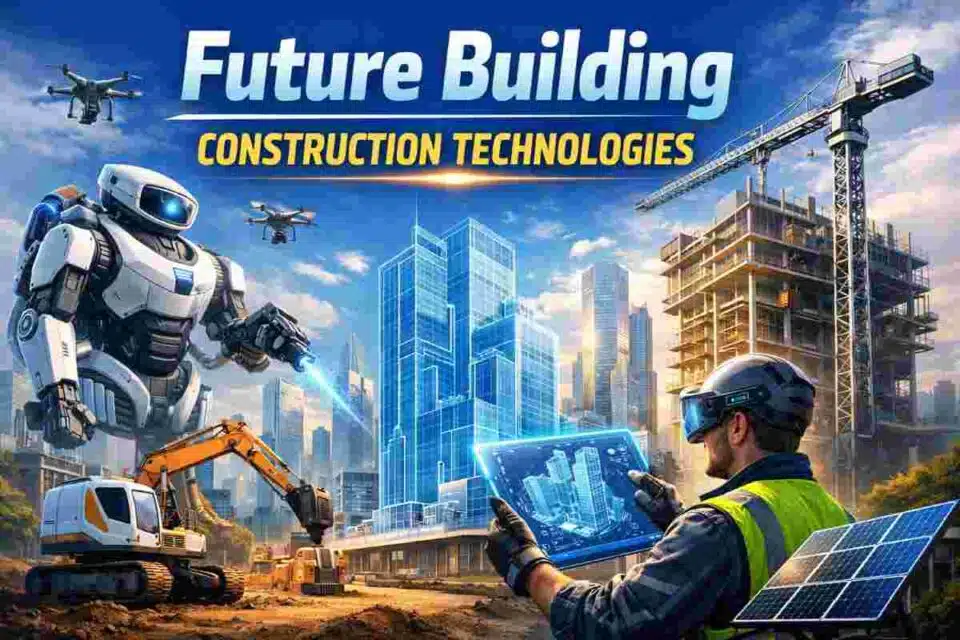
The future of building construction is here — and it is moving faster than any previous industrial revolution. From AI-powered project management to self-healing concrete, the technologies reshaping how we design, build, and operate structures are no longer experimental. In 2026, the global construction technology market is expanding at a 7.90% CAGR, while AI-specific tools within the sector are projected to hit USD 2.18 billion this year alone — scaling to over USD 20.6 billion by 2034. This definitive guide breaks down every major technology trend, the career opportunities they create, and the steps you can take right now to stay ahead.
ConstructionCareerHub App is LIVE — built ONLY for construction careers. Don’t apply with a weak resume.
Get ATS-ready Resume Lab + Interview Copilot + Campus Placement Prep (resume screening, skill gaps, interview readiness) — in minutes & Other advanced features.
Explore Smarter Construction Career Tools →Quick check. Big impact. Start now.
🚀 Build a Tech-Ready Construction Career with ConstructionCareerHub
AI is reshaping construction hiring. Get an ATS-optimised resume, Interview Copilot, BIM Career Roadmap, and personalised skill-gap analysis — all in one place.
→ Explore Free & Premium Career Tools at ConstructionCareerHub.com
📋 Table of Contents
- Construction Technology Market Overview 2026
- Artificial Intelligence (AI) in Construction
- Building Information Modeling (BIM) — The New Baseline
- Digital Twins in Construction
- 3D Printing & Additive Manufacturing
- Robotics, Automation & Cobots
- Modular & Prefabricated Construction
- Drones & Aerial Surveying Technology
- VR, AR & Immersive Technologies in Real Estate & Construction
- IoT, Smart Buildings & 5G Connectivity
- Sustainable & Green Building Technologies
- How These Technologies Are Creating New Construction Careers
- Top Courses to Master Construction Technology
- Frequently Asked Questions (FAQ)
Construction Technology Market Overview 2026
The construction sector — historically one of the slowest industries to digitise — is now at the centre of a technology revolution. With annual global construction output surpassing USD 13 trillion, the pressure to improve the industry’s notoriously sluggish productivity (which has grown at only 0.4% annually over the past two decades) is driving unprecedented investment in digital tools, automation, and sustainable materials.
Here is a snapshot of where the market stands in 2026:
| Technology | 2026 Market Size | Projected Growth |
|---|---|---|
| AI in Construction | USD 2.18 Billion | USD 20.6 Billion by 2034 (32.76% CAGR) |
| Construction Tech (overall) | Multi-billion USD | 7.90% CAGR through 2036 |
| BIM Software | USD 4.69 Billion (2025) | Strong growth; 65% global adoption |
| Digital Twins | USD 16.75 Billion (2024) | USD 110.1 Billion by 2029 |
| Modular Construction | USD 104 Billion (2024) | USD 140.8 Billion by 2029 |
Sources: Precedence Research, Future Market Insights, CMiC Global, Deloitte Engineering & Construction Outlook 2026.
India is identified as the fastest-growing construction tech market at a 10.50% CAGR, driven by massive public infrastructure digitisation programmes. The United States remains the largest value-share market, anchored by mature AI and robotics adoption in commercial projects.
Key Insight: Buildings are responsible for approximately 34% of global CO₂ emissions. Technology adoption is no longer optional — it is the primary lever for meeting net-zero construction targets by 2050.
If you are a civil engineer or construction professional looking to understand where demand is heading, read our guide on BIM Jobs in India 2026 – Top Companies Hiring BIM Engineers.
Artificial Intelligence (AI) in Construction
AI in construction is arguably the most transformative force in the industry right now. From automated scheduling to predictive safety monitoring, AI tools are delivering measurable ROI across every phase of the project lifecycle.
Key AI Applications in 2026
- Predictive maintenance: AI-powered sensor networks cut equipment downtime by up to 60% by forecasting failures before they occur.
- Cost estimation: Machine learning models improve estimation accuracy to 95%, dramatically reducing budget overruns.
- Supply chain optimisation: AI-driven logistics cut material waste by 30% by aligning procurement with real-time project schedules.
- Safety monitoring: Computer vision systems scan live CCTV feeds to detect PPE violations, unsafe behaviour, and site hazards in real time.
- Generative design: Tools like Autodesk’s generative design engine explore thousands of structural configurations simultaneously, selecting the most efficient option in minutes.
- Agentic AI: In 2026, the next frontier is agentic AI — systems that autonomously take actions (scheduling updates, RFI responses, subcontractor alerts) without human prompting.
AI in Construction: India & Gulf Perspective
The Indian construction industry is seeing rapid government-backed AI adoption, particularly in smart city initiatives and infrastructure mega-projects. In the Gulf, smart city programmes such as NEOM (Saudi Arabia) and Abu Dhabi’s vision for digital infrastructure are deploying AI at an unprecedented scale. For construction professionals in these markets, AI fluency is quickly becoming a prerequisite for senior roles.
Want to future-proof your career? Take the Is Your Construction Career AI-Proof? 2026 Test on ConstructionPlacements.
Building Information Modeling (BIM) — The New Baseline
Building Information Modeling (BIM) has completed its transition from a competitive differentiator to an industry baseline. In 2026, BIM is no longer a technology choice — for most markets, it is a regulatory requirement.
- Approximately 65% of construction projects worldwide now use BIM workflows.
- More than 30 countries mandate BIM on large infrastructure programmes.
- In the United States, around 75% of architectural firms use BIM; Europe stands at roughly 70%.
- Projects using BIM finish an average of 20% faster and 15% cheaper than traditionally managed projects.
- In 2026, BIM is evolving beyond design — it is the central data platform for procurement, safety, cost management, and digital handover.
Benefits of BIM in Modern Construction
- Clash detection: Identifies conflicts between structural, MEP, and architectural elements before construction begins, saving significant rework costs.
- 4D scheduling: Links 3D models to project timelines so teams can visualise construction sequences and spot scheduling conflicts.
- 5D cost management: Attaches real-time cost data to model components, enabling live budget tracking.
- Digital handover: Owners receive an as-built digital model for facility management, replacing paper-based O&M manuals.
Explore more in our detailed guide: What is Building Information Modeling (BIM)? | Also see: The Ultimate Guide to Scan to BIM Technology
For professionals ready to enter the BIM space, the BIM Career Ebook — An Ultimate Career Guide is an essential starting point.
Digital Twins in Construction
A digital twin is a live, data-connected virtual replica of a physical building or infrastructure asset. In 2026, digital twins are moving from buzzword to operational standard across large-scale projects.
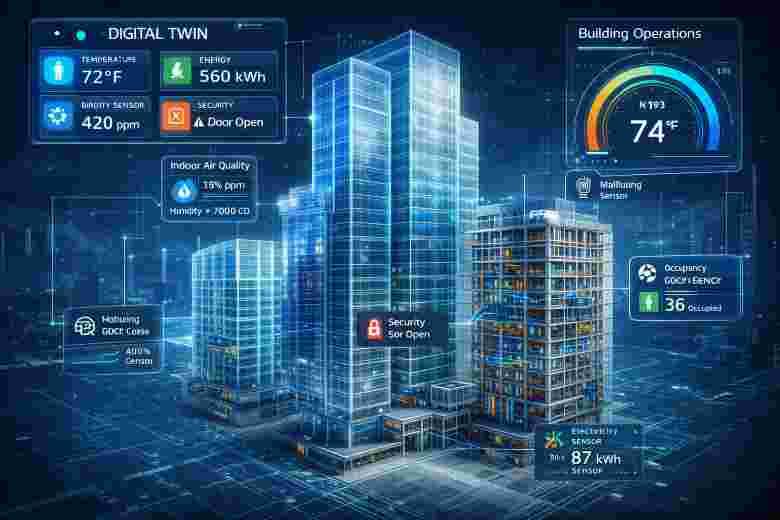
The global digital twin market is projected to grow from USD 16.75 billion in 2024 to USD 110.1 billion by 2029 — a trajectory driven almost entirely by construction, manufacturing, and smart city deployments.
How Digital Twins Are Used in Construction
- Design validation: Run structural load simulations on the model before breaking ground.
- Real-time site monitoring: IoT sensors embedded across the site feed live data (temperature, humidity, structural load, worker location) into the twin.
- Predictive maintenance: Owners use the twin post-handover to monitor HVAC, lifts, and structural integrity — reducing operating costs by 10–20%.
- Sustainability tracking: Energy consumption, carbon footprint, and material usage are tracked against targets across the asset’s full lifecycle.
Read our analysis of how digital tools are shaping the industry: How Smart Construction Technology Is Transforming the Construction Industry
3D Printing & Additive Manufacturing in Construction
3D printing in construction has moved well beyond proof-of-concept. In 2026, robotic printing systems can construct full structural shells within 48 hours, cutting both labour hours and material waste simultaneously.
What 3D Printing Can Build Today
- Entire single-storey homes (ICON’s Vulcan printer, for example, has produced communities of printed homes in the US)
- Emergency and affordable housing units at a fraction of traditional cost
- Complex architectural features impossible with conventional formwork
- Infrastructure components — bridge sections, retaining walls, utility vaults
- Off-site printed modules for rapid on-site assembly
3D Printing Advantages
| Advantage | Impact |
|---|---|
| Speed | Structural shell in under 48 hours |
| Labour reduction | Significant reduction in on-site labour hours |
| Waste reduction | Up to 60% less material waste vs conventional |
| Design freedom | Organic curves and complex geometries at no extra cost |
| Sustainability | Precision deposition eliminates overuse of materials |
Robotics, Automation & Cobots on the Construction Site
Construction robotics has moved decisively beyond pilot programmes. In 2026, autonomous machines and collaborative robots (cobots) operate across active job sites worldwide, tackling tasks that are repetitive, dangerous, or demanding extreme precision.

Construction Robots in Action
- Robotic bricklayers (SAM100, Hadrian X): Lay bricks at speeds 400–500% faster than human bricklayers while maintaining millimetre precision.
- Rebar-tying robots: Automate one of the most labour-intensive tasks in reinforced concrete construction.
- Autonomous excavators: GPS and LiDAR-guided machines that perform earthworks with minimal human intervention.
- Painting & finishing robots: Deliver consistent finishes at consistent speeds, eliminating variability.
- Demolition robots: Remote-controlled units operate safely in unstable or hazardous structures.
- Cobots (collaborative robots): Work alongside human crews — lifting heavy materials, assisting with formwork — with AI-driven collision avoidance ensuring safe co-operation.
Humanoid Robots: The Next Frontier
2026 marks the early commercial deployment of humanoid robots in construction. Companies such as Figure AI and Boston Dynamics are trialling bipedal machines that can navigate uneven terrain, carry materials, and respond to verbal instructions — a capability that traditional wheeled or tracked robots cannot match.
For professionals interested in the intersection of technology and construction management, explore our Emerging Technologies in Construction resource hub.
Modular & Prefabricated Construction
Modular and prefabricated construction is reshaping project economics. By manufacturing building components in controlled factory environments and assembling them on site, construction teams are compressing timelines by up to 60% compared to conventional methods.
- The global modular construction market stood at USD 104 billion in 2024 and is projected to reach USD 140.8 billion by 2029.
- Annual market growth is forecast at 7.9% CAGR through 2030.
- Leading sectors include residential, healthcare, hospitality, and data centres — all of which demand rapid delivery, consistent quality, and strict cost control.
Why Modular Construction Is Gaining Ground
- Factory-controlled quality reduces defects and rework significantly.
- Parallel manufacturing and on-site groundwork happen simultaneously, compressing the programme.
- Weather disruptions are eliminated from the manufacturing phase.
- Modules can be disassembled and relocated, supporting circular economy principles.
- Digital twins and generative AI now optimise modular layouts automatically, removing previous design constraints.
Read our guide on the latest innovations in construction planning to see how prefabrication fits into the broader digitisation story.
Drones & Aerial Surveying Technology
Drones have become standard equipment on modern construction sites. Their capabilities in 2026 go far beyond simple aerial photography:
- Photogrammetry and LiDAR mapping: Produce millimetre-accurate topographic surveys in hours instead of days — improving site assessment accuracy by 61% compared to traditional ground surveys.
- Progress monitoring: Weekly drone flyovers generate 3D point clouds that are overlaid with the BIM model to verify construction progress against schedule.
- Safety inspections: Drones inspect high-risk structures (towers, roof edges, dam faces) without requiring workers to operate at height.
- Material delivery: Heavy-lift drones are beginning to transport small components and tools within large sites, reducing walking time.
- Thermal imaging: Identify energy leaks, moisture ingress, and defective insulation in completed envelopes before handover.
Leading platforms include DJI’s Matrice enterprise series, Skydio’s autonomous inspection drones, and Wingtra’s vertical take-off fixed-wing surveyors — all integrating directly with platforms like Autodesk Construction Cloud and Trimble Connect.
VR, AR & Immersive Technologies in Real Estate & Construction
Virtual Reality (VR) and Augmented Reality (AR) are eliminating costly errors by allowing teams to experience buildings before a single foundation is poured.
Virtual Reality (VR) in Construction
- Architects walk clients through photorealistic virtual models, reducing design change orders mid-construction.
- Safety training programmes deliver immersive hazard simulations without exposing trainees to real risk.
- Real estate developers sell off-plan properties via fully immersive VR walkthroughs — increasing buyer confidence and reservation rates significantly.
Augmented Reality (AR) on the Job Site
- AR headsets (Microsoft HoloLens 2, Apple Vision Pro) overlay BIM model data onto the physical site, enabling workers to see embedded MEP routes through walls before drilling.
- AR accelerates issue identification by up to 41.7% compared to paper-based drawing reviews.
- Remote expert guidance via AR: a specialist in a different city annotates the live camera feed of an on-site engineer to solve complex installation problems in real time.
Explore the full picture in our dedicated article: VR and AR in BIM: Transforming the AEC Landscape | and: Virtual Reality in the Construction Industry — All You Need to Know
IoT, Smart Buildings & 5G Connectivity
The Internet of Things (IoT) is turning construction sites and completed buildings into connected, intelligent environments. 5G connectivity — now widely available across major construction markets — provides the low-latency, high-bandwidth backbone that makes real-time IoT data practical at scale.
IoT on the Construction Site
- Worker wearables: Smart helmets and vests track location, monitor biometrics, and alert supervisors to fatigue or heat stress.
- Structural health monitoring: Embedded sensors measure strain, vibration, and moisture in real time — critical for complex concrete pours and steel erection.
- Equipment telematics: GPS and usage sensors on plant and equipment optimise utilisation, flag maintenance needs, and prevent theft.
- Environmental monitoring: Dust, noise, and vibration sensors ensure compliance with environmental permits and protect neighbouring communities.
Smart Buildings Post-Completion
- Building Management Systems (BMS) integrate HVAC, lighting, security, and energy monitoring on a single AI-driven platform.
- Occupancy sensors adjust temperature and lighting dynamically, cutting energy costs by 20–30%.
- Predictive maintenance AI reduces equipment failure rates by monitoring real-time data from lifts, chillers, and pumps.
For a deeper dive, see our guide on Smart Construction Technology.
Sustainable & Green Building Technologies
Sustainability has moved from aspiration to contractual obligation. In 2026, green building mandates, ESG reporting requirements, and client demand for net-zero assets are driving adoption of low-carbon technologies at every project stage.
Key Sustainable Building Technologies in 2026
- Mass Timber (CLT & LVL): Cross-laminated timber and laminated veneer lumber are replacing concrete and steel in mid-rise construction, sequestering carbon while delivering structural performance. Timber facades on commercial buildings have increased by 25% year-on-year.
- Green concrete: Supplementary cementitious materials (SCMs) such as fly ash, GGBS, and silica fume reduce the carbon intensity of concrete by 30–50%.
- Integrated photovoltaics (BIPV): Solar cells embedded in roof panels, glass facades, and cladding generate renewable energy without requiring dedicated solar arrays.
- Passive design systems: Advanced thermal modelling tools optimise building orientation, insulation, and shading to minimise energy demand from the design stage.
- Carbon tracking platforms: Real-time embodied carbon calculators embedded in BIM tools flag high-carbon specification choices during design, enabling low-carbon alternatives to be selected proactively.
- Water recycling systems: Greywater and rainwater harvesting systems, automated by IoT sensors, are now standard in commercial and institutional projects.
Relevant reading: Top 50 LEED Green Building Interview Questions & Answers [2026]
How These Technologies Are Creating New Construction Careers
Technology adoption in construction is not eliminating jobs — it is fundamentally changing which jobs are in demand and what skills command premium salaries. The “hybrid construction professional” — someone who combines field experience with digital fluency — is the most sought-after profile in 2026.
High-Growth Technology Roles in Construction
- BIM Coordinator / BIM Manager: Salaries up 25–30% as BIM mandates increase globally. BIM jobs in India are growing rapidly in 2026.
- Digital Twin Engineer: An emerging role bridging IoT, data analytics, and building performance modelling.
- Construction Technology Manager: Oversees the firm’s entire technology stack — from BIM to robotics to AI scheduling tools.
- Drone Operator / Photogrammetry Specialist: Entry-level technology role with fast progression into survey management.
- Sustainability / Net-Zero Consultant: Pay has increased 25–30% as ESG mandates intensify across Europe, the Gulf, and Asia.
- Construction Data Analyst: Interprets project dashboards, identifies schedule risks, and presents financial performance data to leadership.
Use the Construction Career Guide 2026 to map your next career move, and discover whether your skills are AI-proof.
For career starters, the Construction Campus Placements Playbook 2026 covers how to land your first role in a technology-driven construction environment.
🎯 AI Career Tools for Construction Professionals
ConstructionCareerHub.com offers AI-powered tools purpose-built for construction professionals:
- ✅ ATS Resume Lab — Optimise your CV for BIM, technology, and management roles
- ✅ Interview Copilot — Practice answers to construction technology interview questions
- ✅ Skill Gap Analyser — Find out which digital skills you need to develop next
- ✅ Salary Benchmarking — See what BIM Managers, Digital Engineers, and Tech Specialists earn in your market
Top Courses to Master Construction Technology in 2026
Upskilling in construction technology is one of the highest-ROI career investments you can make in 2026. Here are verified, high-quality courses from leading platforms:
Coursera
- 🎓 Construction Management (Columbia University via Coursera) — Covers project scheduling, cost management, and digital delivery. Ideal for professionals moving into construction technology management roles.
- 🎓 BIM Fundamentals for Engineers — Hands-on BIM training directly from Autodesk. Perfect for civil and structural engineers entering the BIM space.
edX
- 🎓 Construction Management MicroMasters (edX) — A professional credential covering digital project delivery, cost control, and sustainable construction across global markets.
Udemy
- 🎓 Revit Architecture/BIM for Beginners to Advanced (Udemy) — Best-selling, practical Revit training for architects, structural engineers, and MEP professionals. Self-paced with lifetime access.
📚 Construction Career Ebooks — Instant Download
Written by industry experts, these ebooks give you practical, actionable guidance to launch or advance your career in a technology-driven construction market:
- 📘 AI Construction Career Blueprint — Understand which AI-adjacent roles are growing fastest and how to position yourself to get hired.
- 📘 Civil Engineering Interview Questions & Answers PDF Ebook — 102 researched technical Q&As covering all key civil engineering domains — ideal for freshers and laterals.
- 📘 Construction Campus Placements Playbook 2026 — The complete guide to landing your first construction job from campus, including technology-focused roles.
- 📘 The Construction Job Blueprint 2026 — How civil, BIM & construction engineers actually get hired (not just apply).
Frequently Asked Questions (FAQ)
What is the future of building construction technology?
The future of building construction is defined by five converging technologies: AI-driven project management, BIM-anchored digital workflows, robotics and automation on the job site, digital twins for lifecycle asset management, and sustainable low-carbon materials. By 2030, these technologies will be standard practice rather than competitive differentiators, with the global construction technology market growing at nearly 8% CAGR through 2036.
How is AI being used in the construction industry?
AI is applied across the full construction lifecycle: automated cost estimation (achieving 95% accuracy), predictive maintenance for plant and equipment (reducing downtime by up to 60%), real-time safety monitoring via computer vision, supply chain optimisation (cutting waste by 30%), and generative design tools that explore thousands of structural configurations simultaneously. In 2026, agentic AI systems are emerging that autonomously manage scheduling, RFI responses, and subcontractor communications.
What is Building Information Modeling (BIM) and why does it matter?
BIM is an intelligent 3D model-based process that connects all project data — geometry, materials, costs, schedules, and environmental performance — into a single digital environment. In 2026, 65% of global construction projects use BIM. Projects using BIM complete 20% faster and 15% cheaper on average. More than 30 countries mandate BIM on public infrastructure programmes, making it an essential skill for any construction professional.
How are robots used in construction?
Construction robots perform bricklaying (up to 400–500% faster than manual methods), rebar tying, autonomous excavation, structural inspection, painting, finishing, and demolition. Collaborative robots (cobots) work alongside human crews to lift heavy materials and assist with precision assembly, using AI and computer vision to navigate safely around workers. Humanoid construction robots are beginning early commercial deployment in 2026.
What is a digital twin in construction?
A digital twin in construction is a live, data-connected virtual replica of a physical building or infrastructure asset. IoT sensors embedded across the structure continuously feed real-world data (temperature, load, occupancy, energy use) into the model, enabling real-time monitoring, predictive maintenance, and performance optimisation. The global digital twin market is projected to reach USD 110.1 billion by 2029.
What new construction jobs are created by technology?
Technology is creating high-demand roles including BIM Coordinator, Digital Twin Engineer, Construction Technology Manager, Drone Operator, Photogrammetry Specialist, Sustainability Consultant, and Construction Data Analyst. These roles command salary premiums of 15–30% above equivalent traditional roles and are among the fastest-growing positions in the global construction job market.
How can I prepare for a career in construction technology?
Start by gaining foundational BIM skills (Autodesk Revit, Navisworks), then layer in knowledge of drone surveying, IoT platforms, and project management software. Use ConstructionCareerHub.com to assess your current skill gaps and build a personalised upskilling roadmap. Supplement formal study with targeted online courses from Coursera, edX, and Udemy — particularly BIM, construction project management, and data analytics.
Which countries have the highest demand for construction technology professionals?
The United States leads in overall market size, particularly for AI and robotics expertise. The United Kingdom, Germany, Singapore, Australia, and the UAE have strong BIM mandates creating sustained demand for certified BIM professionals. India is the fastest-growing market at 10.50% CAGR, driven by smart city and infrastructure digitisation programmes, making it an exceptional opportunity for tech-ready Indian construction professionals.
Conclusion
The building construction industry is undergoing the most profound technological transformation in its history. AI, BIM, digital twins, robotics, 3D printing, and sustainable materials are no longer emerging technologies — in 2026, they are the foundation of competitive construction practice worldwide.
For construction professionals, the message is clear: digital fluency is the new site experience. The firms and individuals who embrace these technologies will command higher margins, win better projects, and build more resilient careers than those who wait on the sidelines.
Start your technology upskilling journey today:
- 📌 Get AI-powered career tools at ConstructionCareerHub.com
- 📌 Explore the Construction Career Guide 2026
- 📌 Browse BIM Jobs in India 2026
- 📌 View all live Construction & Engineering Jobs
- 📌Free PMP Practice Exam Questions – 50 Sample Test Practice Questions
- 📌Digital twin: the Age of Aquarius in Construction and Real Estate
- 📌Mastering Construction Project Management in the Era of Digital Twins
- 📌How to Become a Digital Twin Specialist in Construction
- 📌Top 30 Digital Twin Interview Questions for Construction Professionals
Resources & Further Reading
- 🔗 Deloitte 2026 Engineering & Construction Industry Outlook
- 🔗 Construction Dive — Industry News & Technology Updates
- 🔗 Engineering News-Record (ENR) — Global Construction Intelligence
- 🔗 World Green Building Council — Net-Zero Buildings
- 🔗 UK BIM Framework — Government BIM Standards
Last updated: March 2026 | Written by the ConstructionPlacements Editorial Team
