
Last Updated on January 7, 2026 by Admin
For years, construction professionals were told a simple formula would guarantee success:
ConstructionCareerHub App is LIVE — built ONLY for construction careers. Don’t apply with a weak resume.
Get ATS-ready Resume Lab + Interview Copilot + Campus Placement Prep (resume screening, skill gaps, interview readiness) — in minutes & Other advanced features.
Explore Smarter Construction Career Tools →Quick check. Big impact. Start now.
Get a degree → Gain experience → Wait for promotions.
In 2026, that formula is broken.
Across India, the GCC, the US, Europe, and Australia, thousands of construction professionals with 8–15 years of experience remain underpaid, replaceable, and stuck, while others with fewer years—but the right skills—are doubling or tripling their income.
The difference is no longer the job title.
It’s the construction skill stack.
This article breaks down the exact skill stack that actually pays in 2026, how global employers evaluate talent today, and how you can deliberately build a career that compounds income—rather than plateaus.
Table of Contents
What “Skill Stack” Really Means in Construction
A skill stack is not a long list of tools on your resume.
It is a strategic combination of skills that:
- Increase your decision-making value
- Reduce your replaceability
- Connect execution with business outcomes
- Scale across geographies
In construction, single-skill careers are dying.
A Site Engineer who only executes drawings competes with thousands.
A Planning Engineer who understands execution, cost, and risk becomes critical.
In 2026, employers don’t ask:
“How many years of experience do you have?”
They ask (explicitly or implicitly):
“What decisions can we trust you with?”
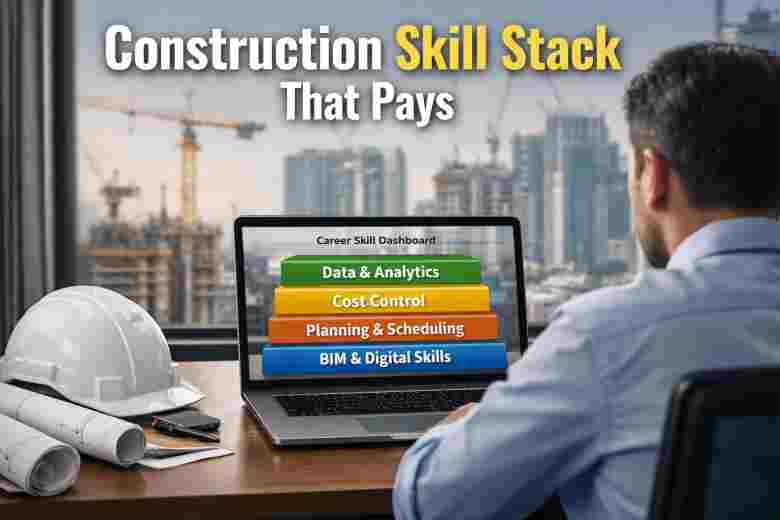
The 4-Layer Construction Skill Stack That Pays
High-earning construction professionals globally follow a four-layer skill structure.
Each layer builds leverage on top of the previous one.
Layer 1: Core Technical Construction Skills (Baseline, Not Differentiator)
These are non-negotiable entry skills.
They help you get hired—but rarely help you grow income beyond a point.
Core Skills Include:
- Reading construction drawings & specifications
- Quantity take-offs and BOQs
- Site execution basics (RCC, finishing, MEP coordination)
- Codes, standards, safety procedures
- AutoCAD / basic Revit understanding
Reality Check
In 2026, everyone has these skills:
- Fresh graduates
- Diploma holders
- Contract engineers
- Offshore teams
These skills keep you employed, but they do not increase bargaining power.
Layer 2: High-Value Digital & Analytical Skills (Income Acceleration)
This is where salaries start diverging.
Digital and analytical skills convert execution knowledge into control and visibility.
High-Paying Skills in This Layer:
- BIM & Digital Coordination (Revit, Navisworks, clash detection)
- Planning & Scheduling (Primavera P6, MS Project)
- Cost Control & Budget Monitoring
- Advanced Excel & Construction Data Analysis
- Basic Power BI/dashboards for project reporting
Why These Skills Pay More
These skills:
- Reduce delays
- Improve predictability
- Support management decisions
A professional who can explain why a project is slipping is more valuable than one who only reports that it has slipped.
This is why roles like Planning Engineer, BIM Coordinator, and Project Controls Engineer consistently command higher pay across regions.
Layer 3: Commercial, Contractual & Business Skills (Senior Role Gateway)
This is the layer that separates doers from decision-makers.
High-Impact Skills:
- Contract interpretation (FIDIC, EPC, item-rate contracts)
- Variations & claims management
- Cost forecasting & cash flow control
- Risk & delay analysis
- Stakeholder and client communication
Why This Layer Changes Everything
At this level, you influence:
- Profitability
- Disputes
- Cash flow
- Client trust
This is where professionals move into roles like:
- Cost Manager
- Project Controls Manager
- Commercial Manager
- Senior Planning Engineer
These roles exist above site firefighting and are far less vulnerable to layoffs or commoditization.
Layer 4: Future-Proof & Niche Skills (2026 Career Insurance)
This layer protects your career against disruption.
High-Growth Niche Skills:
- Sustainability & green building fundamentals
- ESG reporting awareness
- Construction technology adoption
- AI-assisted planning, estimating, and reporting
- Cybersecurity awareness in digital construction systems
You don’t need to become a tech expert—but you must understand the language of modern construction.
Professionals who bridge construction + technology + compliance are already commanding premiums in global markets.
Skill Stack by Role: What Actually Works
| Current Role | Skill Stack Upgrade | Income Impact |
|---|---|---|
| Site Engineer | Planning + Cost Control | High |
| Quantity Surveyor | Contracts + Claims | Very High |
| BIM Modeler | Coordination + Management | High |
| Safety Officer | Compliance + ESG | Medium–High |
| Project Engineer | Project Controls | Very High |
This is why career direction matters more than effort.
Recommended Courses by Skill Stack
For Planning & Project Controls Professionals
Best for: Site Engineers, Planning Engineers, Project Engineers transitioning to controls
-
Primavera P6 Construction Scheduling Mastery – Learn realistic planning, baseline control, progress tracking, and delay analysis used on live projects.
-
Construction Project Controls and Cost Management – Build skills in forecasting, earned value, reporting, and executive-level project reviews.
Recommended if you want to move into Planning Engineer, Project Controls Engineer, or Project Controls Manager roles.
For Quantity Surveying & Commercial Roles
Best for: QS, Billing Engineers, Cost Engineers
-
Advanced Construction Cost Management and Forecasting – Develop control over budgets, cash flow, and financial reporting.
-
Construction Contracts, Claims, and Variations Management – Gain practical exposure to commercial decision-making and dispute avoidance.
Essential for transitioning into Senior QS, Cost Manager, or Commercial Manager positions.
For BIM & Digital Delivery Roles
Best for: BIM Modelers, Coordinators, and Engineers moving into digital roles
-
BIM and Revit for Construction Professionals – Master model-based coordination, documentation, and interdisciplinary workflows.
-
Navisworks Coordination and Clash Detection – Learn how BIM teams reduce rework and improve constructability.
👉 Ideal for advancing into BIM Coordinator, BIM Lead, or Digital Construction roles.
For Construction Data & Decision Support Roles
Best for: Planning, QS, Project Controls, and Management-track professionals
-
Construction Data Analysis using Excel and Power BI – Convert site data into dashboards that management actually uses.
-
Reporting and Analytics for Construction Projects – Improve visibility, decision support, and stakeholder communication.
Highly recommended for professionals aiming to support leadership decisions and improve project predictability.
Before choosing what to learn next, most professionals benefit from identifying their real skill gaps and aligning them with target roles—this is where tools like ConstructionCareerHub.com help bring clarity and direction.
A Practical 90–180 Day Skill Roadmap
First 30–60 Days
- Strengthen one digital skill (BIM / Planning / Cost)
- Learn applied Excel for construction
- Understand how your current role connects to project outcomes
Next 60 Days
- Add commercial or coordination exposure
- Start interpreting reports, not just generating them
- Learn basic dashboards or reporting frameworks
Final 60 Days
- Choose a niche (controls, sustainability, digital delivery)
- Align learning with target roles
- Update resume around decision impact, not duties
Professionals who follow this structured approach consistently outperform those who randomly collect certifications.
Learning That Employers Actually Respect
In 2026, employers value:
- Structured learning
- Practical assignments
- Recognized platforms
This is why role-specific learning paths from platforms like Coursera, edX, and Udemy—when chosen strategically—continue to deliver ROI, especially in:
- BIM implementation
- Construction project controls
- Cost & contract management
- Sustainability and ESG fundamentals
The key is alignment, not volume.
Why Most Professionals Still Get This Wrong
The biggest mistake construction professionals make is learning in isolation.
They collect:
- Tools without direction
- Certificates without a strategy
- Experience without positioning
This is exactly where career intelligence platforms outperform random effort.
How ConstructionCareerHub.com Fits Into This Strategy
Building a skill stack without clarity is inefficient.
ConstructionCareerHub.com is designed to help professionals:
- Identify real skill gaps
- Map skills to global roles
- Build structured career roadmaps
- Transition from execution roles to high-leverage positions
Instead of guessing what to learn next, professionals can make data-driven career decisions aligned with market demand.
For anyone serious about income growth—not just job stability—this becomes a natural next step.
Global Salary Reality: Same Role, Different Pay
A Planning Engineer in India, the GCC, and the US may have the same title—but vastly different pay.
Why?
- Skill depth
- Commercial exposure
- Reporting and decision responsibility
Employers don’t pay for years.
They pay for risk reduction and predictability.
Final Thoughts: The Career Equation Has Changed
In 2026:
- Degrees open doors
- Experience sustains careers
- Skill stacks multiply income
Construction professionals who deliberately build stacked capabilities will always outpace those who wait for promotions.
The question is no longer:
“How hard are you working?”
It is:
“How strategically are you building your skills?”
If you want your career to scale globally—not stall locally—the skill stack approach is no longer optional.
Next step:
Audit your current skills, define your target role, and build with intent.
Platforms like ConstructionCareerHub.com exist for exactly this reason.
Related Posts:
- What is a ‘Smart Site Engineer’? Tech Skills That Set You Apart
- 51 top AutoCAD Interview Questions and Answers
- Innovative Techniques Transforming Modern Construction Engineering Practices
- How to Create and Share CAD Drawings
- Layering Area Rugs: Techniques for a Stylish Look
