

Last Updated on February 17, 2026 by Admin
Every year, thousands of civil engineering graduates walk into placement drives without a strategy — and walk out without an offer.
ConstructionCareerHub App is LIVE — built ONLY for construction careers. Don’t apply with a weak resume.
Get ATS-ready Resume Lab + Interview Copilot + Campus Placement Prep (resume screening, skill gaps, interview readiness) — in minutes & Other advanced features.
Explore Smarter Construction Career Tools →Quick check. Big impact. Start now.
It is not because they lack technical knowledge. It is because nobody taught them how construction hiring actually works. Which roles exist beyond “Site Engineer” What recruiters scan for in the first 30 seconds of reading a resume. How to answer “Tell me about yourself” without freezing. How to target GCC construction jobs that pay 3x more than Indian salaries.
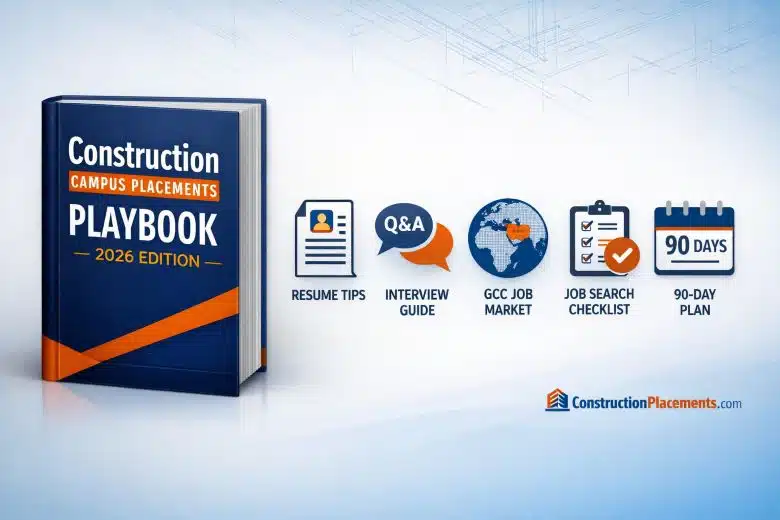
The Construction Campus Placements Playbook — 2026 Edition was built to fix this. It is a 100+ page, step-by-step career system designed exclusively for Indian civil engineering students and fresh graduates targeting construction industry jobs — in India and globally.
In this post, we will walk you through everything inside the playbook, who it is for, how it works, and how to download your copy today.
👉 Download the Playbook Now — ₹150 Only (Instant Download)
Table of Contents
Why Do Most Civil Engineering Students Struggle with Construction Placements?
Let us be direct about the problem. After four years of studying structural analysis, concrete technology, soil mechanics, and surveying, most civil engineering students enter placement season with:
- No clarity on construction roles — They know “Site Engineer” exists. They have never heard of Planning Engineer, Quantity Surveyor, BIM Coordinator, QA/QC Engineer, Contracts Engineer, or Estimation Engineer as distinct career paths with different skill requirements and salary trajectories.
- A generic, weak resume — The same template forwarded on WhatsApp batch groups, with vague bullet points like “Good communication skills” and “Team player” that recruiters ignore instantly.
- Zero interview preparation — No practice with technical civil engineering interview questions, no frameworks for HR rounds, no understanding of how to discuss academic projects professionally.
- No off-campus strategy — If the college placement cell does not bring companies, these students have no backup plan. No LinkedIn presence, no portfolio, no outreach system.
- No awareness of global opportunities — The GCC construction market hires thousands of Indian engineers every year at tax-free salaries. Most students do not even know how to apply.
The playbook addresses every single one of these gaps — systematically, with templates, examples, case studies, and daily action plans.
What Is the Construction Campus Placements Playbook?
The Construction Campus Placements Playbook is a 30,000+ word digital guide (100+ pages) created by the ConstructionPlacements.com team. It covers the complete placement journey — from choosing the right construction role to clearing technical interviews, negotiating salary, and planning your first 90 days on the job.
It is written in a mentor-like tone. No academic jargon. No motivational fluff. Every chapter gives you frameworks, templates, real examples, and action steps you can execute immediately.
The playbook includes:
- 14 detailed chapters covering the full placement lifecycle
- 14 appendices with ready-to-use templates, question banks, and checklists
- A 4-part workbook for self-assessment and planning
- 10 real-world case studies from Tier-2 and Tier-3 college students
- A 90-day mission plan with daily tasks
Format: Downloadable .pdf file (works on phone, laptop, and tablet). Fully editable — you can copy templates directly into your own documents.
📥 Download the Playbook — ₹150 | Instant Access
Complete Chapter-by-Chapter Breakdown
Here is exactly what you will learn in each chapter of the playbook. This is not a surface-level overview — each chapter is a deep, actionable guide in itself.
Chapter 1: Know Your Career Map — 10 Construction Roles Decoded
Most students think construction means one thing: standing on a site in a hard hat. The reality is that the construction industry offers 17+ distinct job profiles, each requiring different skills, software knowledge, and personality traits.
This chapter breaks down 10 core construction career paths:
- Site Engineer — Day-to-day execution, material management, labour coordination
- Planning Engineer — Primavera P6, MS Project, scheduling, delay analysis
- Quantity Surveyor (QS) — BOQ preparation, cost estimation, contract management
- QA/QC Engineer — Quality assurance, NCR management, ISO standards
- BIM Coordinator — Revit, Navisworks, clash detection, 3D/4D/5D modelling
- HSE Officer — NEBOSH, safety audits, toolbox talks, incident investigation
- Survey Engineer — Total station, AutoCAD, GPS/GNSS, levelling
- Contracts Engineer — FIDIC, claims, variation orders, dispute resolution
- Estimation Engineer — Quantity takeoff, rate analysis, tender preparation
- Design Engineer — STAAD Pro, ETABS, structural design, RCC detailing
For each role, you get: a clear job description, required software skills, typical salary range (India and GCC), growth trajectory over 5-10 years, and a “best for” personality profile to help you decide which path fits you.
If you are still unclear about which construction role suits your skills and interests, the comprehensive guide to 110 civil engineering career paths on our website is also a useful reference alongside this chapter.
Chapter 2: The 2026 Construction Hiring Landscape
This chapter explains how construction companies actually hire — the difference between Tier-1 EPC firms, mid-size contractors, consultancies, and real estate developers. You will learn which types of companies visit campuses, which hire only off-campus, seasonal hiring patterns, and how economic cycles affect fresher recruitment.
The chapter also covers the India-to-Gulf hiring pipeline — how Indian EPC companies serve as a launchpad for GCC careers, which recruitment agencies are legitimate, and what the typical career progression looks like for an Indian engineer going global.
For a deeper look at the Gulf opportunity specifically, read our detailed analysis of the Gulf construction boom and jobs Indians should target in 2026.
Chapter 3: Build Your 2026 Skill Stack
Recruiters do not hire based on CGPA alone. They hire based on a combination of technical fundamentals, software proficiency, and professional skills that together form your “skill stack.”
This chapter gives you the exact skill stack framework for 2026, organised into three layers: core engineering knowledge, software and tools (role-specific), and professional skills (communication, documentation, site etiquette). It includes a 30-day self-study plan for each skill gap, recommended certifications, and a comparison of free vs. paid learning platforms.
The chapter also covers emerging skills like AI in construction and hybrid construction roles that combine site expertise with digital capabilities — skills that are becoming increasingly important for career growth in 2026 and beyond.
Chapter 4: 20 Construction Concepts Every Fresher Must Know
Interviews test practical knowledge — not textbook definitions. This chapter covers 20 foundational construction concepts that interviewers expect every fresher to understand, including: bar bending schedule (BBS), cube testing, slump test, curing methods, formwork types, waterproofing techniques, soil bearing capacity, reinforcement lap lengths, concrete mix design basics, and more.
Each concept is explained with practical context — what it means on a construction site, common mistakes, and how to explain it confidently in an interview. This pairs well with our guide on how to face civil engineering interviews.
Chapter 5: Resume That Gets Callbacks — 3 Templates Inside
Your resume gets 30 seconds. If it does not immediately communicate your value, it goes into the rejection pile — regardless of your actual abilities.
This chapter teaches you the anatomy of a construction-specific resume, the Action + Metric + Context formula for bullet points, and how to handle common fresher challenges (no internship, low CGPA, career gaps). It includes three complete, copy-paste-ready resume templates:
- Template 1: Pure Fresher — No internship, limited experience. Focus on academic projects, coursework, and self-learned skills.
- Template 2: Internship-Heavy — For students with 1-2 internships. Focus on site experience, tools used, and measurable contributions.
- Template 3: Project-Heavy — For students with strong academic or competition projects. Focus on design, analysis, and portfolio-worthy work.
Each template includes before-and-after examples showing weak vs. strong bullet points for the same experience.
Want an even faster way to get your resume right? The ConstructionCareerHub Resume Lab is an AI-powered tool that analyses your resume against ATS requirements specifically for construction roles and gives you an instant improvement report.
Chapter 6: Build a Project Portfolio That Impresses Recruiters
A portfolio transforms you from “another fresher” to “the candidate who actually shows their work.” This chapter provides a complete blueprint for turning your academic projects — whether it is a final-year design project, an internship report, or a competition entry — into a professional 10-page portfolio.
It covers: project summary format, how to present drawings and calculations, photography dos and don’ts, digital portfolio tools, and how to share your portfolio on LinkedIn and during interviews.
Chapter 7: LinkedIn and Digital Presence for Construction Professionals
LinkedIn is where construction recruiters find candidates. This chapter provides a section-by-section LinkedIn optimisation guide: headline formula, summary template, experience descriptions, skills to endorse, and content strategy for visibility.
It also includes 5 cold message templates — tested scripts for reaching out to recruiters, HR managers, and senior engineers on LinkedIn without sounding desperate or spammy. Plus email templates for follow-ups and informational interviews.
Chapter 8: Campus Placement Strategy
This chapter is your game plan for placement drives. It covers aptitude preparation (quantitative, verbal, logical — with a 6-week prep schedule), group discussion strategy (15 construction-specific GD topics with structured talking points), and company targeting (how to research companies, identify your top 10, and prepare company-specific answers).
It includes a “Placement Week Countdown” checklist — what to do 30 days, 7 days, and 1 day before the drive.
Chapter 9: Technical Interview Mastery — 50 Questions with Answers
The core of interview preparation. This chapter contains 50 technical interview questions with detailed, interview-ready answers, organised by construction role:
- Concrete and RCC questions (BBS, mix design, curing, testing)
- Soil and foundation questions (bearing capacity, types of foundations, compaction)
- Structural questions (load paths, beam design, column reinforcement)
- Site and practical questions (setting out, quality checks, safety procedures)
- Software questions (AutoCAD, Primavera, Revit, Excel for construction)
- Safety and quality questions (PPE, toolbox talks, NCR process)
Each answer includes the “what to say” response plus a “why this works” explanation so you understand the interviewer’s intent, not just the words to repeat.
For role-specific deep dives, also explore our top 100 estimation engineer interview questions and the comprehensive construction interviews master guide on our website.
And if you want to practice these questions in a simulated interview environment with instant AI feedback, try the Interview Copilot on ConstructionCareerHub — it generates role-specific technical and HR questions and scores your answers on clarity, structure, and confidence.
Chapter 10: HR Interview — 25 Questions with Tested Answers
HR rounds eliminate more candidates than technical rounds. This chapter provides strong, tested answers for 25 common HR questions, including the ones freshers dread most:
- “Tell me about yourself” — A structured framework (not a script) that works every time
- “Why should we hire you?” — How to connect your skills to the company’s specific needs
- “What is your expected salary?” — Negotiation frameworks for India and GCC roles
- “What is your biggest weakness?” — How to answer honestly without self-sabotaging
- Handling tough situations: low GPA, no internship, career gaps, relocation concerns
Chapter 11: Off-Campus Job Hunting System
If your college does not have strong placement support — or if you graduated without an offer — this chapter gives you a complete off-campus strategy. It covers: LinkedIn daily outreach routine, job portals that actually work for construction roles, how to get referrals without feeling awkward, a follow-up cadence that keeps you top-of-mind, and a tracking spreadsheet template.
You can also browse the latest civil engineering and construction jobs and current walk-in interview opportunities on our website as part of your off-campus search.
Chapter 12: Going Global — GCC Deep Dive and Beyond
The Gulf construction market (UAE, Saudi Arabia, Qatar, Kuwait, Oman, Bahrain) is one of the largest employers of Indian construction professionals. This chapter provides a country-by-country breakdown — salary ranges, visa processes, cultural expectations, document requirements, and which roles are in highest demand in each market.
It also covers other international markets: Australia, Canada, the UK, and Southeast Asia — entry pathways, certification requirements, and realistic timelines.
For company-level research, our list of top construction companies in Dubai and the UAE and the guide to top 10 in-demand construction jobs in the UAE will help you identify target employers. For a complete preparation kit with ATS keywords, Gulf resume format, and negotiation scripts, also see our India to Gulf Construction Career Kit.
Chapter 13: Your 30-60-90 Day Mission Plan
Once you get hired, the real work begins. This chapter provides a structured plan for your first 90 days — daily routines, key milestones, relationship-building strategies, and a self-assessment scorecard. It also includes a “Quick 5-Thing Plan” for students who only have 2 weeks before a placement drive and need an emergency preparation strategy.
Chapter 14: Document Readiness Checklist
Missing one document can delay your joining by weeks — or cost you the offer entirely. This chapter provides a master checklist for every document you need (academic, professional, and personal), covering both Indian and international requirements including: degree certificates, transcripts, experience letters, passport, visa documents, medical fitness, attestation process for GCC countries, and digital document management best practices.
14 Appendices — Ready-to-Use Resources
The playbook appendices are designed for quick reference and direct use. Here is what you get:
- Appendix A: 3 Resume Templates (Fresher, Internship-Heavy, Project-Heavy) — formatted and ready to customise
- Appendix B-D: Email Templates, LinkedIn Templates, Cold Message Templates — tested scripts for professional outreach
- Appendix E: Project Portfolio Outline — page-by-page structure for a 10-page portfolio
- Appendix F: Interview Tracker Template — spreadsheet format to track applications, follow-ups, and outcomes
- Appendix G: 8-Week Study Plan — daily schedule covering aptitude, technical, HR, and GD preparation
- Appendix H: 50 Technical Interview Questions with Answers — comprehensive Q&A bank organised by engineering discipline
- Appendix I: 25 HR Questions Quick Reference — one-page cheatsheet for last-minute revision
- Appendix J: 15 GD Topics Quick Reference — structured talking points for common group discussion topics
- Appendix K: 20 Aptitude Practice Problems — quantitative, verbal, and logical reasoning with solutions
- Appendix L: Global Readiness Checklist — everything you need for international job applications
- Appendix M: Certification Roadmap — 5 career tracks (BIM, Planning, Safety, QA/QC, QS) with recommended certifications, costs, and timelines
- Appendix N: Suggested Online Learning Paths — curated course recommendations on Coursera, Udemy, NPTEL, and YouTube
4-Part Workbook — Plan Your Own Placement Journey
Reading is not enough. The playbook includes a hands-on workbook section with four interactive exercises:
- W1 — Target Role Selection Worksheet: A structured decision matrix to compare roles against your skills, interests, and career goals
- W2 — Skill-Gap Calculator: Identify exactly which skills you need to develop and create a prioritised learning plan
- W3 — Weekly Schedule Planner: A customisable weekly template that balances academic work, placement preparation, and skill-building
- W4 — Interview Practice Scorecard: Self-assessment rubric for mock interview practice with scoring criteria for content, delivery, and confidence
Who Is This Playbook For?
The Construction Campus Placements Playbook is specifically built for:
- Final-year civil engineering students preparing for campus placement drives
- Recent civil engineering graduates (2024-2026 batch) searching for their first construction job
- Diploma holders in civil engineering targeting construction site roles
- Students from Tier-2 and Tier-3 colleges with limited campus recruitment opportunities
- Career switchers moving into construction from related fields
- Anyone targeting high-paying construction jobs in India or the GCC region
It is also a valuable resource for college Training and Placement Officers (TPOs) looking to provide their civil engineering students with industry-relevant placement preparation material.
What Makes This Playbook Different from Other Career Guides?
There are generic career guides available everywhere. This is not one of them. Here is what sets the Construction Campus Placements Playbook apart:
1. Built exclusively for construction. Every example, every template, every interview question is specific to construction industry roles. Not generic “engineering placement” advice that tries to cover IT, mechanical, electrical, and civil in the same breath.
2. Action-oriented structure. Every chapter ends with: key takeaways (for quick revision), common mistakes (so you avoid what others get wrong), a mini case study (real scenario, real outcome), a 7-day action plan (so you never wonder “what next?”), and a one-page summary (for last-night revision before interviews).
3. Mentor-like tone. This reads like advice from a senior who already cracked placements and is sitting next to you, telling you exactly what to do — practical, honest, and direct.
4. 10 real case studies. Not hypothetical scenarios. Real situations from students at Tier-2 and Tier-3 colleges who faced challenges like low CGPA, no internship, limited campus opportunities, or family pressure to take government jobs — and how they navigated these situations to land construction roles.
5. India + Global coverage. The playbook covers both Indian construction placements and international opportunities (with particular depth on GCC countries), making it useful regardless of whether you want to work in Hyderabad or Dubai.
How to Use This Playbook Effectively
Here is our recommended approach for getting maximum value from the playbook:
If you have 3+ months before placements: Read the full playbook chapter by chapter. Complete the workbook exercises. Follow the 8-week study plan in Appendix G. Build your resume, portfolio, and LinkedIn profile using the templates. Practice interview questions weekly.
If you have 1 month before placements: Start with Chapter 1 (know your target role), then jump to Chapter 5 (resume), Chapter 9 (technical interview), and Chapter 10 (HR interview). Use the appendix cheatsheets for quick revision.
If you have 1 week or less: Go directly to the one-page summaries at the end of each chapter. Use the “Quick 5-Thing Plan” in Chapter 13. Memorise 10 technical answers from Appendix H and 5 HR answers from Appendix I. Prepare your “Tell me about yourself” using the Chapter 10 framework.
Pair the Playbook with AI-Powered Career Tools
The playbook gives you knowledge and templates. For hands-on, personalised career preparation, we have also built ConstructionCareerHub — the first AI-powered career platform built exclusively for construction professionals.
Here is how the two work together:
- Resume Lab — Upload your resume and get an instant ATS compatibility score with specific improvement suggestions for construction roles. Apply the resume principles from Chapter 5, then validate with the AI tool.
- Interview Copilot — Practice 15+ AI-generated technical and HR interview questions for Site, BIM, QS, Planning, HSE, and Construction Management roles. Get instant feedback on your answers. Use this after studying the 50 technical and 25 HR questions in the playbook.
- Campus Placement Prep — AI-powered resume screening simulation, skill gap analysis, and interview readiness assessment — designed specifically for construction students preparing for campus drives.
- Career Planner — Get a personalised career roadmap based on your skills, interests, and target market (India or GCC).
- Salary Calculator — Research realistic salary ranges for your target role, experience level, and location before walking into negotiations.
The playbook is your strategy. ConstructionCareerHub is your practice ground. Together, they give you the most comprehensive construction placement preparation system available anywhere.
One free interview session is included — no credit card required. Explore ConstructionCareerHub tools here →
Pricing, Format, and Download
Here are the details:
- Price: ₹150 (one-time payment, no subscription)
- Format: .pdf file — works on phone, laptop, tablet. Editable in Microsoft Word, Google Docs, or any word processor.
- Delivery: Instant digital download after payment via Instamojo
- Access: Lifetime. Download once, keep forever.
- Word count: 30,000+ words across 100+ pages
- Contents: 14 chapters + 14 appendices + 4-part workbook + 10 case studies
That is less than one Zomato order. Less than one movie ticket. Less than your monthly mobile recharge. But it could be the single resource that bridges four years of college and your first construction job.
📥 Ready to Start Your Construction Career?
Download the Construction Campus Placements Playbook 2026 →
₹150 | Instant Download | Lifetime Access | 30,000+ Words
For College TPOs and Faculty Members
If you are a Training and Placement Officer or a civil engineering faculty member looking to provide your students with industry-relevant placement preparation, we offer bulk pricing for campus-wide distribution. Email us at info@constructionplacements.com with your college name, number of students, and department details. We will set up a custom link for your institution.
Continue Your Placement Preparation
The playbook is your comprehensive foundation. To keep building on it, explore these additional resources on ConstructionPlacements.com:
- Construction Interviews: Complete Questions, Answers and Career Guide
- Top 50 Basic Civil Engineering Interview Questions and Answers
- How to Face Civil Engineering Interview — Updated Guide
- Cracking Construction Jobs Interviews: Your Q&A Success Guide
- Top 100 Estimation Engineer Interview Questions and Answers
- Top 17 Jobs in the Construction Industry
- 110 Career Paths with Civil Engineering
- Top 21 Highest Paying Construction Jobs
- The Gulf Construction Boom: Jobs Indians Should Target in 2026
- India to Gulf Construction Career Kit
- Introduction to Construction Careers
- AI in Construction: 2026 Skills and Tools That Get You Hired
- Latest Walk-in Interviews for Construction and Engineering Jobs
- Browse All Latest Civil Engineering and Construction Jobs
- Campus Placements Preparation Guide for 2026
- Can You Get a Civil Engineering Job Without Campus Placement? Here’s How
- What are the best practices for preparing for campus placements in engineering colleges?
- Essential Tips for Choosing the Ultimate Construction Management College
And for AI-powered, personalised career preparation — resume analysis, mock interviews, skill gap assessment, and salary research — visit www.ConstructionCareerHub.com.
Frequently Asked Questions
Is this playbook only for students in India?
The playbook is written with Indian civil engineering students as the primary audience, but it covers global opportunities extensively — particularly GCC countries (UAE, Saudi Arabia, Qatar). The interview questions, resume frameworks, and career strategies are applicable to construction professionals targeting jobs anywhere in the world.
I am not a fresher. Is this still useful?
The core audience is final-year students and recent graduates (0-2 years experience). However, professionals with 2-5 years of experience will find the GCC career roadmap, certification guidance, salary negotiation frameworks, and advanced interview strategies highly valuable — especially if they are planning a career transition to a new role or a new country.
Can I get a refund if I am not satisfied?
Since this is a digital download product, refunds are not available after delivery. However, the detailed chapter breakdown on this page gives you full transparency about what is inside before you purchase.
Is this available in Hindi?
The current edition is in English. We are evaluating a Hindi version based on demand.
How is this different from free interview question lists available online?
Free lists give you questions. This playbook gives you a complete system — role clarity, resume building, portfolio creation, LinkedIn strategy, campus and off-campus approaches, technical and HR interview preparation with detailed answer frameworks, GCC career planning, and a 90-day action plan with daily tasks. It is the difference between having ingredients and having a recipe.
Do I need any software to open the file?
The playbook is a .pdf file. You can open it with Microsoft Word, Google Docs , WPS Office, or any standard word processor on your phone, laptop, or tablet.
I have more questions. How can I reach you?
Email us at construplacements@gmail.com or reach out through our contact page. You can also DM us on LinkedIn or Instagram.
Your construction career does not have to start with confusion.
30,000+ words. 14 chapters. 50 technical Q&A. 25 HR answers. 3 resume templates. GCC roadmap. 90-day plan.
Download the Construction Campus Placements Playbook 2026 — ₹150 →
From confused final-year student to confident, job-ready construction professional — one chapter at a time.
