

Last Updated on April 23, 2026 by Admin
There’s nothing quite like a warm summer day with a broken AC unit.
ConstructionCareerHub App is LIVE — built ONLY for construction careers. Don’t apply with a weak resume.
Get ATS-ready Resume Lab + Interview Copilot + Campus Placement Prep (resume screening, skill gaps, interview readiness) — in minutes & Other advanced features.
Explore Smarter Construction Career Tools →Quick check. Big impact. Start now.
The fan is blowing air. But nothing is cold. The temperature keeps rising and nothing looks wrong outside the unit.
So what’s going on?
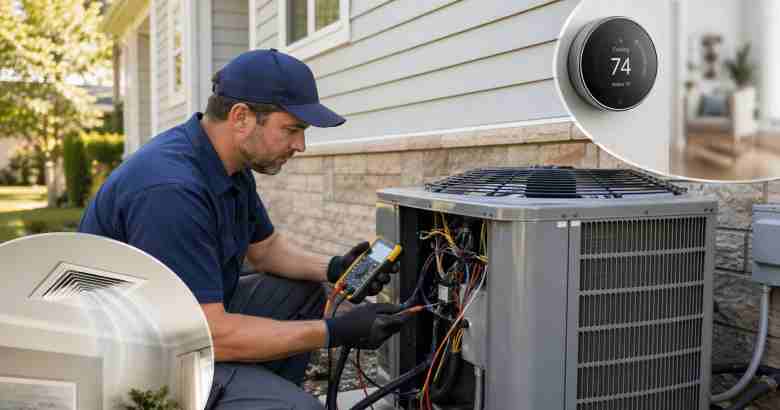
The reality is that most AC troubles come down to three things — a bad capacitor, faulty thermostat or something related to airflow. Calling in Chicago AC repair experts is the quickest way to get an accurate AC repair diagnosis. However, many times homeowners are able to pinpoint the problem before dialing for help.
Here’s how to do it…
What’s Inside:
- Why Your AC Isn’t Cooling
- Capacitor Problems — The Most Common Culprit
- Thermostat Fixes That Actually Work
- Airflow Issues You Can’t Afford to Ignore
- When To Call a Professional
Table of Contents
Why Your AC Isn’t Cooling
Before jumping into fixes, it helps to understand what’s actually happening inside the unit.
Your AC draws hot air out of your home, cools it over refrigerant coils, then pushes that cooled air back in. If any piece of that process stops working properly, the entire system feels the effects.
The annoying thing is? The system can keep running — it will just not cool. According to industry statistics, the majority of AC repairs are to the capacitor, compressor, fan motor or condenser coil. Virtually all of these problems share one symptom in common. The system runs but blows little or no cold air.
Sound familiar?
Capacitor Problems — The Most Common Culprit
The capacitor looks like a small cylinder and this is what provides starting torque to the AC motor. Think of it like a battery that helps the motor start. The compressor and fan motors will not start correctly without a good capacitor.
Here’s how to spot a failing capacitor:
- The AC hums but doesn’t fully start up
- The fan is sluggish or won’t spin at all
- The unit starts and shuts off repeatedly
- There’s a clicking sound each time the system tries to turn on
If a capacitor goes bad, the motor won’t start or it will run badly — which means no cooling even though it’s “on.”
Capacitor replacement is one of the easiest AC repair services that can be done. A technician can easily replace it in no time. Getting it done early matters because a bad capacitor can severely damage the compressor.
And compressor replacement is a much bigger bill.
Jump on it. Quick capacitor replacement helps prevent the rest of the system from failing.
Thermostat Fixes That Actually Work
Here’s something that surprises a lot of people…
The majority of AC “failures” are thermostat related. Rule out these things before thinking the unit has a serious problem:
- Is the thermostat set to “cool” and not “fan only”?
- Is the set temperature lower than the current room temperature?
- Are the batteries dead or running low?
- Is the thermostat near a source of heat (direct sunlight, lamp, etc.)?
Actually, that last issue is more prevalent than many homeowners think. If a thermostat is reading the surrounding air as being warmer than it actually is, it will either continue to run the AC longer than necessary or think the job is finished when it is not. Either scenario results in discomfort.
The smart thermostat upgrade.
Smart thermostats can reduce cooling costs by 10-15% annually, according to the EPA. They can also assess conditions much more accurately and allow for significantly greater control over scheduling and zoning temperatures within the home.
If the thermostat is old, replacing it could fix the cooling issue and help reduce energy costs.
That’s a win-win.
Airflow Issues You Can’t Afford to Ignore
One of the most common causes of AC issues goes unnoticed far too often. Poor airflow. The system can be running perfectly fine mechanically — but if air struggles to move through the home, it won’t cool right.
Here’s where to check:
Dirty or clogged air filters. Oh yes, this is the absolute number one enemy of airflow. When the filter is clogged, air can’t flow over the evaporator coil. If that occurs, the coil freezes up — and when the coil is frozen, there is no cooling. Filters need to be checked monthly, and changed every one to three months.
Blocked or closed vents. Sounds like a no-brainer. But really, this is more common than most people think. Go room to room through the house and double check that all of the vents are completely open and nothing is blocking airflow (furniture, curtains, boxes).
Dirty evaporator or condenser coils. Dirty coils covered in dust and grime don’t exchange heat very well. The AC struggles and runs longer without reaching the desired temperature. Prevent buildup with annual maintenance.
Leaks in the refrigerant lines. Airflow might seem fine, but if it isn’t cooling, there could be a refrigerant leak. Low refrigerant limits the ability of the system to absorb heat. This will need to be repaired by a professional.
Only 43% of Americans have yearly maintenance performed on their central AC — and those who do enjoy 40% longer AC life. Tune-ups help find airflow issues before they become expensive AC repairs.
When To Call a Professional
Some AC problems are simple to diagnose at home. Others aren’t.
When everything looks okay with the capacitor, thermostat, and airflow doesn’t seem blocked… there’s something else going on. Problems with refrigerant charge, compressor problems and electrical problems all require a certified technician with special equipment.
Average HVAC repair visits cost about $350. Preventing issues with professional detection keeps costs on the low end.
The longer an AC problem goes unaddressed, the more expensive it gets.
The Bottom Line
A non-cooling AC can be maddening — but it’s usually caused by one of these three things:
- A failed capacitor stopping the motors from working properly
- A thermostat reading the wrong temperature or set incorrectly
- Airflow blocked by dirty filters, closed vents, or low refrigerant
Begin with the easy solutions. Cycle through the thermostat settings. Check the filters. Listen for unusual noises. If all else fails…
It’s time to bring in the professionals.
To quickly recap:
- Check thermostat settings first — it’s the most overlooked fix
- Inspect and replace dirty air filters regularly
- Listen for clicking or humming sounds (classic capacitor warning signs)
- Book annual maintenance to stay ahead of airflow issues
- Call a licensed technician for refrigerant leaks or compressor problems
Don’t wait until the last minute for AC repair — keep the house cool throughout summer.
Related Posts:
- How HVAC Efficiency Shapes Year-Round Home Comfort
- HVAC Maintenance: The Complete Guide for U.S. Homeowners
- Industrial Air Compressor: Key Component in Modern Manufacturing
- HVAC Repair Services Guide : Cut Energy Bills & Boost Comfort
- Top Benefits Of An Air Conditioner In Home
