

Last Updated on February 4, 2026 by Admin
Fire doors play a critical role in protecting lives and property by slowing the spread of fire and smoke. They are designed to compartmentalise a building, allowing occupants time to escape and emergency services to respond. However, fire doors are not fit-and-forget products. Over time, wear, damage, building alterations, and changes in regulations all affect their performance. Knowing when a fire door should be replaced, rather than repaired or adjusted, is essential for maintaining legal compliance and safety standards.
ConstructionCareerHub App is LIVE — built ONLY for construction careers. Don’t apply with a weak resume.
Get ATS-ready Resume Lab + Interview Copilot + Campus Placement Prep (resume screening, skill gaps, interview readiness) — in minutes & Other advanced features.
Explore Smarter Construction Career Tools →Quick check. Big impact. Start now.
This article explains how long fire doors typically last, the warning signs that indicate replacement may be necessary, and how certification and evolving standards affect decision-making.
Table of Contents
How long should a fire door last?
A correctly specified, installed, and maintained fire door can last many years, but there is no fixed lifespan. In practice, longevity depends on several factors including the quality of the door set, frequency of use, environmental conditions, and how well it is maintained.
In commercial and multi-occupancy residential buildings, fire doors are often subject to heavy daily use. Doors in high-traffic areas such as stairwells, corridors, and entrances deteriorate more quickly than those in low-use locations. Moisture, temperature fluctuations, and building movement can also shorten a door’s effective service life.
Regular inspections are a legal requirement in many settings, particularly in flats, care homes, hotels, and workplaces. These checks help determine whether a fire door is still capable of meeting its rated performance, such as 30 or 60 minutes of fire resistance. If inspections identify defects that can’t be remedied through adjustment or approved repair methods, replacement is then required.
Signs you need a new fire door service or repair
Not every issue means a fire door must be replaced immediately. Some problems can be resolved through professional servicing, adjustment, or component replacement. However, repeated failures or multiple defects indicate that the door has reached the end of its safe working life.
Routine fire door inspections focus on the door leaf, frame, seals, ironmongery, and surrounding structure. When issues are found, it’s important to assess whether repairs will restore full compliance or whether replacement is the safer and more cost-effective option in the long term.
Damaged or warped door surface
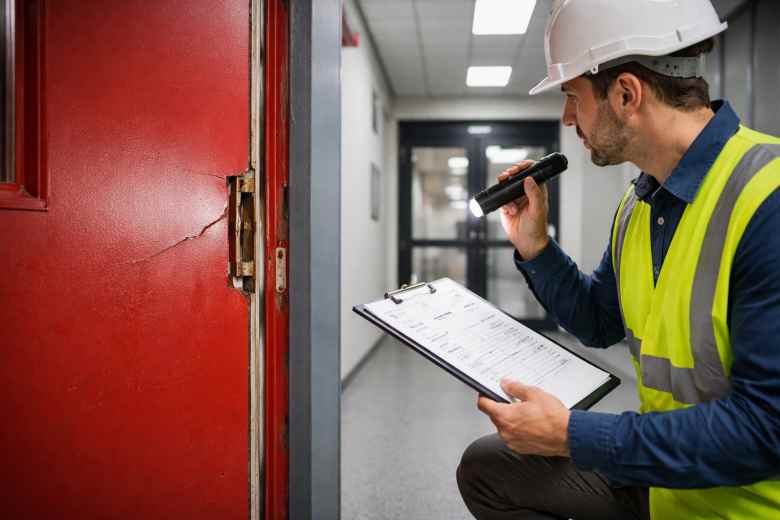
Visible damage to the door leaf is one of the clearest indicators that a fire door needs replacing. Fire doors are manufactured with specific core materials and construction methods to achieve their fire resistance rating. Cracks, splits, dents, or holes compromise this.
Warping is another serious concern. A warped door won’t sit correctly within the frame, preventing it from closing fully. Even small distortions affect how the door reacts in a fire, particularly when exposed to heat that causes materials to expand.
Surface damage caused by impact, water ingress, or unauthorised alterations such as unapproved glazing or hardware cut-outs should always be assessed by a competent professional. In many cases, damage of this nature cannot be reliably repaired without invalidating the door’s certification, making replacement the safest option.
Gaps around the door frame
Correct clearances are critical to fire door performance. When closed, a fire door should fit closely within its frame, with consistent gaps around the sides and top. Excessive gaps allow smoke and hot gases to pass through, reducing the door’s effectiveness.
In the UK, guidance states that gaps around the sides and top should be no larger than 4 mm. Gaps bigger than this are a common reason for fire door failure during inspections.
While minor clearance issues can sometimes be corrected through adjustment or hinge replacement, larger or uneven gaps may indicate frame movement, door distortion, or poor original installation. Where gaps cannot be corrected, it’s necessary to replace the door set.
Frequent repairs
A fire door that requires repeated repairs is a strong candidate for replacement. While occasional maintenance is expected, ongoing issues with closing, latching, seals, or ironmongery can point to underlying problems with the door or frame.
Repeated repairs also increase the risk of non-compliant work being carried out over time. Each modification has the potential to reduce fire resistance or invalidate certification.
From a practical perspective, frequent repairs can become more costly than installing a new, compliant fire door set. Replacement allows the entire assembly to be specified and installed to current standards, providing confidence that the door will perform as intended.
Fire door certification labels
Fire doors should carry certification evidence in the form of a label or plug located on the top edge or hinge side of the door leaf. This confirms that the door has been tested to a recognised standard and provides details such as the fire rating and manufacturer.
If a door has no visible certification, or if the label is damaged or unreadable, it can be difficult to prove compliance. In some cases, missing labels may be acceptable if documentation is available to confirm the door’s specification. However, where evidence cannot be established, replacement is the only reliable way to ensure compliance.
It’s also important to note that certification applies to the complete door set, including the frame, seals, glazing, and ironmongery. Significant changes to any of these elements without approved methods can invalidate the original certification, again making replacement the safest course of action.
Outdated standards
Fire safety standards and building regulations evolve over time in response to new research, testing methods, and lessons learned from real-world incidents. Fire doors installed many years ago may have been compliant at the time but no longer meet current expectations.
Older doors may lack essential features now considered standard, such as effective smoke seals, self-closing devices, or compliant glazing systems. They may also have been tested to superseded standards.
When buildings are refurbished, change use, or undergo regulatory review, older fire doors are often identified as needing replacement to meet current guidance. Upgrading to doors manufactured and tested to modern standards ensures consistent performance across the building and reduces uncertainty during inspections.
Making an informed decision
Deciding whether to repair or replace a fire door should always be based on a professional assessment carried out by a competent person. This should consider the door’s condition, certification status, usage, and ability to meet current regulatory requirements.
Replacing a fire door is not just about compliance, it’s about ensuring that a critical safety component will perform as expected in an emergency. Investing in properly designed, manufactured, and installed fire doors provides long-term assurance, reduces ongoing maintenance issues, and supports a robust fire safety strategy.
Related Posts:
- Step by Step Guide To DIY New Door Installation and Fitting
- 5 Common Fire Door Fitting Mistakes to Avoid
- Composite Doors – Pros and Cons
- How Does Concrete Leveling Compare to Full Replacement in Cost And Longevity?
- How to Explain Employment Gaps on Your Construction Resume (Without Lying)
