

Last Updated on March 31, 2026 by Admin
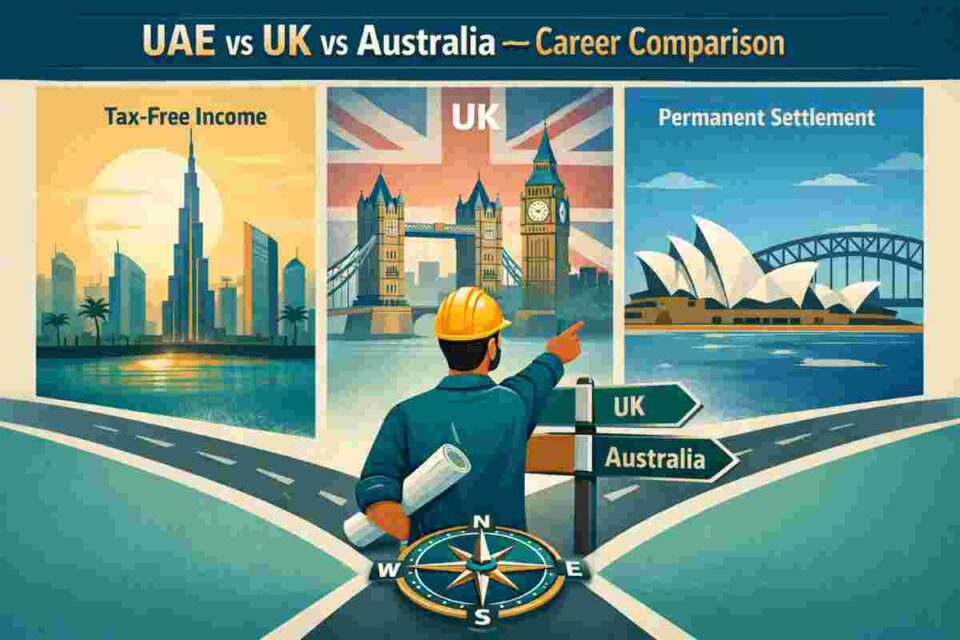
If you are an Indian engineer weighing your options between the UAE, UK, and Australia in 2026, you are not alone. These three destinations collectively attract over 60% of Indian engineering professionals who move abroad each year — and each country offers a radically different career equation. Tax-free earnings in Dubai, a structured pathway to permanent residency in Sydney, or a Chartered Engineer credential from London — the “right” choice depends entirely on your career stage, financial goals, family situation, and long-term settlement plans.
ConstructionCareerHub App is LIVE — built ONLY for construction careers. Don’t apply with a weak resume.
Get ATS-ready Resume Lab + Interview Copilot + Campus Placement Prep (resume screening, skill gaps, interview readiness) — in minutes & Other advanced features.
Explore Smarter Construction Career Tools →Quick check. Big impact. Start now.
This comprehensive comparison breaks down every factor that matters — from visa processes and salary ranges to professional licensing, cost of living, and permanent residency pathways — so you can make an informed, strategic decision about your next career move.
Whether you are a fresh B.Tech graduate, a mid-career civil or mechanical engineer, or a senior construction professional planning your next decade, this guide will give you the clarity that generic career advice cannot. If you are still evaluating whether moving abroad makes sense at all, start with our detailed analysis: Is Going Abroad Worth It for Civil Engineers in 2025?
Table of Contents
Quick Snapshot: UAE vs UK vs Australia at a Glance
Before diving into the details, here is a high-level comparison to frame your thinking. Each country serves a different career archetype:
| Factor | UAE | UK | Australia |
|---|---|---|---|
| Income Tax | 0% (tax-free) | 20–45% (progressive) | 19–45% (progressive) |
| Avg. Engineer Salary (Mid-Career) | AED 8,000–15,000/month (~₹18–34 LPA) | £40,000–55,000/year (~₹42–58 LPA) | AUD 90,000–120,000/year (~₹49–65 LPA) |
| Primary Visa Route | Employer-Sponsored Work Visa | Skilled Worker Visa (£41,700 min salary) | Subclass 189/190/482 (Points-Based) |
| PR Pathway | Golden Visa (10 years) — limited | ILR after 5 years on Skilled Worker Visa | Direct PR via Subclass 189/190 |
| Citizenship Possibility | Extremely rare | After 6 years (5 ILR + 1 year) | After 4 years (1 year as PR) |
| Best For | Rapid savings, Gulf mega-projects | Chartered status, European exposure | Long-term settlement, family migration |
| Indian Engineer Community | Very large (35%+ of UAE population) | Growing (IT, healthcare, engineering) | Large and well-established |
For a broader perspective on which countries offer the strongest construction careers, explore our Top Countries for Civil Engineers guide.
Visa and Immigration: How Each Country Works for Indian Engineers
The immigration pathway is often the single biggest differentiator between these three destinations. Here is what Indian engineers need to know in 2026.
UAE: Employer-Sponsored and Fast
The UAE remains the easiest of the three countries for Indian engineers to enter. The process is employer-driven: once you secure a job offer, your employer sponsors your work visa, typically processed within 2–4 weeks. There are no points tests, no language exams, and no lottery systems.
Key visa types for engineers in 2026 include the Standard Employment Visa (2-year validity, employer-sponsored), the Green Visa (5-year self-sponsored visa for skilled professionals), and the Golden Visa (10-year residency for specialists earning AED 30,000+ per month). The UAE introduced four new visa categories in 2026, including an AI Specialist Visa, and has expanded Golden Visa eligibility to more engineering and technology professions.
One important requirement: Indian engineers must get their educational documents attested through India’s MEA and the UAE’s MOFA before the visa can be processed. The UAE’s new eDAS 2.0 digital attestation system has simplified this process considerably.
UK: High Threshold, Structured Pathway
The UK operates a points-based Skilled Worker Visa system that has become significantly more restrictive in 2026. Indian engineers must score 70 points across four categories: a Certificate of Sponsorship from a licensed UK employer (20 points), a graduate-level job at RQF Level 6 (20 points), meeting the salary threshold (20 points), and English language proficiency at B2 level (10 points).
The minimum salary threshold for the Skilled Worker Visa has risen to £41,700 per year in 2026 — or the occupation-specific “going rate,” whichever is higher. For civil engineers, the going rate is approximately £42,300. The English language requirement has also increased from B1 to B2 (roughly IELTS 5.5–6.5) since January 2026.
The upside: after 5 continuous years on a Skilled Worker Visa, you can apply for Indefinite Leave to Remain (ILR), the UK’s equivalent of permanent residency. Citizenship is possible one year after ILR.
Australia: Points-Based with Direct PR
Australia offers the most transparent and merit-based pathway for Indian engineers. The three main visa routes are Subclass 189 (Skilled Independent — direct PR, no sponsorship needed), Subclass 190 (Skilled Nominated — state-nominated PR), and Subclass 482 (Temporary Skill Shortage — employer-sponsored, leads to PR).
The points-based system evaluates age (maximum points for 25–32), English proficiency (IELTS 8+ preferred), work experience, education, and Australian study or professional year experience. The minimum qualifying score is 65 points, but competitive applicants in 2026 typically need 85–90+ points for engineering occupations on the Subclass 189 pathway.
Civil engineering, mechanical engineering, electrical engineering, and structural engineering all appear on Australia’s Skilled Occupation List (SOL). Engineers must obtain a positive skills assessment from Engineers Australia before applying, which evaluates your qualifications against Australian standards using the Washington Accord framework.
For detailed guidance on Australia’s engineering immigration process, read our guide: Career Pathways for Civil Engineers in Australia.
Salary Comparison: What Indian Engineers Actually Earn
Raw salary numbers can be misleading without context. What matters is your take-home pay after tax, adjusted for cost of living. Here is an honest comparison for 2026.
UAE Engineer Salaries (Tax-Free)
Civil engineers in the UAE earn an average of AED 7,500–10,000 per month (approximately ₹1.7–2.3 lakh/month) at the mid-career level. Senior engineers and project managers with 10+ years of experience can command AED 15,000–25,000 per month. In Dubai specifically, engineers earn approximately 10–15% more than the UAE average, with major firms like Shapoorji Pallonji, Parsons, and AECOM paying the highest packages.
The biggest advantage: 100% of your salary is take-home. No income tax, no social security deductions. Many employers also provide housing allowance, medical insurance, annual flights home, and end-of-service gratuity — effectively adding 25–40% to your base salary.
UK Engineer Salaries (Taxed)
The average civil engineer salary in the UK is approximately £35,000–45,000 per year, with London-based roles paying £38,000–55,000. Graduate engineers start at £25,000–32,000, while chartered senior engineers can earn £60,000–80,000+. After UK income tax (20% on earnings above £12,570, rising to 40% above £50,270), National Insurance contributions, and the Immigration Health Surcharge (£1,035/year for visa holders), take-home pay is significantly reduced.
A mid-career engineer earning £45,000 gross takes home approximately £34,500 after deductions — roughly £2,875 per month. The high cost of living in London and the South East further compresses disposable income.
Australia Engineer Salaries (Taxed)
Civil engineers in Australia earn an average of AUD 90,000–110,000 per year at the mid-career level, with Sydney and Melbourne commanding premiums of AUD 120,000–150,000 for experienced professionals. Graduate engineers start at AUD 60,000–75,000. Senior engineers and project managers can earn AUD 130,000–180,000+.
Australian tax rates for residents range from 19% (on income AUD 18,201–45,000) to 45% (above AUD 190,000). A mid-career engineer earning AUD 100,000 takes home approximately AUD 75,000–78,000 after tax — around AUD 6,300 per month.
For comprehensive salary data across experience levels and specialisations, refer to our Civil Engineering Salary Guide 2026.
Net Savings Comparison (Realistic Scenario)
| Parameter | UAE (Dubai) | UK (London) | Australia (Sydney) |
|---|---|---|---|
| Gross Annual Salary | AED 180,000 (~₹40 LPA) | £45,000 (~₹47 LPA) | AUD 105,000 (~₹57 LPA) |
| Tax | ₹0 | ~₹12 LPA | ~₹13 LPA |
| Estimated Monthly Rent | AED 4,000–6,000 | £1,200–1,800 | AUD 2,000–3,000 |
| Est. Annual Savings (Single) | ₹15–22 LPA | ₹5–10 LPA | ₹8–14 LPA |
| Est. Annual Savings (Family of 3) | ₹10–15 LPA | ₹2–5 LPA | ₹4–8 LPA |
Note: These are indicative estimates. Actual savings vary based on lifestyle, employer benefits, and specific city. Use the ConstructionCareerHub Salary Calculator for personalised estimates.
Professional Licensing and Recognition
Your Indian engineering degree is not automatically recognised in any of these countries. Each has its own professional accreditation framework.
UAE: MMUP/SCE Registration
To practice as an engineer in the UAE, you need registration with the Society of Engineers (formerly MMUP — Ministry of Municipal and Urban Planning in Abu Dhabi, or DM in Dubai). The process requires attested degree certificates, experience letters, and passing a technical exam in some emirates. Indian B.Tech degrees from AICTE-approved institutions are generally accepted, but the attestation process involves HRD, MEA, and UAE Embassy verification.
UK: Engineering Council / ICE Chartership
The UK recognises Indian engineering degrees under the Washington Accord (for accredited programmes). To gain full professional standing, engineers should pursue Chartered Engineer (CEng) status through institutions such as the Institution of Civil Engineers (ICE) or the Institution of Structural Engineers (IStructE). CEng status significantly boosts salary and career prospects — chartered civil engineers earn 30–50% more than non-chartered peers.
Australia: Engineers Australia Assessment
Engineers Australia (EA) conducts the mandatory skills assessment for immigration purposes. Indian engineers typically apply through the Washington Accord pathway (for accredited degrees) or write a Competency Demonstration Report (CDR) for non-accredited programmes. The CDR requires three career episode reports demonstrating engineering competence, plus a summary statement mapping competencies to EA standards.
After migration, pursuing Chartered Professional Engineer (CPEng) status enhances career progression. For a broader view of career options after your engineering degree, explore What Can I Do with a Civil Engineering Degree?
Job Market and Demand in 2026
Understanding which sectors are hiring — and where the skills gaps are deepest — helps you target the right country for your specialisation.
UAE: Mega-Project Driven Demand
The UAE construction market is fuelled by NEOM-adjacent projects, Expo 2030 legacy developments, Abu Dhabi’s Saadiyat Island cultural district, renewable energy installations, and ongoing residential and commercial development across Dubai. Civil, structural, mechanical, and MEP engineers are in high demand, along with BIM specialists, quantity surveyors, and project managers. The growing focus on sustainable construction and smart city infrastructure is creating new roles for engineers with green building and digital construction expertise.
UK: Infrastructure Investment Programme
The UK government’s infrastructure pipeline exceeds £700 billion through 2030, spanning HS2 rail, nuclear new-build (Hinkley Point C, Sizewell C), renewable energy (offshore wind), road upgrades, and housing development. Engineering roles on the Temporary Shortage List (valid until December 2026) include engineering technicians and specialised trades. However, the shift to RQF Level 6 (graduate-level) requirements means only degree-level engineering roles are now sponsorable under the standard Skilled Worker route.
Australia: Talent Shortage Across States
Australia faces one of the deepest civil engineering talent shortages globally. An infrastructure boom spanning transport (Sydney Metro, Melbourne Metro Tunnel), renewable energy, mining, and residential construction drives demand across all states. Western Australia and Queensland particularly need mining and civil construction engineers, while NSW and Victoria focus on transport infrastructure and urban development. The Subclass 190 state nomination pathway remains the most viable route for engineers, with South Australia and Tasmania offering more accessible nomination criteria.
For a detailed comparison of India’s domestic opportunities against these international markets, read our analysis: India vs Global Construction Careers: Salaries, Skills & Growth.
Cost of Living: Where Your Money Goes Further
Salary means little without understanding what it costs to live in each country. Here is a practical monthly budget comparison for a single Indian engineer.
| Monthly Expense | Dubai (AED) | London (£) | Sydney (AUD) |
|---|---|---|---|
| Rent (1-BHK, City) | 4,500–7,000 | 1,500–2,200 | 2,200–3,200 |
| Groceries | 800–1,200 | 250–400 | 400–600 |
| Transport | 500–1,000 (car common) | 150–200 (Oyster card) | 150–250 (Opal card) |
| Utilities + Internet | 500–800 | 150–250 | 200–350 |
| Health Insurance | Employer-provided | NHS (IHS paid upfront) | Medicare + private top-up |
| Dining/Entertainment | 1,000–2,000 | 200–400 | 400–700 |
Key takeaway: Dubai offers the best savings potential for single engineers and couples without children because of zero income tax and employer-provided housing benefits. London is the most expensive when tax, rent, and the Immigration Health Surcharge are combined. Sydney falls in between — high salaries offset by high rent and moderate tax rates, but superannuation (employer-contributed retirement fund) adds long-term value.
Permanent Residency and Long-Term Settlement
If your goal is to build a permanent life abroad — and especially if you are planning for your family’s future — the PR pathway is critical.
UAE: Limited Settlement Options
The UAE does not offer citizenship to foreign workers (with extremely rare exceptions). The Golden Visa provides 10-year renewable residency for high-earning professionals (AED 30,000+/month salary or AED 2 million+ investment), but it does not lead to citizenship. Standard work visas are tied to your employer — lose your job, and you must find new sponsorship or leave the country within a grace period. The UAE is best treated as a wealth-accumulation phase rather than a permanent settlement destination.
UK: Structured But Expensive
The UK offers a clear pathway: 5 years on a Skilled Worker Visa → Indefinite Leave to Remain (ILR) → British Citizenship after 1 additional year. However, the total cost is substantial. Application fees, the Immigration Health Surcharge (£1,035/year × 5 years = £5,175), the ILR application fee, and the citizenship ceremony fee collectively cost £10,000–15,000 over the journey. The path to settlement may also extend to 10 years under proposed 2026 reforms, though this is not yet confirmed.
Australia: The Strongest PR Pathway
Australia offers the most favourable permanent residency pathway for engineers. The Subclass 189 and 190 visas grant PR from day one — no waiting period, immediate access to Medicare healthcare, and the ability to sponsor family members. After 4 years of residence (including 1 year as a PR holder), you can apply for Australian citizenship. The PR also entitles you to subsidised university education for your children — a significant long-term financial benefit.
Which Country Is Best for Your Career Stage?
There is no universally “best” country. The optimal choice depends on where you are in your career and what you prioritise.
Fresh Graduates (0–3 Years Experience)
Best choice: UAE. The UAE has the lowest entry barriers — no points test, no language exam beyond basic English, and employers actively recruit from Indian engineering campuses. You can build 3–5 years of international experience, save aggressively (₹10–15 lakh/year is realistic), and develop your professional profile before targeting Australia or UK with a stronger CV. Dubai’s construction sector offers rapid career progression for motivated engineers willing to take on site responsibilities.
For step-by-step guidance on landing your first international role, see our roadmap: Overseas Jobs for Indian Civil Engineers.
Mid-Career Engineers (5–10 Years Experience)
Best choice: Australia (for settlement) or UAE (for savings). With 5–10 years of experience, you have the points and skills assessment profile to target Australia’s Subclass 189 or 190 PR pathway. You will also be at the optimal age bracket (25–32 years gets maximum points). If immediate savings are the priority and you are not yet ready to settle permanently abroad, the UAE’s tax-free salary and senior engineer roles offer the strongest financial returns.
Senior Engineers (10+ Years Experience)
Best choice: UK or Australia. Senior engineers benefit most from the UK’s Chartered Engineer pathway (CEng via ICE or IStructE), which carries global recognition and opens consulting opportunities. Alternatively, Australia’s demand for principal engineers and project directors offers high salaries (AUD 150,000–200,000+) with the stability of permanent residency. The UAE remains viable for senior project managers on mega-projects, though career growth can plateau after a certain level.
Explore our comprehensive construction careers abroad guide for additional strategies: A Comprehensive Guide to Construction Jobs Abroad.
Key Skills That Increase Your Value in All Three Markets
Regardless of which country you target, certain skills consistently command premium salaries and improve your immigration prospects.
BIM and Digital Construction: Building Information Modelling (Revit, Navisworks, Tekla) proficiency is now almost mandatory for mid-level and senior roles across all three countries. Australian employers particularly value BIM Level 2+ competence, while UAE mega-projects increasingly require digital twin and 4D scheduling expertise.
Project Management Certifications: PMP, PRINCE2, and APM qualifications are valued in the UK and Australia. In the UAE, PMP combined with Primavera P6 proficiency is the gold standard for construction project management roles.
Green Building and Sustainability: LEED AP, BREEAM, or Green Star certifications differentiate you in all three markets. The UK’s push toward net-zero construction and Australia’s Green Star framework make sustainability expertise increasingly essential.
English Language Proficiency: While the UAE has minimal English requirements for visa purposes, both the UK (B2/IELTS 5.5–6.5) and Australia (IELTS 7+ preferred for competitive points) require demonstrated English proficiency. Investing in IELTS preparation early is one of the highest-ROI career moves for Indian engineers planning to move abroad.
To build these skills strategically, explore courses from Coursera’s Construction Management catalogue, edX Civil Engineering courses, or Udemy’s BIM and Revit training.
Need an AI-powered career assessment to identify your skill gaps? Try the tools at ConstructionCareerHub.com — including the ATS-Ready Resume Lab, Interview Copilot, and Career Planner designed specifically for construction professionals.
Family and Lifestyle Considerations
Career decisions do not happen in isolation. Here is how each country stacks up for Indian engineers with families.
UAE: Excellent for families in the short to medium term. International schools with Indian curricula (CBSE, ICSE) are widely available. Healthcare is employer-provided. The large Indian community (35%+ of UAE population) means familiar food, festivals, and social networks. Limitations include extreme summer heat, the lack of permanent residency, and the risk of job loss disrupting your family’s visa status.
UK: Free public schooling and NHS healthcare (once you pay the IHS) are significant family benefits. However, the high cost of living — especially childcare (£1,000–2,000/month in London) — can strain budgets. The UK’s multicultural cities offer strong Indian community networks, and the education system is globally respected.
Australia: Often considered the best family destination. Public schools are high quality and free for PR holders. Medicare provides universal healthcare. The outdoor lifestyle, work-life balance, and safety make Australia particularly attractive for families with young children. The Indian community in cities like Melbourne and Sydney is well-established, with cultural events, temples, and Indian grocery stores widely available.
Step-by-Step Action Plan for Indian Engineers
Regardless of which country you choose, here is a practical roadmap to get started.
Step 1: Assess your profile. Calculate your Australia points score, check if your salary qualifies for UK’s £41,700 threshold, and evaluate your UAE job market fit. Use the 90-Day Career Plan for Civil Engineers for a personalised strategy.
Step 2: Get your credentials in order. Ensure your degree certificates are attested (for UAE), get your IELTS/PTE score (for UK and Australia), and initiate your skills assessment with Engineers Australia or prepare your CDR if targeting Australia.
Step 3: Build in-demand skills. Add BIM, project management certifications, or sustainability credentials to your profile. These improve both your employability and your immigration points score.
Step 4: Network strategically. Join LinkedIn groups for Indian engineers abroad, connect with professionals already working in your target country, and engage with industry bodies like ICE (UK), Engineers Australia, or the Society of Engineers (UAE).
Step 5: Apply systematically. Target employers with a track record of hiring international engineers. In the UK, check the Home Office Sponsor Register. In Australia, focus on companies known for 482 visa sponsorship. In the UAE, approach major contractors and consultancies directly.
For job search templates and professional messaging strategies, explore our Best Countries with Growing Construction Industries resource page.
Common Mistakes Indian Engineers Make When Choosing a Country
After working with thousands of construction professionals, these are the most frequent errors we see:
Comparing gross salaries without adjusting for tax. A £55,000 UK salary and an AED 15,000/month UAE salary may look similar in INR, but the take-home difference is massive once UK income tax, NI, and IHS are deducted.
Ignoring the PR timeline. Engineers who spend 8–10 years in the UAE without building toward PR elsewhere often find themselves starting the immigration process from scratch in their late 30s — when age-related points in Australia drop significantly.
Underestimating professional licensing requirements. Arriving in Australia without a positive Engineers Australia assessment, or in the UK without CEng eligibility, limits your career ceiling and earning potential.
Following friends instead of strategy. Your friend’s success in Dubai does not mean Dubai is right for your specialisation, experience level, and family situation. Make data-driven decisions.
Useful Resources and Ebooks
To deepen your preparation, these resources from ConstructionPlacements and our digital store can help:
- The Construction Job Blueprint 2026 — comprehensive job search strategies for construction professionals
- AI Construction Career Blueprint — leveraging AI tools for your construction career advancement
- India-to-Gulf Construction Career Kit — step-by-step guide for Indian engineers targeting Gulf countries
Note: Verify ebook availability and slugs on digitslick.gumroad.com before purchasing.
FAQ: UAE vs UK vs Australia for Indian Engineers
Which country pays the highest salary to Indian engineers?
In terms of gross salary, Australia typically offers the highest figures for mid-career and senior engineers (AUD 100,000–180,000). However, the UAE provides the best take-home pay due to zero income tax. A mid-career engineer in Dubai keeps 100% of their AED 10,000–15,000 monthly salary, while UK and Australian engineers lose 20–35% to taxes.
Can I get permanent residency as an Indian engineer?
Australia offers the clearest PR pathway through the Subclass 189 (independent) and 190 (state-nominated) visa programmes. The UK grants Indefinite Leave to Remain after 5 years on a Skilled Worker Visa. The UAE does not offer traditional PR — the Golden Visa (10-year renewable residency) is the closest alternative, available to high-earning professionals.
Is IELTS required for all three countries?
IELTS is mandatory for Australian immigration (minimum 6.0 per band for Subclass 189/190, with 7.0+ giving significant bonus points). The UK now requires B2 English proficiency (IELTS 5.5–6.5) for Skilled Worker Visa applications since January 2026. The UAE does not require IELTS for work visa purposes, though employers may prefer candidates with demonstrated English proficiency.
How long does the visa process take?
UAE work visas are typically processed in 2–4 weeks. UK Skilled Worker Visa applications take approximately 8 weeks (standard processing). Australian Subclass 189 visas take 3–12 months, while Subclass 190 processing has extended to 15–25 months as of early 2026.
Which country is best for Indian engineers with families?
Australia is generally considered the best destination for family settlement due to its high quality of life, free public education for PR holders, universal healthcare via Medicare, and a clear path to citizenship. The UAE is excellent for short-to-medium-term family living with its Indian school options and tax-free income. The UK offers strong education and healthcare but at a higher cost of living.
Can I switch between these countries later?
Yes, and many Indian engineers follow a strategic multi-country career path: start in the UAE for 3–5 years to build savings and international experience, then transition to Australia or UK for permanent settlement. UAE experience is well-regarded by employers in both countries, and the savings accumulated can fund your immigration process.
What engineering specialisations are most in demand across all three countries?
Structural engineering, geotechnical engineering, MEP engineering, and project management are consistently high-demand across UAE, UK, and Australia. BIM specialists, sustainability consultants, and engineers with digital construction skills (digital twins, 4D scheduling) command premium salaries in all three markets. In Australia specifically, mining and infrastructure engineers are particularly sought after.
Is the UAE a good stepping stone before moving to Australia or UK?
Absolutely. The UAE offers low entry barriers, high savings potential, and exposure to international mega-projects — all of which strengthen your profile for Australia’s points-based system or UK employer sponsorship. Many successful Indian engineers in Australia and UK started their international careers in the Gulf.
Final Verdict: Making Your Decision
There is no single “best” country — only the best country for your situation right now. Here is the decision framework distilled:
Choose UAE if: You want to save money fast, you are early in your career, you have limited IELTS scores, you want to work on iconic mega-projects, or you need a low-barrier entry point to international experience.
Choose UK if: You value Chartered Engineer status and global professional credentials, you want access to European markets, you can meet the £41,700 salary threshold, and you are willing to invest 5+ years for permanent settlement.
Choose Australia if: Long-term family settlement is your priority, you can score 85+ points on the skilled migration test, you want immediate permanent residency, or you are targeting the mining, infrastructure, or renewable energy sectors.
Whichever path you choose, thorough preparation is the difference between success and wasted time. Build your skills, get your credentials assessed, prepare your IELTS, and apply strategically.
For more career guides, salary data, and job opportunities across the global construction industry, explore ConstructionPlacements.com — and take your career planning to the next level with the AI-powered tools at ConstructionCareerHub.com.
Disclaimer: Immigration policies, salary figures, and visa requirements change frequently. Always verify the latest information from official government sources before making decisions. This article reflects data and policies current as of March 2026.
Related Posts:
- MSc Construction Project Management in the UK
- Master’s in Construction Management in the UK: A Comprehensive Guide
- Top 15 Construction Recruitment Agencies in London: Your Ultimate Guide to Landing a Construction Job in the UK
- International Construction Career Opportunities: Complete Guide to Working Abroad in 2026
- Finding Construction Jobs in the UK with Visa Sponsorship
