
Last Updated on February 26, 2026 by Admin
AI in construction interview questions are now becoming a core part of hiring discussions across civil engineering, BIM, project management, quantity surveying, planning, QA/QC, HSE, and construction technology roles. If you are preparing for a modern construction job interview in 2026, you must be ready to answer questions about artificial intelligence construction, automation, digital workflows, data-driven decision-making, and practical AI use cases on projects.
ConstructionCareerHub App is LIVE — built ONLY for construction careers. Don’t apply with a weak resume.
Get ATS-ready Resume Lab + Interview Copilot + Campus Placement Prep (resume screening, skill gaps, interview readiness) — in minutes & Other advanced features.
Explore Smarter Construction Career Tools →Quick check. Big impact. Start now.
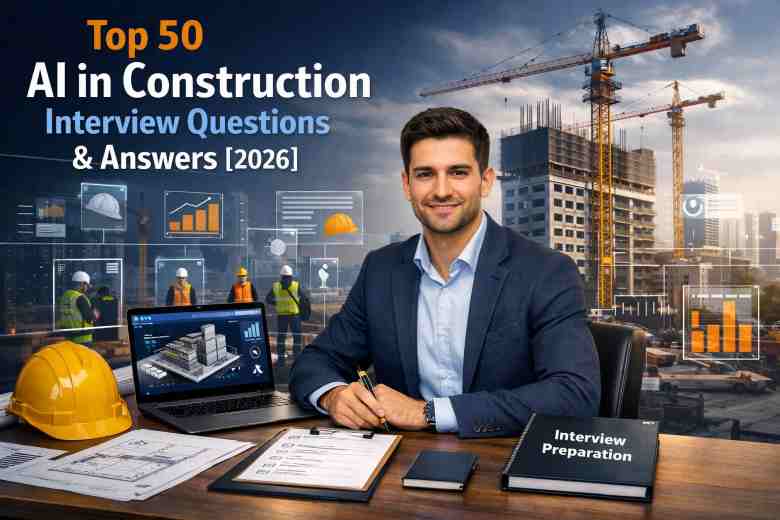
This detailed guide covers the top 50 AI in construction interview questions and answers that freshers, working professionals, and career switchers can use to prepare smartly. The questions are designed for real-world job interviews in EPC, real estate, infrastructure, BIM consultancy, project controls, and digital construction teams.
Table of Contents
Why AI in Construction Interview Questions Matter in 2026
Construction companies are increasingly asking candidates how they understand and use AI-enabled systems in planning, cost estimation, safety monitoring, risk prediction, documentation, and collaboration workflows. This does not mean every role requires coding or machine learning expertise. It means employers want professionals who can:
- Understand where AI adds value in construction workflows
- Use AI tools responsibly and verify outputs
- Improve productivity without compromising safety or quality
- Work with data, BIM, scheduling, and reporting systems more efficiently
- Recognize AI risks such as bias, hallucinations, and privacy issues
To understand current industry direction, read our recent guide on AI in Construction: 2026 Skills & Tools That Get You Hired and our breakdown of what works and what doesn’t in AI for construction.
Who Should Use This Interview Guide?
- Civil engineering students and fresh graduates
- BIM engineers, coordinators, and modelers
- Planning engineers and project controls professionals
- Quantity surveyors and estimators
- Construction project managers and site engineers
- QA/QC, HSE, and digital transformation professionals
- Candidates preparing for GCC / international construction jobs
For broader interview prep, also check our Construction Interviews: Questions, Answers & Career Guide and the Interview Questions & Answers category.
How to Use This Post for Maximum Interview Success
- Read all 50 questions once for understanding.
- Shortlist 15–20 questions relevant to your target role.
- Customize answers with your project experience, software exposure, and achievements.
- Practice speaking answers in 45–90 seconds.
- Use mock interview practice tools to improve clarity and confidence.
Pro Tip: Interviewers usually prefer candidates who can explain AI in practical construction terms (site safety, delay reduction, quality checks, coordination, reporting) rather than only giving theoretical definitions.
Top 50 AI in Construction Interview Questions & Answers [2026]
Section A: Fundamentals of Artificial Intelligence in Construction (1–10)
1) What is AI in construction?
Answer: AI in construction refers to the use of artificial intelligence technologies (such as machine learning, computer vision, natural language processing, and predictive analytics) to improve planning, design, execution, monitoring, safety, quality, and decision-making in construction projects. It helps teams automate repetitive tasks, identify risks earlier, and make data-driven decisions.
2) How is AI different from automation in construction?
Answer: Automation follows predefined rules (for example, auto-generating standard reports). AI goes further by learning from data and improving decisions or predictions (for example, predicting delay risk based on historical project data, weather, and resource patterns). In short, all AI can automate tasks, but not all automation is AI.
3) What are the main AI technologies used in construction?
Answer: Common technologies include machine learning (risk prediction), computer vision (site safety/PPE detection), natural language processing (document search and report drafting), predictive analytics (cost and schedule forecasting), generative AI (drafting communication, checklists, and summaries), and optimization algorithms (resource allocation and scheduling).
4) Why is AI becoming important in the construction industry now?
Answer: Construction projects generate large volumes of data (drawings, RFIs, schedules, progress logs, inspections, cost reports, and photos). AI tools now make it easier to extract insights from this data, improve productivity, reduce manual errors, and support better decision-making—especially in large, fast-track, and multi-stakeholder projects.
5) Can AI replace civil engineers or construction professionals?
Answer: AI is more likely to augment professionals than fully replace them in most construction roles. It can automate repetitive analysis, documentation, and monitoring tasks, but site judgement, stakeholder coordination, field decisions, compliance accountability, and execution leadership still require human expertise.
6) What is machine learning in construction?
Answer: Machine learning is a subset of AI where algorithms learn patterns from historical data to make predictions or classifications. In construction, it can be used for delay prediction, cost overrun risk analysis, productivity trends, safety incident risk forecasting, and equipment maintenance prediction.
7) What is computer vision in construction?
Answer: Computer vision is AI that analyzes images and video. In construction, it is used for PPE compliance monitoring, progress tracking, site hazard detection, defect identification, and comparing actual site conditions with BIM/model expectations.
8) What is generative AI in construction workflows?
Answer: Generative AI helps create content such as draft reports, method statements, meeting summaries, checklists, interview preparation answers, training material, and communication drafts. It can improve speed, but outputs must be reviewed by engineers for accuracy, codes, specifications, and project context.
9) What are the biggest limitations of AI in construction?
Answer: Poor data quality, fragmented systems, lack of standardized workflows, site variability, privacy concerns, over-reliance on AI outputs, and limited user training. AI tools can also produce incorrect results if the input data is incomplete or biased.
10) Give one simple example of AI use in a construction project.
Answer: A simple example is an AI-powered safety camera system that detects whether workers are wearing helmets and reflective vests, and alerts the safety team when non-compliance is found.
Section B: AI Applications in Construction Projects (11–20)
11) How is AI used in construction planning?
Answer: AI can support planning by analyzing historical project data, resource productivity, weather patterns, and risk trends to improve activity sequencing, identify delay risks, and recommend better schedule scenarios.
12) How can AI help in cost estimation?
Answer: AI can assist by analyzing historical project costs, BOQs, productivity rates, material trends, and scope patterns to generate faster preliminary estimates, flag outliers, and improve forecasting. However, estimators must validate assumptions and local market rates.
13) How is AI used in quantity surveying?
Answer: AI can support quantity surveyors through document analysis, cost benchmarking, variation tracking, claim documentation support, automated data extraction, and faster reporting. When connected to BIM or digital measurement tools, it can also improve measurement workflows and reduce manual effort.
14) Can AI improve construction safety management?
Answer: Yes. AI can help with hazard detection, PPE compliance monitoring, near-miss trend analysis, unsafe behavior alerts, and predictive risk insights from incident records and site observations. It supports safety teams but does not replace physical inspections and toolbox talks.
15) How is AI used for quality control in construction?
Answer: AI can analyze images, inspection data, and punch lists to detect recurring defects, identify non-conformance patterns, and support root-cause analysis. It can also help standardize quality documentation and reporting.
16) How can AI support project monitoring and progress tracking?
Answer: AI can process photos, drone imagery, CCTV footage, and daily reports to estimate progress, compare planned vs actual work, flag delays, and generate dashboards for project teams. It improves visibility but requires proper data collection and review.
17) How is AI used in equipment maintenance on construction sites?
Answer: AI can support predictive maintenance by analyzing equipment sensor data, operating hours, fault logs, and usage patterns to predict failures before breakdowns happen. This reduces downtime and maintenance cost.
18) What role does AI play in risk management?
Answer: AI helps identify and rank risks based on historical incidents, schedule trends, cost variance patterns, subcontractor performance, and project complexity. It improves early warning systems but should be combined with expert judgement and periodic reviews.
19) How can AI help in document management for construction projects?
Answer: AI can classify documents, search drawings/specifications quickly, summarize RFIs/submittals, extract key clauses, and support version tracking. This saves time and improves access to information across teams.
20) What are some examples of AI tools in construction today?
Answer: Examples include AI-enabled safety monitoring systems, predictive analytics dashboards, BIM-integrated clash/risk insights, schedule optimization tools, smart document search assistants, and generative AI tools for project communication and reporting drafts.
Section C: BIM, Digital Construction, and AI (21–30)
21) How do BIM and AI work together in construction?
Answer: BIM provides structured digital project data (models, quantities, attributes, sequencing), while AI helps analyze that data for insights such as clashes, sequencing improvements, cost/schedule risks, and quality/safety planning support. BIM is the data-rich foundation; AI is the intelligence layer.
22) What is the benefit of AI in BIM coordination?
Answer: AI can prioritize clashes, detect repeat coordination issues, suggest model-checking workflows, and help identify patterns that lead to rework. It improves coordination efficiency, especially in large multidisciplinary projects.
23) Can AI help in 4D/5D BIM?
Answer: Yes. AI can support 4D/5D BIM by analyzing schedule and cost data linked with BIM models, identifying sequencing risks, suggesting alternative work packages, and highlighting cost variance trends early.
24) What is digital twin and how is AI related to it?
Answer: A digital twin is a dynamic digital representation of a physical asset or project, often updated with real-time or periodic data. AI helps interpret the twin’s data for predictions, optimization, anomaly detection, and maintenance planning.
25) How can AI support clash detection workflows?
Answer: Traditional clash detection often creates too many clashes. AI can help classify, prioritize, and group clashes based on severity, constructability impact, and recurring patterns, which saves coordination time.
26) How does AI support field BIM applications?
Answer: AI can improve field BIM use by enabling image-based progress checks, issue categorization, voice-to-report conversion, and smart access to model information on mobile devices for site teams.
27) What is the difference between rule-based model checking and AI-based analysis?
Answer: Rule-based model checking validates predefined rules (e.g., clearance or naming conventions). AI-based analysis can identify patterns, anomalies, or risk trends beyond explicit rules by learning from historical data and project outcomes.
28) Can generative AI be used by BIM teams?
Answer: Yes, for drafting coordination meeting minutes, issue summaries, RFI drafts, model review checklists, standard responses, and training notes. However, technical outputs must always be validated by BIM coordinators/engineers.
29) What interviewers expect when they ask “Do you know AI in BIM?”
Answer: Usually, they are not expecting advanced coding. They want to know whether you understand practical applications such as model-based data extraction, issue prioritization, reporting automation, and AI-assisted workflows in Revit/Navisworks/common data environments.
30) How would you explain AI in BIM to a site engineer?
Answer: I would say: “BIM stores project information in a digital model, and AI helps us analyze that information faster—like finding risky clashes, predicting delays, and improving coordination decisions—so site work becomes smoother and rework reduces.”
Section D: Role-Based AI Interview Questions (Civil / PM / QS / Planning / HSE) (31–40)
31) As a site engineer, how can AI help you daily?
Answer: AI can help with daily report drafting, checklists, photo categorization, progress tracking support, issue logging, and quick access to specs/drawings. It improves speed and documentation quality, but site decisions must be verified physically.
32) As a planning engineer, how can AI improve schedule control?
Answer: AI can detect delay patterns, identify high-risk activities, analyze productivity trends, and suggest scenario-based recovery planning. It is useful for early warning but should be combined with site reality, constraints, and subcontractor commitments.
33) As a quantity surveyor, what AI skills are useful in interviews?
Answer: Useful skills include data cleaning, cost trend analysis, AI-assisted document review, faster quantity extraction support (especially in BIM workflows), variation tracking, and the ability to verify AI-generated estimates against BOQ and market rates.
34) As a project manager, what is the biggest value of AI?
Answer: The biggest value is better decision support—faster insights into schedule risk, cost variance, productivity trends, and issue prioritization—so the PM can take action earlier and communicate more clearly with stakeholders.
35) As an HSE engineer, where can AI be practically used?
Answer: AI can be used in PPE detection, hazard trend analysis, incident data classification, unsafe zone alerts, and safety observation analytics. It helps improve monitoring and preventive action planning.
36) What AI interview question might be asked to a QA/QC engineer?
Answer: A common question is: “How can AI improve quality inspections?” A strong answer includes image-based defect detection support, recurring NCR trend analysis, standardized checklist generation, and faster documentation review.
37) How should a fresher answer if they have not used AI tools on a live project?
Answer: Be honest. Say you may not have live project experience yet, but you understand the main AI applications in construction, have explored AI-assisted workflows (e.g., report drafting, interview prep, data summaries), and are ready to learn tool-specific workflows quickly.
38) How can AI help in construction recruitment and hiring?
Answer: AI can assist in resume screening, skill matching, interview question standardization, and candidate communication. Ethical use is important to avoid bias and ensure final hiring decisions remain transparent and human-reviewed.
39) What AI skills should a civil engineer learn first for career growth?
Answer: Start with AI literacy, prompt writing for technical use, data analysis basics (Excel/Sheets + dashboards), BIM/data workflows, digital documentation, and understanding practical AI use cases in planning, QS, safety, and reporting.
40) How do you present AI knowledge in your resume/interview without exaggerating?
Answer: Mention specific use cases and outcomes: “Used AI tools to draft DPR summaries and meeting minutes (with manual verification), reducing documentation time by 30%.” Avoid vague claims like “expert in AI” unless you can demonstrate real work.
Section E: AI Ethics, Risks, Data Privacy, and Practical Judgment (41–50)
41) What are the risks of using AI in construction decision-making?
Answer: Risks include incorrect outputs, bias from poor historical data, overconfidence in predictions, privacy issues, non-compliance if outputs are not reviewed, and operational mistakes if AI recommendations are followed blindly.
42) What is AI hallucination and why is it dangerous in construction?
Answer: AI hallucination means the tool generates information that sounds correct but is false or unsupported. In construction, this can lead to wrong specifications, incorrect calculations, or unsafe advice if users do not verify outputs.
43) How would you verify AI-generated technical content?
Answer: I would verify against approved drawings, specifications, BOQ, standards/codes, project procedures, and senior review. For calculations or technical recommendations, I would re-check assumptions and use engineering judgement before implementation.
44) What data privacy concerns exist when using AI tools in construction?
Answer: Project documents may contain confidential drawings, commercial terms, client data, and personal information. Teams should follow company policies, restrict sensitive uploads, use approved tools, and maintain access control and audit trails.
45) Why is human oversight important in AI-powered construction workflows?
Answer: Because AI provides assistance, not accountability. Construction decisions affect cost, safety, quality, and legal compliance. Human oversight ensures context, ethics, site realities, and standards are applied correctly.
46) What would you do if your AI tool recommends something that conflicts with site conditions?
Answer: I would treat it as a suggestion, not a final decision. I would verify the input data, inspect site conditions, consult relevant stakeholders, and then revise the decision based on engineering judgement and approved project controls.
47) How can bias enter AI systems in construction?
Answer: Bias can come from incomplete historical data, unrepresentative project datasets, inconsistent reporting practices, or biased human labeling. This can affect predictions, prioritization, and hiring-related AI tools if not monitored properly.
48) What is a good answer to “How will you use AI responsibly in your job?”
Answer: “I will use AI to improve productivity and decision support, but I will always verify outputs against project documents, standards, and site reality. I will avoid sharing confidential data in unapproved tools and use AI as an assistant, not a substitute for engineering responsibility.”
49) What future AI trends in construction should candidates mention in interviews?
Answer: Candidates can mention AI-assisted project controls, computer vision for site monitoring, BIM + AI integration, predictive maintenance, generative AI for documentation and knowledge retrieval, digital twins, and stronger governance around AI risk and data privacy.
50) How do you answer “Why should we hire you for an AI-enabled construction role?”
Answer: A strong answer combines domain knowledge + digital mindset: “I understand core construction workflows and can use AI tools to improve speed, reporting quality, and decision support. I also know the importance of verification, safety, and project standards. That combination helps teams adopt AI practically and responsibly.”
Bonus: Sample Interview Answer Framework (Best for AI in Construction Questions)
Use this simple structure in interviews:
1. Define: Briefly explain the AI concept in plain language.
2. Apply: Mention one construction use case (planning, safety, QS, BIM, etc.).
3. Benefit: Explain the value (speed, accuracy, risk reduction, productivity).
4. Caution: Mention verification / human oversight / data quality.
5. Example: Share a practical example from your learning or project work.
Example (30–45 sec): “AI in construction means using tools that analyze data and help teams make faster decisions. For example, in planning, AI can detect activities with high delay risk based on historical trends. This helps project teams take corrective action early. But AI outputs must be verified with site constraints and actual progress before final decisions are made.”
Common Mistakes Candidates Make in AI Construction Interviews
- Speaking only theory and no practical project examples
- Claiming “AI expertise” without showing actual use cases
- Ignoring data quality and validation issues
- Assuming AI replaces engineering judgement
- Confusing BIM software usage with AI (they overlap, but are not the same)
- Not linking AI answers to role-specific responsibilities (QS, PM, HSE, BIM, etc.)
How to Prepare Faster with ConstructionCareerHub (Recommended)
If you want to convert this knowledge into interview performance, use www.constructioncareerhub.com for structured preparation. It is built specifically for construction students, freshers, and professionals and helps with:
- AI-powered interview practice (role-based)
- Construction resume improvement
- Career planning and role-fit guidance
- Salary insights and job-readiness tools
- Focused preparation for modern hiring expectations
Also explore our article on the platform here: ConstructionCareerHub: AI Career Platform for Construction.
Recommended eBooks for Interview & Career Preparation (Digitslick / Gumroad)
To strengthen your interview preparation and job strategy, here are a few highly relevant resources from our ebook store:
- An Ultimate Interview Preparation Guide (Ebook)
- Construction Career Launchpad: A Comprehensive eBook to Construction Job Preparedness
- Passive Income for Construction Professionals: 15 Proven Strategies for 2026
- Construction Career Mastery Bundle (Interview + Career Resources)
- Browse the latest Digitslick Gumroad eBooks
Also see the latest featured products on Digitslick.com, including 2026-focused construction career guides and placement playbooks.
Recommended Courses to Build AI + Construction Skills (Coursera / edX / Udemy)
Here are a few relevant courses/programs to strengthen your artificial intelligence in construction management, BIM, and digital project skills (keep your learning focused and practical):
- Coursera: Construction Project Management
- Coursera: Building Smarter – BIM in Practice Specialization
- edX (PurdueX): BIM for Construction
- Udemy: Smart BIM with AI (ChatGPT & Claude for BIM Automation)
Tip: In interviews, don’t just mention course names—explain what practical workflow you learned (e.g., 4D/5D BIM, model coordination, AI-assisted reporting, schedule analysis).
High-Quality External Resources (Authority Links)
If you want deeper and more credible understanding of AI, risk management, and construction technology trends, these are useful references:
- NIST AI Risk Management Framework (AI governance & responsible AI)
- OSHA Construction Industry Resources (safety standards and guidance)
- OSHA Training Requirements and Resources
- Autodesk AI for Design & Construction (industry product direction)
- Autodesk Digital Builder Blog (construction technology & AI insights)
- McKinsey Engineering, Construction & Building Materials Insights
Final Thoughts
In 2026, strong candidates are no longer judged only on technical knowledge and years of experience. Employers increasingly look for professionals who can combine construction domain expertise with digital fluency and responsible AI usage. If you can explain where AI helps, where it fails, and how you verify outputs in real construction workflows, you will stand out in interviews.
Use these AI in construction interview questions and answers for daily practice, personalize them to your role, and build confidence through mock interviews. For faster preparation, resume improvement, and guided career tools, visit ConstructionCareerHub.com.
All the best for your next interview!
FAQs: AI in Construction Interview Questions (SEO Boost Section)
What are AI in construction interview questions?
These are interview questions that test your understanding of artificial intelligence applications in construction, such as planning, safety, BIM, cost estimation, and data-driven project management.
Do civil engineers need coding knowledge for AI interviews?
Not always. Most construction interviews focus on practical AI use cases, tool awareness, workflow understanding, and responsible usage—not deep coding.
How do I prepare for artificial intelligence in construction interview questions?
Study practical AI use cases, understand role-specific applications (BIM/QS/Planning/HSE), practice short structured answers, and prepare examples of how you would verify AI outputs.
Is AI in construction only for BIM professionals?
No. AI is relevant across planning, project management, HSE, QA/QC, QS, site engineering, project controls, and digital transformation roles.
Can freshers answer AI construction interview questions without project experience?
Yes. Freshers can explain core concepts, practical use cases, responsible AI principles, and show willingness to learn tool-based workflows quickly.
