
Last Updated on March 26, 2026 by Admin
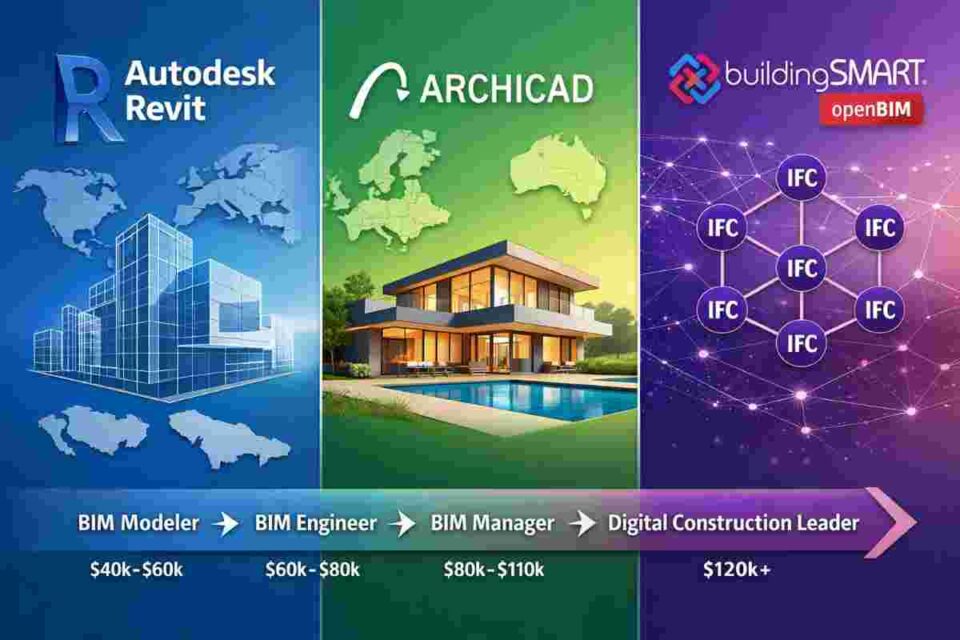
Choosing between Revit, ArchiCAD, and OpenBIM workflows is one of the most consequential decisions a construction professional can make in 2026. The global BIM market is projected to surpass $15 billion by 2030, and governments from the UK to Singapore now mandate BIM on public projects. But here’s the catch — the software you learn shapes not just your immediate employability, but the trajectory of your entire career across borders.
ConstructionCareerHub App is LIVE — built ONLY for construction careers. Don’t apply with a weak resume.
Get ATS-ready Resume Lab + Interview Copilot + Campus Placement Prep (resume screening, skill gaps, interview readiness) — in minutes & Other advanced features.
Explore Smarter Construction Career Tools →Quick check. Big impact. Start now.
Whether you’re a civil engineering student in India, an architect in the Gulf, or a mid-career MEP professional exploring digital construction roles in North America, this guide breaks down exactly what each platform offers, where each dominates the job market, and how OpenBIM standards like IFC and ISO 19650 are rewriting the rules for global mobility.
By the end, you’ll know which platform (or combination) to invest your time in — and how to position yourself for the highest-paying BIM roles worldwide.
Also Read: BIM Career Opportunities: A Complete Guide
Table of Contents
What Are Revit, ArchiCAD, and OpenBIM? Quick Definitions
Before comparing these three, it helps to understand that Revit and ArchiCAD are BIM authoring software platforms, while OpenBIM is a methodology and set of open data standards. They operate at different levels of the BIM ecosystem.
Autodesk Revit
Revit is a parametric BIM software developed by Autodesk, first released in 2000. It includes dedicated toolsets for architecture, structural engineering, and MEP (mechanical, electrical, and plumbing) design within a single platform. Revit’s strength lies in multi-discipline coordination, and its deep integration with the Autodesk ecosystem — including AutoCAD, Navisworks, Civil 3D, and Autodesk Construction Cloud — makes it the default choice for large-scale commercial and infrastructure projects, particularly in North America.
Graphisoft ArchiCAD
ArchiCAD is a BIM platform developed by Graphisoft (part of the Nemetschek Group), first released in 1987 — making it one of the earliest commercial BIM tools. It uses what Graphisoft calls the “Virtual Building” concept and is built by architects for architects. ArchiCAD runs natively on both macOS and Windows, has a lighter hardware footprint than Revit, and is a champion of the OpenBIM philosophy with strong IFC export/import capabilities.
OpenBIM (IFC / ISO 19650 Standards)
OpenBIM is not software — it’s a collaborative approach to building design and construction based on open data standards maintained by buildingSMART International. The core technologies include IFC (Industry Foundation Classes), BCF (BIM Collaboration Format), and bSDD (buildingSMART Data Dictionary). OpenBIM enables teams using different software — Revit, ArchiCAD, Tekla, Allplan, or any IFC-compliant tool — to exchange model data without proprietary lock-in.
Also Read: 20 Best BIM Software in 2026: Complete Guide & Comparison
Revit vs ArchiCAD vs OpenBIM: Head-to-Head Comparison (2026)
Here’s a detailed comparison across the factors that matter most for career decisions:
| Feature | Autodesk Revit | Graphisoft ArchiCAD | OpenBIM (IFC Standards) |
|---|---|---|---|
| Type | BIM authoring software | BIM authoring software | Open data standard & methodology |
| Best For | Multi-discipline projects (Architecture + Structure + MEP) | Architecture-focused design studios | Cross-platform collaboration & interoperability |
| Platform | Windows only | Windows and macOS | Software-agnostic (works with any IFC-compliant tool) |
| Annual Cost (2026) | ~$2,910/user (subscription) | Subscription-only (2026); varies by region | Free standards; certification courses available |
| Learning Curve | Steeper; structured process | More intuitive; easier for beginners | Conceptual — requires understanding standards, not just tools |
| Market Dominance | North America, Middle East, India | Europe, Australia, smaller design studios globally | Growing everywhere; mandatory in EU, UK, Singapore public works |
| AI Integration (2026) | Autodesk Forma for generative design, energy analysis | AI-assisted real-time visualization | AI applied via clash prioritisation, schedule validation in open workflows |
| Cloud Collaboration | Autodesk Construction Cloud (ACC) | BIMcloud | IFC + BCF via any compliant viewer/server |
Where Each Platform Dominates: Regional Job Market Analysis
Your geographic career target should heavily influence which platform you learn first. Here’s where each has the strongest employer demand:
Revit Dominates These Markets
North America (USA & Canada): Revit is the undisputed standard for large AEC firms. Nearly every major contractor, engineering consultancy, and architecture firm in the US requires Revit proficiency. Government projects increasingly mandate Revit-compatible BIM deliverables.
India: The fast-growing Indian AEC sector is heavily Autodesk-aligned. Firms servicing international clients — especially those working with US, UK, and Gulf-based companies — require Revit skills. BIM engineer salaries in India range from ₹3 LPA for freshers to over ₹20 LPA for senior professionals as of 2026.
Middle East (UAE, Saudi Arabia, Qatar): Mega-projects in Dubai, NEOM, and other Gulf developments run primarily on Revit and the Autodesk ecosystem, particularly for MEP coordination and structural modeling.
Also Read: BIM Engineer Salary in India 2026 (City + Experience)
ArchiCAD Dominates These Markets
Europe (especially Germany, Scandinavia, Hungary, Netherlands): ArchiCAD maintains a strong market share among architecture practices. The Nemetschek Group’s broader ecosystem (including Allplan and Solibri) is widely adopted in European construction.
Australia & New Zealand: ArchiCAD is popular among small-to-mid-size architectural studios, and its OpenBIM approach aligns well with Australia’s BIM frameworks.
Japan & Parts of Asia: ArchiCAD has a significant presence in Japanese architectural practices, where its design flexibility and lighter hardware requirements are valued.
OpenBIM Knowledge Is Valued Everywhere
United Kingdom: The UK mandated BIM Level 2 (now aligned with ISO 19650) on all public projects since 2016. OpenBIM fluency is a baseline requirement for any BIM professional working on UK government contracts.
Singapore: The Building and Construction Authority (BCA) requires BIM e-submissions for regulatory approvals. Singapore’s Integrated Digital Delivery (IDD) initiative relies on open standards.
European Union: Multiple EU nations are integrating IFC and ISO 19650 into public procurement regulations, making OpenBIM certification increasingly valuable.
Also Read: Why BIM Is Becoming a Career Multiplier
BIM Salary Comparison: Revit vs ArchiCAD vs OpenBIM Skills (2026)
Salary potential varies by role, region, and the specific skill combination you bring. Here’s what the data shows:
| Role / Skill | USA (Annual) | UK (Annual) | India (Annual) | UAE (Annual) |
|---|---|---|---|---|
| BIM Modeler (Entry-Level) | $50,000–$70,000 | £28,000–£38,000 | ₹2.5–4.5 LPA | AED 80,000–120,000 |
| BIM Engineer (Revit-focused) | $67,000–$120,000 | £35,000–£50,000 | ₹5–12 LPA | AED 120,000–220,000 |
| BIM Manager | $90,000–$130,000+ | £50,000–£70,000 | ₹12–20+ LPA | AED 250,000–500,000 |
| OpenBIM / ISO 19650 Specialist | $85,000–$140,000 | £45,000–£75,000 | ₹8–18 LPA | AED 180,000–350,000 |
Key insight: Professionals who combine strong Revit or ArchiCAD skills with OpenBIM/ISO 19650 knowledge consistently command higher salaries than those with software-only expertise. Employers increasingly value interoperability literacy alongside modeling proficiency.
Also Read: BIM Job Roles and Their Latest Salary Trends
Which Should You Learn First? A Decision Framework
There’s no single correct answer — the best choice depends on your career stage, discipline, and target market. Use this framework:
Learn Revit First If:
- You’re targeting the US, India, or Middle East job markets
- Your discipline is structural engineering, MEP, or multi-discipline coordination
- You want to work for large AEC firms, EPC contractors, or infrastructure consultancies
- Your projects involve complex commercial, industrial, or infrastructure buildings
- You need integration with AutoCAD, Navisworks, and Autodesk Construction Cloud
Learn ArchiCAD First If:
- You’re an architect focused on design-led practice
- You’re targeting European, Australian, or Japanese markets
- You work on a Mac or prefer cross-platform flexibility
- You’re part of a small-to-mid-size studio that values workflow efficiency
- You want a tool with a shorter learning curve to get productive quickly
Learn OpenBIM Standards If:
- You want maximum global career mobility across different firms and countries
- You’re aiming for BIM management, BIM coordination, or digital construction leadership roles
- You work in or plan to work in the UK, EU, or Singapore where open standards are mandated
- You want to be software-agnostic and future-proof against vendor lock-in
- You’re interested in digital twin, facility management, or asset lifecycle careers
The Smart Strategy: Learn one authoring tool (Revit or ArchiCAD) deeply as your primary skill, then layer on OpenBIM/IFC/ISO 19650 knowledge as your differentiator. This combination makes you hireable in the largest number of markets and positions.
Use ConstructionCareerHub.com to assess your current skill gaps with the AI-powered Career Planner and map your personalized BIM career roadmap.
Learning Revit in 2026: What You Need to Know
Revit remains the most job-listed BIM software globally. Here’s what a structured learning path looks like:
Core Skills to Develop
Start with architectural modeling fundamentals — walls, floors, roofs, stairs, and curtain walls. Progress to parametric family creation, which is the backbone of Revit’s power. Then move into discipline-specific workflows: structural framing and analytical models if you’re an engineer, or MEP systems modeling for building services professionals.
Advanced Skills for Career Growth
Dynamo (Revit’s visual programming environment) is increasingly expected at the senior level. Learn to automate repetitive tasks, generate schedules programmatically, and create custom parametric content. Cloud collaboration through Autodesk Construction Cloud and clash detection via Navisworks are essential for coordination roles.
Certifications Worth Pursuing
The Autodesk Certified Professional in Revit credential validates your proficiency and is recognized globally. It’s particularly valued for resumes targeting US, Indian, and Gulf employers.
Recommended Courses
- BIM Fundamentals for Engineers – Coursera (National Taiwan University)
- BIM-Revit Architecture 2026: From Zero to Advanced – Udemy
- Construction Management with BIM Integration – edX (University of Maryland)
Also Read: Essential BIM Skills & Career Insights
Learning ArchiCAD in 2026: What You Need to Know
ArchiCAD remains the preferred platform for design-centric architectural practices and is gaining momentum in markets that value OpenBIM compliance.
Core Skills to Develop
Begin with the “Virtual Building” modeling approach — understanding how ArchiCAD treats building elements as intelligent objects with embedded data. Learn the Morph tool for freeform geometry, which is one of ArchiCAD’s standout features for organic and complex architectural designs.
Advanced Skills for Career Growth
Master Teamwork (ArchiCAD’s built-in multi-user collaboration system) and BIMcloud for distributed project access. Learn IFC export optimization — ArchiCAD’s IFC implementation is considered one of the strongest in the industry, and knowing how to configure clean IFC exports is a valuable coordination skill.
Certifications Worth Pursuing
Graphisoft offers the ArchiCAD Certification program through its partner academies. While less universally recognized than Autodesk certifications, it carries significant weight in European and Australian job markets.
Rendering Advantage
ArchiCAD 2026 includes the CineRender engine (based on Maxon technology) and the Redshift GPU rendering engine, plus AI-assisted real-time visualization. This integrated rendering capability is a significant advantage for architects who handle presentation duties alongside design.
Also Read: The Ultimate Guide to Becoming a BIM Specialist
Learning OpenBIM in 2026: What You Need to Know
OpenBIM is transitioning from a “nice-to-have” to a core professional competency — particularly for anyone targeting management, coordination, or international project roles.
Core Concepts to Master
IFC (Industry Foundation Classes): The open data format for BIM models, maintained as ISO 16739. Version IFC 4.3 extends coverage to infrastructure including roads, railways, bridges, and tunnels. Understanding how IFC structures data — classes, property sets, and geometric representations — is fundamental.
BCF (BIM Collaboration Format): The open standard for issue tracking and model-based communication. BCF allows team members using different software to report, discuss, and resolve coordination issues without needing to share native model files.
ISO 19650: The international standard for managing information over the whole lifecycle of a built asset using BIM. It defines how information requirements are specified, how models are produced and exchanged, and how quality is maintained across organizations.
Certifications Worth Pursuing
The buildingSMART Professional Certification is the recognized global standard for OpenBIM competency. It does not expire and validates your understanding of IFC, BCF, IDM, and bSDD. This certification is increasingly listed as a preferred qualification in UK, EU, and Singapore BIM job postings.
Why OpenBIM Is the Career Differentiator
As the construction industry moves toward digital twins, asset lifecycle management, and AI-driven project delivery, the professionals who understand open data standards will be the ones bridging the gap between different software ecosystems. OpenBIM knowledge positions you for roles like BIM Information Manager, Digital Construction Lead, and Chief Digital Officer — all among the fastest-growing and highest-paying positions in AEC.
Also Read: How Civil Engineers Can Thrive in the Age of AI and AGI
The Best Career Strategy: Combine Platform Skills with OpenBIM Knowledge
The most employable BIM professionals in 2026 don’t limit themselves to a single tool. Here’s what the optimal skill stack looks like at each career level:
Entry-Level (0–2 Years)
Master one primary platform deeply (Revit or ArchiCAD based on your target market). Build a portfolio of at least 3–5 projects demonstrating model creation, documentation, and basic coordination. Get certified in your chosen platform.
Mid-Level (3–5 Years)
Add OpenBIM/IFC knowledge and familiarity with the second platform. Learn Navisworks or Solibri for clash detection and model checking. Understand ISO 19650 workflows. Begin leading small BIM coordination tasks.
Senior Level (5+ Years)
Pursue the buildingSMART Professional Certification. Develop expertise in Dynamo/Grasshopper for computational BIM. Understand digital twin workflows, 4D/5D BIM, and point cloud integration. Position yourself for BIM Manager or Digital Construction Manager roles.
Practice your BIM interview skills with the Interview Copilot on ConstructionCareerHub.com — it simulates real technical and HR rounds specifically for construction and BIM roles.
Industry Trends Shaping BIM Careers in 2026 and Beyond
Several macro trends are reshaping which skills matter most:
AI Integration in BIM Platforms
Both Revit and ArchiCAD have embedded AI capabilities in their 2026 releases. Revit leverages Autodesk Forma for predictive analysis of sunlight, wind, and noise during early design. ArchiCAD focuses on AI-assisted visualization for instant photorealistic rendering during modeling. Understanding how to leverage these AI tools adds significant value to your skill set.
Cloud-First Collaboration
Autodesk Construction Cloud and BIMcloud have made real-time, distributed collaboration the norm rather than the exception. BIM professionals who can manage cloud-based model coordination across time zones are in high demand for international projects.
Digital Twins and Asset Lifecycle BIM
BIM is no longer just about design and construction — it extends into operations and facility management through digital twin technology. Sensors stream live data into BIM models, creating a living representation of built assets. Professionals who understand both the modeling side (Revit/ArchiCAD) and the data standards side (IFC/ISO 19650) are uniquely positioned for these emerging roles.
OpenBIM Mandates Are Expanding
Beyond the UK and Singapore, Ireland now requires ISO 19650-compliant BIM on public projects exceeding €20 million, with similar thresholds expected across the EU. India’s NITI Aayog guidelines are also pushing BIM adoption in smart city and infrastructure projects. This trend makes OpenBIM knowledge progressively more valuable each year.
Also Read: 150+ Construction Job Titles & Descriptions [2026 Guide]
Free and Open-Source BIM Alternatives Worth Knowing
If budget is a constraint, several free tools support BIM and OpenBIM workflows:
- FreeCAD (with BIM Workbench): Open-source parametric modeler with IFC export. Good for learning BIM concepts without licensing costs.
- BlenderBIM: A BIM add-on for Blender that supports native IFC editing — increasingly popular for OpenBIM advocacy and smaller projects.
- BIM Vision / Solibri Anywhere: Free IFC model viewers for reviewing and checking models from any authoring platform.
While these won’t replace Revit or ArchiCAD for professional production work, knowing they exist demonstrates your awareness of the broader BIM ecosystem — a quality employers value in coordination and management roles.
How to Build a Global BIM Career: Actionable Steps
Here’s a practical 12-month roadmap to position yourself for international BIM opportunities:
Months 1–3: Complete a structured course on your chosen platform (Revit or ArchiCAD). Build 2–3 practice projects. Get familiar with IFC export/import basics.
Months 4–6: Earn your platform certification (Autodesk Certified Professional or Graphisoft ArchiCAD Certification). Start learning ISO 19650 fundamentals.
Months 7–9: Build a portfolio website showcasing your BIM projects. Learn Navisworks or Solibri for clash detection. Begin studying for the buildingSMART Professional Certification.
Months 10–12: Apply to international BIM roles. Tailor your resume for your target market. Use ConstructionCareerHub’s Resume Lab to create ATS-optimized resumes specifically for BIM and construction positions.
Download: AI Construction Career Blueprint eBook — a comprehensive guide to leveraging AI and digital tools for career growth in construction.
Download: Hidden Construction Careers eBook — discover high-paying, unconventional career paths in the construction industry that most professionals overlook.
Frequently Asked Questions (FAQ)
Is Revit better than ArchiCAD for a BIM career?
Revit has a larger global market share and more job listings, particularly in North America, India, and the Middle East. However, ArchiCAD dominates in European and Australian architectural markets. The “better” choice depends entirely on your target geography and discipline. For maximum flexibility, learn one deeply and gain familiarity with the other.
What is OpenBIM and why does it matter for careers?
OpenBIM is an approach to construction collaboration based on open data standards like IFC and ISO 19650. It matters because it enables professionals to work across different software platforms and companies without proprietary barriers. As more governments mandate OpenBIM on public projects, professionals with this knowledge have access to a wider range of opportunities globally.
Can I learn both Revit and ArchiCAD?
Yes, and many senior BIM professionals are proficient in both. However, it’s more strategic to master one platform first (typically over 6–12 months of intensive use), then develop working knowledge of the second. The fundamental BIM concepts transfer well between platforms.
What salary can I expect as a BIM professional in 2026?
BIM engineer salaries vary significantly by region. In the US, the range is approximately $67,000 to $120,000 per year. In India, the range is ₹3 LPA for freshers to ₹20+ LPA for senior professionals. In the UK, BIM engineers typically earn £35,000 to £50,000, while BIM managers earn £50,000 to £70,000 or more.
Is the buildingSMART certification worth it?
Yes, particularly if you’re targeting international projects or roles in the UK, EU, or Singapore. The buildingSMART Professional Certification is the only globally recognized OpenBIM credential, and it does not expire. It validates your understanding of IFC, BCF, and information management standards.
Which BIM software is best for beginners?
ArchiCAD generally has a more intuitive interface and a shorter learning curve, making it beginner-friendly — especially for architects. Revit has a steeper initial learning curve but offers more comprehensive multi-discipline capabilities and a larger online learning ecosystem with tutorials, forums, and third-party content.
How do I transition from AutoCAD to BIM?
Start by understanding that BIM is fundamentally different from CAD — you’re creating intelligent 3D models with embedded data, not 2D drawings. Take a structured beginner course in Revit or ArchiCAD (both have AutoCAD import capabilities), and focus on learning parametric modeling concepts rather than trying to replicate your CAD workflows.
Does learning OpenBIM replace the need for Revit or ArchiCAD?
No. OpenBIM is a set of standards and workflows — you still need a BIM authoring tool to create models. Think of it as learning both a language (software skills) and grammar (open standards). The authoring tool creates the data; OpenBIM ensures that data can be shared, validated, and managed across the project lifecycle.
Also Read:
- BIM Modeler Job Description and Salary
- BIM Technician Job Description and Salary
- 11 Best Revit Alternatives for BIM Managers in 2026
- Autodesk Revit Software Online Tutorials and Courses [2026 Updated]
- All you need to know about Autodesk Revit Software
- A Beginner’s Guide to Revit Architecture Training: Unlocking Your Path to Architectural Mastery
- BIM Careers in 2026: Your Complete Guide to Roles, Salaries, Software, and Global Demand
Final Verdict: Revit vs ArchiCAD vs OpenBIM for Your Career
If you’re making this decision today, here’s the bottom line:
Choose Revit if you want the widest immediate job market access, especially in North America, India, and the Gulf. It’s the safe, high-demand choice for engineers and multi-discipline professionals.
Choose ArchiCAD if you’re an architect who values design freedom, works on a Mac, or targets European and Australian markets. Its OpenBIM DNA gives you a natural bridge to interoperability standards.
Learn OpenBIM standards regardless of which software you choose. IFC, BCF, and ISO 19650 are becoming the professional baseline for BIM careers worldwide. They’re what elevate you from “tool operator” to “BIM professional.”
The construction industry’s digital transformation is accelerating. The professionals who thrive will be those who combine deep software skills with broad interoperability knowledge — and who never stop learning. Start building your BIM career stack today.
Disclaimer: Salary figures cited in this article are estimates based on aggregated data from Glassdoor, Salary.com, and industry reports as of early 2026. Actual compensation varies by employer, experience, location, and project type. Software pricing reflects publicly listed figures from Autodesk and Graphisoft — always verify on official vendor websites.
