

Last Updated on February 18, 2026 by Admin
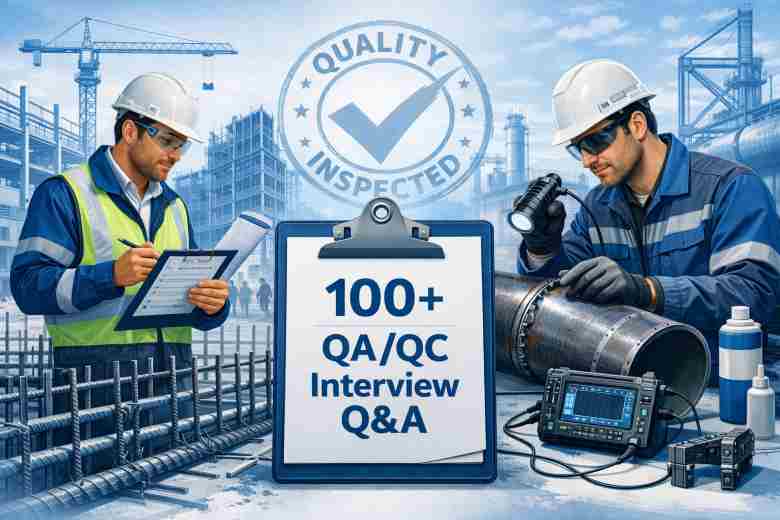
Preparing for a QA/QC engineer interview in construction? You’re in the right place. This comprehensive guide covers 100+ QA QC engineer interview questions with detailed answers, practical examples, and real interviewer expectations — tailored for both civil and mechanical quality engineers. Whether you’re a fresher entering the construction industry or an experienced professional targeting Gulf megaprojects, metro rail, data centers, or oil and gas assignments, these quality engineer construction interview questions will help you prepare with confidence. Each question includes a clear explanation, a site-relevant example, and insight into what hiring managers are actually looking for. From basic QA/QC concepts and ISO 9001 documentation to discipline-specific technical rounds and scenario-based problem-solving, this 2026-updated resource is designed to give you a real edge on interview day.
ConstructionCareerHub App is LIVE — built ONLY for construction careers. Don’t apply with a weak resume.
Get ATS-ready Resume Lab + Interview Copilot + Campus Placement Prep (resume screening, skill gaps, interview readiness) — in minutes & Other advanced features.
Explore Smarter Construction Career Tools →Quick check. Big impact. Start now.
Table of Contents
Why QA/QC Hiring Is Booming in 2026
If you’ve been tracking construction hiring trends this year, one thing is clear — demand for quality assurance and quality control professionals has never been stronger. With an unprecedented infrastructure boom sweeping across India, the Middle East, Southeast Asia, and North America, companies are racing to fill QA/QC roles at every level.
India’s metro rail expansion across 25+ cities, Saudi Arabia’s NEOM and Vision 2030 megaprojects, data center construction in Hyderabad, Chennai, and the US sunbelt, and a global push toward semiconductor fabrication plants have created a hiring wave that shows no sign of slowing down. For civil and mechanical engineers eyeing quality roles, preparation is everything.
This guide covers 100+ QA QC engineer interview questions — organized by discipline, experience level, and real-world relevance. Whether you’re a fresher preparing for your first quality engineer construction interview or a mid-career professional targeting a Gulf posting, you’ll find detailed answers, practical examples, and interviewer expectations for every question.
We’ve structured this post to mirror how actual hiring panels think — starting from fundamentals, moving through discipline-specific technical rounds, and ending with scenario-based and documentation questions that separate average candidates from outstanding ones.
Role of a QA/QC Engineer in Construction
Before diving into QA QC interview questions in construction, it’s worth understanding what employers actually expect from quality engineers on-site.
Core Responsibilities
A QA/QC engineer in construction is responsible for ensuring that all work — from earthwork and concrete placement to mechanical installations and welding — meets the approved specifications, codes, and project quality standards. This includes reviewing method statements and Inspection & Test Plans (ITPs), conducting inspections at hold and witness points, raising Non-Conformance Reports (NCRs), processing Requests for Information (RFIs), and maintaining quality documentation for client and third-party audits.
For a complete breakdown of daily duties, see our detailed QA/QC Engineer Job Description.
Site QA vs. Documentation QA
Site QA engineers spend most of their time physically verifying work — checking rebar spacing, witnessing hydrostatic tests, or reviewing weld joint preparation. Documentation QA engineers, on the other hand, focus on maintaining quality records, calibration logs, material traceability matrices, and audit compliance. Most roles, especially in the Gulf, require proficiency in both.
Civil vs. Mechanical QA/QC — Key Differences
Civil QA/QC focuses on concrete technology, soil testing, reinforcement inspection, waterproofing, and structural elements. Mechanical QA/QC centers around welding inspection, piping systems, NDT, pressure testing, and rotating equipment. Many QA QC interview questions in civil engineering differ significantly from mechanical QA/QC engineer interview questions, so we’ve separated them in this guide.
Skills Employers Look For
Interviewers consistently evaluate candidates on knowledge of relevant codes and standards (IS, ASTM, BS, AWS), familiarity with ISO 9001 quality management systems, documentation skills, ability to read and interpret drawings, and — critically — the confidence to stop non-conforming work on site. Salary expectations for QA/QC engineers vary significantly by region and experience; check our Construction Salary Guide for current benchmarks.
100+ QA/QC Engineer Interview Questions with Answers
A. Basic QA/QC Interview Questions (Freshers & 0–3 Years)
1. What is the difference between Quality Assurance and Quality Control?
Quality Assurance (QA) is a proactive, process-oriented approach that focuses on preventing defects by establishing proper systems, procedures, and standards before work begins. Quality Control (QC) is reactive and product-oriented — it involves inspecting and testing completed work to verify it meets specified requirements.
Practical example: Reviewing and approving a method statement before concrete pouring is QA. Testing cube samples after the pour is QC.
What the interviewer expects: A clear, concise distinction with a site-relevant example — not a textbook definition.
2. What is an Inspection & Test Plan (ITP)?
An ITP is a structured document that lists every inspection, test, and verification activity required for a specific scope of work. It defines hold points (where work cannot proceed without approval), witness points, review points, acceptance criteria, and the responsible parties — contractor, consultant, and client.
Practical example: An ITP for structural concrete would include reinforcement inspection (hold point), pre-pour check (hold point), concrete placement (witness point), and cube testing (review point).
What the interviewer expects: That you’ve actually worked with ITPs, not just heard of them.
3. What is a Non-Conformance Report (NCR)?
An NCR is a formal document raised when work, material, or a process deviates from the approved specification, drawing, or standard. It records the nature of the non-conformance, root cause analysis, proposed corrective action, and verification of closure.
Practical example: If concrete cube results at 28 days show 22 MPa against a required 25 MPa, an NCR would be raised, triggering core testing and structural assessment.
What the interviewer expects: Understanding of the NCR lifecycle — identification, documentation, correction, verification, and closure.
4. Explain the difference between a Hold Point and a Witness Point.
A hold point is a mandatory inspection stage where work must stop until the designated party (usually the client or consultant) inspects and approves. Work cannot proceed without sign-off. A witness point is an inspection stage where the designated party is notified and invited to attend, but work can proceed if they don’t show up after adequate notice.
What the interviewer expects: Knowledge that hold points carry contractual weight and skipping them can result in rework.
5. What is an RFI in construction quality?
A Request for Information (RFI) is a formal document used to seek clarification on drawings, specifications, or scope when something is unclear, conflicting, or missing. In quality management, RFIs help prevent non-conformances by resolving ambiguities before work starts.
What the interviewer expects: That you use RFIs proactively, not after problems occur.
6. What is a Method Statement?
A method statement is a detailed, step-by-step written procedure describing how a specific construction activity will be carried out safely and in compliance with quality requirements. It typically includes scope, resources, equipment, methodology, quality checks, and HSE considerations.
What the interviewer expects: Experience reviewing, commenting on, or preparing method statements.
7. What is the purpose of material submittals?
Material submittals ensure that all materials brought to site are pre-approved by the consultant/client and conform to project specifications. They include technical data sheets, test certificates, material safety data sheets, and manufacturer certifications.
8. What does EEAT stand for in quality documentation?
This is a trick question sometimes used by interviewers. EEAT is actually a Google SEO concept (Experience, Expertise, Authoritativeness, Trustworthiness), not a quality term. In construction quality, the equivalent concept is competence verification — ensuring that personnel performing quality-critical work are qualified and experienced.
What the interviewer expects: Honesty when you don’t know something, rather than bluffing.
9. What is a Quality Management System (QMS)?
A QMS is a formalized system that documents processes, procedures, and responsibilities for achieving quality objectives. In construction, the most widely recognized framework is ISO 9001, which provides principles for consistent quality through a Plan-Do-Check-Act cycle.
10. What is the difference between Specification and Standard?
A specification is a project-specific document that defines requirements for materials, workmanship, and testing for that particular project. A standard is a published document by a recognized body (IS, ASTM, BS, EN) that establishes accepted practices, test methods, or requirements for general industry use.
11. What is a calibration certificate and why is it important?
A calibration certificate confirms that a measuring instrument has been tested against a known reference standard and found accurate within acceptable limits. On construction sites, all testing equipment — cube testing machines, slump cones, survey instruments — must have valid calibration certificates traceable to national standards.
12. What is the role of a Third-Party Inspection (TPI)?
TPI involves an independent inspection agency hired to verify quality on behalf of the client or regulatory authority. Common in oil & gas and infrastructure projects, TPI adds an additional layer of quality assurance beyond the contractor’s own QC.
13. What is a Punch List / Snag List?
A punch list is a document prepared near project completion that identifies remaining defects, incomplete work, or items not meeting specification. QA/QC engineers typically compile this during pre-commissioning inspections.
14. Explain the term “Right First Time.”
Right First Time is a quality philosophy that emphasizes doing work correctly the first time to avoid rework, delays, and cost overruns. It requires thorough planning, clear communication, and proactive quality assurance.
15. What is the Cost of Quality?
The Cost of Quality includes prevention costs (training, planning), appraisal costs (inspection, testing), internal failure costs (rework, scrap), and external failure costs (warranty claims, legal issues). Understanding this helps justify QA/QC investment to management.
B. Civil QA/QC Engineer Interview Questions (25+ Questions)
16. What are the different grades of concrete and how do you select them?
Concrete grades (M15, M20, M25, M30, etc.) indicate the characteristic compressive strength in MPa at 28 days. Selection depends on the structural element, exposure conditions, and design requirements as specified in IS 456 or ACI 318. For example, M25 is commonly used for RCC columns, while M30 or higher may be required for marine structures.
What the interviewer expects: Practical knowledge of when each grade is used, not just the definition.
17. Explain the concrete cube testing procedure.
Cube specimens (150mm) are cast from fresh concrete at the point of placement, compacted in two layers using a tamping rod (25 strokes per layer), cured in a moist environment at 27±2°C, and tested at 7 and 28 days using a compression testing machine. Results must meet the acceptance criteria per IS 456 — no individual sample below fck – 3 MPa, and the average of three consecutive samples not less than fck + 0.825 × standard deviation.
Practical example: For M25 concrete, individual cube strength should not fall below 22 MPa, and the average must meet statistical compliance.
18. What is a slump test and what are acceptable values?
The slump test measures workability of fresh concrete. A standard slump cone is filled in three layers, each tamped 25 times. The cone is lifted, and the difference between the cone height and the settled concrete is the slump value. Acceptable slump varies: 25–50mm for road work, 50–100mm for general RCC, 100–150mm for columns and walls using pump concrete.
19. How do you inspect reinforcement before concrete pouring?
Pre-pour rebar inspection covers: bar diameter and grade verification against BBS (Bar Bending Schedule), spacing and cover measurement using a cover meter, lap length verification, chair and spacer placement, cleanliness (no oil, loose rust, or mud), binding wire tightness, starter bar alignment, and embedment provisions for future construction joints.
What the interviewer expects: A systematic checklist approach, not a vague “I check the steel.”
20. What is a cover meter survey and why is it important?
A cover meter (also called a rebar locator) uses electromagnetic pulse induction to detect the position, depth, and diameter of reinforcement bars within hardened concrete. It is used to verify that adequate concrete cover has been achieved — critical for corrosion protection and structural durability as per IS 456 minimum cover requirements.
21. What are the quality checks during concrete pouring?
Quality checks during pouring include: verifying concrete grade on the delivery ticket, slump testing at point of placement, checking pour temperature (should not exceed 32°C generally), ensuring continuous pouring without cold joints, monitoring vibration (no over- or under-vibration), checking formwork for displacement, and casting test cubes at specified frequency.
22. What is a waterproofing inspection checklist?
Waterproofing QC covers: surface preparation (clean, dry, free of sharp protrusions), primer application and drying time, membrane thickness verification using wet film gauges, overlap dimensions (minimum 100mm typically), seal integrity at penetrations and corners, flood testing or spray testing for verification, and protection board installation.
23. Explain the soil compaction testing process.
Field density testing verifies that backfill or subgrade has been compacted to the required percentage of Maximum Dry Density (MDD) as determined by a Proctor test (IS 2720 Part VII or ASTM D698). Common field methods include the sand replacement method, core cutter method, and nuclear density gauge. Typical requirement is 95% MDD for structural fills.
24. What is a pile integrity test?
Pile integrity testing (PIT) uses low-strain impact testing to assess the structural soundness of cast-in-situ or driven piles. A hammer strike at the pile head generates a stress wave, and the reflected signal is analyzed to detect defects like necking, bulging, cracks, or voids. It is a mandatory QC check on most large foundation projects.
25. How do you verify formwork before concrete pouring?
Formwork inspection includes: dimensional accuracy against structural drawings, alignment and plumb check, surface treatment (release agent application), structural adequacy of props and supports, cleanliness of formwork interior, proper provision of construction joints, embedded item placement, and watertightness of joints.
26. What is the acceptance criteria for structural steel bolted connections?
For high-strength friction grip (HSFG) bolts, acceptance criteria include: correct bolt grade and diameter, hole alignment within tolerance, proper washer placement, torque value verification using a calibrated torque wrench per IS 4000 or AISC specification, and visual inspection for thread engagement and nut rotation.
27. How do you ensure quality in block/brick work?
Quality checks for masonry include: block/brick compressive strength testing, water absorption testing, mortar mix proportion verification, verticality (plumb) check, coursing height check, bond pattern verification, joint thickness (typically 10–12mm), and curing procedures.
28. What is a concrete mix design and who approves it?
A concrete mix design is a laboratory-developed formula specifying the proportions of cement, aggregite, water, and admixtures to achieve the required strength, workability, and durability. The design is prepared by the contractor’s concrete technologist, reviewed by the consultant, and approved before production begins. It follows IS 10262 or ACI 211.1 methodology.
29. What are construction joints and how are they treated?
Construction joints are predetermined locations where concrete placement is intentionally stopped and restarted. Treatment includes: roughening the surface using wire brush or water jet, removing laitance, applying bonding agent if specified, installing water stops where required, and ensuring new concrete is placed against a saturated surface-dry joint.
30. What checks do you perform during pile cap construction?
Pile cap QC includes: pile head treatment and trimming to correct level, pile position verification against tolerance, reinforcement placement per drawing, concrete cover verification, formwork inspection, embedded bolt and starter bar positioning, and concrete pouring and curing procedures.
31-40: Additional Civil QA/QC Questions (Quick-Fire Format)
31. What is the minimum curing period for concrete? — 7 days minimum per IS 456; 10–14 days recommended for pozzolanic cement mixes.
32. What is honeycombing and how do you repair it? — Voids in concrete surface caused by improper vibration or poor formwork. Repair involves chipping loose material, applying bonding agent, and filling with non-shrink grout.
33. What is the purpose of a trial mix? — To validate mix design proportions in the actual batching plant before production begins.
34. How do you check the quality of TMT reinforcement bars? — Mill test certificates, physical and chemical test reports, rebend testing, and visual inspection for corrosion and deformation.
35. What is a rebound hammer test? — A non-destructive test that estimates in-situ concrete compressive strength by measuring surface hardness.
36. What is the difference between OPC and PPC cement? — OPC (Ordinary Portland Cement) gains strength faster; PPC (Portland Pozzolana Cement) offers better durability and resistance to chemical attack.
37. What is grouting and when is it used? — Injection of cementitious or chemical material to fill voids, typically in anchor bolt pockets, base plates, and post-tensioning ducts.
38. How do you ensure level and alignment of structural steel? — Using precise survey instruments (total station, laser level), checking against erection tolerances per relevant standards, and documenting as-built positions.
39. What is the maximum free fall height for concrete? — Generally 1.5 meters to prevent segregation, though this varies by specification.
40. What is the role of admixtures in concrete? — Admixtures modify properties: plasticizers improve workability, retarders delay setting time (useful in hot climates), accelerators speed up strength gain, and air-entraining agents improve freeze-thaw resistance.
C. Mechanical QA/QC Engineer Interview Questions (20+ Questions)
41. What is a Welding Procedure Specification (WPS)?
A WPS is a written document that provides direction to the welder for making production welds according to code requirements. It specifies essential variables including base metal, filler metal, joint design, preheat temperature, welding position, electrical parameters, and post-weld heat treatment. A WPS must be qualified through a Procedure Qualification Record (PQR).
What the interviewer expects: Understanding that a WPS is not just paperwork — it is the blueprint for weld quality.
42. What is a PQR and how is it different from a WPS?
A Procedure Qualification Record (PQR) documents the actual welding parameters used during a test weld and the results of mechanical testing (tensile, bend, impact, macro examination). The PQR provides the factual basis for the WPS. While the WPS prescribes ranges for variables, the PQR records exact values used during qualification.
43. Explain the common NDT methods used in construction.
Non-Destructive Testing (NDT) methods include: Visual Testing (VT) — the most basic and common; Radiographic Testing (RT) — uses X-rays or gamma rays to detect internal defects; Ultrasonic Testing (UT) — uses sound waves for thickness measurement and flaw detection; Magnetic Particle Testing (MT) — detects surface and near-surface defects in ferromagnetic materials; Liquid Penetrant Testing (PT) — reveals surface-breaking defects using capillary action; and Eddy Current Testing — for surface and near-surface inspection of conductive materials.
What the interviewer expects: Knowledge of which method suits which application, not just listing them.
44. What is hydrostatic testing?
Hydrostatic testing involves filling a piping system or pressure vessel with water (or another specified test medium) and pressurizing it to a specified test pressure (typically 1.5 times the design pressure) for a defined hold period to verify the structural integrity and leak-tightness of the system. Temperature, pressure, and any pressure drop are monitored and documented.
45. How do you inspect a welded joint?
Weld inspection follows a sequence: review the approved WPS, verify welder qualification, check fit-up and joint preparation (root gap, bevel angle, alignment), monitor welding parameters during production, conduct visual inspection after completion (undercut, porosity, spatter, bead profile), and perform specified NDT per the ITP (RT, UT, MT, or PT).
46. What are common weld defects?
Common weld defects include: porosity (gas pockets), slag inclusion, lack of fusion, lack of penetration, undercut, overlap, cracks (hot or cold), excessive reinforcement, and misalignment. Each defect has specific causes and acceptance criteria per codes like AWS D1.1 or ASME Section IX.
47. What is PWHT and when is it required?
Post-Weld Heat Treatment (PWHT) is a controlled heating and cooling process applied after welding to relieve residual stresses, improve toughness, and reduce the risk of hydrogen-induced cracking. It is typically required for thick-wall carbon steel (above 19mm per ASME), alloy steels, and as specified by the applicable code or project specification.
48. Explain the piping material classification system.
Piping systems are classified by service, pressure, temperature, and material using a piping class or piping specification. Each class (e.g., A1A, B2B) defines the pipe material, wall thickness (schedule), fittings, flanges, gaskets, and bolting for a specific pressure-temperature rating. This ensures consistent material selection across the project.
49. What is a pneumatic test and how does it differ from hydrostatic testing?
A pneumatic test uses air or inert gas as the test medium instead of water. It is used when water contamination is unacceptable, the system cannot support the weight of water, or freezing is a concern. Pneumatic testing is inherently more dangerous due to stored energy in compressed gas, so test pressure is typically limited to 1.1 times design pressure with additional safety precautions.
50. How do you verify material traceability for piping?
Material traceability involves maintaining a documented chain linking each pipe spool, fitting, and flange to its original mill test certificate (MTC) through heat numbers. This is achieved through physical marking on components, a material traceability register, and verification during receiving inspection.
51-60: Additional Mechanical QA/QC Questions
51. What is a welder qualification test? — A test per AWS D1.1 or ASME Section IX to verify a welder’s ability to produce sound welds in specific positions, processes, and material combinations.
52. What is the purpose of a radiography film interpretation? — To evaluate weld quality by identifying internal defects (porosity, slag, cracks, lack of fusion) against acceptance criteria.
53. What is flange management? — A systematic approach to controlling bolted flange joint assembly, including gasket selection, bolt tensioning sequence, and torque values, to prevent leaks.
54. Explain ASME Section IX. — It is the American Society for Quality (ASQ) and ASME code section that governs welding and brazing qualifications for pressure equipment.
55. What is a positive material identification (PMI) test? — A field test (typically using XRF analyzer) to verify the chemical composition of alloy materials against the specified grade.
56. What are the types of piping joints? — Butt weld, socket weld, threaded, flanged, and grooved connections — selected based on pipe size, pressure class, and service.
57. What is cathodic protection? — An electrochemical method to prevent corrosion of buried or submerged metallic structures using sacrificial anodes or impressed current systems.
58. What is the purpose of a reinstatement inspection? — To verify that insulation, coatings, and fire protection have been properly reinstated after maintenance or modification work on piping or equipment.
59. What is valve testing? — QC checks on valves including seat leakage test, shell test, functional test, and verification of actuator operation against the datasheet.
60. How do you read a piping isometric drawing? — Isometric drawings show piping layout in 3D representation with dimensions, weld locations, supports, fittings, and bill of materials for fabrication and installation.
D. Documentation & ISO Questions (15+ Questions)
61. What is ISO 9001 and how does it apply to construction?
ISO 9001 is the international standard for Quality Management Systems. In construction, it provides a framework for establishing quality policies, procedures, document control, internal audits, corrective actions, and continuous improvement. Most large construction contractors are ISO 9001 certified, and it is often a pre-qualification requirement for tenders.
62. What are the seven quality management principles of ISO 9001?
Customer focus, leadership, engagement of people, process approach, improvement, evidence-based decision making, and relationship management. An interviewer asking this wants to know you understand the philosophy, not just the certification.
63. What is a Quality Audit and what are its types?
A quality audit is a systematic, independent examination to determine whether quality activities comply with planned arrangements. Types include: First-Party (internal audit by the organization), Second-Party (audit by a customer or client), and Third-Party (audit by an independent certification body).
64. What is Document Control in a QMS?
Document control ensures that only the latest approved versions of procedures, drawings, specifications, and forms are used on site. It involves document numbering, revision tracking, distribution lists, and retrieval/destruction of obsolete documents.
65. What is the CAPA process?
Corrective and Preventive Action (CAPA) is a systematic approach to investigating non-conformances, identifying root causes, implementing corrective actions to eliminate the cause, and establishing preventive actions to stop recurrence.
66. How do you maintain a calibration register?
A calibration register tracks all measuring and testing equipment, recording: equipment ID, description, range, accuracy, calibration date, next due date, calibration agency, certificate number, and status (in use/under calibration/out of service).
67. What is a Quality Manual?
A quality manual is the top-tier document in a QMS that outlines the organization’s quality policy, objectives, organizational structure, scope of the QMS, and references to supporting procedures.
68. Explain the Document Submittal process.
The submittal process involves: preparation of the document by the contractor, internal QA review, submission to the consultant with a transmittal, consultant review and comment, revision if required, resubmission, and final approval before implementation.
69-75: Additional Documentation Questions
69. What is a Material Receiving Inspection Report? — Documentation of incoming material inspection covering visual checks, quantity verification, damage assessment, MTC review, and storage compliance.
70. What is the difference between a procedure and a work instruction? — A procedure defines “what” and “who,” while a work instruction provides the detailed “how” for a specific task.
71. What is Management Review in ISO 9001? — A periodic evaluation by top management of the QMS effectiveness, including audit results, customer feedback, NCR trends, and improvement opportunities.
72. How do you manage as-built documentation? — By systematically updating drawings and records throughout construction to reflect actual field conditions, then compiling them into the final handover package.
73. What is a daily inspection report? — A field record documenting all inspection activities, observations, test results, and work approvals for a given day.
74. What is a project quality plan? — A project-specific document that tailors the QMS to the project requirements, defining quality objectives, organizational chart, ITPs, inspection frequencies, and applicable standards.
75. What is risk-based thinking in ISO 9001:2015? — An approach that requires organizations to identify risks and opportunities that could affect QMS outcomes and take actions to address them proactively.
E. Scenario-Based QA/QC Interview Questions (15+ Questions)
These questions test your real-world judgment. Interviewers use scenario-based questions to separate candidates who have genuine site experience from those who’ve only read textbooks.
76. Concrete cube test results are failing at 28 days. What do you do?
First, verify the testing process itself — check cube casting procedure, curing conditions, and compression testing machine calibration. If the testing is valid, raise an NCR. Order core testing from the actual structure as per IS 456 guidelines. Engage the structural consultant to evaluate the core results against the acceptance criteria. Depending on the outcome, the structure may be accepted, strengthened, or in the worst case, demolished.
77. You discover that uncertified welders have been welding on a pressure piping system. What action do you take?
Immediately stop the welding work. Identify all joints made by uncertified welders through the weld log. Raise an NCR. All affected joints must undergo 100% NDT. If any defects are found, the joints must be cut out and re-welded by qualified welders. Document everything and conduct a root cause investigation — this is a QMS failure, not just a welding issue.
78. The client rejects your concrete pour because you missed a hold point inspection. How do you handle it?
Accept responsibility. Do not proceed with covering the work. Request an inspection at the earliest convenience. If the work has already been covered, you may need to propose non-destructive verification methods (cover meter survey, core testing) to demonstrate compliance. Update procedures to prevent recurrence. This is one of the most costly QA failures on site.
79. A material arrives on site without a valid mill test certificate. What do you do?
Quarantine the material in a designated non-conforming area. Do not allow it to be used. Contact the supplier to obtain the MTC. If it cannot be provided, arrange independent third-party testing. Do not release the material for use until proper documentation is available and verified.
80. You notice the subcontractor is not following the approved method statement. What’s your response?
Stop the activity and document the deviation with photographs. Issue a site instruction to the subcontractor to comply with the approved method statement. If the work already done deviates from specifications, raise an NCR. Conduct a toolbox talk with the crew and ensure the foreman acknowledges the correct procedure.
81-90: Additional Scenario Questions (Concise Format)
81. Survey reveals column is 15mm out of plumb. What do you do? — Compare against tolerance (typically L/500). If within tolerance, document as-built. If exceeding, raise NCR and consult structural engineer.
82. Hot weather concreting at 45°C ambient. What precautions? — Use chilled water, ice replacement, retarders, night pours, fog spraying, immediate curing, and monitor concrete temperature (max 32°C typically).
83. Client asks why you raised so many NCRs. How do you respond? — Explain that NCRs are a quality tool, not a blame mechanism. High NCR count during early stages often indicates an effective QA system catching issues before they escalate.
84. Welding electrode oven is found not working. Impact? — Low-hydrogen electrodes exposed to moisture can cause hydrogen-induced cracking. All exposed electrodes must be discarded or re-baked per manufacturer instructions. Check all welds made with potentially compromised electrodes.
85. Compaction test fails for a backfill layer. Next steps? — Stop placing subsequent layers. Re-compact the failed area. Retest. Do not allow further layers until the previous layer passes.
86. Rebar spacing doesn’t match the drawing after concrete is poured. What now? — Conduct a cover meter survey to map actual rebar positions. Submit results to the structural consultant for assessment against design requirements.
87. The project manager asks you to approve substandard work to meet a deadline. What do you do? — Refuse politely but firmly. Document the request. Escalate to the QA Manager or Project Director if necessary. Quality engineers must maintain independence.
88. Hydrostatic test shows pressure drop during the hold period. What’s your action? — Investigate for leaks. Check all joints, connections, and valve seats. Temperature variations can also cause pressure changes; verify this is not thermal expansion/contraction.
89. Paint DFT (Dry Film Thickness) readings are below specification. Response? — Raise NCR. Apply additional coats to achieve specified thickness. Retest. Ensure surface preparation was adequate before recoating.
90. Client wants to change specification after work has started. QA implications? — All changes must come through a formal variation/change order process. Assess impact on completed work, materials already procured, and ITPs. Update documents before resuming.
F. Gulf-Specific QA/QC Interview Questions (10+ Questions)
For engineers targeting projects in Saudi Arabia, UAE, Qatar, Oman, or Kuwait, these questions reflect what Gulf employers specifically assess.
91. What are Saudi Aramco Engineering Standards (SAES)?
Saudi Aramco’s engineering standards define project-specific technical requirements that often exceed international codes. QA/QC engineers on Aramco projects must be familiar with SAES, SAMSS (Saudi Aramco Materials System Specifications), and the company’s inspection requirements. Aramco projects typically require enhanced documentation, stricter NCR management, and certified inspectors.
92. What is the CNIS system in Aramco projects?
The Contractor Non-Conformance Identification System is Aramco’s specific NCR management framework. Contractors must report, track, and close NCRs within defined timelines, and Aramco’s inspection department monitors compliance closely.
93. What are ADNOC approved vendor requirements?
Abu Dhabi National Oil Company (ADNOC) maintains approved vendor lists for critical materials and equipment. QA/QC engineers must verify that all materials are sourced from ADNOC-approved manufacturers and comply with their technical specifications.
94. How do Gulf projects handle multi-code environments?
Large Gulf projects often reference multiple international codes — ASME for pressure equipment, AWS for structural welding, API for piping, BS/EN for structural steel, and project-specific supplementary requirements. QA/QC engineers must navigate these overlapping requirements and identify the most stringent applicable criteria.
95. What is a Gulf-standard material traceability requirement?
Gulf projects, particularly oil & gas, require full material traceability from mill certificate to installed location. This means every pipe spool, fitting, and structural member must carry physical identification (stamping, color coding, or tagging) linked to documented mill test certificates throughout the construction lifecycle.
96-100: Additional Gulf Questions
96. What is the QCP (Quality Control Procedure) format expected by Aramco? — A detailed, activity-specific procedure that covers scope, references, responsibilities, methodology, inspection criteria, documentation, and attachments with checklists.
97. How do Gulf consultants handle shop drawing approval? — Through a formal submittal process with status codes: A (approved), B (approved with comments), C (revise and resubmit), D (rejected). Only A and B status drawings can be used for construction.
98. What is the typical NDT acceptance criteria for Gulf pipeline projects? — Usually 100% radiography for critical welds, with acceptance per ASME B31.3 or API 1104 depending on service. Repair rate targets are closely monitored.
99. How do you handle quality coordination with multiple subcontractors on a Gulf megaproject? — Through a unified project quality plan, common ITP templates, regular quality coordination meetings, and a centralized NCR tracking system.
100. What certifications improve your employability for Gulf QA roles? — AWS CWI (Certified Welding Inspector), CSWIP 3.1/3.2, IRCA Lead Auditor, BGAS-CSWIP coating inspector, and relevant NDT level certifications (ASNT, PCN).
Download QA QC Engineer Interview Questions PDF (Free)
Looking for a portable version of these questions? We’ve compiled the complete set of QA QC engineer interview questions and answers into a downloadable PDF that you can review offline, print, or share with colleagues.
What’s included in the PDF:
All 100+ categorized questions with detailed answers, practical examples and interviewer insights, Gulf-specific and scenario-based sections, and a preparation checklist for your interview day.
Many candidates search for “QA QC Civil Engineer interview questions and answers pdf download” or “QA/QC Engineer interview questions and answers pdf free download” — and for good reason. Having a structured reference document helps you revise systematically rather than randomly browsing forums.
Go beyond reading — practice live. For interactive preparation, use the Interview Copilot at ConstructionCareerHub.com to simulate real QA/QC interview scenarios with AI-powered feedback. The platform also offers Resume Lab for building ATS-optimized QA/QC resumes, a Salary Calculator for benchmarking your worth, and Career Planner to map your quality engineering career progression.
For more construction interview preparation, check out our broader Construction Interview Questions guide.
Common Mistakes in QA/QC Interviews
Even technically strong candidates lose out because of avoidable errors:
Overconfidence without substance. Claiming you “know everything about quality” but failing to name specific codes, standards, or clause numbers. Interviewers test depth, not breadth of claims.
No code knowledge. If you’re a civil QA/QC engineer who can’t reference IS 456, ASTM C39, or ACI 318, you’ll struggle. Mechanical candidates must know ASME Section IX, AWS D1.1, and API 650 at minimum. Memorize at least the key clauses you use daily.
Weak documentation answers. Many candidates focus only on site inspection and neglect documentation. Gulf employers especially weight documentation skills heavily — knowing how to prepare an ITP, manage an NCR register, or conduct a document review is non-negotiable.
No real site examples. Every answer should include “for example, on my last project…” If you’re a fresher, reference internship or academic project experiences. Generic answers signal a lack of practical exposure.
Ignoring soft skills. QA/QC is a role that requires diplomacy. You need to stop non-conforming work without creating conflicts. Interviewers look for candidates who can assert quality requirements firmly but professionally.
2026 Hiring Trends for QA/QC Engineers
The quality engineering job market in 2026 is being shaped by several major trends:
Metro rail and urban transit. With metro projects active in Mumbai, Bengaluru, Hyderabad, Pune, Chennai, Riyadh, and Doha, demand for civil QA/QC engineers with tunnel, viaduct, and station construction experience is exceptionally strong.
Data centers. The global data center construction boom — driven by AI infrastructure — has created a niche for QA/QC engineers experienced in MEP-heavy, precision-tolerance construction. Markets include Hyderabad, Chennai, Northern Virginia, and Singapore.
Oil & gas revival. Rising energy investment in the Middle East, particularly Saudi Arabia’s gas expansion and UAE’s downstream projects, is driving demand for mechanical QA/QC engineers with piping, welding, and pressure vessel experience.
Renewable energy. Solar farm and wind energy projects require QA/QC oversight for structural foundations, electrical installations, and commissioning — creating a new sub-specialty.
Semiconductor fabrication plants. India’s semiconductor push and global chip factory construction require ultra-high-precision quality control for cleanroom construction, MEP systems, and vibration-sensitive structures.
Salary Insights for QA/QC Engineers (India + Gulf)
Salaries for QA/QC engineers vary significantly by geography, experience, and sector.
India (2026 estimates): Freshers start at ₹3.5–5 LPA. Engineers with 3–5 years experience earn ₹6–10 LPA. Senior QA/QC engineers (7–10 years) command ₹12–20 LPA, with infrastructure and oil & gas sectors at the higher end.
Gulf (2026 estimates): Entry-level positions in UAE/Saudi start at $1,500–2,500/month (tax-free). Mid-level engineers (5–7 years) earn $3,000–5,000/month. Senior QA/QC managers on megaprojects can earn $6,000–10,000+/month with housing and benefits.
For detailed, region-specific salary benchmarks, refer to our Construction Salary Guide.
How to Crack Your QA/QC Interview in 7 Days
Here’s a focused preparation plan:
Day 1–2: Master the fundamentals. Review QA vs QC definitions, ITP concepts, NCR processes, and RFI procedures. Ensure you can explain each with a practical example.
Day 3: Deep-dive into your discipline. Civil candidates should revise concrete technology, rebar inspection, and soil testing. Mechanical candidates should focus on welding inspection, NDT methods, and hydrostatic testing.
Day 4: Study documentation and ISO. Review ISO 9001 principles, audit procedures, document control, and calibration. This area catches many candidates off-guard.
Day 5: Practice scenario-based answers. Run through the scenario questions in this guide. For each, structure your answer as: identify the problem → immediate action → root cause → corrective action → prevention.
Day 6: Research the employer. If targeting a specific company or project, understand their standards (Aramco SAES, ADNOC specs, etc.), recent projects, and quality expectations. Tailor your answers accordingly.
Day 7: Mock interview and final review. Practice answering questions aloud — timing, confidence, and clarity matter. Use the Interview Copilot at ConstructionCareerHub.com to simulate a real interview experience with AI-driven feedback and improvement suggestions.
Frequently Asked Questions
What are the most asked QA QC engineer interview questions?
The most commonly asked questions cover the difference between QA and QC, ITP preparation and management, NCR processes, concrete cube testing procedures, understanding of ISO 9001, and NDT methods. Interviewers also frequently ask scenario-based questions about handling failed test results and managing non-conformances on site.
Is QA/QC a good career in 2026?
Yes. QA/QC engineering is one of the most stable and growing specializations in construction. With infrastructure megaprojects, data center construction, and oil & gas expansion globally, demand for quality professionals exceeds supply in most markets. Career progression typically leads to QA/QC Manager, Quality Director, or independent consultant roles.
What is the salary of a QA/QC engineer in the Gulf?
In 2026, Gulf-based QA/QC engineers earn between $1,500–2,500/month for entry-level roles and $3,000–5,000/month for experienced engineers. Senior QA/QC managers on megaprojects can earn $6,000–10,000+/month, plus accommodation, transport, and annual flights — all tax-free.
What are QA/QC interview questions in civil engineering?
Civil-specific questions focus on concrete technology (grades, mix design, cube testing, slump test), reinforcement inspection, soil compaction testing, waterproofing procedures, formwork checks, and understanding of relevant codes like IS 456, ACI 318, and ASTM standards.
What qualifications do I need for a QA/QC engineer role?
A bachelor’s degree in civil or mechanical engineering is the baseline. Certifications that strengthen your profile include ISO 9001 Lead Auditor (IRCA), AWS CWI, CSWIP 3.1, ASNT NDT Level II, and NEBOSH for HSE awareness. Practical site experience and knowledge of relevant codes are more important than certifications alone.
How do I prepare for a mechanical QA/QC engineer interview?
Focus on welding inspection (WPS, PQR, welder qualification), NDT methods and their applications, piping material specifications, hydrostatic and pneumatic testing procedures, ASME Section IX, and AWS D1.1. Practice explaining each concept with real project examples.
Can freshers get QA/QC jobs in construction?
Yes, but competition is tough. Freshers should target trainee or junior QA/QC positions, gain internship experience in quality departments, obtain foundational certifications (ISO 9001 awareness, basic NDT), and demonstrate strong documentation and communication skills.
What is the difference between QA/QC in civil and mechanical engineering?
Civil QA/QC focuses on concrete, soil, reinforcement, masonry, waterproofing, and structural elements. Mechanical QA/QC covers welding, piping, pressure vessels, NDT, coating inspection, and rotating equipment. The codes, standards, and inspection methods differ significantly between the two.
Final Takeaway
Cracking a QA/QC engineer interview in construction comes down to three things: deep knowledge of relevant codes and standards, the ability to explain real-world applications with practical examples, and confidence in your documentation skills. Whether you’re preparing for QA QC interview questions in construction for the first time or gearing up for a Gulf megaproject posting, systematic preparation beats last-minute cramming every time.
Ready to practice? Simulate real QA/QC interview scenarios, build an ATS-optimized resume, and plan your quality engineering career at ConstructionCareerHub.com.
Related Posts:
- QA/QC Engineer: Salary, Job Description & Career Guide (2026)
- Online Practice Test for QA/QC Engineer Job Profile
- Welding Careers: Career Opportunities and Training for Welders
- 5 Tips For Choosing A Welding Equipment Manufacturer
