

Last Updated on April 8, 2026 by Admin
If you are a petroleum, mechanical, or chemical engineer weighing a career in the oil and gas sector, one question probably dominates your research: should I go onshore or offshore — and how much more will I actually earn?
ConstructionCareerHub App is LIVE — built ONLY for construction careers. Don’t apply with a weak resume.
Get ATS-ready Resume Lab + Interview Copilot + Campus Placement Prep (resume screening, skill gaps, interview readiness) — in minutes & Other advanced features.
Explore Smarter Construction Career Tools →Quick check. Big impact. Start now.
The answer is not a single number. It depends on where you work (USA, India, or the Gulf), your experience level, the type of project, and the certifications you hold. In this guide, we break down every variable with 2026 salary data so you can plan your next career move with real numbers — not guesswork.
Whether you are a fresher evaluating your first offer or a mid-career engineer considering an offshore rotation, this post covers compensation across the full spectrum — from entry-level onshore roles to senior offshore leadership positions.
For a broader overview of what this industry offers, start with our complete oil and gas industry career guide.
Table of Contents
What Does an Oil and Gas Engineer Do?
Oil and gas engineers design and oversee the processes used to extract hydrocarbons from beneath the earth’s surface or the ocean floor. Their responsibilities span exploration, drilling, production optimization, reservoir management, pipeline design, and facility construction. The role requires a blend of technical engineering knowledge, field experience, safety awareness, and project management skills.
Within this broad discipline, engineers are typically categorized based on their work environment:
Onshore engineers work at land-based drilling sites, refineries, petrochemical plants, gas processing facilities, or pipeline corridors. They usually follow standard work schedules and live near the project site or commute daily.
Offshore engineers work on drilling platforms, floating production storage and offloading (FPSO) vessels, or subsea installations in ocean environments. They typically follow rotational schedules — such as 14 days on and 14 days off, or 28/28 — and live on the platform during their rotation.
Both paths demand the same foundational engineering degree and technical competencies, but the working conditions, lifestyle trade-offs, and compensation structures differ significantly. To explore the full range of roles available, see our guide to 150+ job titles in the oil and gas industry.
Oil and Gas Engineer Salary Overview — 2026 Snapshot
Before diving into the onshore vs offshore breakdown, here is a high-level view of what oil and gas engineers earn across major markets in 2026.
United States
The average oil and gas engineer salary in the United States is approximately $143,978 per year, according to Salary.com data as of February 2026. The typical range falls between $128,614 (25th percentile) and $154,456 (75th percentile), with top earners reaching $163,995 or more. Specialized offshore roles — particularly in drilling and subsea engineering — often exceed these averages due to hazard premiums and rotation allowances.
India
Petroleum engineers in India earn an average of approximately ₹8–10.75 LPA according to PayScale and Glassdoor 2026 data. Entry-level positions at PSUs like ONGC start around ₹5–7 LPA, while experienced professionals with 10+ years can command ₹25–50 LPA or more. Offshore roles in India typically pay 30–70% more than equivalent onshore positions.
Middle East (Gulf Region)
The Gulf remains one of the highest-paying markets for oil and gas engineers, especially when factoring in the tax-free income structure in countries like the UAE, Saudi Arabia, Qatar, and Kuwait. Average salaries for petroleum engineers in the UAE range from AED 192,000–412,000+ per year (approximately $52,000–$112,000), while Saudi Arabia averages around SAR 210,000–340,000 ($56,000–$90,000). Senior and expatriate engineers on offshore or HPHT projects can earn significantly more with housing, transport, and end-of-service benefits.
Onshore Oil and Gas Engineer Salary Breakdown
Onshore roles form the backbone of the oil and gas workforce. These positions are spread across upstream exploration and production sites, midstream pipeline networks, and downstream refining facilities.
USA Onshore Salaries by Experience Level
| Experience Level | Annual Salary Range (USD) | Typical Roles |
|---|---|---|
| Entry-Level (0–3 years) | $75,000 – $100,000 | Junior Production Engineer, Field Engineer, Graduate Trainee |
| Mid-Level (4–8 years) | $100,000 – $140,000 | Production Engineer, Drilling Engineer, Reservoir Engineer |
| Senior (9–15 years) | $140,000 – $185,000 | Senior Drilling Engineer, Lead Reservoir Engineer, Operations Manager |
| Executive (15+ years) | $185,000 – $300,000+ | VP Operations, Drilling Superintendent, Chief Engineer |
Onshore salaries in the USA are influenced heavily by basin activity — engineers working in the Permian Basin (West Texas) and Eagle Ford Shale (South Texas) often command premium pay due to high drilling activity. For a broader salary context, see our guide on highest paying construction and engineering jobs in the US.
India Onshore Salaries
| Experience Level | Annual Salary Range (INR) | Key Employers |
|---|---|---|
| Fresher (0–2 years) | ₹4 – 8 LPA | ONGC, Oil India, HPCL, BPCL |
| Mid-Level (3–8 years) | ₹10 – 20 LPA | Reliance Industries, Cairn Oil & Gas, L&T Hydrocarbon |
| Senior (9–15 years) | ₹20 – 35 LPA | Shell India, Schlumberger, Halliburton |
| Leadership (15+ years) | ₹35 – 50+ LPA | ONGC (senior management), Vedanta, MNC regional heads |
PSU roles in India (ONGC, Indian Oil, BPCL) are recruited through GATE and typically start at ₹10–12 LPA CTC, including allowances. Private sector roles may start lower but offer faster progression and international mobility.
Offshore Oil and Gas Engineer Salary Breakdown
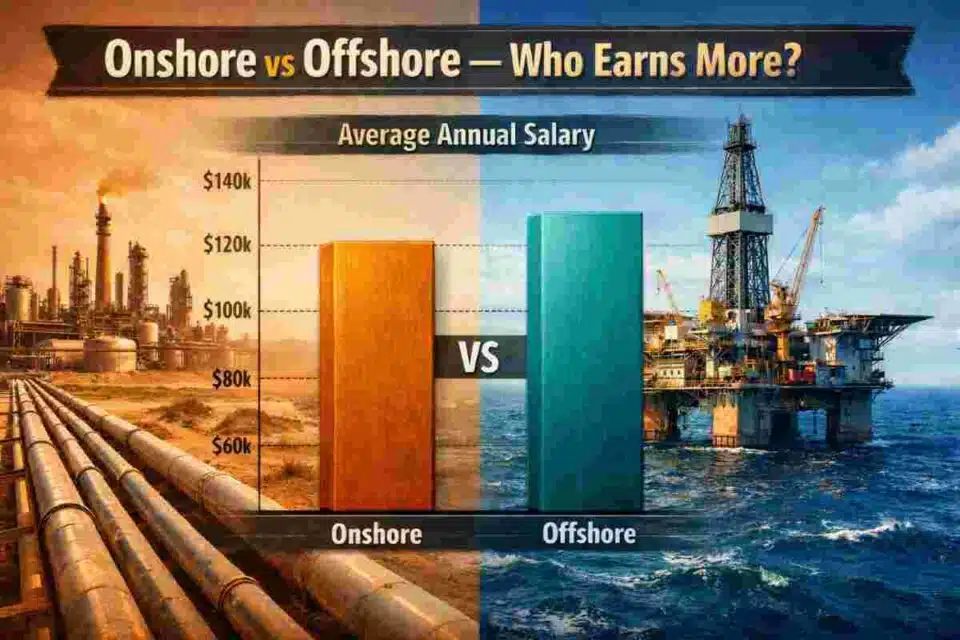
Offshore positions consistently pay more than their onshore equivalents — the premium typically ranges from 15% to 70% depending on the role, location, and project complexity. This premium compensates for extended time away from home, physically demanding work, hazardous marine environments, and rotational schedules.
USA Offshore Salaries by Role
| Role | Average Annual Salary (USD) | Top Earners (90th %ile) |
|---|---|---|
| Offshore Drilling Engineer | $116,666 | $135,500 |
| Offshore Engineer (General) | $132,244 | $242,007 |
| Subsea Engineer | $130,000 – $175,000 | $200,000+ |
| Drilling Superintendent (Offshore) | $180,000 – $250,000 | $300,000+ |
| Offshore Production Manager | $160,000 – $220,000 | $280,000+ |
Sources: ZipRecruiter (Jan 2026), Glassdoor (Feb 2026), Airswift GETI 2026 Report.
Gulf of Mexico platforms — where production reached approximately 1.9 million barrels per day in 2025 — remain the primary offshore hub for US-based engineers. Major deepwater projects like Shell’s Whale Field and Beacon Offshore’s Shenandoah Field continue to drive demand for specialized offshore talent.
India and Gulf Offshore Salaries
Indian engineers working offshore — whether on ONGC’s Mumbai High platforms or on international rotations in the Gulf — typically earn 30–70% more than their onshore peers. An onshore production engineer earning ₹12 LPA could expect ₹18–22 LPA in an equivalent offshore role. Engineers with Gulf offshore experience often report total packages of ₹30–80+ LPA (converted), particularly in senior drilling and subsea positions.
Onshore vs Offshore: Head-to-Head Comparison
The following comparison summarizes the key differences between onshore and offshore oil and gas engineering careers.
| Factor | Onshore | Offshore |
|---|---|---|
| Base Salary | Standard market rates | 15–70% higher than onshore |
| Allowances | HRA, travel, standard benefits | Uplift, hazard pay, rotation bonus, accommodation, meals |
| Work Schedule | 8–10 hour days, Mon–Sat | 12-hour shifts, 14/14 or 28/28 rotations |
| Location Stability | Live near site, daily commute | Weeks on platform, weeks off at home |
| Physical Demand | Moderate (varies by role) | High — harsh weather, confined space, marine conditions |
| Risk Level | Standard industrial hazards | Elevated — blowouts, weather events, isolation |
| Career Progression | Structured corporate ladder | Fast-track technical expertise, slower managerial path |
| Family Life | Regular daily presence | Extended absences, concentrated family time during off-rotation |
| Overtime Pay | Standard 1.5x rates | Often built into day rate; 1.5–2x for additional shifts |
| Tax Benefit (Gulf) | Standard local taxation | Often tax-free (UAE, Saudi, Qatar, Kuwait) |
The bottom line: offshore roles pay more, but they demand significant personal sacrifice. Many experienced professionals alternate between onshore and offshore roles at different career stages — building rapid technical depth offshore in their 20s and 30s, then transitioning to onshore management or consulting roles as they approach mid-career.
Factors That Influence Oil and Gas Engineer Salaries
Raw salary numbers only tell part of the story. Several factors determine where an individual falls within any given pay range.
1. Geographic Location
Location is the single largest determinant of oil and gas compensation. Engineers in Houston, Texas earn more than those in Tulsa, Oklahoma for the same role due to cost of living and basin activity. Similarly, Gulf countries offer tax-free packages that significantly boost net income compared to equivalent salaries in India or Europe. For US-specific state comparisons, see our best-paying states for engineers in the USA.
2. Project Complexity
Engineers working on high-pressure, high-temperature (HPHT) wells, deepwater installations, extended-reach drilling campaigns, or sour gas projects consistently earn more than those on conventional onshore sites. Complexity premiums can add 20–40% above base pay.
3. Employer Type
Major operators (ExxonMobil, Shell, Chevron, Saudi Aramco, ADNOC) generally pay more than independent producers or oilfield service companies. National oil companies (NOCs) and PSUs in India offer job security and benefits that partially offset lower base salaries.
4. Certifications and Specialized Training
Industry certifications significantly impact earning potential. The most impactful credentials include IWCF Well Control Level 4, PMP (Project Management Professional), NEBOSH for HSE roles, SPE membership, and specialized training in managed pressure drilling, subsea systems, or reservoir simulation software like Petrel and Eclipse.
5. Experience and Track Record
Experience creates the largest salary jumps in this industry. An engineer who has managed a full well delivery cycle — from planning through post-well review — will command significantly more than one who has only worked on isolated technical tasks. The 3–5 year and 7–10 year marks typically represent the steepest salary step-ups.
6. Contract Type
Rotational contractor positions (common offshore) often offer higher day rates — sometimes $800–$2,500+ per day for senior roles — but may lack long-term benefits like pensions, medical insurance, or equity participation. Permanent staff roles provide lower base pay but include comprehensive benefits packages.
Certifications That Boost Your Oil and Gas Salary
The right certifications can accelerate both salary growth and hiring priority. Here are the credentials with the strongest compensation impact in 2026.
IWCF Well Control (Level 2–4): Often mandatory for drilling roles. Level 4 (Drilling Supervisor level) is essential for senior positions and supports higher bonus structures. The International Well Control Forum (IWCF) administers accreditation globally.
PMP (Project Management Professional): Particularly valuable for engineers transitioning into project management. PMP holders earn 22–33% more on average across construction and engineering disciplines. For related salary data, see our construction management degree salary guide.
NEBOSH International General Certificate / Oil & Gas Certificate: Essential for HSE-focused roles in oil and gas. NEBOSH-certified professionals are mandatory on most major EPC projects in the Gulf and North Sea. Explore top 100 HSE interview questions for oil and gas to prepare for related positions.
SPE Membership and Certifications: The Society of Petroleum Engineers offers petroleum engineering certification and continuing education that enhance credibility with international employers.
HAZOP/HAZID Training: Required for process safety roles, particularly in midstream and downstream operations. Engineers with HAZOP certification are in consistent demand for facility design reviews and operational safety assessments.
How to Maximize Your Oil and Gas Engineer Salary
Based on industry patterns and compensation data, here are the most effective strategies for maximizing earning potential in this sector.
Step 1: Build hands-on field experience early. Prioritize field assignments — whether onshore production sites or offshore rotations — over office-based design roles during your first 3–5 years. Employers consistently pay premiums for candidates with demonstrated operational experience.
Step 2: Earn high-impact certifications. Target IWCF, PMP, and NEBOSH in your first 5 years. These credentials provide measurable salary lifts and unlock access to senior positions and international opportunities.
Step 3: Develop specialized technical depth. Engineers who develop expertise in niche areas — such as HPHT drilling, managed pressure drilling, subsea engineering, reservoir simulation, or well integrity management — consistently out-earn generalists.
Step 4: Accept international assignments. Willingness to work in the Gulf, North Sea, West Africa, Southeast Asia, or other international basins dramatically increases lifetime earnings. Tax-free Gulf postings in particular can accelerate wealth building.
Step 5: Negotiate beyond base salary. In offshore and international roles, negotiable elements include rotation schedules, housing allowances, flight tickets, end-of-service gratuity, retention bonuses, and vehicle provisions. Total compensation packages often exceed base salary by 40–60%.
For a comprehensive view of career paths in this sector, read our detailed guide on careers in oil and gas production.
Top Companies Hiring Oil and Gas Engineers in 2026
The following companies are among the most active hirers for onshore and offshore engineering positions globally.
Supermajors and IOCs: ExxonMobil, Shell, Chevron, BP, TotalEnergies, and ConocoPhillips consistently offer the highest compensation packages with comprehensive benefits, training programs, and international mobility.
National Oil Companies (NOCs): Saudi Aramco (Saudi Arabia), ADNOC (UAE), QatarEnergy, Kuwait Oil Company, and ONGC (India) are major employers. Gulf NOCs offer tax-free salaries with generous housing, education, and medical allowances.
Oilfield Service Companies: Schlumberger (SLB), Halliburton, Baker Hughes, and Weatherford offer strong career development but typically pay 10–20% less than operators for equivalent roles.
EPC Contractors: L&T Hydrocarbon, Technip Energies, Wood, Worley, Saipem, McDermott, and Bechtel are major employers for construction-phase engineering roles in oil and gas projects. To understand why domain knowledge matters in these settings, see the importance of domain knowledge in oil and gas.
Related Posts:
- 10 Tips on How to Hire Great Construction Workers (2026 Guide)
- Construction Data: How It’s Revolutionizing the Construction Industry in 2026
- The Future of Innovation in Oil and Gas Projects
- Top 100 HSE Engineer Interview Questions & Answers for Oil & Gas and Construction [2026]
Oil and Gas Engineer Salary by Country — 2026 Comparison
| Country | Average Annual Salary | Tax Advantage | Offshore Premium |
|---|---|---|---|
| USA | $128,000 – $164,000 | Standard federal + state taxes | 15–30% |
| UAE | $52,000 – $112,000 (AED 192K–412K) | No income tax | 20–40% |
| Saudi Arabia | $56,000 – $90,000 (SAR 210K–340K) | No income tax | 25–50% |
| India | ₹8 – 50+ LPA | Standard Indian income tax | 30–70% |
| UK (North Sea) | £55,000 – £100,000+ | Standard UK taxes | 20–35% |
| Australia | AUD 120,000 – 200,000+ | Standard Australian taxes | 20–40% |
| Norway | NOK 750,000 – 1,200,000+ | High taxes but strong social benefits | 15–25% |
Sources: Glassdoor 2026, Salary.com, PayScale, ERI Salary Expert, ZipRecruiter. Offshore premiums are estimates based on industry reports and the GETI 2026 survey.
Recommended Courses for Oil and Gas Engineers
Investing in continuous education is one of the most reliable ways to increase your earning potential and stay competitive in this evolving industry. The following courses are particularly relevant for engineers looking to strengthen their technical profile in 2026.
Oil & Gas Industry Operations and Markets — Duke University (Coursera) — an excellent foundational course covering upstream operations, market dynamics, and industry economics. Ideal for engineers early in their careers or professionals from adjacent fields entering oil and gas.
Petroleum Engineering with AI Applications — L&T EduTech (Coursera) — a comprehensive specialization covering upstream and midstream operations integrated with AI and machine learning applications. Particularly relevant as the industry accelerates digital transformation.
AI & ML Applications in Oil and Gas Industry — L&T EduTech (Coursera) — focuses on how machine learning enhances seismic data processing, reservoir engineering, and production optimization. Engineers with these skills are increasingly in demand.
Utilities, Safety & Environmental Care in Oil & Gas — L&T EduTech (Coursera) — covers safety analysis methods (FMEA, HAZOP, HAZID), environmental management, and waste systems. Essential for engineers targeting HSE or operations roles.
Oil Industry Courses — edX — a curated collection including petroleum geology, energy economics, and environmental sustainability from leading universities.
Future Outlook: Oil and Gas Engineer Demand and Salary Trends (2026–2030)
Despite the global energy transition, oil and gas engineering roles remain in strong demand for several reasons.
According to the Bureau of Labor Statistics, petroleum engineering employment in the US is projected to grow steadily through the decade, driven by the need to optimize existing fields, develop unconventional reserves, and meet continuing global energy demand.
The 2026 Global Energy Talent Index (GETI) report found that approximately 60% of hiring managers reported salary increases over the past year, with 68% anticipating continued pay growth. Salary expectations among oil and gas workers remain optimistic, with 67% expecting a raise in the coming year.
Key trends shaping future compensation include the growing demand for engineers with AI and digital skills (automation is expected to improve operational efficiency by up to 20% according to McKinsey), the continued expansion of deepwater projects in the Gulf of Mexico and offshore Brazil, and the emergence of adjacent roles in carbon capture, hydrogen production, and geothermal energy that leverage petroleum engineering expertise.
The International Association of Oil & Gas Producers (IOGP) continues to emphasize workforce development and safety standards that sustain demand for qualified engineers globally.
Related Career Resources
To deepen your oil and gas career knowledge, explore these additional resources from ConstructionPlacements:
Top 50 Piping Engineer Interview Questions and Answers — essential preparation for roles in oil and gas EPC projects.
QA/QC Engineer: Salary, Roles & Career Guide 2026 — salary data and career pathway for quality engineering in oil and gas and construction.
Construction Engineer Job Description and Salary Details — a comparison of construction engineering compensation globally.
Civil Engineering Salary Guide (2026 Updated) — comprehensive salary benchmarks across civil engineering disciplines.
Download our career ebooks for deeper preparation: Construction Interview Preparation Guide | Civil Engineering & Construction Career eBook | Career Resource Bundle
Frequently Asked Questions (FAQ)
What is the average oil and gas engineer salary in 2026?
In the United States, the average oil and gas engineer earns approximately $143,978 per year according to Salary.com (February 2026). In India, the average ranges from ₹8–10.75 LPA, while Gulf countries offer $52,000–$112,000+ in tax-free packages depending on the role and employer.
How much more do offshore engineers earn compared to onshore engineers?
Offshore engineers typically earn 15–70% more than onshore engineers in equivalent roles. The premium varies by region — in India, the offshore premium can be as high as 70%, while in the USA and Gulf, it typically ranges from 15–40%. This premium compensates for rotational schedules, isolation, hazardous conditions, and time away from family.
Which country pays the highest salary for oil and gas engineers?
In terms of gross salary, the USA pays the highest, with top earners exceeding $200,000 annually. However, when factoring in tax-free income, the Gulf countries (UAE, Saudi Arabia, Qatar) often deliver higher net take-home pay. Norway and Australia also offer competitive packages, though with higher tax obligations.
What qualifications do I need to become an oil and gas engineer?
Most roles require a bachelor’s degree in petroleum engineering, mechanical engineering, chemical engineering, or a closely related discipline. Advanced roles often require specialized certifications (IWCF, NEBOSH, PMP), field experience, and proficiency with industry software like Petrel, Eclipse, OLGA, or WellPlan.
Is petroleum engineering still a good career choice in 2026?
Yes. Despite the energy transition, global oil and gas consumption continues at significant levels, and the industry faces talent shortages as experienced professionals retire. Engineers with digital skills (AI, data analytics, automation) alongside traditional petroleum expertise are especially well-positioned for long-term career growth.
What is the salary difference between a drilling engineer and a reservoir engineer?
Both roles earn comparably at entry and mid-career levels. However, reservoir engineers tend to command slightly higher salaries at senior levels due to the strategic and analytical nature of their work. Drilling engineers, especially those in offshore roles, can offset this gap through hazard premiums and rotation bonuses.
Do oil and gas engineers get housing and travel allowances?
Offshore and international positions almost always include housing (or housing allowance), meals during rotation, and travel (flights to and from the platform or international assignment location). In the Gulf, residential packages typically include family housing, school fees, annual flights home, medical insurance, and end-of-service gratuity.
How can I transition from onshore to offshore engineering roles?
Start by obtaining mandatory offshore certifications such as BOSIET/HUET (offshore survival), IWCF Well Control, and a valid offshore medical certificate. Apply to service companies (SLB, Halliburton, Baker Hughes) that frequently rotate engineers between onshore and offshore assignments. Building experience in challenging onshore environments — such as remote sites or high-activity basins — also strengthens an offshore candidacy.
This salary guide is published by ConstructionPlacements.com and is based on data from Glassdoor, Salary.com, PayScale, ZipRecruiter, BLS, ERI Salary Expert, and the GETI 2026 Report. Salary figures are indicative and may vary based on employer, location, project complexity, and individual qualifications. Last updated: April 2026.
