

Last Updated on January 20, 2026 by Admin
Knocking down a wall to create an open-plan living space sounds straightforward until you realise that wall’s holding up your house. Load bearing wall removal is one of the most common structural alterations in London homes, but it’s also one of the riskiest if done incorrectly. Load bearing walls transfer the weight of floors, ceilings, and roofs down to your foundations. Remove one without proper engineering and you’re risking structural failure, dangerous cracks, and potentially life-threatening collapse. If you’re planning load bearing wall removal in your London home, you’ll need a structural engineer’s calculations, Building Control approval, and proper steel beam installation. AC Design Solution, CIAT Chartered Architectural Technologists with over 10,000 UK projects delivered, guides London homeowners through the entire process—from structural surveys and calculations to Building Control submissions and construction support.
ConstructionCareerHub App is LIVE — built ONLY for construction careers. Don’t apply with a weak resume.
Get ATS-ready Resume Lab + Interview Copilot + Campus Placement Prep (resume screening, skill gaps, interview readiness) — in minutes & Other advanced features.
Explore Smarter Construction Career Tools →Quick check. Big impact. Start now.
Table of Contents
What Makes a Wall Load Bearing?
Load bearing walls carry weight from above. Non-load bearing walls just divide space—they’re not supporting anything structural.
Load bearing walls typically run perpendicular to your floor joists and are often positioned centrally in your property or directly above another wall on the floor below. External walls are almost always load bearing. In terraced and semi-detached London properties, party walls usually carry structural loads too.
But here’s the problem: you can’t always tell just by looking. Original architectural drawings help, but many London homes don’t have accurate records—especially Victorian and Edwardian properties modified over decades. That’s where a structural engineer comes in. Every load bearing wall removal project starts with a proper structural survey to assess the wall’s role in your home’s structure.
The Structural Engineering Process
Removing a load bearing wall isn’t demolition—it’s precise structural engineering that requires calculations, approvals, and careful execution.
A structural engineer visits your property to examine what’s above the wall, what’s below it, and how loads currently transfer through your building. They’ll calculate exactly how much load that wall carries and design a replacement support system—typically a steel beam (RSJ) or reinforced concrete lintel. These calculations account for dead loads, live loads, and safety factors required by British Standards.
The engineer produces detailed structural drawings showing beam specifications, support positions, temporary props required during installation, and connection details. These become your instruction manual for the build.
Building Regulations and Approvals
You cannot legally remove a load bearing wall without Building Control approval.
Building Control ensures your proposed structural changes meet safety standards under the Building Regulations 2010. They’ll review your structural engineer’s calculations and drawings before issuing approval. Once work starts, they’ll conduct site inspections at key stages—before concealing any structural steelwork and after completion.
The process takes 4-8 weeks typically, depending on your local authority’s workload. Fees vary by borough but expect £300-£600 for a straightforward load bearing wall removal. Some London homeowners try skipping approval to save money or time. That’s remarkably short-sighted. You’ll face enforcement action if discovered, struggle to sell your property later, and potentially invalidate your home insurance.
If your property’s a listed building, you’ll also need Listed Building Consent. If it affects a party wall, the Party Wall Act 1996 applies—you’ll need proper notices served to affected neighbours before starting work.
Steel Beam Installation
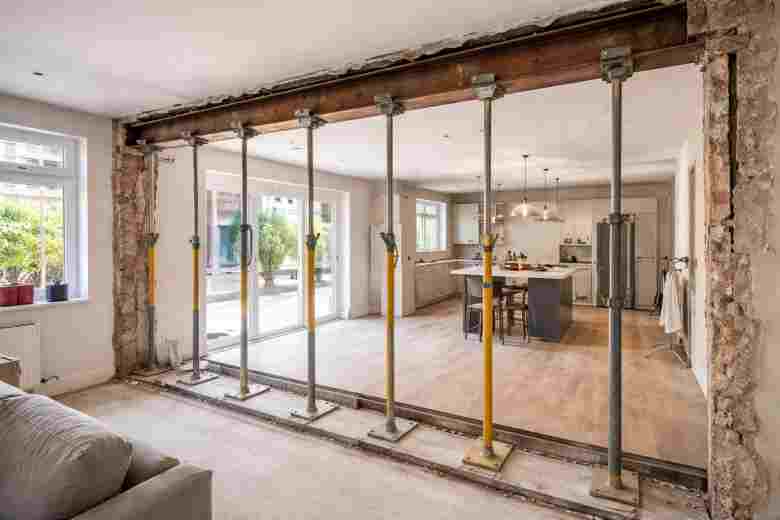
The actual installation requires careful planning and temporary support. Before removing any brickwork, builders install adjustable steel props (Acrow props) on both sides of the wall to support the floor or ceiling above. These props carry the load temporarily while the wall’s removed and the permanent steel beam’s installed.
The steel beam sits on padstones—concrete or steel plates that distribute the beam’s load across a wider area of supporting wall. Without proper padstones, concentrated loads can crush brickwork. The beam’s positioned, levelled precisely, and secured before builders remove the temporary props and make good the surrounding plasterwork.
Common mistakes include inadequate temporary propping, incorrect beam sizing, poor padstone installation, and removing too much wall before the steel’s in place. Each one creates serious risk. That’s why your structural engineer should specify exactly how the work’s carried out and Building Control inspects it during construction.
Costs and Timeline
Expect to pay £1,500-£3,000 for structural engineer’s calculations and drawings, £300-£600 for Building Control fees, and £2,000-£4,000 for the actual construction work including steel beam and labour. Total project costs typically range from £3,800 to £7,600 depending on beam size, wall length, and site access.
Timeline breaks down as follows: structural survey and calculations take 1-2 weeks, Building Control approval takes 4-8 weeks, and physical construction work takes 2-5 days. You’re looking at roughly 6-11 weeks from initial engineer visit to completion.
Why Professional Support Matters
Load bearing wall removal transforms how you use your home, but only when done properly. DIY structural work isn’t just illegal—it’s genuinely dangerous. Your structural engineer ensures the maths is right, Building Control confirms you’re meeting regulations, and experienced builders execute the work safely.
AC Design Solution provides integrated structural engineering services for London homeowners, handling everything from initial surveys through to final Building Control sign-off. With construction backgrounds before professional qualifications, we understand what actually works on site—not just what looks good on paper.
Related Posts:
- Top 15 Construction Recruitment Agencies in London: Your Ultimate Guide to Landing a Construction Job in the UK
- A Comprehensive Guide to Remove Construction Debris
- What Engineers Must Know About Construction Contracts & Risk (2026 Edition)
- 151 Most Important Construction Terms To Know
