
Last Updated on March 6, 2026 by Admin
India’s construction sector is undergoing a transformative shift toward sustainability, and green building certification in India has become one of the most critical topics for civil engineers, architects, and construction professionals in 2026. With the country now holding the second-largest green building footprint in the world — over 19,000 IGBC-registered projects covering more than 15.74 billion square feet — the demand for certified green buildings, sustainability consultants, and green construction specialists is at an all-time high.
ConstructionCareerHub App is LIVE — built ONLY for construction careers. Don’t apply with a weak resume.
Get ATS-ready Resume Lab + Interview Copilot + Campus Placement Prep (resume screening, skill gaps, interview readiness) — in minutes & Other advanced features.
Explore Smarter Construction Career Tools →Quick check. Big impact. Start now.
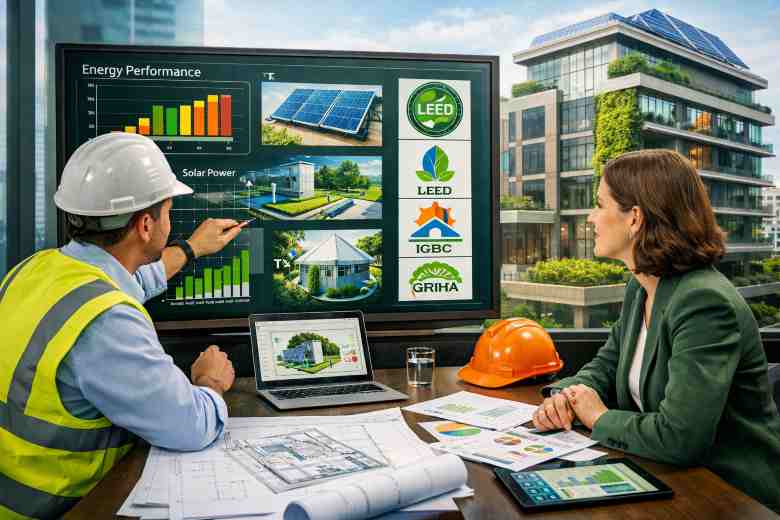
Green buildings are structures designed to minimize environmental impact by optimizing energy use, conserving water, reducing waste, and creating healthier indoor environments. In India, three major certification systems drive this movement: the Indian Green Building Council (IGBC), the Green Rating for Integrated Habitat Assessment (GRIHA), and the globally recognized Leadership in Energy and Environmental Design (LEED). Whether you are a fresh graduate exploring civil engineering career opportunities or a working professional looking to specialize in sustainability, understanding green building certification in India is now essential.
Table of Contents
What Is Green Building Certification in India?
Green building certification in India is a formal assessment process that evaluates and rates a building’s environmental performance across parameters such as energy efficiency, water conservation, sustainable material use, indoor air quality, and waste management. Certified buildings are recognized for meeting stringent sustainability benchmarks that go well beyond conventional building standards.
The purpose of these certifications is to promote environmentally responsible construction practices while delivering measurable benefits to building owners, occupants, and the broader community. Certified green buildings in India have demonstrated energy savings of 30–50%, water savings of 20–40%, and significantly reduced carbon emissions compared to conventional structures.
The Indian government has actively pushed for sustainable building practices through policies such as the Energy Conservation Building Code (ECBC), mandatory GRIHA certification for central government projects, and state-level incentives like additional Floor Area Ratio (FAR) benefits for green-certified projects. Several state governments — including Maharashtra, Rajasthan, Assam, and Punjab — now offer premium rebates, property tax reductions, and FAR incentives for developers who obtain green building ratings.
Why Green Buildings Are Important in India (2026)
India faces some of the most pressing environmental challenges in the world, and the building and construction sector is a major contributor. According to the World Resources Institute, India’s construction sector accounts for approximately 17% of total greenhouse gas emissions and consumes around 33% of the country’s electricity. Overall, buildings contribute nearly 40% of India’s carbon footprint.
Here’s why green buildings are more critical than ever in 2026:
- Climate change urgency: India has committed to achieving Net Zero emissions by 2070 under the Paris Agreement. Green buildings are a cornerstone of this commitment, with potential to reduce CO₂ emissions by millions of tonnes annually.
- Energy consumption: The residential and commercial building sectors are among the largest consumers of electricity. Energy-efficient buildings help reduce peak electricity demand and lower utility costs.
- Water scarcity: With many Indian cities experiencing chronic water shortages, water-efficient buildings that incorporate rainwater harvesting, greywater recycling, and low-flow fixtures are no longer optional — they’re essential.
- Government sustainability policies: The ECBC 2017, National Building Code revisions, and multiple state-level green building policies are creating a regulatory environment that increasingly favors certified green construction.
- ESG and sustainable investment trends: Global and domestic investors are increasingly channeling funds toward ESG-compliant infrastructure. Green building certification provides the credibility and documentation needed to attract this capital.
The Indian green building materials market alone is valued at approximately USD 15.5 billion in 2025 and is projected to reach USD 32.2 billion by 2032, growing at a CAGR of 11.3%. This growth reflects a fundamental shift in how India approaches construction.
Major Green Building Certifications in India
India has multiple green building rating systems, each designed for specific building types, project scales, and sustainability goals. The three most widely recognized certifications are IGBC, GRIHA, and LEED. Let’s explore each in detail.
IGBC Certification (Indian Green Building Council)
The Indian Green Building Council (IGBC) is India’s premier body for green building certification, established by the Confederation of Indian Industry (CII) in 2001 and headquartered in Hyderabad. IGBC is a founding member of the World Green Building Council and has been instrumental in shaping India’s green building movement over the past two decades.
As of 2026, IGBC has registered over 19,000 projects covering 15.74 billion square feet of green building footprint. More than 7,370 projects have been fully certified and are operational, delivering annual savings of 66.4 billion units of energy, 199.3 billion litres of water, and a reduction of 53.1 million tonnes of CO₂ emissions.
IGBC certification levels (in ascending order):
- Certified
- Silver
- Gold
- Platinum
Types of IGBC certifications cover virtually every building typology:
- Residential: Green Homes, Green Residential Societies, Green Affordable Housing, IGBC Nest
- Commercial: Green New Buildings, Green Existing Buildings, Green Interiors, Green Data Centers, Green Healthcare
- Industrial: Green Factory Buildings, Green Logistics Parks & Warehouses
- Built Environment: Green Townships, Green Cities, Green Mass Rapid Transit Systems, Green Railway Stations
- Net Zero: Net Zero Water Buildings, Net Zero Waste, Net Zero Carbon Guidelines
Benefits for developers and engineers: IGBC certification enhances property value, attracts ESG-focused investors, reduces operational costs, and gives professionals a recognized credential in the growing green construction market. The upcoming IGBC Green New Building Rating System Version 4 (launching May 2026) will align with even more advanced sustainability benchmarks.
Learn more: Indian Green Building Council (IGBC) Official Website
GRIHA Certification
The Green Rating for Integrated Habitat Assessment (GRIHA) is India’s national green building rating system, developed by The Energy and Resources Institute (TERI) and adopted by the Ministry of New and Renewable Energy (MNRE). GRIHA stands apart as an indigenous system specifically designed for Indian climatic conditions, resources, and building practices.
GRIHA has registered over 3,869 projects covering more than 86.4 million square metres of green building footprint, with 972 certified professionals and 60 evaluators across India. The Indian government has mandated GRIHA certification for all new central government building projects.
GRIHA rating levels: The system uses a 1-star to 5-star rating based on a 100-point performance evaluation, with mandatory core criteria and optional advanced criteria.
Types of GRIHA ratings available:
- GRIHA (new buildings with built-up area above 2,500 sqm)
- SVAGRIHA (smaller buildings between 100 sqm and 2,500 sqm)
- GRIHA for Existing Buildings
- GRIHA for Affordable Housing (aligned with PMAY)
- GRIHA for Existing Schools
Government incentives for GRIHA-rated buildings: Pimpri Chinchwad Municipal Corporation (PCMC) in Maharashtra offers up to 50% premium rebate. NOIDA Authority provides additional FAR for 4- and 5-star projects. The recently announced Assam green building policy offers 3% additional FAR for Silver, 6% for Gold, and 9% for Platinum IGBC or equivalent GRIHA-rated projects.
GRIHA-compliant office buildings have demonstrated 30–50% reduction in energy consumption and 40–65% reduction in water consumption compared to benchmarks. Notable GRIHA-certified buildings include the Indira Paryavaran Bhawan in New Delhi — India’s first net-zero energy government building with a 930 kW rooftop solar system.
Learn more: GRIHA Official Website
LEED Certification in India
LEED (Leadership in Energy and Environmental Design) is the most widely recognized green building rating system globally. Developed by the U.S. Green Building Council (USGBC) and managed in India by the Green Business Certification Inc. (GBCI), LEED provides international credibility that is particularly valued by multinational corporations, IT parks, and commercial real estate developers.
LEED-certified buildings in India have reported 25–30% energy savings and 30–50% water savings compared to conventional buildings. The certification is especially popular among India’s IT sector, with major tech parks in Bengaluru, Hyderabad, Pune, and Chennai pursuing LEED Gold and Platinum ratings.
LEED certification levels:
- Certified (40–49 points)
- Silver (50–59 points)
- Gold (60–79 points)
- Platinum (80+ points)
LEED evaluates buildings across categories including sustainable sites, water efficiency, energy and atmosphere, materials and resources, indoor environmental quality, and innovation in design. For professionals targeting international careers or working with global clients, LEED accreditation remains a powerful credential.
Learn more: LEED by USGBC Official Website
Green Building Certification Process in India
While specific steps vary between IGBC, GRIHA, and LEED, the general green building certification process in India follows a structured pathway:
Step 1 — Registration: The project team registers with the chosen certification body (IGBC, GRIHA Council, or GBCI for LEED) by submitting project details and paying the registration fee. An online portal is provided for documentation submission.
Step 2 — Design Evaluation: The building design is reviewed against the rating criteria. This includes sustainable site planning, material selection, water management systems, and energy efficiency measures. Pre-certification is available from most systems to confirm the design intent.
Step 3 — Energy Modelling: A comprehensive energy simulation is performed using tools like EnergyPlus, eQuest, or DesignBuilder to demonstrate compliance with energy efficiency benchmarks and predict operational performance.
Step 4 — Documentation Submission: The project team compiles and submits all required documentation — design drawings, specifications, simulation reports, material certificates, water balance calculations, and compliance checklists — through the online certification portal.
Step 5 — Third-Party Assessment: Independent evaluators review the documentation, conduct site inspections (where applicable), and verify that the building meets the required criteria. GRIHA also requires post-occupancy audits for rating renewal.
Step 6 — Final Certification: Based on the evaluation score, the building receives its rating (Certified/Silver/Gold/Platinum for IGBC and LEED, or 1–5 stars for GRIHA). Certification is typically valid for a set period (3–5 years) and can be renewed through performance audits.
Benefits of Green Building Certification
Green building certification delivers tangible advantages for multiple stakeholders in the construction ecosystem:
For Developers: Certified green buildings command a 7–15% higher resale value and sell up to 20% faster than conventional properties. FAR incentives and premium rebates from state governments can significantly improve project economics. Green certification also strengthens brand reputation and attractcts ESG-aligned investment.
For Building Owners: Operational cost savings of 20–35% through reduced energy and water consumption. Lower maintenance costs due to high-quality, durable building systems. Property tax rebates in jurisdictions like Pune, NOIDA, and Jaipur.
For Occupants: Better indoor air quality through low-VOC materials and enhanced ventilation. Improved thermal and visual comfort. Studies consistently show higher productivity and lower absenteeism in green-certified workplaces.
For Construction Professionals: Green building expertise opens doors to specialized, higher-paying roles. Certification credentials like IGBC AP and LEED AP distinguish professionals in a competitive job market. Explore more construction industry careers that benefit from green building knowledge.
For the Environment: IGBC-certified projects alone save 66.4 billion units of energy annually, conserve 199.3 billion litres of water, and reduce CO₂ emissions by 53.1 million tonnes per year. Each certified project diverts approximately 2.5 million tonnes of construction waste from landfills annually.
Career Opportunities in Green Building & Sustainable Construction
The explosive growth of sustainable building certification in India has created a surge in demand for qualified professionals. Here are the most promising career roles in this sector:
- Green Building Consultant: Advises developers and architects on achieving certification. Requires strong knowledge of IGBC, GRIHA, or LEED rating systems.
- Sustainability Engineer: Integrates sustainable strategies into building design and operations. Combines engineering skills with environmental science.
- Energy Modeler: Specializes in building energy simulations to optimize performance and demonstrate code compliance. Highly sought after for LEED and IGBC projects.
- LEED Accredited Professional (LEED AP): Globally recognized credential demonstrating expertise in green building design and construction.
- IGBC Accredited Professional (IGBC AP): India-specific credential with over 6,100 qualified professionals currently active. Demand continues to grow as IGBC expands its rating systems.
- Net Zero Building Specialist: Focuses on designing buildings that produce as much energy as they consume. Over 350 organizations in India have pledged to achieve Net Zero targets.
- Environmental Design Engineer: Designs HVAC, lighting, and water systems optimized for sustainability and occupant comfort.
Salary potential: Entry-level green building professionals in India can expect ₹4–7 LPA, while experienced LEED APs and sustainability consultants command ₹10–20+ LPA. In international markets (Gulf, USA, UK), certified green building professionals earn significantly more due to stricter compliance requirements.
Future growth: With India’s built-up area expected to grow nearly 2.5 times by 2040, the demand for green construction professionals will only intensify. IGBC aims to certify 10 billion square feet of green buildings in the next decade — requiring tens of thousands of new professionals. Explore the latest green construction careers.
Skills Required for Green Building Professionals
To build a successful career in green building certification in India, professionals need a blend of technical expertise and domain-specific knowledge:
- Energy modelling: Proficiency in simulating building energy performance using tools like EnergyPlus, eQuest, and DesignBuilder.
- Building performance analysis: Ability to assess and optimize thermal, daylight, and ventilation performance.
- HVAC optimization: Understanding of high-efficiency heating, ventilation, and air-conditioning systems designed for tropical and sub-tropical climates.
- BIM for sustainable design: Using Revit and other BIM tools to integrate sustainability criteria into the design process from concept through construction.
- Environmental regulations: Knowledge of ECBC, National Building Code, NBC 2016 revisions, and state-level green building policies.
- Life cycle assessment (LCA): Evaluating the environmental impact of building materials and systems across their entire lifecycle — from extraction to disposal.
Top Courses to Learn Green Building & Sustainability
Here are five highly recommended courses to build your green building expertise:
- Green Building Design and Sustainability — Coursera (covers fundamentals of sustainable design, energy-efficient systems, and green rating systems)
- Sustainable Construction and Green Building Principles — edX (ideal for engineers wanting to understand lifecycle sustainability in construction)
- LEED Green Associate Exam Preparation — Udemy (focused preparation for the LEED GA credential, great for career advancement)
- Energy Efficient Buildings: Design and Operations — Coursera (deep dive into energy modelling, building science, and performance optimization)
Tools Used in Green Building Design
Green building professionals rely on specialized software for performance analysis, simulation, and design optimization:
- EnergyPlus: The gold standard for whole-building energy simulation, developed by the US Department of Energy. Used extensively for LEED and IGBC energy modelling requirements.
- eQuest: A user-friendly energy simulation tool built on the DOE-2 engine. Popular in India for quick design comparisons and energy code compliance.
- DesignBuilder: A powerful visual interface for EnergyPlus that enables detailed thermal, daylight, and HVAC analysis with intuitive 3D modelling.
- IES VE (Integrated Environmental Solutions Virtual Environment): A comprehensive suite for performance analysis including energy, daylight, thermal comfort, and carbon emissions.
- Autodesk Revit for Sustainable Design: BIM integration allows designers to analyze energy performance, solar exposure, and material lifecycle impacts directly within the design workflow.
How Students and Engineers Can Start a Career in Green Construction
Here’s a step-by-step roadmap for building a career in sustainable building certification and green construction:
- Build foundational knowledge: Complete your degree in civil engineering, architecture, or environmental engineering. Supplement with online courses on green building fundamentals.
- Get certified: Earn your IGBC AP, LEED Green Associate, or GRIHA Certified Professional credential. These certifications validate your expertise and dramatically improve your employability.
- Learn key tools: Master energy modelling software (EnergyPlus, eQuest, DesignBuilder) and BIM tools like Revit.
- Gain practical experience: Seek internships or entry-level roles with green building consultancies, architectural firms with sustainability divisions, or developers pursuing IGBC/LEED certification.
- Build a portfolio: Document your contributions to green building projects. Include energy models, certification documentation, and sustainability reports.
- Network actively: Attend IGBC Green Building Congress, GRIHA workshops, and industry events. Join IGBC local chapters to connect with professionals in your area.
- Stay updated: Green building standards evolve regularly. Follow industry updates, new rating system versions, and government policy changes.
For personalized career guidance, use the AI-powered tools at ConstructionCareerHub.com — it helps engineers with interview preparation, construction career planning, and job preparation tools designed specifically for the construction industry.
Future of Green Buildings in India
The trajectory of green building certification in India points toward exponential growth driven by several converging trends:
Net Zero Buildings: India has set a target of Net Zero emissions by 2070, and over 350 organizations have already pledged to achieve Net Zero across their building portfolios. IGBC has launched dedicated Net Zero Water, Waste, and Carbon rating systems. The Indira Paryavaran Bhawan and ITC Green Centre are pioneering examples of what’s possible.
Smart Buildings: The integration of IoT sensors, building management systems, and AI-driven analytics is transforming how green buildings are operated and optimized. Smart buildings can automatically adjust lighting, HVAC, and water systems to maximize efficiency in real time.
AI in Sustainable Construction: Artificial intelligence is being used for predictive energy modelling, construction waste optimization, and lifecycle performance analysis. AI-powered design tools are making it easier to achieve green building targets during the concept stage itself.
Government Mandates: More states are expected to follow Assam, Maharashtra, Rajasthan, and Punjab in offering FAR incentives, property tax rebates, and fast-track approvals for green-certified projects. GRIHA compliance remains mandatory for all central government projects.
ESG Investment Trends: With global ESG assets projected to grow significantly, Indian real estate developers are increasingly pursuing green certification to attract institutional investors and international tenants. Green-certified commercial properties are becoming the market standard for Grade A office spaces.
Conclusion
Green building certification in India is no longer a niche pursuit — it is rapidly becoming the standard for new construction across residential, commercial, industrial, and government sectors. With IGBC targeting 10 billion square feet of new green certifications, GRIHA expanding into affordable housing and existing buildings, and LEED maintaining its global relevance for commercial projects, the opportunities for professionals in this space are immense.
Whether you are a student exploring civil engineering career opportunities, a working professional looking to upskill, or a developer seeking to future-proof your projects, investing in green building knowledge and certification will pay dividends for years to come.
Start your journey today:
- Explore green building careers
- Access AI-powered career tools for interview preparation and career planning at ConstructionCareerHub.com
Related Posts:
- The Importance of LEED Certification in Green Building Careers
- Top 50 LEED Green Building Interview Questions & Answers [2026]
- LEED Auditor Job Description and Salary Details
- How to Succeed as a Specialist in Construction Environmental Compliance
FAQs — Green Building Certification in India
What is green building certification in India?
Green building certification in India is a formal rating process that evaluates a building’s environmental performance across parameters like energy efficiency, water conservation, material sustainability, indoor air quality, and waste management. The three major certification systems are IGBC, GRIHA, and LEED.
Which green building certification is best in India?
It depends on the project type. IGBC is best for a wide range of residential, commercial, and industrial projects. GRIHA is ideal for government buildings and projects seeking an indigenous Indian rating system. LEED is best suited for commercial buildings and IT parks targeting international recognition.
What is IGBC certification?
IGBC (Indian Green Building Council) certification is India’s most widely adopted green building rating system, established by CII in 2001. It offers 32+ rating programs across residential, commercial, industrial, and infrastructure categories, with four certification levels: Certified, Silver, Gold, and Platinum.
What is GRIHA certification?
GRIHA (Green Rating for Integrated Habitat Assessment) is India’s national green building rating system developed by TERI and adopted by the Ministry of New and Renewable Energy. It uses a 1-star to 5-star rating based on a 100-point performance system and is mandatory for all new central government building projects.
Is LEED certification recognized in India?
Yes, LEED certification is fully recognized in India and is especially popular among multinational corporations, IT parks, and commercial real estate developers. LEED-certified buildings in India have demonstrated 25–30% energy savings and 30–50% water savings.
How can engineers get green building certification?
Engineers can earn professional credentials such as IGBC Accredited Professional (IGBC AP), LEED Green Associate (LEED GA), LEED AP, or GRIHA Certified Professional by completing the respective training programs and passing the certification exams. Online courses on Coursera, edX, and Udemy can help with exam preparation.
Are green building professionals in demand?
Absolutely. With India’s green building footprint growing rapidly and IGBC targeting 10 billion additional square feet of certification in the next decade, demand for qualified green building consultants, sustainability engineers, energy modelers, and LEED/IGBC APs is increasing every year. Entry-level salaries start at ₹4–7 LPA, with experienced professionals commanding ₹10–20+ LPA.
What is the cost of green building certification in India?
Costs vary by certification body and project size. GRIHA registration fees go up to ₹20 lakhs for large projects. IGBC and LEED fees depend on the project’s built-up area and rating system selected. However, the long-term energy and water savings typically offset certification costs within 3–5 years.
