

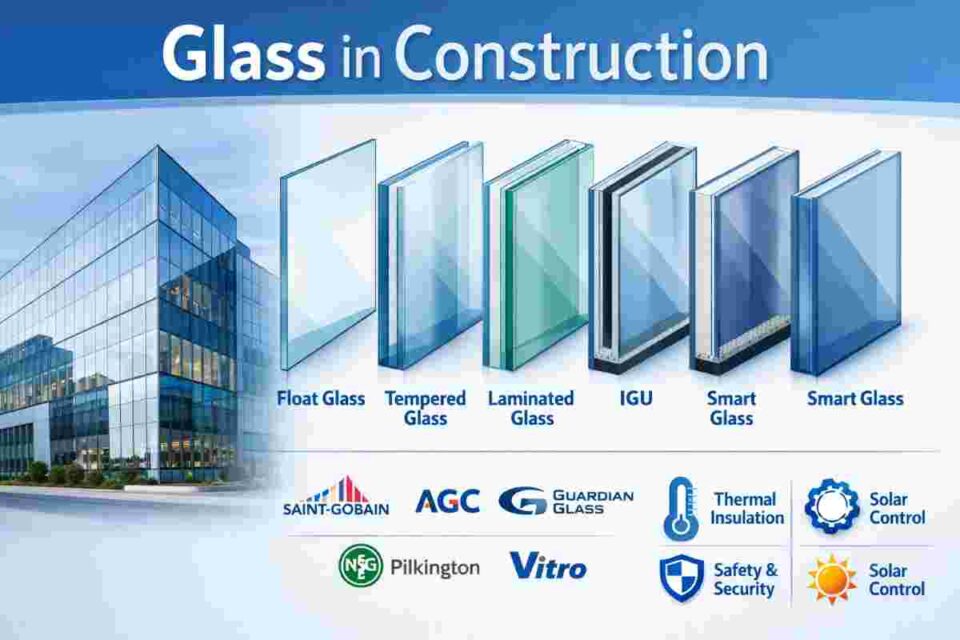
Last Updated on April 6, 2026 by Admin
Glass has evolved from a basic window pane material into one of the most strategically important building materials of the 21st century. In 2026, glass shapes how buildings perform thermally, how they look architecturally, and how they interact with the environment. From self-tinting smart glass facades to triple-glazed insulated units in net-zero homes, the role of glass in modern construction is expanding faster than ever.
ConstructionCareerHub App is LIVE — built ONLY for construction careers. Don’t apply with a weak resume.
Get ATS-ready Resume Lab + Interview Copilot + Campus Placement Prep (resume screening, skill gaps, interview readiness) — in minutes & Other advanced features.
Explore Smarter Construction Career Tools →Quick check. Big impact. Start now.
The global flat glass market was valued at approximately USD 156 billion in 2025, and forecasts project it will reach USD 169 billion in 2026 — growing at a CAGR of 8.6% through 2035. Construction alone accounts for over 80% of flat glass demand, driven by urbanization, energy-efficiency mandates, and a decisive shift toward high-performance glazing systems.
Whether you are a civil engineer, architect, project manager, contractor, or a construction professional planning your next career move, understanding the types, applications, and leading manufacturers of construction glass is essential in 2026 and beyond.
Table of Contents
What Is Glass in Construction?
Glass in construction refers to any glass product engineered, processed, or coated for use in buildings and infrastructure. Unlike commodity glass used in packaging or tableware, construction glass must meet stringent requirements for structural integrity, thermal performance, acoustic insulation, fire resistance, and safety.
Construction glass is manufactured primarily through the float glass process — a method pioneered by Sir Alastair Pilkington in 1952 — where molten glass flows onto a bath of molten tin to form perfectly flat, uniform sheets. These base sheets are then processed into specialized products through tempering, laminating, coating, or insulating, depending on the application.
Modern construction glass serves multiple functions simultaneously: it controls solar heat gain, reduces UV penetration, provides sound insulation, ensures occupant safety during breakage, and even generates energy when integrated with photovoltaic cells. Understanding these capabilities is critical for anyone involved in the selection of construction materials for building projects.
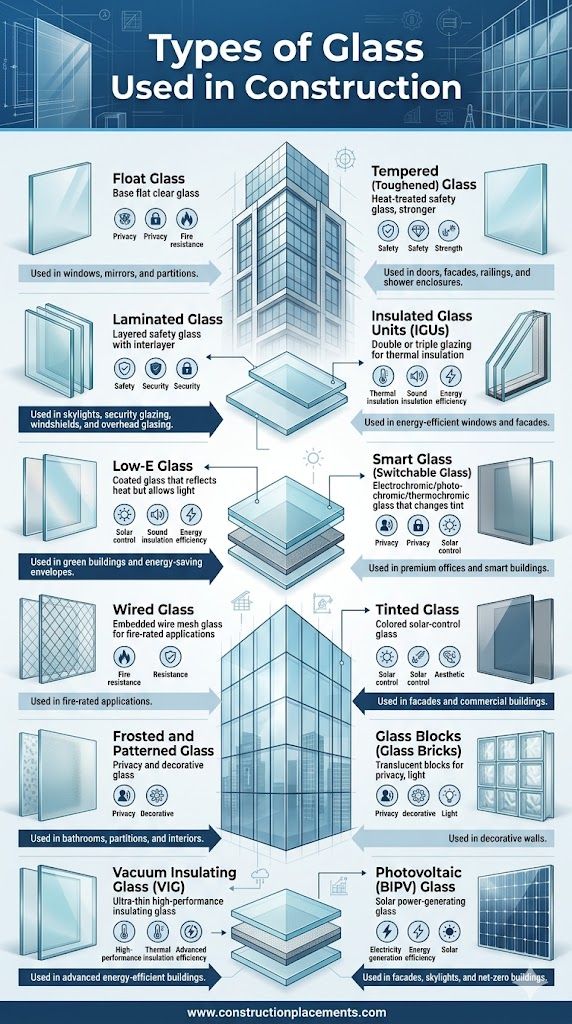
Types of Glass Used in Construction
The construction industry in 2026 uses a wide range of glass types, each engineered for specific performance characteristics. Below is a detailed breakdown of the most important types.
1. Float Glass
Float glass is the base product from which most other construction glass types are derived. It is produced by floating molten glass on a bed of molten tin, resulting in a perfectly flat sheet with uniform thickness ranging from 2 mm to 25 mm. Float glass offers excellent optical clarity and is used in windows, partitions, and mirrors. However, it breaks into sharp shards, making it unsuitable for safety-critical applications without further processing.
2. Tempered (Toughened) Glass
Tempered glass is created by heating float glass to approximately 620°C and then rapidly cooling it with jets of air. This process makes the glass four to five times stronger than regular annealed glass. When broken, tempered glass shatters into small, blunt-edged fragments rather than dangerous sharp shards. It is widely used in frameless shower enclosures, glass doors, facade glazing, balcony railings, and glass partitions.
3. Laminated Glass
Laminated glass consists of two or more glass layers bonded together with an interlayer — typically polyvinyl butyral (PVB) or ethylene-vinyl acetate (EVA). If the glass breaks, the interlayer holds the fragments in place, preventing the glass from falling apart. This makes laminated glass the standard choice for automotive windshields, overhead glazing, skylights, hurricane-resistant windows, and security glazing. It also provides excellent sound insulation and UV filtration.
4. Insulated Glass Units (IGUs)
Insulated glass units, also called double-glazed or triple-glazed units, consist of two or three glass panes separated by a sealed air or gas-filled space (typically filled with argon or krypton gas). IGUs dramatically reduce heat transfer through windows, improving a building’s thermal performance. In 2026, triple-glazed systems are increasingly specified for commercial and residential buildings in cold climates, driven by stricter energy codes and green building certifications like LEED and BREEAM.
5. Low-Emissivity (Low-E) Glass
Low-E glass features a microscopically thin metallic coating — usually silver or tin oxide — deposited on the glass surface. This coating reflects infrared radiation (heat) while allowing visible light to pass through. Hard-coat Low-E (pyrolytic) glass is more durable and can be used in single glazing, while soft-coat (sputtered) Low-E glass offers superior performance but must be used within an IGU. Low-E glass is now a baseline specification for energy-efficient buildings worldwide.
6. Smart Glass (Switchable Glass)
Smart glass, also called switchable glass, can change its light transmission properties in response to an electrical signal, heat, or light. The main technologies include electrochromic glass (voltage-controlled tinting), photochromic glass (light-reactive), and thermochromic glass (heat-reactive). Smart glass eliminates the need for blinds or curtains, reduces cooling loads, and enhances occupant comfort. The smart glass market is projected to reach USD 8.37 billion in 2026, signaling rapid mainstream adoption.
7. Wired Glass
Wired glass has a mesh of thin steel wire embedded within it during manufacturing. While it is not a safety glass (it can still produce sharp fragments), the wire mesh holds the glass together during a fire, preventing flames and smoke from passing through. It is primarily used in fire-rated doors, fire-rated windows, and institutional buildings where fire compartmentalization is required.
8. Tinted Glass
Tinted glass is produced by adding metal oxides during the float glass manufacturing process. Common tints include bronze, grey, green, and blue. Tinted glass reduces solar heat gain, glare, and visible light transmission without the need for additional coatings. It is widely used in commercial office facades, automotive glazing, and residential projects where aesthetic and functional solar control is needed.
9. Frosted and Patterned Glass
Frosted glass is produced by sandblasting or acid-etching one surface of the glass, creating a translucent finish that diffuses light while obscuring visibility. Patterned glass has textured designs rolled into one surface during manufacturing. Both types are used for privacy partitions, bathroom enclosures, interior doors, and decorative panels in residential and commercial buildings.
10. Glass Blocks (Glass Bricks)
Glass blocks are hollow, sealed units made from two pressed glass halves fused together. They allow light to pass through while providing thermal insulation, sound reduction, and privacy. Glass blocks are used in feature walls, bathroom partitions, stairwell enclosures, and facade elements, particularly in institutional and commercial architecture.
11. Vacuum Insulating Glass (VIG)
Vacuum insulating glass is an emerging technology where two glass panes are separated by a vacuum gap maintained by micro-spacers. VIG provides thermal performance comparable to or better than double-glazed IGUs, but at the thickness of a single pane. This makes it ideal for heritage building retrofits and applications where slim profiles are required. While still considered niche, VIG is gaining traction as energy codes become more stringent.
12. Photovoltaic (BIPV) Glass
Building-integrated photovoltaic glass incorporates thin-film solar cells within or on the glass surface, allowing the glass to generate electricity while functioning as a building envelope component. BIPV glass is used in facades, skylights, and canopies. It plays a key role in net-zero energy buildings and is increasingly supported by green building incentive programs globally.
For professionals exploring sustainable construction careers, understanding these advanced glass technologies can be a significant advantage. Check out the top eco-friendly technologies in construction for more context.
Comparison Table: Types of Glass in Construction
| Glass Type | Strength | Safety | Thermal Performance | Common Applications |
|---|---|---|---|---|
| Float Glass | Standard | Low (sharp shards) | Poor | Windows, mirrors, partitions |
| Tempered Glass | 4–5x stronger | High (blunt fragments) | Moderate | Doors, railings, facades |
| Laminated Glass | High | Very High (holds together) | Moderate | Skylights, security glazing, windshields |
| IGU (Double/Triple) | Standard per pane | Moderate | Excellent | Residential windows, commercial facades |
| Low-E Glass | Standard | Low–Moderate | Excellent | Energy-efficient buildings |
| Smart Glass | Standard | Moderate | Good–Excellent | Offices, hospitals, smart homes |
| BIPV Glass | Standard | Moderate | Good | Facades, skylights, net-zero buildings |
Key Applications of Glass in Construction
Glass serves a remarkably diverse set of functions in modern buildings. Here are the primary applications shaping the built environment in 2026.
Windows and Fenestration Systems
Windows remain the largest application of glass in construction. Modern fenestration systems combine Low-E coatings, gas-filled IGUs, and thermally broken frames to achieve exceptional energy efficiency. In 2026, floor-to-ceiling windows and oversized glass doors are increasingly popular in both residential and commercial projects, maximizing natural light and visual connection to the outdoors.
Curtain Walls and Structural Glazing
Curtain walls are non-structural cladding systems that form the exterior envelope of high-rise buildings. These systems use large panels of tempered or laminated glass held by aluminum or steel frames. Structural glazing eliminates visible frames entirely, using silicone adhesives to bond glass directly to the building structure, creating sleek, seamless facades. Both systems are standard in commercial office towers, hotels, airports, and institutional buildings.
Skylights and Roof Glazing
Glass skylights and roof glazing systems bring natural daylight deep into building interiors, reducing the need for artificial lighting. Laminated glass is mandatory for overhead applications to prevent injury from falling fragments. In 2026, motorized skylights with rain sensors and integrated smart glass tinting are becoming standard in premium residential and commercial projects.
Glass Railings and Balustrades
Glass railings using tempered or laminated glass panels are widely used in staircases, balconies, terraces, and atriums. They provide unobstructed views, allow light to flow through spaces, and meet safety codes when properly specified and installed.
Interior Partitions and Office Glazing
Glass partitions are replacing traditional drywall in modern offices, creating open, light-filled work environments while providing acoustic separation. Switchable smart glass is increasingly used for conference rooms and executive offices, offering privacy on demand.
Fire-Rated Glazing
Fire-rated glass systems are designed to maintain integrity and insulation for specified durations (30, 60, 90, or 120 minutes) during a fire. These systems use ceramic glass, wired glass, or multi-layer laminated glass and are critical in fire compartmentalization, escape routes, and stairwell enclosures.
Acoustic Glazing
Laminated glass with acoustic interlayers provides superior sound insulation, making it essential for buildings near airports, highways, railways, and urban noise sources. Acoustic glass is increasingly specified in healthcare, educational, and hospitality projects.
Understanding how these glass systems integrate with broader building design is essential for professionals working in the AEC (Architecture, Engineering, and Construction) industry.
Top Glass Manufacturers in the World (2026)
The global construction glass market is dominated by a handful of major manufacturers with decades of experience, massive production capacity, and extensive R&D capabilities. Here are the leading companies shaping the glass industry in 2026.
1. Saint-Gobain (France)
Founded in 1665, Saint-Gobain is the world’s oldest and one of the most trusted glass manufacturers. The company produces high-performance float, tempered, laminated, and coated glass for architectural and automotive applications. Saint-Gobain operates in over 70 countries and led the flat glass market with approximately 11.2% market share in 2025. Its products are widely used in commercial high-rises, residential projects, and infrastructure worldwide.
2. AGC Inc. (Japan)
AGC (formerly Asahi Glass Company), founded in 1907, is one of the world’s largest glass companies and a key member of the Mitsubishi Group. AGC produces float glass, automotive glass, and high-tech display glass. It employs over 51,000 people globally and generates approximately USD 15.28 billion in annual revenue. AGC’s Lamisafe laminated glass and advanced Low-E coatings are widely specified in construction projects around the world.
3. NSG Group / Pilkington (Japan / UK)
The NSG Group, headquartered in Tokyo, operates globally under the Pilkington brand. Pilkington is historically significant as the company that invented the float glass process — the foundation of modern glass manufacturing. NSG produces architectural glass, automotive glass, and specialty technical glass. Its Pilkington Optiwhite ultra-clear glass is widely used for premium interiors and solar applications.
4. Guardian Glass (USA)
Based in Auburn Hills, Michigan, Guardian Glass was founded in 1932 and specializes in float glass and fabricated glass products. Guardian is a major player in the construction and automotive sectors, known for its energy-efficient glass solutions and advanced coating technologies. The company employs approximately 14,000 people and has a substantial global manufacturing footprint.
5. Xinyi Glass Holdings (China / Hong Kong)
Founded in 1984 and listed on the Hong Kong Stock Exchange, Xinyi Glass is a leading global manufacturer of flat glass, automotive glass, and solar glass. The company operates over 40 production facilities across China, Southeast Asia, Europe, and North America. Xinyi supplied automotive-grade tempered glass for Tesla’s Berlin Gigafactory and has achieved a 41% reduction in CO₂ emissions through energy retrofitting initiatives.
6. Corning Inc. (USA)
Founded in 1851, Corning is a pioneer in specialty glass, ceramics, and advanced optics. Known for developing Gorilla Glass for smartphones, Corning also produces thin glass for architectural applications that offers lower embodied carbon, superior breakage resistance, and better optical clarity compared to traditional soda-lime float glass. Corning generates approximately USD 14.19 billion in annual revenue.
7. PPG Industries (USA)
PPG Industries, originally the Pittsburgh Plate Glass Company, is a Fortune 500 company with a diverse product portfolio that includes architectural glass, coatings, and specialty materials. PPG’s iconic Gothic glass headquarters in Pittsburgh is itself a landmark in architectural glass history. The company remains a leader in the American glass manufacturing industry.
8. Asahi India Glass (AIS) (India)
AIS is India’s leading integrated glass solutions company, established as a joint venture with AGC and Maruti Suzuki. AIS dominates the Indian automotive and architectural glass markets, producing laminated windshields, tempered glass, and processed glass products. For construction professionals in India, AIS is a critical supplier for both residential and commercial glazing projects.
9. China National Building Material Group (CNBM)
CNBM is one of China’s largest building materials companies, producing tempered glass, laminated safety glass, solar-control Low-E glass, photovoltaic glass, and smart glass with electrochromic properties. CNBM supplied 18,000 square meters of curved laminated glass with dynamic dimming capabilities for the Guangzhou Opera House renovation in 2023.
10. Vitro (Mexico)
Vitro is the largest glass manufacturer in Mexico and a significant player in the Western Hemisphere. The company produces a diverse range of glass products for architectural and automotive applications, with a strong strategic focus on the Latin American market.
Many of these companies are active employers in the construction sector globally. Professionals looking for career opportunities with major construction and materials companies should explore the top 50 construction companies in the world and the largest construction companies in the United States.
Top Glass Manufacturers in India
India’s construction glass market is growing rapidly, supported by massive urbanization, infrastructure development, and smart city initiatives. Here are the key glass manufacturers operating in India.
- Asahi India Glass (AIS) — India’s largest integrated glass company, producing architectural and automotive glass
- Saint-Gobain India — Operates multiple float glass plants in India, serving the residential, commercial, and automotive sectors
- Borosil Renewables — Specializes in solar glass manufacturing, supporting India’s renewable energy push
- Gold Plus Glass Industry — One of India’s largest float glass manufacturers, producing clear, tinted, and reflective glass
- Triveni Glass — Produces float glass and value-added glass products for the Indian construction market
- HNG Float Glass (Hindusthan National Glass) — Long-established producer of container and flat glass products
Glass Industry Trends in 2026
The construction glass industry is being reshaped by several major trends in 2026. Professionals who understand these trends will be better positioned for career growth.
Energy Efficiency and Green Building Codes
Stricter energy codes worldwide are making high-performance glass — including Low-E, IGUs, and triple glazing — a mandatory specification rather than an optional upgrade. LEED, BREEAM, and GRIHA certifications increasingly require advanced glazing solutions to meet energy reduction targets. The demand for insulated and safety glass is growing at rates above the overall market average.
Smart Glass Adoption
Electrochromic and photochromic smart glass is moving from niche to mainstream. Integrated into building management systems (BMS), smart glass can dynamically adjust tinting based on ambient conditions, reducing HVAC loads and improving occupant comfort. Professionals with expertise in BMS engineering will find growing demand in this space.
AI in Glass Manufacturing
Artificial intelligence is transforming glass manufacturing through automated quality inspection, predictive maintenance of float lines, and optimized energy consumption during production. AI-powered vision systems can detect defects invisible to the human eye, improving consistency and reducing waste.
Circular Economy and Glass Recycling
Glass is infinitely recyclable without loss of quality, making it inherently suited for a circular economy. However, recycling rates for construction glass remain low compared to container glass. The EU Circular Economy Act, slated to take effect in 2026, is expected to drive significant improvements in glass recycling infrastructure and collection networks.
Thin Glass and Lightweight Glazing
Advances in thin glass technology — pioneered by companies like Corning — are enabling lighter glazing assemblies with lower embodied carbon and improved structural performance. Thin glass could reduce the weight of IGU assemblies significantly, opening new possibilities for curtain wall design and high-performance facades.
Vacuum Insulating Glass (VIG) Expansion
VIG technology is gaining attention as energy codes become more stringent. With thermal performance matching or exceeding double glazing in a single-pane thickness, VIG is ideal for retrofit projects and historic preservation. Industry analysts expect VIG to move from niche to broader adoption as production scales and costs decrease.
Staying current with these trends is essential for professionals in construction technology integration careers.
Glass in Construction: Career Relevance and Opportunities
The expanding role of glass in construction is creating new career opportunities across multiple disciplines. Here is how glass technology impacts construction careers in 2026.
Facade Engineering
Facade engineers specialize in designing and specifying building envelope systems, including curtain walls, structural glazing, and cladding. This is a rapidly growing niche that combines structural engineering, thermal physics, and architectural design. Facade engineers in developed markets earn between USD 80,000 and USD 130,000 annually, depending on experience and location.
BIM and Glass Modeling
Building Information Modeling (BIM) professionals increasingly need expertise in modeling glazing systems, curtain walls, and fenestration details. Understanding glass performance data — including U-values, Solar Heat Gain Coefficients (SHGC), and Visible Light Transmission (VLT) — is essential for accurate BIM modeling. Explore career opportunities in BIM and BIM in civil engineering for more information.
Green Building and Sustainability Roles
Professionals working in green building design and sustainability consulting must understand how glass selection affects a building’s energy performance. Knowledge of Low-E coatings, smart glass, and BIPV systems is increasingly expected in sustainability-focused roles. The green infrastructure specialist career path is worth exploring for those interested in this direction.
Quality Control and Testing
Glass testing and quality control roles involve verifying that glass products meet applicable standards (IS 2553, EN 12150, ASTM C1048, etc.) for strength, safety, thermal performance, and optical quality. These roles exist within glass manufacturing companies, construction companies, and independent testing laboratories.
Relevant Salary Context
For professionals evaluating career options in the construction industry, understanding salary benchmarks is critical. Refer to the civil engineering salary guide and the highest paying construction jobs in the US for current compensation data.
🛠️ ConstructionCareerHub Resources: Use the Resume Lab on ConstructionCareerHub.com to build an ATS-ready resume highlighting your expertise in building materials, facade engineering, or green building technologies. Try the Interview Copilot to practice technical questions.
Key Standards and Codes for Construction Glass
Construction glass must comply with numerous national and international standards. Here are the most important ones for professionals to know.
- IS 2553 (India) — Safety glass specifications for tempered and laminated glass
- EN 12150 (Europe) — Thermally toughened soda lime silicate safety glass
- EN 1279 (Europe) — Insulating glass units specifications
- ASTM C1048 (USA) — Standard specification for heat-strengthened and fully tempered flat glass
- ASTM E2190 (USA) — Insulating glass unit performance and evaluation
- AS 1288 (Australia) — Glass in buildings: selection and installation
- IGCC/IGMA (North America) — Insulating Glass Certification Council standards
- NBC 2016 (India) — National Building Code provisions on glazing and safety
These standards define minimum requirements for strength, safety, thermal performance, and installation. Familiarity with applicable codes is essential for architects, structural engineers, and facade consultants working on glass-intensive projects.
Advantages and Disadvantages of Glass in Construction
Advantages
- Natural Daylighting: Maximizes natural light, reducing artificial lighting energy consumption by 30–50% in well-designed buildings
- Aesthetic Appeal: Creates modern, transparent facades that enhance architectural design and visual connectivity
- Recyclability: Glass is 100% recyclable without any loss in quality, supporting circular economy goals
- Versatility: Available in a wide range of types, coatings, and configurations to meet virtually any performance requirement
- UV Protection: Laminated and coated glass can block up to 99% of harmful ultraviolet radiation
- Thermal Performance: Advanced glass systems (Low-E, IGU, VIG) significantly reduce heating and cooling loads
- Durability: Glass does not corrode, rot, or degrade from UV exposure, making it extremely long-lasting
Disadvantages
- High Cost: Advanced glass products (smart glass, VIG, BIPV) can be significantly more expensive than conventional materials
- Heat Gain in Hot Climates: Excessive glazing without proper solar control can increase cooling loads and energy costs
- Privacy Concerns: Clear glass offers limited privacy without additional treatments (frosting, tinting, or smart glass)
- Maintenance: Glass facades require regular cleaning, particularly in urban environments with pollution and grime
- Brittleness: Glass is inherently brittle and can shatter under impact, though tempering and laminating mitigate this risk
- Embodied Energy: Glass manufacturing is energy-intensive, though innovations in production processes are reducing emissions
- Bird Collisions: Transparent facades can pose hazards to birds, requiring bird-friendly glass designs in ecologically sensitive areas
How to Select the Right Glass for Your Construction Project
Selecting the appropriate glass for a construction project requires evaluating several interconnected factors. Here is a practical framework for making informed decisions.
Step 1: Define Performance Requirements. Determine the thermal, acoustic, safety, and fire-resistance requirements based on the building’s location, use, and applicable codes. For instance, buildings in tropical climates prioritize solar control, while those in cold regions focus on thermal insulation.
Step 2: Assess Safety Requirements. Identify areas requiring safety glass (tempered or laminated) based on building codes. Overhead glazing, glass railings, doors, and areas accessible to children or the public typically require safety glass.
Step 3: Evaluate Energy Codes. Check the applicable energy code requirements for U-values, SHGC, and VLT. This will dictate whether Low-E coatings, IGUs, or triple glazing are required to comply.
Step 4: Consider Aesthetics and Design Intent. Align glass selection with the architectural vision — transparency level, color, reflectivity, and surface texture all impact the building’s appearance.
Step 5: Budget and Lifecycle Cost Analysis. While advanced glass products have higher upfront costs, their energy savings and reduced maintenance can deliver a lower total cost of ownership over the building’s lifecycle.
Step 6: Source from Reputable Manufacturers. Always source glass from established manufacturers with proper certifications, quality control systems, and after-sales support. Verify that products comply with the relevant national standards outlined above.
Recommended Ebooks from ConstructionPlacements
Take your construction career to the next level with these digital resources:
- 📘 Construction Interview Guide — Prepare for technical interviews with expert questions and model answers
- 📗 Civil Engineering Career Ebook — A comprehensive guide to building a successful civil engineering career
- 📕 Construction Career Bundle — The complete career resource pack for construction professionals
Related Posts:
- Safety and Aesthetics: Balancing Function and Style with Glass Railings
- Glazed Brick Slips: Colour Trends and Ideas
- Stylish and Affordable Flooring Trends that will Define Interiors
- Facade Engineer Job Description: Roles, Skills, and Career Path
- Should You Repair or Replace Window Glass
Frequently Asked Questions (FAQ)
What is the most commonly used glass in building construction?
Float glass is the most commonly used base glass in building construction. However, for safety and energy-efficiency applications, tempered glass and insulated glass units (IGUs) with Low-E coatings are the most widely specified processed glass products in 2026.
What is the difference between tempered and laminated glass?
Tempered glass is heat-treated to be four to five times stronger than regular glass and shatters into small, blunt fragments when broken. Laminated glass consists of two or more glass layers bonded with an interlayer (PVB or EVA) and holds together when broken. Laminated glass is preferred for overhead glazing and security, while tempered glass is used for doors, railings, and partitions.
Which type of glass is best for energy-efficient buildings?
Low-E glass combined with insulated glass units (double or triple glazed) provides the best thermal performance for energy-efficient buildings. Triple-glazed IGUs filled with argon or krypton gas offer the highest level of insulation and are increasingly specified in net-zero and passive house projects.
What is smart glass and how is it used in construction?
Smart glass, also known as switchable glass, can change its transparency using electrical signals (electrochromic), light exposure (photochromic), or heat (thermochromic). It is used in office partitions, conference rooms, hospital windows, and residential applications to provide privacy on demand and reduce solar heat gain without blinds or curtains.
Who are the largest glass manufacturers in the world?
The top global glass manufacturers include Saint-Gobain (France), AGC Inc. (Japan), NSG Group / Pilkington (Japan/UK), Guardian Glass (USA), Xinyi Glass (China), Corning Inc. (USA), and PPG Industries (USA). Together, the top five companies held approximately 46.4% of the global market share in 2025.
Is glass recyclable in construction?
Yes, glass is 100% recyclable and can be recycled indefinitely without any loss of quality. However, recycling rates for construction glass remain lower than for container glass due to challenges in collection, sorting, and removing laminated interlayers and coatings. Industry initiatives and regulations like the EU Circular Economy Act aim to improve this.
What career opportunities exist in the glass and facade industry?
Key career opportunities include facade engineer, curtain wall designer, glass technologist, BIM specialist (facade modeling), green building consultant, glazing estimator, quality control inspector, and glass product sales engineer. Facade engineering, in particular, is a high-demand, well-compensated specialization in the construction industry.
What is vacuum insulating glass (VIG)?
Vacuum insulating glass consists of two glass panes separated by a vacuum gap maintained by micro-spacers. VIG delivers thermal insulation comparable to double-glazed IGUs at the thickness of a single pane. It is particularly promising for heritage building retrofits and applications requiring slim glazing profiles.
🚀 Accelerate Your Construction Career with ConstructionCareerHub.com — The only AI-powered career platform built exclusively for construction professionals. Get ATS-ready resumes, AI interview prep, and personalized career planning.
Last Updated: April 2026 | ConstructionPlacements.com
Disclaimer: This article is for informational purposes only. Product specifications and manufacturer details may change. Always verify current data directly with manufacturers and consult applicable building codes for your jurisdiction.
