
Last Updated on February 22, 2026 by Admin
If your resume reads like a job description, EPC recruiters will skip it in under 20 seconds.
ConstructionCareerHub App is LIVE — built ONLY for construction careers. Don’t apply with a weak resume.
Get ATS-ready Resume Lab + Interview Copilot + Campus Placement Prep (resume screening, skill gaps, interview readiness) — in minutes & Other advanced features.
Explore Smarter Construction Career Tools →Quick check. Big impact. Start now.
EPC shortlists don’t go to the longest resumes. They go to resumes that read like a project dashboard — showing scope, scale, package ownership, tools, and measurable outcomes.
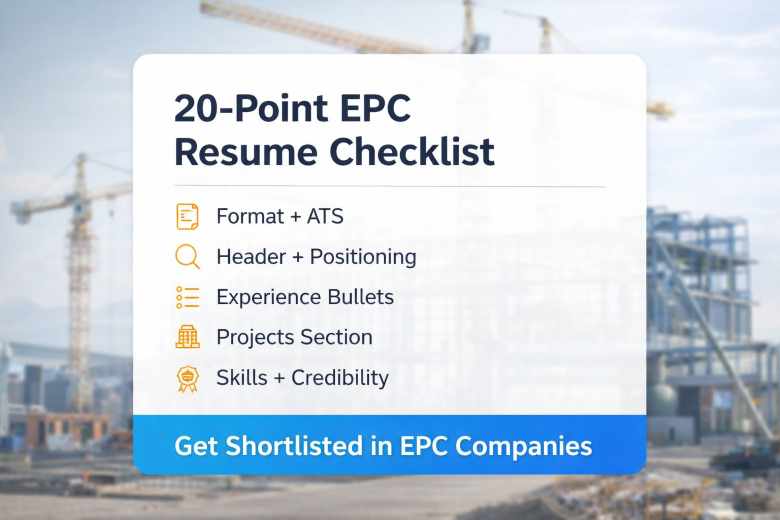
Whether you’re a planning engineer, QS, QA/QC inspector, site engineer, or HSE officer — this 20-point EPC resume checklist will help you build a resume that gets past ATS filters and into the shortlist pile.
Save this. Bookmark it. Use it before every application.
Table of Contents
Why EPC Resumes Get Rejected (In 20 Seconds)
Most EPC resumes fail the initial screening for three simple reasons:
- No numbers — No project value, no quantities, no scale. Recruiters can’t gauge your level.
- No package ownership — It’s unclear what you personally handled vs. what the team did.
- No EPC keywords or tools — The ATS (Applicant Tracking System) can’t match your resume to the job description.
If your resume has even one of these problems, it’s likely getting filtered out — before a human ever reads it. That’s why understanding what recruiters actually look for in construction resumes is so critical.
The EPC Resume Gold Formula (Copy This)
Every bullet on your EPC resume should follow this proven structure:
Action → Scope → Scale → Result
Example:
“Planned weekly updates in Primavera P6 for ₹120Cr high-rise project; improved schedule visibility and reduced slippages by 12%.”
This single bullet tells the recruiter your tool (P6), your domain (high-rise), the project value (₹120Cr), and your result (12% fewer slippages). That’s what gets shortlisted.
Don’t send another generic CV—craft a data-driven, EPC-ready resume with Resume Lab at ConstructionCareerHub.com.
Need more examples? Here are 50+ real achievement examples by construction role to help you quantify your bullets.
Now, let’s go through the full 20-point checklist.
Section A — Format + ATS (Must-Pass Filter)
Before your content matters, your resume has to survive the ATS. Most top EPC companies in India and the GCC use ATS software to screen resumes automatically. Here’s how to pass:
1. Use a Single-Column Layout
ATS software reads left to right, top to bottom. Two-column layouts, tables, and text boxes confuse parsers and cause your content to get scrambled or skipped entirely. Stick to a clean, single-column format.
2. Use Standard Section Headings
Don’t get creative with section names. Use the headings that ATS software recognizes: Summary, Experience, Projects, Skills, Education, Certifications.
3. Choose a Readable Font (10–11pt)
Arial, Calibri, or Times New Roman at 10–11pt. Clean spacing. No fancy design elements that break parsing.
4. Avoid Photos, Icons, and Graphics
Progress bars, skill charts, icons, and photos look nice to humans but are invisible (or confusing) to ATS software. Remove them all.
5. Do the Notepad Test
Export your resume as a PDF, then copy-paste the text into Notepad. If it breaks, garbles, or loses structure — the ATS will break too. Fix it before applying. For a detailed walkthrough, check our guide on how to create an ATS-compliant resume.
6. Follow the Length Rule
Keep it tight:
- 0–5 years experience: 1 page maximum
- 6–15 years experience: 2 pages (only if the content is strong and project-rich)
Section B — Header + Positioning (Make Yourself Searchable)
Your resume header is your search engine. It decides whether recruiters find you — and whether they keep reading.
7. Write a Title Line That Includes Role + Domain + Tool
Instead of just “Civil Engineer,” write something like:
Planning Engineer (Primavera P6) | High-rise + Industrial | Billing + DPR
This tells the ATS and the recruiter exactly what you do, what domain you work in, and what tools you use — all in one line.
8. Mention Location + Mobility
Only if it’s true, add your willingness to relocate:
Open to PAN India / GCC
This is especially important for EPC roles where site postings are in remote or international locations.
9. Write a 3-Line Summary
Your summary should cover three things in three lines:
- Line 1: Years of experience + domain focus
- Line 2: Key packages handled
- Line 3: Your best proof point (a number)
10. Add a “Core Skills / Keywords” Section
List 10–14 keywords aligned with the job description. This is where ATS matching happens. For a deeper breakdown of how to write this section, read our complete construction resume writing guide.
Section C — Experience Bullets (Where Shortlisting Happens)
This is the section where EPC recruiters spend the most time — and where most candidates lose.
11. Start Every Bullet With a Strong Action Verb
Use verbs like: Executed, Coordinated, Verified, Certified, Optimized, Managed, Delivered, Tracked, Monitored, Reviewed.
Never start with “Responsible for” or “Involved in.”
12. Put At Least 1 Metric in Every Bullet
Include ₹ value, m³, MT, km, floors, MW, MLD, duration, or percentage. Numbers are the single biggest differentiator on EPC resumes.
13. Replace “Responsible For” With Outcomes
❌ Bad: “Responsible for billing”
✅ Good: “Prepared RA bills and reconciliation for ₹85Cr highway package; reduced billing delays by 7 days through tighter measurement tracking.”
14. Use Authentic EPC Language
Include only the terminology you’ve genuinely worked with: WBS, BOQ, RA Bills, MIR/WIR, ITP/QCP, RFI, DPR, BBS, reconciliation, snag/punch list, NCR closure.
15. Clarify YOUR Role vs. the Team’s
Use ownership verbs: “Led / Owned / Prepared / Reviewed / Coordinated.” Avoid vague phrases like “was part of” or “involved in” — recruiters need to know what you did.
Section D — Projects Section (EPC Loves Project Clarity)
EPC recruiters don’t just evaluate your role — they evaluate your projects. This section can make or break your resume.
16. Add a “Project Snapshot” for Each Major Project
Use a simple one-liner format for quick scanning:
Project Name | Client | Location | Value (₹Cr) | Duration | Package | Your Role
17. Show Package Ownership Clearly
Recruiters want to know exactly which packages you’ve handled. Be specific:
- Civil: RCC, shuttering/formwork, rebar, finishing, waterproofing
- Infra: Earthwork, GSB/WMM, DBM/BC, bridges, culverts
- MEP: HVAC, firefighting, plumbing, electrical, ELV, BMS
18. Mention Tools Used Per Project
Don’t just list tools at the bottom of your resume — tie them to specific projects: Primavera P6, MS Project, AutoCAD, Revit/Navisworks, Excel billing trackers, QA checklists, safety management systems, etc.
Section E — Skills + Credibility (Prove You’re Deployable)
This is your proof section. It tells recruiters you’re ready to be deployed on-site — not just trained.
19. Write Software Skills With Use Cases
Don’t just list software names. Show how you used them:
- “Primavera P6 (baseline, updates, lookahead, S-curves, reports)”
- “Excel (pivot tables, reconciliation, trackers, dashboards)”
- “AutoCAD (shop drawings, as-built, layout verification)”
20. Add Only Relevant Certifications
Include certifications that EPC recruiters value: NEBOSH/IOSH (for HSE roles), Primavera P6, PMP, QA/QC Lead Auditor, Revit/BIM, STAAD Pro, etc.
If you’re a fresher building your first resume, our free resume formats for engineering freshers can help you get started with the right structure.
Bonus: EPC Keyword Bank (Steal Responsibly)
Use these keywords in your resume — but only the ones you’ve actually worked with. Copy-pasting keywords you can’t defend in an interview will backfire.
Planning: WBS, baseline, lookahead, S-curve, catch-up plan, delay analysis, critical path, resource loading
QS / Billing: BOQ, RA bills, reconciliation, variation, measurement, rate analysis, interim payment certificate, final account
QA / QC: ITP, MIR, WIR, NCR, snagging, audits, test reports, method statement, material approval
Execution: Formwork, rebar, concreting, finishing, waterproofing, coordination, subcontractor management, daily progress
HSE: PTW, toolbox talk, JSA/JHA, audits, incident reporting, emergency preparedness, HIRA, near-miss reporting
Upgrade your resume the smart way with Resume Lab on ConstructionCareerHub.com and improve your chances of selection.
3 Free Tools to Use Before You Apply
Don’t send out your next application without running it through these tools first:
① Quantify Your Bullets
Struggling to add numbers to your experience? Use our ready-made library of 50+ real construction achievement examples by role to turn generic duties into powerful, metric-driven bullets.
② Build a Clean, ATS-Friendly Resume
Start from scratch with our free construction resume builder. It gives you an ATS-safe format that’s already structured for EPC roles.
③ Customize Your Resume for Any JD
Match your resume to specific job descriptions using our AI-powered Resume Customizer. It identifies missing ATS keywords and suggests tailoring improvements.
More Useful Resources
- How to Write a Civil Engineering Resume
- Complete Guide to ATS-Compliant Resumes
- Construction Resume Writing Guide
- Free Resume Formats for Engineering Freshers
Frequently Asked Questions
What is the best resume format for EPC companies?
The best resume format for EPC companies is a single-column, ATS-friendly layout with clear sections: Summary, Experience (with project-specific bullets), Projects (with value, location, and package details), Skills, Education, and Certifications. Avoid graphics, tables, and two-column designs. Use the Action → Scope → Scale → Result formula for every experience bullet.
How long should an EPC resume be?
If you have 0–5 years of experience, keep your EPC resume to 1 page. For 6–15 years, 2 pages is acceptable — but only if every line adds value. Anything beyond 2 pages is generally too long for EPC recruiters who screen hundreds of resumes per role.
What keywords should I include in a construction resume for EPC jobs?
Include role-specific EPC keywords like WBS, BOQ, RA Bills, ITP, MIR/WIR, NCR, DPR, Primavera P6, S-curve, lookahead, method statement, and reconciliation. Only include keywords for tools and processes you’ve actually used — recruiters will verify these during interviews.
How do I quantify achievements on an EPC resume?
Add at least one metric to every bullet point: project value in ₹Cr, quantities in m³/MT/km, number of floors or MW, time saved in days/weeks, or percentage improvements. For example, instead of “handled billing,” write “prepared RA bills for ₹200Cr highway project; reduced billing cycle by 10 days.” Need more examples? Check our construction achievement examples guide.
Should I use Primavera P6 on my resume even if I only have basic knowledge?
Only list Primavera P6 (or any tool) if you can confidently discuss it in an interview. Instead of just writing “Primavera P6,” specify your actual usage level: “Primavera P6 (baseline creation, weekly updates, lookahead scheduling)” so the recruiter knows your depth.
Do EPC companies in India and the Gulf use ATS software?
Yes. Most large EPC contractors including L&T, Tata Projects, Shapoorji Pallonji, Petrofac, Samsung Engineering, and others use ATS platforms to screen resumes. If your resume isn’t ATS-optimized, it may never reach a human recruiter. Learn how to make yours compliant with our ATS resume guide.
If you’re serious about getting shortlisted in EPC companies, build and optimize your resume today with Resume Lab at ConstructionCareerHub.com.
Related Posts:
- The Ultimate Guide to EPC Contractors: Meaning, Role, and How They Shape Modern Construction
- EPC Professionals in Demand: Top Construction Career Opportunities & Tips
