

Last Updated on March 26, 2026 by Admin
Planning to work on a construction site in Britain? You will need a CSCS card UK — the industry-standard proof that you hold the right qualifications and health and safety training for your role. In 2026, virtually every major contractor requires one for site entry. This complete guide explains all 13 CSCS card types, the CITB HS&E test you must pass, current costs, and the exact step-by-step process for foreign engineers to apply using overseas qualifications. Whether you are a graduate engineer or a chartered professional, start here.
ConstructionCareerHub App is LIVE — built ONLY for construction careers. Don’t apply with a weak resume.
Get ATS-ready Resume Lab + Interview Copilot + Campus Placement Prep (resume screening, skill gaps, interview readiness) — in minutes & Other advanced features.
Explore Smarter Construction Career Tools →Quick check. Big impact. Start now.
Table of Contents
What Is the CSCS Card?
The Construction Skills Certification Scheme (CSCS) card is the recognised standard for proving occupational competence across construction sites in the United Kingdom. Managed by CSCS Ltd and supported by the Construction Industry Training Board (CITB), this card confirms that the holder possesses the right qualifications, training, and health and safety knowledge for their specific on-site role.
While carrying a CSCS card is not a legal requirement under UK law, the reality in 2026 is straightforward: virtually every major contractor, principal contractor, and client organisation requires every person on site — from labourers to chartered engineers — to hold a valid CSCS card as a condition of entry. The scheme, established in 1995, now covers over 2.3 million active cardholders across Britain.
For foreign engineers planning to work in UK construction, understanding the CSCS system is not optional. Without the correct card, you will almost certainly be refused site access, regardless of your qualifications or experience from your home country.
This guide covers every card type available in 2026, the tests you must pass, how overseas qualifications are verified, and the step-by-step application process for international engineers and construction professionals.
Why Every Construction Worker in the UK Needs a CSCS Card
The CSCS card serves as an industry-wide trust signal. When a site manager or security team checks your card, they are confirming three things: you hold a recognised qualification for your role, you understand UK health and safety standards, and your credentials have been independently verified.
For foreign engineers, the card carries additional weight. UK employers and clients use the CSCS scheme to ensure that international qualifications meet the same occupational standards applied to domestic workers. This protects both the individual and the wider workforce on site.
Key reasons the CSCS card matters in 2026:
- Site access: Major contractors including Balfour Beatty, Laing O’Rourke, Skanska UK, and Kier Group mandate CSCS cards for all personnel on their projects.
- Career progression: The card acts as a visible marker of your competence level, from entry-level labourer through to chartered professional. Upgrading your card as you gain qualifications is part of the UK construction career ladder.
- Legal and insurance compliance: While not legally mandated, the Health and Safety Executive (HSE) recognises the CSCS scheme as best practice, and many insurance policies for construction projects require cardholders.
- Employer confidence: Holding the correct CSCS card demonstrates to UK employers that your skills have been verified to a national standard, making you a more attractive candidate — particularly if your qualifications are from outside the UK.
If you are exploring UK construction careers, also see our guide on finding construction jobs in the UK with visa sponsorship.
Types of CSCS Cards in 2026: Complete Colour-Coded Guide
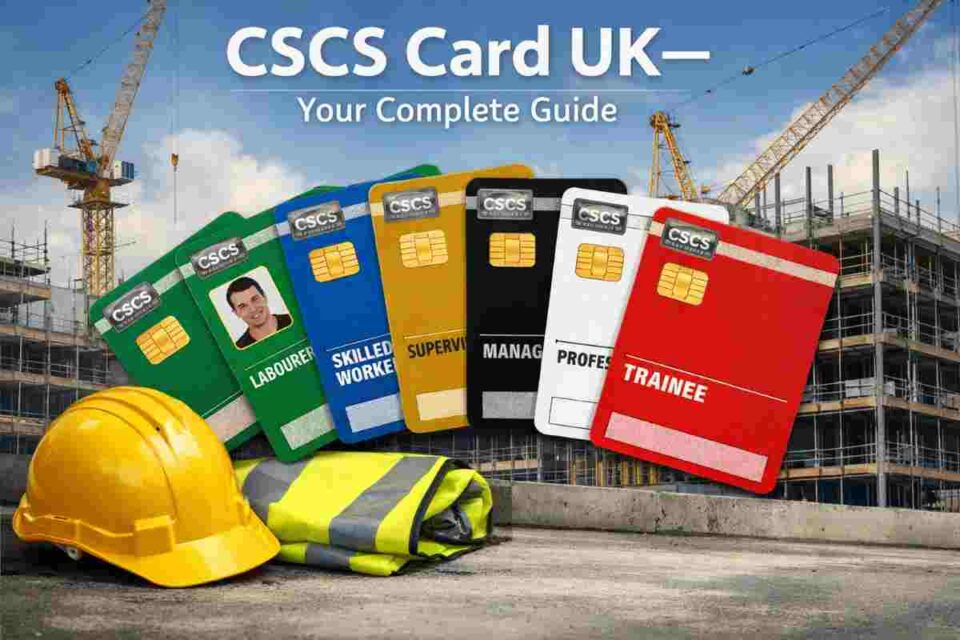
The CSCS scheme uses a colour-coded card system, where each colour corresponds to a specific level of qualification, experience, or professional standing. There are 13 card types across seven colours. Holding the wrong card for your role can result in site refusal, so identifying the correct card before applying is essential.
Green Card — Labourer
The Green CSCS card is the entry-level card for general labourers and site operatives. It is the most common starting point for workers new to UK construction.
Requirements: Level 1 Award in Health and Safety in a Construction Environment (or an approved alternative) plus a pass in the CITB Operatives HS&E test.
Validity: 2 years on first issue (changed from February 2025). Renewals are for 5 years.
Who it’s for: General labourers, cleaners working on live construction sites, and those starting out in the industry. Do not apply for this card if you work in a skilled occupation.
Blue Card — Skilled Worker
The Blue card is the target card for most tradespeople — bricklayers, carpenters, electricians, plumbers, plasterers, and other skilled trades. Engineers with an NVQ Level 2 in a construction-related discipline also fall into this category.
Requirements: A relevant NVQ/SVQ Level 2 (or approved equivalent) plus a pass in the CITB Operatives or Specialists HS&E test.
Validity: 5 years, renewable.
Gold Card — Advanced Craft / Supervisor
The Gold card has two distinct versions:
- Advanced Craft: For highly skilled tradespeople with NVQ/SVQ Level 3 in their trade.
- Supervisor: For site supervisors and technical roles requiring NVQ/SVQ Level 3 or 4 in a supervisory discipline.
Requirements: NVQ/SVQ Level 3 or above plus a valid Operatives (for craft) or MAP test pass (for supervisory roles).
Validity: 5 years.
Black Card — Manager
The Black card is the highest-level card in the CSCS hierarchy, reserved for construction managers and senior technical professionals.
Requirements: NVQ/SVQ Level 5, 6, or 7 in a construction management discipline plus the MAP (Managers and Professionals) HS&E test.
Validity: 5 years.
This card is particularly relevant for foreign engineers moving into senior project management or construction management roles in the UK. For career context, see our construction management career guide.
White Card — Academically Qualified Person (AQP)
The White AQP card is designed for holders of construction-related academic qualifications — Bachelor’s degrees, Master’s degrees, HNDs, HNCs, CIOB Certificates, and NEBOSH Diplomas.
Requirements: A recognised construction-related academic qualification plus the MAP HS&E test.
Validity: 5 years.
Important for foreign engineers: If you hold a civil engineering, structural engineering, or construction management degree from your home country, the White AQP card is often the most relevant option. However, your overseas degree must first be verified through the Ecctis Industry Skills Statement process (explained below).
White Card — Professionally Qualified Person (PQP)
The White PQP card is for members of CSCS-approved professional bodies. These bodies assess competence as part of their membership process, which CSCS recognises as equivalent to holding a qualification.
Approved professional bodies include: ICE (Institution of Civil Engineers), CIOB (Chartered Institute of Building), RICS (Royal Institution of Chartered Surveyors), RIBA (Royal Institute of British Architects), IStructE (Institution of Structural Engineers), and CABE (Chartered Association of Building Engineers), among others.
Requirements: Current, paid-up membership of a CSCS-approved professional body plus the MAP HS&E test.
Validity: 5 years.
If you are a chartered engineer or hold membership of an international professional body that has a reciprocal agreement with a UK body, this route may be the fastest path to a CSCS card.
Red Cards — Trainee, Apprentice, and Experienced Worker
The CSCS scheme offers several red entry-level cards:
- Apprentice Card: Free of charge for individuals on recognised construction apprenticeships.
- Trainee Card: For those registered on a competence-assessed qualification but not yet qualified.
- Experienced Worker Card: For workers with at least one year of on-the-job experience who are working towards a formal qualification.
- Provisional Card: A temporary card for workers going through probationary periods.
Red cards are temporary and cannot be renewed. They are designed as stepping stones towards permanent cards.
Yellow Card — Construction Site Visitor
Note: The yellow visitor card was phased out for non-construction visitors. Visitors engaged in non-construction activities on a site are no longer required to hold a CSCS card.
Quick Reference: CSCS Card Types at a Glance
| Card Colour | Card Type | NVQ Level Required | HS&E Test | Validity |
|---|---|---|---|---|
| Green | Labourer | Level 1 Award | Operatives | 2 years (first), then 5 years |
| Blue | Skilled Worker | NVQ Level 2 | Operatives/Specialists | 5 years |
| Gold | Advanced Craft / Supervisor | NVQ Level 3–4 | Operatives or MAP | 5 years |
| Black | Manager | NVQ Level 5–7 | MAP | 5 years |
| White | AQP (Academic) | Degree / HND / HNC | MAP | 5 years |
| White | PQP (Professional) | Professional body membership | MAP | 5 years |
| Red | Trainee / Apprentice / Experienced Worker | Registered for qualification | Operatives | 1–5 years (temporary) |
Use the official CSCS Card Finder tool to confirm the exact card for your role and qualifications.
CITB Health, Safety and Environment (HS&E) Test: What You Need to Know
Every CSCS card application requires the applicant to pass the relevant CITB Health, Safety and Environment test. This is a computer-based exam taken at a Pearson VUE test centre, with over 150 centres across the UK.
Test Levels
There are three levels of the CITB HS&E test:
1. Operatives Test — For general labourers, tradespeople, and skilled workers applying for Green, Blue, or craft-level Gold cards.
- 50 multiple-choice questions in 45 minutes
- Pass mark: 45 out of 50 (90%)
- Topics: general site safety, health and welfare, manual handling, working at height, hazardous substances, fire prevention, and environmental awareness
2. Specialists Test — For workers in specific trades requiring specialist knowledge (demolition, highway works, plumbing, HVAC, etc.).
- 50 questions in 45 minutes
- Includes trade-specific health and safety scenarios alongside general questions
3. Managers and Professionals (MAP) Test — For managers, supervisors, and professionally or academically qualified persons applying for Black, Gold (Supervisor), or White cards.
- 50 questions in 45 minutes
- Pass mark: 46 out of 50 (92%)
- Topics: CDM 2015 Regulations, legislation, management responsibilities, risk assessment, method statements, and advanced health and safety management
Test Cost and Validity
The CITB HS&E test costs £22.50 and the pass certificate is valid for 2 years. You must apply for your CSCS card within this 2-year window; otherwise, you will need to retake the test. The test can be booked directly through the CITB at citb.co.uk.
Test Preparation Tips for Foreign Engineers
If English is not your first language, the test is also available in several other languages. Check with CITB for the latest language options. Study resources include the official CITB revision materials, the CITB HS&E test app (£6.99), and numerous free CSCS practice test websites. Familiarise yourself specifically with UK-specific legislation such as the Construction (Design and Management) Regulations 2015 (CDM 2015) and the Health and Safety at Work Act 1974, as these are heavily tested.
For broader health and safety career context, review our comparison of NEBOSH vs OSHA certifications.
How to Apply for a CSCS Card as a Foreign Engineer: Step-by-Step
The application process for international engineers involves additional steps compared to UK-based applicants, primarily around qualification verification. Here is the complete process:
Step 1: Identify the Correct CSCS Card for Your Role
Use the CSCS Card Finder tool at cscs.uk.com or call the CSCS helpline (0344 994 4777, Monday to Friday) to determine which card matches your occupation and qualifications. As an engineer with an overseas degree, you will typically be looking at the White AQP card, the White PQP card (if you hold professional body membership), or a Blue/Gold/Black card if your vocational qualification can be mapped to a UK NVQ equivalent.
Step 2: Get Your Overseas Qualification Verified by Ecctis
This is the critical step for foreign applicants. CSCS requires all overseas qualifications to be verified through Ecctis (formerly UK NARIC), which operates the UK ENIC service on behalf of the UK government.
There are two Ecctis services depending on the type of CSCS card you are applying for:
Industry Skills Statement for Academically Qualified Persons (AQP): If you are applying for a White AQP card using an overseas degree (Bachelor’s, Master’s, PhD, HND, or HNC), Ecctis will evaluate and verify your academic qualification against UK standards.
Industry Skills Statement with Skills Mapping: If you are applying for a Blue, Gold, or Black Skilled Worker card using an overseas vocational qualification, Ecctis will map the technical content of your qualification against the relevant UK National Occupational Standard (NOS). This mapping must be verified by CITB before the qualification can be accepted.
Both services include Primary Source Verification (PSV) — Ecctis directly contacts the institution that awarded your qualification to confirm its authenticity. This anti-fraud measure was introduced to bring overseas verification in line with the standards applied to UK-based applications.
What you need to submit to Ecctis:
- Colour photographs of your original qualification certificates
- Certified English translations of all documents not in English
- Details of the awarding institution and the programme completed
- Evidence of practical on-site work completed as part of your qualification (for Skills Mapping applications)
Processing time: Allow several weeks for the Ecctis process, as Primary Source Verification involves international communication with your awarding institution. Plan accordingly.
Exception: If you hold an NVQ/SVQ, Degree, FETAC, or QQI qualification issued in the Republic of Ireland, you can apply directly to CSCS without contacting Ecctis.
Step 3: Pass the Relevant CITB HS&E Test
Book and pass the appropriate level of the CITB HS&E test (Operatives, Specialists, or MAP) at a Pearson VUE test centre. Ensure you complete this within the 2-year validity window of your Ecctis statement.
Step 4: Apply for Your CSCS Card
Applications can be made through the My CSCS app (available on Google Play and the App Store) or via CSCS Online.
Documents required:
- Ecctis Industry Skills Statement (AQP or with Skills Mapping, depending on your card type)
- Primary Source Verification (PSV) Report
- Copy of your original qualification (preferably translated)
- CITB HS&E test pass certificate (test ID number)
- Passport photograph
- Payment of the £36 application fee
Once approved, you can access a digital version of your card immediately through the My CSCS app, while the physical card is typically delivered within 5–10 working days.
Step 5: Professional Body Route (Alternative for Engineers)
If you are a member of an international professional engineering body that has a reciprocal recognition agreement with a UK-based CSCS-approved body, you may be able to apply for a White PQP card without going through the Ecctis qualification verification route.
For example, if you hold chartered membership of the Institution of Civil Engineers (ICE), the Institution of Structural Engineers (IStructE), or the Chartered Institute of Building (CIOB), you can use your professional body membership as the qualification evidence for a White PQP card.
Check whether your home-country professional body has a mutual recognition agreement with a UK body listed on the CSCS approved bodies register.
CSCS Card Costs: Complete Breakdown for 2026
Understanding the full cost of obtaining a CSCS card helps you budget correctly, especially if you are relocating to the UK.
| Cost Component | Amount (£) | Notes |
|---|---|---|
| CSCS Card Application Fee | £36 | Flat rate for all card types |
| CITB HS&E Test | £22.50 | Valid for 2 years |
| Ecctis Industry Skills Statement | Varies (check ecctis.com) | Required for overseas qualifications only |
| Certified Translation of Documents | Varies | Only if documents are not in English |
| NVQ Qualification (if needed) | £1,000–£2,500 | Required for Blue, Gold, Black cards if not already qualified |
| Minimum Total (with overseas degree) | £58.50 + Ecctis fees | Card fee + CITB test |
Apply only through the official CSCS website or My CSCS app to avoid unnecessary third-party fees.
How Long Does It Take to Get a CSCS Card from Overseas?
The timeline for foreign engineers is longer than for UK-based applicants due to the Ecctis verification process.
Typical timeline:
- Ecctis Industry Skills Statement: Several weeks to several months, depending on how quickly your awarding institution responds to the Primary Source Verification request.
- CITB HS&E test booking and preparation: 1–4 weeks (depending on availability at your chosen test centre).
- CSCS card processing: Digital card available immediately upon approval; physical card delivered within 5–10 working days.
Planning tip: Begin the Ecctis process as early as possible — ideally before you travel to the UK. You can complete the Ecctis application from abroad, and then book and sit the CITB HS&E test once you arrive.
Which CSCS Card Should a Foreign Engineer Apply For?
The right card depends on your qualifications and the role you intend to perform on UK construction sites. Here is a decision framework for international engineers:
You hold a construction-related Bachelor’s or Master’s degree: Apply for the White AQP card via the Ecctis AQP route.
You are a chartered member of a CSCS-approved professional body (ICE, CIOB, RICS, RIBA, IStructE, etc.): Apply for the White PQP card using your membership as evidence.
You hold a vocational/trade qualification (equivalent to NVQ Level 2–7): Apply for a Blue, Gold, or Black card via the Ecctis Skills Mapping route.
You have experience but no formal qualifications: Apply for an Experienced Worker (Red) card while you work towards an NVQ through on-site assessment.
You are starting fresh with no UK-recognised qualifications: Consider obtaining the Level 1 Award in Health and Safety in a Construction Environment to get a Green Labourer card as an entry point while you build your UK qualifications.
For more on the qualifications landscape, read our comprehensive guide on what qualifications you need to work in construction.
CSCS Card and UK Construction Salaries: What to Expect
Holding the correct CSCS card is a prerequisite for accessing construction work in the UK, and your card level directly influences the roles — and therefore the salary bands — available to you.
Indicative UK construction salary ranges in 2026:
- General Labourer (Green Card): £25,000–£32,000 per year
- Skilled Tradesperson (Blue Card): £32,000–£48,000 per year
- Site Supervisor (Gold Card): £40,000–£55,000 per year
- Construction Manager (Black Card): £55,000–£85,000+ per year
- Chartered Engineer / Professional (White Card): £45,000–£80,000+ per year
These ranges vary by region, project type, and employer. London and the South East typically pay 10–20% above national averages. For detailed salary data across multiple countries, explore our Construction Salary Guide 2026.
CSCS Card Renewal Process
Most CSCS cards are valid for 5 years (except the Green Labourer card on first issue, which is valid for 2 years). Renewal can be initiated up to 6 months before and up to 6 months after the expiry date.
To renew, you will need to:
- Retake and pass the relevant CITB HS&E test (cost: £22.50)
- Provide evidence that you still hold the qualifications required for your card type
- Pay the £36 renewal fee
If your card expires and you miss the 6-month renewal window, you will need to reapply as a new applicant.
CSCS Smart Check: Digital Verification in 2026
CSCS Smart Check is a free verification tool that allows employers, site managers, and security teams to verify any card displaying the CSCS logo. It is available as a mobile app and via the CSCS website.
For foreign engineers, this means your card is verifiable anywhere in the UK in real time. The My CSCS app also serves as your Digital Skills Passport, storing your CSCS card, qualifications, and training records in one place.
Common Mistakes Foreign Engineers Make When Applying for a CSCS Card
- Applying for the wrong card type: Always use the Card Finder tool before applying. Holding the wrong card can lead to site refusal.
- Skipping the Ecctis verification: CSCS will not accept overseas qualifications without a valid Ecctis Industry Skills Statement and PSV report.
- Waiting until arrival in the UK to start the process: The Ecctis verification can take weeks or months. Begin this process from your home country.
- Letting the CITB test expire: Your HS&E test pass is only valid for 2 years. If your Ecctis process takes longer than expected, you may need to retake the test.
- Using third-party application services: Apply directly through cscs.uk.com or the My CSCS app. Third-party services charge unnecessary additional fees for the same process.
- Not having documents translated: All documents submitted to Ecctis must be in English. Use a certified translation service.
Career Resources for Engineers Moving to UK Construction
Transitioning to UK construction as an international professional requires preparation beyond just the CSCS card. Here are resources to help you succeed:
Build your UK-ready CV and interview skills: Use the ConstructionCareerHub platform for AI-powered resume building (Resume Lab), interview practice (Interview Copilot), and salary benchmarking (Salary Calculator) — all built specifically for construction professionals.
Find UK construction recruitment agencies: Our guides to top construction recruitment agencies in London and top construction recruitment agencies in the UK list verified agencies specialising in construction hiring.
Understand UK construction job roles: Review our complete list of job profiles in the construction industry and the construction project engineer job description for role-specific guidance.
Explore the wider UK and global job market: Browse our curated list of top construction job websites and job boards to start your job search.
Plan your career progression: Read our guides on best construction careers for beginners and highest-paying construction jobs for long-term career planning.
Recommended Courses for CSCS Preparation and UK Construction Careers
Investing in recognised courses strengthens both your CSCS application and your overall employability in UK construction:
- Construction Management Specialisation — Columbia University (Coursera)
- Construction Management Professional Certificate — University of Maryland (edX)
- Health and Safety in Construction courses (Udemy)
Recommended eBooks from ConstructionPlacements
For detailed guidance on building your construction career internationally, explore these resources from our eBook store:
- Construction Career Launchpad eBook — Comprehensive guide to breaking into high-value construction roles
- The Remote Job Hunting System — Step-by-step system for landing construction and engineering jobs abroad
- India-to-Gulf Construction Career Kit — Visa checklists, ATS resumes, salary data, and 60+ interview Q&A
Browse the complete collection at digitslick.gumroad.com.
Frequently Asked Questions (FAQ)
Is a CSCS card legally required to work on UK construction sites?
No, holding a CSCS card is not a legal requirement. However, the vast majority of UK construction sites — including all major contractor sites — require a valid CSCS card as a condition of entry. In practice, you will be unable to work on most sites without one.
Can I get a CSCS card with a foreign engineering degree?
Yes. You will need to get your overseas qualification verified through Ecctis, which will issue an Industry Skills Statement confirming its equivalence to a UK qualification. You will also need to pass the relevant CITB HS&E test. Most foreign engineers with a construction-related degree will qualify for a White Academically Qualified Person (AQP) card.
How much does a CSCS card cost in 2026?
The CSCS card application fee is £36 for all card types. The CITB HS&E test costs £22.50. Foreign engineers will also need to pay for the Ecctis Industry Skills Statement and any required document translations. The minimum total for the card and test is £58.50 plus Ecctis fees.
How long does the Ecctis overseas qualification verification take?
Processing times vary depending on how quickly your awarding institution responds to Ecctis’s Primary Source Verification enquiry. Allow several weeks to a few months. It is advisable to begin this process well before you plan to start working in the UK.
What is the difference between the Operatives test and the MAP test?
The Operatives HS&E test is for general labourers and tradespeople (pass mark: 45/50). The MAP test is for managers, supervisors, and professionals, with harder questions on CDM 2015, legislation, and management responsibilities (pass mark: 46/50). Both cost £22.50 and consist of 50 questions in 45 minutes.
Can I apply for a CSCS card before arriving in the UK?
You can begin the Ecctis qualification verification from abroad. However, the CITB HS&E test must be taken at a Pearson VUE test centre in the UK. You cannot complete the full application until you have both your Ecctis statement and your CITB test pass.
What professional bodies are approved by CSCS for the White PQP card?
CSCS-approved professional bodies include ICE (Institution of Civil Engineers), CIOB (Chartered Institute of Building), RICS (Royal Institution of Chartered Surveyors), RIBA (Royal Institute of British Architects), IStructE (Institution of Structural Engineers), CABE, and several others. Full list available on the CSCS website.
What happens if my CSCS card expires?
You can renew up to 6 months before or after the expiry date. You will need to retake the CITB HS&E test and pay the £36 renewal fee. If you miss the 6-month grace period, you must reapply as a new applicant.
Do I need a CSCS card if I work in an office and rarely visit construction sites?
If you are office-based and do not regularly visit live construction sites, you are generally not expected to hold a CSCS card. However, if your role involves any site visits, having the appropriate card ensures you will not be denied access.
Can my employer apply for my CSCS card on my behalf?
Yes. Employers and training providers can apply for CSCS cards on behalf of their workforce through CSCS Online using an employer account.
This article was written by the editorial team at ConstructionPlacements.com to provide authoritative, practical guidance for construction professionals worldwide. For the latest UK construction career opportunities, tools, and resources, visit www.constructionplacements.com and www.constructioncareerhub.com.
