

Last Updated on December 1, 2025 by Admin
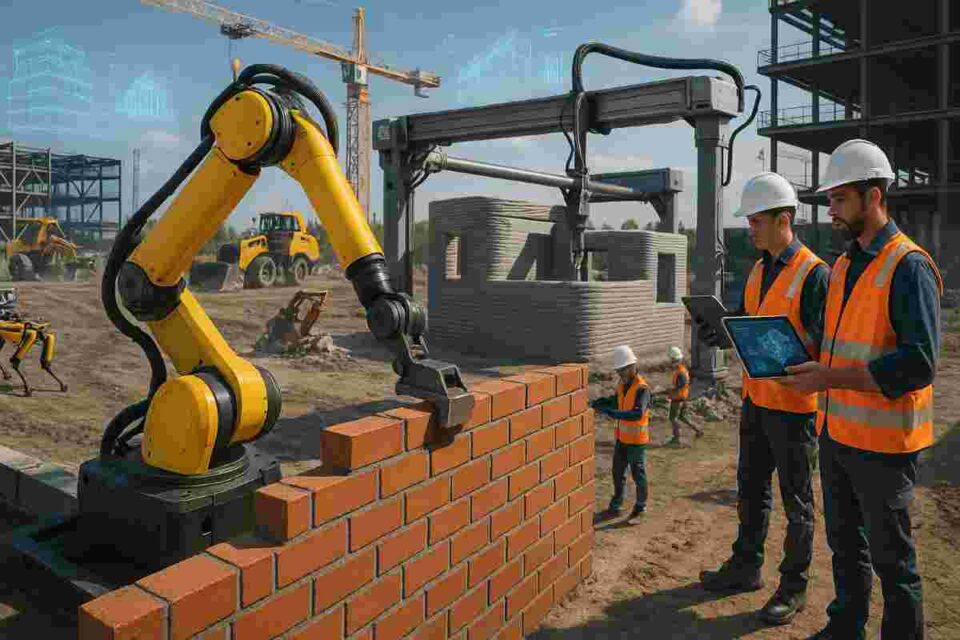
The construction industry is undergoing a revolutionary transformation as leading construction robotics companies deploy autonomous machines, 3D printers, and AI-powered equipment on jobsites worldwide. From Boston Dynamics’ intelligent surveillance robots to ICON’s neighborhood-scale 3D printing systems, these 15 pioneering firms are addressing critical challenges, including labor shortages, safety concerns, and productivity gaps. Construction robotics now encompasses everything from robotic bricklayers laying 1,000 bricks hourly to autonomous bulldozers operating 24/7, fundamentally reshaping how we build. This comprehensive guide profiles the industry’s most innovative construction automation firms, transforming traditional building methods into high-tech, efficient operations.
Table of Contents
Top 15 Construction Robotics Companies
The construction industry is undergoing a high-tech transformation as robots take on tasks once done solely by human hands. From autonomous machines on jobsites to 3D printers erecting buildings, construction robotics are boosting productivity, improving safety, and helping to tackle labor shortages.
Below, we profile 15 leading companies around the world that are driving this robotics revolution in construction. Each is pushing the boundaries in their domain – whether it’s bricklaying, 3D printing, demolition, earthmoving, layout, or finishing – and collectively they are reshaping how we build.
Practice 15+ AI-generated technical and HR interview questions for Civil, BIM, QS, Planning, HSE and Construction roles. Get instant feedback, improved answers, a 7-day improvement plan, and a full PDF report. Designed exclusively for construction professionals.
One free full interview session included. No credit card required.
1. Boston Dynamics – Autonomous Jobsite Surveillance and Inspection
Boston Dynamics is famous for its agile robots, and its quadruped robot Spot is finding a niche on construction sites. Spot can autonomously navigate through dynamic construction environments, carrying cameras and laser scanners to capture 360° imagery and 3D scans of progress. Contractors like Hensel Phelps and Skanska have deployed Spot to perform routine site patrols, document work, and compare as-built conditions to BIM models.
Using the SpotWalk integration, the four-legged robot can traverse a jobsite along a preset route and take high-fidelity photos or laser scans at designated points, creating a digital record of construction progress.
This offloads a tedious task from personnel and allows data to be captured more frequently (even multiple times per day) than human crews typically would. By automating reality capture, Spot provides real-time insights for project managers and improves safety by reducing the need for workers to enter hazardous or hard-to-access areas.
Boston Dynamics is also known for its humanoid Atlas robot (an R&D project adept at climbing and other feats), but Spot is the company’s commercial workhorse in construction, delivering comprehensive job site visibility to act as the eyes and ears of site supervisors. In short, Boston Dynamics has brought sci-fi robotics to real-world construction sites – and it’s making them safer and more data-driven.
2. Built Robotics – Autonomy for Heavy Equipment

Built Robotics (USA) focuses on turning existing heavy machinery into autonomous robots for earthmoving and excavation. Its Exosystem kit retrofits standard construction equipment – like excavators and bulldozers – with GPS, LiDAR, and AI-powered controls so they can dig, grade, and move earth with minimal human input.
In practice, a contractor can outfit a dozer or skid-steer with Built’s system and have it operate 24/7 on repetitive tasks such as trenching or grading, supervised remotely by a human operator.
This automation technology dramatically increases equipment utilization and addresses skilled operator shortages by allowing one person to oversee multiple machines. Built Robotics’ autonomous machines have been used on infrastructure and energy projects, enabling work in remote or hazardous locations while keeping people out of harm’s way.
A testament to their innovation is the RPD 35 robot – a fully autonomous robotic pile driver for solar farms. Launched in 2023, RPD 35 combines surveying, pile placement, driving, and verification into one robotic system.
A two-person crew can install over 300 solar foundation piles a day with RPD 35, achieving up to 5× the productivity of traditional methods. Built Robotics’ breakthroughs in autonomous heavy equipment are not only speeding up construction but also making sites safer and more efficient by letting machines handle the “dirty and dull” earthwork around the clock.
3. ICON – 3D Printing Entire Communities of Homes
ICON (USA) has become a poster child for construction 3D printing. The Texas-based startup builds large-scale robotic 3D printers (called the Vulcan) that extrude layers of concrete to form walls of houses and other structures. ICON’s technology can print the envelope of a house directly from a digital model, drastically reducing manual labor and construction time.
In 2022–2023, ICON made headlines by 3D-printing an entire 100-home neighborhood (the world’s largest 3D-printed community) in Georgetown, Texas. The massive Vulcan printer – 46 feet wide and weighing over 4.7 tons – pipes out a proprietary concrete mix layer by layer to build each home’s walls. Compared to traditional methods, ICON says this approach is faster, uses fewer workers, and generates less waste.
In fact, one robot and a small crew can replace several trade crews that would normally frame and finish walls. The single-story homes (3–4 bedrooms) in the Georgetown project each took about three weeks of printing time, and the printed concrete walls are water- and mold-resistant and extremely sturdy.
ICON has proven its tech in the field: it previously built small home communities for the homeless and printed military barracks, and its houses have survived extreme weather.
Beyond Earth, ICON has even been awarded a NASA contract to develop a system for 3D-printing lunar habitats and landing pads on the Moon. By scaling up 3D printing, ICON is demonstrating a new paradigm of “printing” housing on-demand – potentially cutting construction costs and addressing housing shortages in the future.
4. Apis Cor – Guinness Record 3D Printer and Space Habitat Vision
Apis Cor (USA) is another trailblazer in 3D-printing construction. Apis Cor’s claim to fame is holding the Guinness World Record for the largest 3D-printed building on Earth – achieved with a two-story municipal office building it printed in Dubai in 2019. The company builds a mobile 3D printer that operates within the footprint of the structure, using a robotic arm to extrude concrete walls.
Apis Cor’s technology impressed industry observers when it 3D-printed a small house in just 24 hours in early demonstrations, and it has since printed larger commercial structures. The startup has garnered top honors in NASA’s 3D-Printed Habitat Challenge, having won multiple phases of the competition for its innovative approach to off-world construction.
This space-angle isn’t just for bragging rights – Apis Cor is adapting its system to one day print habitats on Mars or the Moon. Back on Earth, Apis Cor received a strategic investment from the largest U.S. homebuilder, D.R. Horton, to collaborate on building 3D-printed homes in Florida. The partnership underscores the industry’s interest in printing technology to boost housing production.
Apis Cor’s printers (nicknamed “Frank”) are designed to be easily transportable and operated by a small crew, making the tech accessible to regular homebuilders.
By automating the construction of entire building shells, Apis Cor aims to dramatically improve productivity and reduce the need for scarce labor in the homebuilding sector. With a Guinness World Record under its belt and an eye toward extraterrestrial construction, Apis Cor is a standout leader in robotic construction printing.
5. FBR (Fastbrick Robotics) – Automated Bricklaying at Unprecedented Speed

Fastbrick Robotics (FBR) from Australia has developed the Hadrian X, a truck-mounted robotic bricklaying system poised to revolutionize masonry. Hadrian X is essentially a boom arm on a heavy truck that precisely lays bricks (or blocks) in sequence, guided by a CAD model. The robot uses a specialized adhesive instead of mortar, allowing continuous operation without waiting for mortar to set.
FBR’s creation can lay bricks at astonishing speeds – up to 1,000 bricks per hour under optimal conditions. In a 2018 pilot, Hadrian X built a three-bedroom, two-bathroom house structure in under three days, working autonomously from foundation to finished brick shell. It precisely cuts bricks as needed and places them with millimeter accuracy, thanks to a Dynamic Stabilisation Technology (DST) that accounts for environmental factors like wind or vibration.
By operating 24/7, one Hadrian X unit can do the brickwork of a small army of masons, which is why FBR has attracted interest globally – including a partnership with Saudi Arabia to potentially build tens of thousands of homes using robotic bricklayers. Caterpillar Inc. even invested in FBR, seeing its potential to automate a traditionally labor-intensive trade.
The Hadrian X represents a major innovation for the masonry field: it performs consistent, fast bricklaying with minimal waste, addressing skilled labor shortages and delivering building shells in a fraction of the normal time. As FBR continues to refine the tech (it launched a next-gen version in 2020 and piloted U.S. projects in 2025), the company is truly “building the future” one brick at a time – via robot.
6. Construction Robotics – Robotic Masons and Lifting Assistants
Construction Robotics (USA) lives up to its straightforward name with two flagship products automating masonry tasks. The first is SAM100 (Semi-Automated Mason), a robotic bricklaying machine for onsite masonry. SAM100 works alongside masons, picking bricks, applying mortar, and placing them in position on the wall. It can lay bricks much faster than humans and with great precision.
According to industry reports, one SAM100 unit can do the work of about six skilled masons, doubling the speed of brick installation while cutting costs in half. This was demonstrated on real projects – SAM has been used to build walls on schools and office buildings, handling the repetitive laying while masons handle setup and finishing.
The second key product is MULE (Material Unit Lift Enhancer), essentially a robotic lift assist for handling heavy materials. MULE can grab and lift blocks or other material (up to 135 kg / 300 lbs) and hold them in place, acting like a portable robotic crane for individual pieces.
This greatly reduces strain on workers and allows one person to set large blocks or panels that would normally require a team. MULE can be mounted or stationed in hazardous or hard-to-reach areas to aid construction in those environments.
By automating bricklaying and heavy lifting, Construction Robotics targets two of the most labor-intensive aspects of building. Notably, their SAM robot has been on the market since the mid-2010s – making Construction Robotics one of the early pioneers successfully putting robotics on jobsites.
Their solutions improve productivity and also extend the careers of tradespeople by reducing repetitive strain and injury. For an industry under pressure to do more with less labor, Construction Robotics is providing practical, field-tested answers.
7. Advanced Construction Robotics (ACR) – Robots Tying Rebar and Reinforcing Bridges
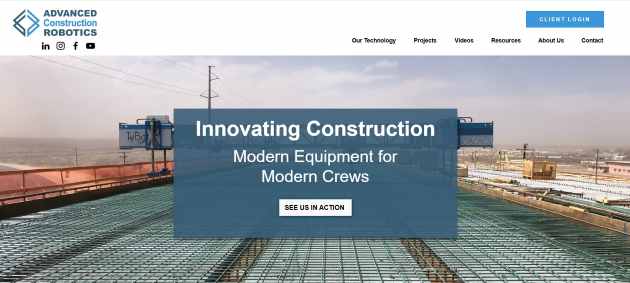
Advanced Construction Robotics (ACR) (USA) specializes in automating the installation of reinforcing steel on heavy civil projects. ACR’s TyBot is an autonomous rebar-tying robot that has been deployed on bridge deck and road projects to handle the repetitive task of tying intersections of rebar. TyBot uses computer vision to locate rebar junctions and a robotic arm to twist tie wire around them – all without direct human control once it’s set up.
This robot can perform approximately 1,000 ties per hour, doing the work at a speed equivalent to a crew of 6–8 ironworkers. In real-world use, TyBot has completed nearly 18,000 ties in a couple of shifts, dramatically accelerating what is normally a slow, laborious process. According to ACR, contractors have seen about an 8× reduction in the time required for rebar tying on large projects.
Importantly, TyBot also improves safety – it takes workers out of the tedious and posture-damaging job of bent-over rebar tying, cutting labor hours in hazardous positions by up to 70%. Building on TyBot’s success, ACR introduced IronBot, a complementary robot that automatically picks, carries, and places heavy rebar rods into position on bridge decks. IronBot handles the strenuous material placement so that TyBot can then tie the bars.
This tandem approach automates a large swath of the rebar installation process. Together, TyBot and IronBot can save contractors significant time and labor costs, especially on infrastructure projects where miles of rebar must be installed. By focusing on this niche, Advanced Construction Robotics has quickly proven that robots can excel at dull, repetitive structural tasks, delivering productivity gains and keeping workers safer.
8. Dusty Robotics – Robot Layout Automation for Precise Floor Plans
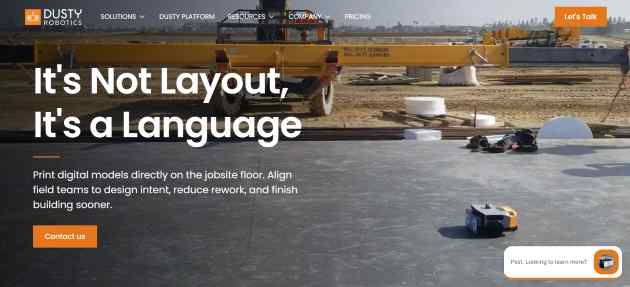
Dusty Robotics (USA) brings automation to one of the first steps of construction: the layout. Dusty’s FieldPrinter robot is essentially a small cart-mounted robot that prints full-size floor plan markings directly onto concrete slabs. Instead of crews pulling tape measures and snapping chalk lines for walls, partitions, and MEP penetrations, Dusty’s robot rolls around and ink-prints the layout from the BIM design with millimeter precision.
The Dusty Robotics system takes digital CAD/BIM files and translates them into accurate markings on site – whether it’s wall locations, door openings, or electrical and plumbing points. This eliminates manual measuring errors and speeds up the layout process tremendously. Contractors who’ve used Dusty report significantly fewer rework incidents because the layout is “right the first time” and always up-to-date with the design model.
According to industry coverage, Dusty’s FieldPrinter can cut layout labor by days: what might take a crew a full day or more to mark out can be done by the robot in a matter of hours, and it often reduces total layout time by 50–70% on complex projects. The robot’s printed lines are also easier for all trades to read and understand, improving coordination.
As the robot operates, it continuously self-corrects and learns, further improving accuracy over time. By syncing directly with BIM plans, any design changes can be reprinted quickly, ensuring the field is always building off the latest information. In sum, Dusty Robotics is automating a critical but tedious task in construction – bringing digital precision to the field layout. This not only saves time but also prevents costly mistakes downstream, making the entire construction process more efficient.
9. Hilti (Jaibot) – Overhead Drilling Robot Boosting MEP Productivity
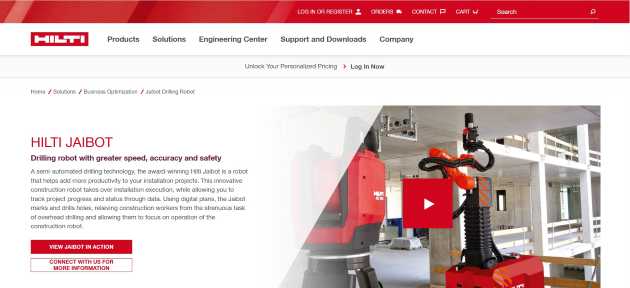
Hilti, a global construction technology company headquartered in Liechtenstein, entered the robotics arena with its Jaibot drilling robot. The Hilti Jaibot is a mobile, semi-autonomous robot designed to drill holes in ceilings for mechanical, electrical, and plumbing (MEP) installations. Using BIM data as its guide, Jaibot accurately positions itself and drills overhead anchor holes or hanger holes, then marks each hole’s position for the relevant trade.
The robot is essentially a wheeled unit with a robotic arm that reaches up to the ceiling. It is cordless and requires only a remote operator to supervise and move it to general areas – no specialist programming skills needed. On a jobsite, a human sets Jaibot up and then the robot handles the repetitive, strenuous task of overhead drilling. This provides a huge relief to workers who would otherwise be lifting tools above their heads for hours, a task that is both slow and a common source of fatigue and injury.
Hilti’s research found Jaibot can increase drilling productivity by about 30% and perform up to 500 overhead holes per day, all while freeing human crew members to focus on installation and quality checks. Safety is improved as well – dust is contained through the robot’s integrated vacuum, and workers spend less time on ladders or scissor lifts performing repetitive motions.
Since its introduction in late 2020, Jaibot has been adopted on projects like data centers and hospitals, where large numbers of ceiling inserts are needed. By leveraging BIM-to-field automation, Hilti’s Jaibot exemplifies robotics improving both productivity and safety in construction: it takes over a “tough on the body” job and completes it faster, with digital accuracy, and consistent performance.
10. Brokk – Remote-Controlled Demolition Robots Enhancing Safety
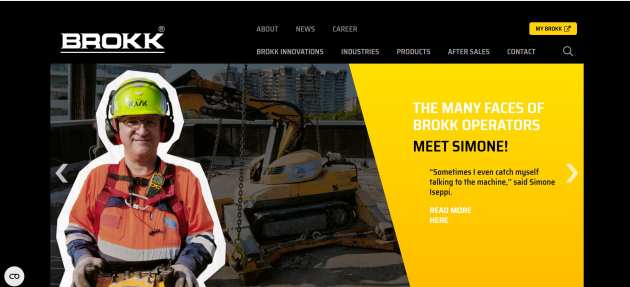
Brokk (Sweden) is the world’s leading manufacturer of remote-controlled demolition robots – highly powerful robotic machines that can break concrete, chisel walls, and remove debris in the most dangerous environments. For over 35 years, Brokk has been developing these compact demolition robots, and today thousands of Brokk machines are in use across more than 100 countries.
These yellow robotic machines, which range in size from small 1-ton units to larger 5-ton units, are operated via remote control by an operator at a safe distance. They come equipped with hydraulic breaker hammers, crushers, drills, or buckets to tackle demolition of concrete and masonry in sites like old buildings, industrial facilities, and even nuclear power plants.
The key advantage is safety and precision: instead of sending workers with jackhammers into confined or unstable structures, a Brokk robot can do the job while the crew stands a safe distance away. Brokk robots have been used to demolish concrete in hazardous areas such as bomb-damaged buildings, tunnels, mines, and petrochemical plants, where manual demolition would be extremely risky.
Despite their compact footprint (some can fit through standard doorways), they pack tremendous power and can outperform larger excavators in tight spaces. The machines also reduce noise and vibration compared to handheld tools. By taking on “the three Ds” of demolition (dull, dirty, dangerous work), Brokk’s robots have become an industry standard for specialty demolition contractors.
They improve productivity as well – working continuously without fatigue and often completing jobs faster than manual methods. Brokk continues to innovate with new models (like the electric Brokk 70 for interior demolition) and features like digital connectivity for machine monitoring. In summary, Brokk’s long-established lineup of demolition robots has made demolition smarter and safer, keeping workers out of harm’s way while machines tackle the brute force work.
11. Komatsu – Smart Construction Machinery with Robotics and AI
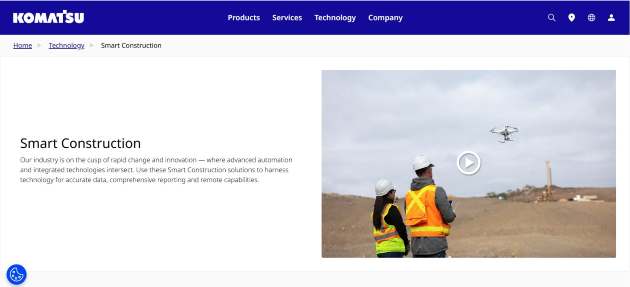
Japan’s Komatsu is a construction and mining equipment giant that has been a pioneer in integrating robotics and automation into heavy machinery. Komatsu’s vision of “smart construction” includes a range of intelligent machines and systems that automate earthmoving tasks.
For example, Komatsu has developed bulldozers and excavators with built-in AI guidance that can automatically grade terrain or dig to precise depths using GPS and sensor input. Its “Intelligent Machine Control” dozers come pre-equipped with sensors and 3D machine guidance, enabling automated blade control to follow design grade with minimal operator input. In essence, Komatsu’s machines can perform tasks like excavating, hauling, and grading autonomously or semi-autonomously after the operator initiates the work.
The company also deploys fleets of autonomous dump trucks (especially in mining) and has been trialing self-driving construction trucks on large earthwork sites. Komatsu’s intelligent equipment ecosystem includes drones for surveying, cloud platforms for project data, and machine-to-machine communications on site. All these parts work together to optimize the construction process – for instance, a drone survey feeds terrain data to an excavator which then digs the plan, while a robotic dozer spreads the fill, all supervised by a remote site manager.
According to Komatsu, their automated equipment can significantly shorten project timelines and reduce rework by executing plans exactly as designed. One notable system is Komatsu’s Autonomous Haulage System (AHS) used in mines, which the company is adapting for large construction projects. By leveraging advanced sensors, controllers, and communication infrastructure, Komatsu has positioned itself as a leader in “construction robotics” among major OEMs. Customers in Japan, the U.S., and Europe have begun using these robotic features – for example, on highway projects where bulldozers auto-grading saves time and labor.
While not a “robotics startup,” Komatsu is transforming traditional heavy machines into robots on wheels, pushing the industry toward fully automated construction sites.
12. Ekso Bionics (EksoWorks) – Wearable Robots Augmenting Workers
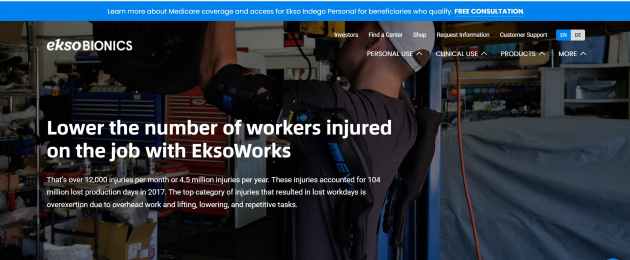
Ekso Bionics (USA) brings robotics to construction in the form of exoskeleton suits that augment the human worker. Through its EksoWorks division, the company designs industrial exoskeleton vests and arms that support laborers in tasks like overhead drilling, lifting tools, or carrying heavy materials. These wearable robotic devices are not autonomous robots performing work by themselves, but rather human-integrated systems that reduce strain and fatigue for the wearer.
For instance, Ekso’s Vest is worn by a worker and provides lift assistance for arms, making overhead work (like ceiling wiring or grinding) feel much lighter. Another product, EksoZeroG, mounts to aerial lifts and holds heavy tools, allowing a worker to maneuver a 30-lb breaker or grinder with minimal effort. The technology allows workers to maintain full range of motion while minimizing physical stress on muscles and joints.
This results in fewer injuries, less fatigue at the end of the day, and improved productivity since workers can perform tasks longer or more repetitively without as much strain. Construction and manufacturing companies have adopted Ekso’s exoskeletons to reduce workman’s comp claims and improve efficiency – for example, a crew installing overhead anchors with exosuits can be far more productive than one without.
Ekso Bionics has roots in medical exoskeletons for physical rehabilitation, but its EksoWorks products have been embraced in construction, aviation maintenance, and other industrial sectors for augmenting human capability. By acting as “wearable robots,” these systems effectively turn workers into bionic builders who can accomplish more with less risk of injury. As construction firms increasingly focus on safety and ergonomics, Ekso’s exoskeletons offer a compelling solution: robotics that empower the workforce rather than replace it.
13. Canvas – Drywall Finishing Robot Delivering Perfect Walls

Canvas (USA) is a startup that has tackled the messy, labor-intensive job of drywall finishing with a semi-automated robotic solution. The Canvas robot is essentially an intelligent robotic arm mounted on a scissor lift platform that sands and finishes drywall surfaces. After drywall boards are hung, achieving a perfectly smooth finish (especially Level 5, the highest quality) typically requires multiple days of manual mudding, sanding, and skimming by skilled tapers.
Canvas changes this by using a robot to apply joint compound and sand with machine precision. A human operator works alongside – loading material and overseeing the process – but the robot does the repetitive, high-angle work. The result: Canvas can tape, mud, and sand drywall for a Level 5+ finish in about 2 days for what normally takes 7 days.
On a recent project, the Canvas system reduced the finishing cycle by 34%, with only one drying cycle needed between coats. It also captured 99.9% of the dust with its vacuum system, greatly improving jobsite air quality during sanding. Major contractors like Webcor and Suffolk Construction have used Canvas robots on projects including a San Francisco airport terminal and a civic center.
Union drywall tapers operate the robots (Canvas partnered with the local Painters and Tapers union), showing how the technology creates new high-tech jobs for tradespeople. Quality-wise, the robot produces extremely consistent finishes, eliminating variation and touch-ups. And from a safety perspective, workers avoid strain by not having to repeatedly climb scaffolds or handle vibrating sanding tools – instead they supervise the robot’s work from ground level.
The Canvas system underscores how robotics can enhance skilled trades, not by replacing workers but by making them more efficient and their jobs less arduous. With its ability to deliver high-grade finishes faster and safer than traditional methods, Canvas is gaining recognition as a breakthrough in interior construction tech.
14. Fischer (Baubot) – Multi-Purpose Construction Robot for Assistive Tasks
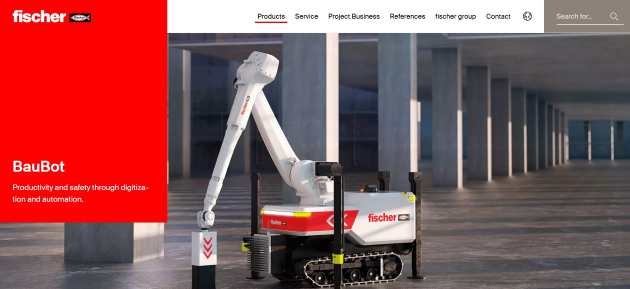
Fischer, a German company known for construction fasteners and tools, has introduced Baubot, a versatile mobile robot designed to assist crews with various on-site tasks. Developed via Fischer’s innovation group, Baubot is described as a “Swiss Army knife” of construction robots. It’s a compact, wheeled robotic platform with an adjustable arm that can be fitted with different attachments (grippers, drills, saws, etc.) to perform tasks like drilling holes, lifting and placing materials, cutting openings, milling concrete, and even basic layout marking.
In essence, Baubot can take on many of the demanding and repetitive jobs that humans find tiring or hazardous. For example, it can continuously drill overhead anchors or cut wall openings while the operator monitors, reducing the risk of vibration-related injuries to workers. The robot can also carry heavy loads, which minimizes manual material handling on site.
A notable feature is Baubot’s integrated dust extraction system, which collects dust at the source during drilling or cutting – contributing to a cleaner, safer work area. This improves compliance with silica dust regulations and protects worker health. Fischer’s Baubot has demonstrated capabilities like autonomously drilling thousands of holes in a tunnel project within a short time, showing it can boost productivity in large-scale jobs.
The robot operates using digital plans, so it executes tasks with layout precision guided by BIM data. While still in early adoption, Baubot represents a new class of generalist construction robots – machines that aren’t limited to one function, but can be flexibly deployed across various trades and tasks on a jobsite. By teaming Baubot with human crews, contractors can offload the heaviest and most monotonous work to the robot, thereby increasing efficiency and protecting workers from injury. Fischer’s foray into robotics with Baubot highlights the industry’s trend toward multi-function automation tools that support (rather than replace) construction labor.
15. KEWAZO – Robotic Scaffold Assembly with Liftbot
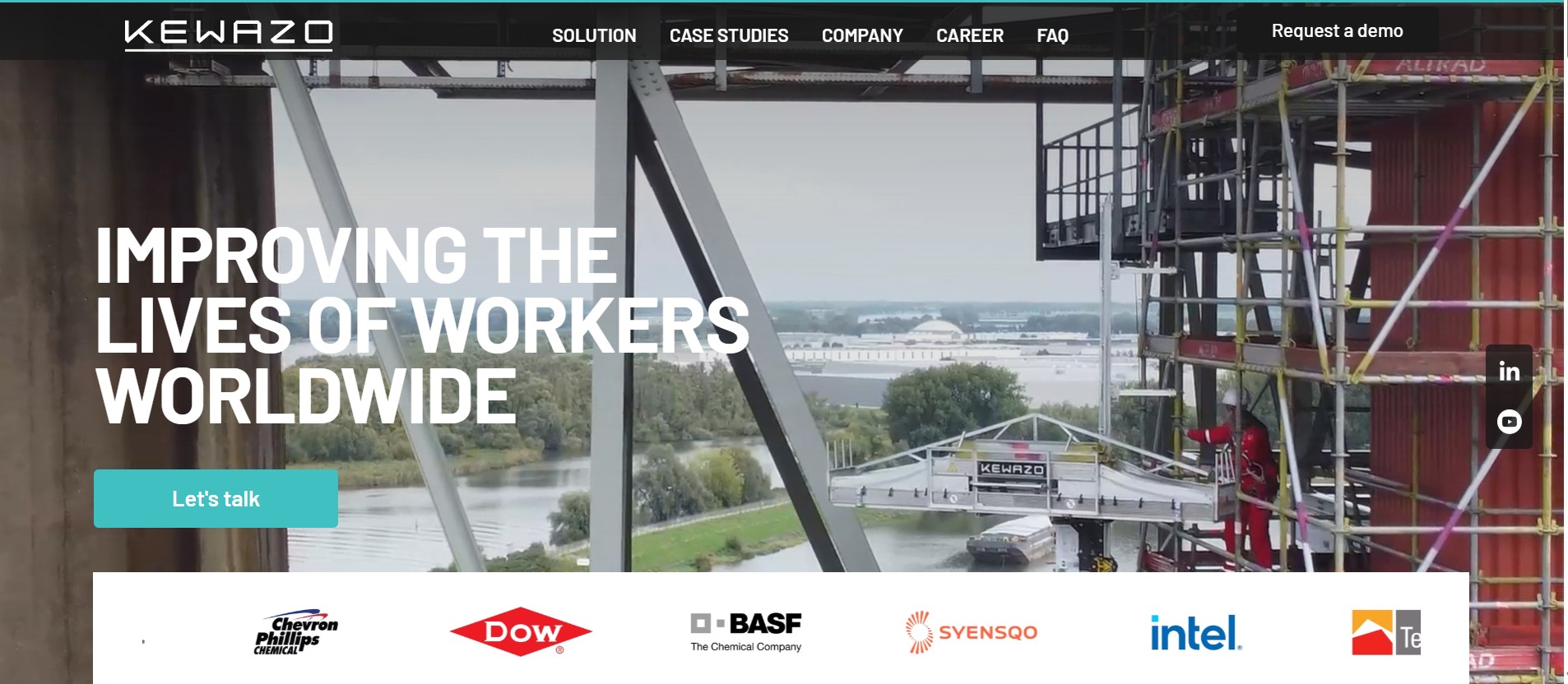
KEWAZO (Germany) is bringing robotics and digitalization to an often-overlooked construction domain: scaffolding assembly and material logistics. Its primary product, Liftbot, is a smart robotic hoist system that automates the lifting of scaffold components (or other materials) during scaffold erection and dismantling. On a scaffolding job, typically multiple workers continually carry boards and braces up and down or rely on rope pulleys; Liftbot instead attaches to the scaffold itself and ferries pieces up to the scaffolders with the push of a button.
The system is battery-powered, requires only two people to set up in about 20 minutes, and can climb the scaffold structure carrying materials. KEWAZO claims that using Liftbot can save around 70% of the man-hours involved in scaffolding assembly. This is a massive efficiency boost in an industry where labor is costly and in short supply.
By taking over the lifting and hauling, the robot allows the human scaffolders to focus on the skilled task of assembling the scaffold, rather than waste energy on logistics. This not only speeds up the process but also significantly reduces the physical strain and the risk of accidents (no more workers climbing laden with heavy parts). Liftbot is also equipped with sensors and an analytics platform (“Onsite Analytics”) that collects data on utilization and productivity, giving contractors insights into their operations.
In addition to scaffolding, Liftbot has applications for moving other construction materials vertically – such as for insulation or painting jobs where supplies need to go to elevated work areas. So far, a dozen Liftbots have been used in Europe at large industrial plants and construction sites, and KEWAZO’s recent funding is helping expand this technology to new regions. By automating a traditionally labor-heavy process, KEWAZO is improving safety and efficiency in construction logistics, showing that even supporting activities like material transport are ripe for robotic innovation.
Conclusion – A Robotic Renaissance in Construction
From the examples above, it’s clear that construction is entering a new era where robots big and small are becoming trusted members of the jobsite team. These 15 companies are leading the charge globally, each addressing different pain points of construction – whether it’s speeding up major tasks like earthmoving and masonry, improving quality in finishing work, or enhancing safety in demolition and handling.
Several trends emerge from their innovations. Productivity gains are a common thread: Robots can work faster or longer (or both) than humans at repetitive tasks, as seen with Hadrian X laying bricks or TyBot tying rebar eight times faster than crews. This helps contractors deliver projects quicker and tackle more work with limited labor.
Safety and ergonomics are equally important drivers – many of these robots remove workers from dangerous or physically taxing activities (demolition, overhead drilling, heavy lifting), leading to fewer injuries and less fatigue. It’s also notable that robots are complementing human workers, not making them obsolete. In fact, a lot of these solutions – from exoskeletons to canvas finishing robots – are about augmenting skilled labor and allowing tradespeople to work smarter.
Another trend is the integration of digital planning (BIM) with robotics. Products like Hilti’s Jaibot and Dusty’s FieldPrinter rely on digital building models to drive their precision, indicating that the future of construction robotics goes hand-in-hand with the broader digital transformation of the industry.
Geographically, innovation is widespread – we see pioneering companies from the US, Europe, Asia, and Australia, reflecting a worldwide push to modernize construction. And these technologies are moving from pilot phase to real project deployments: 3D-printed homes are being sold to the public, autonomous machines are breaking ground on infrastructure projects, and finishing robots are teaming with union crews on commercial sites.
The Future of Construction Robotics
Going forward, we can expect construction robotics to become more common and more capable. As AI and sensor tech advance, robots will get better at navigating dynamic jobsites and performing complex tasks (perhaps one day we’ll have autonomous robots assembling rebar or installing facade panels autonomously). The industry is also learning how to blend human expertise with robotic efficiency – a hybrid approach that could help address chronic labor shortages while upskilling the workforce.
For construction professionals and tech enthusiasts, these developments signal an exciting paradigm shift. The dusty, dangerous jobsite of the past is evolving into a safer, more productive environment where humans and machines build side by side. The 15 companies profiled here are at the forefront of this transformation, proving that robotics is no longer a futuristic concept but a practical tool disrupting the construction industry today.
Interested in exploring career opportunities in this rapidly evolving field? Check out our comprehensive guide on job opportunities in construction robotics and learn about how AI and robotics are reshaping construction careers.
Related Posts:
- Robotics Engineering: A Lucrative Career Option In 2025
- Future-Proof Construction: Essential 2030 Skills
