
Last Updated on March 30, 2026 by Admin
If you are preparing to enter the construction industry in 2026, you are stepping into one of the most competitive hiring markets in recent memory. Global infrastructure spending is projected to exceed $9 trillion annually by 2030, and employers across the United States, United Kingdom, Middle East, Australia, and India are actively seeking entry-level professionals who bring more than just a degree to the table.
ConstructionCareerHub App is LIVE — built ONLY for construction careers. Don’t apply with a weak resume.
Get ATS-ready Resume Lab + Interview Copilot + Campus Placement Prep (resume screening, skill gaps, interview readiness) — in minutes & Other advanced features.
Explore Smarter Construction Career Tools →Quick check. Big impact. Start now.
A construction certification signals to hiring managers that you have verified, job-ready skills — not just theoretical classroom knowledge. Whether you are a civil engineering graduate, a construction management student, or a career switcher exploring construction career paths, the right certification can accelerate your first job offer by weeks or even months.
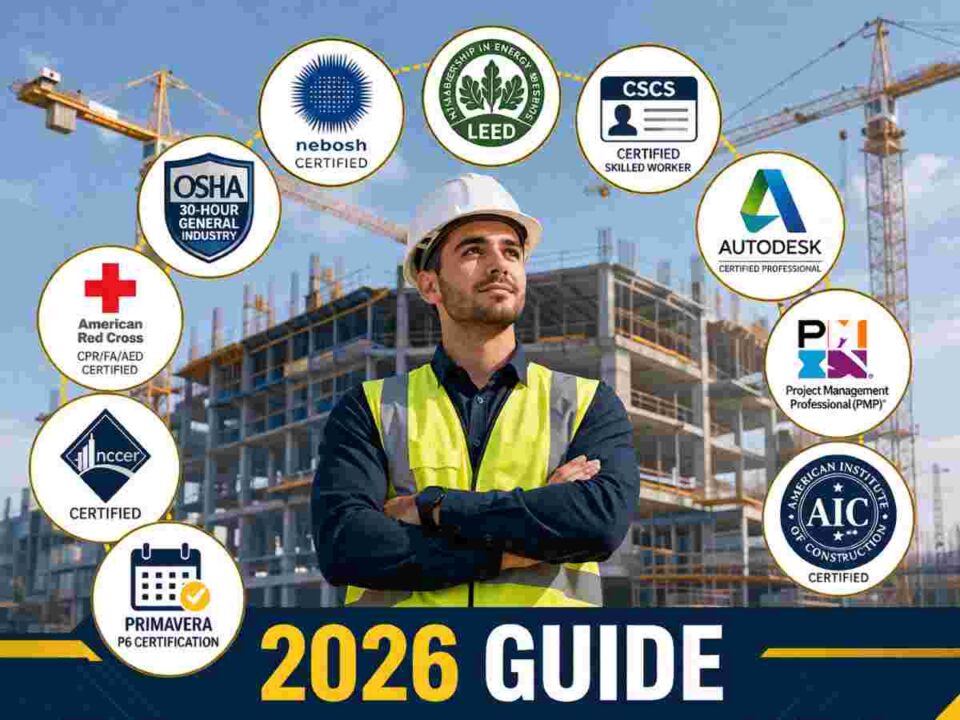
In this comprehensive 2026 guide, we break down the top 10 construction certifications that freshers, students, and early-career professionals should seriously consider before applying for their first role. Each certification is evaluated for global recognition, cost, career impact, and relevance to current industry demand.
Looking for AI-powered tools to sharpen your resume and interview skills? Try the ConstructionCareerHub platform — built exclusively for construction professionals — featuring Resume Lab, Interview Copilot, and Salary Calculator.
Table of Contents
1. OSHA 30-Hour Construction Safety Certification (USA)
What It Is
The OSHA 30-Hour Construction Industry Outreach Training is a workplace safety certification administered by the Occupational Safety and Health Administration under the U.S. Department of Labor. It is widely regarded as the baseline safety credential for anyone entering the American construction industry.
Why It Matters for Freshers
Nearly every major contractor in the United States — from Turner Construction to Bechtel — requires OSHA certification as a condition of site access. For freshers, completing the OSHA 30 before your first interview demonstrates safety awareness and regulatory knowledge, two traits employers value highly. According to the Bureau of Labor Statistics, the construction industry continues to have one of the highest rates of workplace injuries, making safety training non-negotiable.
Key Details
- Cost: $50–$189 (online), varies by provider
- Duration: 30 hours (available online or in-person)
- Eligibility: No prerequisites — open to students and freshers
- Validity: Does not expire, but many employers prefer recent completion
- Career Impact: Required for site access on most U.S. construction projects
The OSHA 10-Hour course is a shorter alternative for labourers, but the 30-Hour version is recommended for aspiring engineers, supervisors, and project coordinators. For a detailed cost and salary comparison between OSHA and NEBOSH, read our NEBOSH vs OSHA guide.
Official Resource: OSHA Outreach Training Program
2. NEBOSH International General Certificate (IGC)
What It Is
The NEBOSH IGC is a globally recognized health and safety qualification issued by the National Examination Board in Occupational Safety and Health, a UK-based body established in 1979. It is considered the international gold standard for occupational health and safety professionals in construction and other high-risk industries.
Why It Matters for Freshers
If you plan to work in the Gulf (UAE, Qatar, Saudi Arabia), the UK, or with multinational EPC contractors, NEBOSH is often a mandatory requirement. The global EHS market is projected to reach $95.71 billion by 2033, and professionals with NEBOSH credentials command significantly higher salaries — often $20,000–$30,000 more annually than peers with only basic safety training.
Key Details
- Cost: $800–$2,500 depending on delivery mode and region
- Duration: 10–14 weeks (online or classroom)
- Eligibility: No formal prerequisites — freshers can enrol directly
- Validity: Lifetime (no renewal required)
- Career Impact: Opens doors to HSE Officer, Safety Engineer, and Safety Manager roles globally
For freshers, starting with the NEBOSH IGC and later adding the NEBOSH International Diploma creates a powerful career pathway in construction safety. Explore our detailed NEBOSH interview questions and answers guide to prepare for safety roles.
Official Resource: NEBOSH Official Website
3. LEED Green Associate (USGBC)
What It Is
The LEED Green Associate credential, offered by the U.S. Green Building Council (USGBC), validates foundational knowledge of green building principles, LEED certification processes, and sustainable construction practices. It is the entry-level credential within the LEED professional accreditation pathway.
Why It Matters for Freshers
The global green building market is projected to reach $774 billion by 2030, and LEED-certified buildings now represent over 14 billion square feet across 185+ countries. Employers in the sustainability-focused construction sector increasingly prefer candidates who understand green building frameworks — even at the entry level. Having a LEED Green Associate credential on your resume positions you for roles in sustainability consulting, green building design, MEP engineering, and ESG-aligned project management.
Key Details
- Cost: $250 (exam fee; USGBC members get a discount)
- Duration: Self-paced preparation; typically 2–3 months of study
- Eligibility: No prerequisites — ideal for students and freshers
- Validity: 2 years (requires continuing education credits for renewal)
- Career Impact: Valued in the USA, Middle East, and Asia-Pacific markets
For a deeper understanding of the LEED certification tiers and how they influence project decisions, read our guide to LEED certification levels. Also explore the importance of LEED in green building careers.
Official Resource: USGBC LEED Green Associate
4. Associate Constructor (AC) — American Institute of Constructors
What It Is
The Associate Constructor (AC) certification, offered by the American Institute of Constructors (AIC), is a professional credential specifically designed for early-career construction professionals. It validates knowledge in estimating, scheduling, safety, contract management, and construction methods.
Why It Matters for Freshers
Unlike many certifications that require years of experience, the AC is explicitly tailored for recent graduates and entry-level professionals. It serves as a stepping stone toward senior credentials like the Certified Professional Constructor (CPC) and the Certified Construction Manager (CCM). Having the AC on your resume signals to employers that you have been independently tested on core construction management competencies — giving you an edge over peers with only academic credentials.
Key Details
- Cost: Approximately $375 (exam fee)
- Duration: Self-study; exam taken at Prometric centers
- Eligibility: Bachelor’s degree in construction or related field (or equivalent combination of education and experience)
- Validity: 5 years (renewable with continuing education)
- Career Impact: Recognized by U.S. employers, especially in commercial and residential construction
For more on construction management certifications and how the AC fits into the broader landscape, explore our top construction management certifications guide.
Official Resource: American Institute of Constructors
5. CSCS Card (UK Construction)
What It Is
The Construction Skills Certification Scheme (CSCS) card is the UK construction industry’s standard proof that workers have the appropriate training and qualifications for their on-site role. While not a traditional certification, the CSCS card functions as a mandatory site access credential across nearly all UK construction projects.
Why It Matters for Freshers
If you are targeting construction jobs in the United Kingdom, you will need a valid CSCS card before stepping onto most construction sites. Major contractors like Balfour Beatty, Laing O’Rourke, and Kier Group require the CSCS card as a non-negotiable condition of employment. International engineers can apply for a CSCS card by having their qualifications verified through Ecctis (formerly UK NARIC) and passing the CITB Health, Safety and Environment (HS&E) test.
Key Details
- Cost: £36 (card application) + £22.50 (CITB HS&E test) + Ecctis fees for international applicants
- Duration: Test preparation can take 1–2 weeks; Ecctis verification may take several weeks
- Eligibility: Valid qualification and CITB HS&E test pass required
- Validity: 5 years (2 years for the Green Labourer card on first issue)
- Career Impact: Required for site access across the UK
For a complete step-by-step guide including card types, test preparation, and the international application process, read our detailed CSCS Card UK 2026 guide.
Official Resource: CSCS Official Website
6. Autodesk Certified Professional (ACP) — Revit / AutoCAD / Civil 3D
What It Is
The Autodesk Certified Professional (ACP) credential validates proficiency in industry-standard design software such as Revit, AutoCAD, and Civil 3D. These are the most widely used tools in the architecture, engineering, and construction (AEC) industry for BIM modelling, drafting, and design.
Why It Matters for Freshers
In 2026, BIM adoption is near-universal on large-scale construction projects. Employers increasingly expect entry-level hires to demonstrate verified software skills rather than listing self-taught abilities on a resume. Industry data shows that professionals with Autodesk certifications earn 15–30% higher salaries and have access to senior positions requiring validated BIM expertise. For freshers, an ACP in Revit is particularly powerful because it positions you for BIM Modeller, BIM Coordinator, and Design Engineer roles — some of the highest-demand construction technology careers in the industry.
Key Details
- Cost: $175–$200 (exam fee per specialization)
- Duration: Self-paced preparation; Autodesk provides learning paths
- Eligibility: No formal prerequisites, but practical experience recommended
- Validity: 3 years
- Career Impact: Valued globally across AEC firms, particularly in the USA, UK, Australia, and Middle East
Explore our comprehensive Revit interview questions and answers guide and learn more about BIM in civil engineering.
Official Resource: Autodesk Certification
7. CAPM — Certified Associate in Project Management (PMI)
What It Is
The Certified Associate in Project Management (CAPM), offered by the Project Management Institute (PMI), is an entry-level project management credential designed specifically for professionals who do not yet have the experience required for the PMP certification. It validates knowledge of fundamental project management concepts, terminology, and processes based on the PMBOK Guide.
Why It Matters for Freshers
While the PMP certification remains the gold standard for experienced project managers, it requires 3–5 years of professional experience. The CAPM fills the gap for freshers and recent graduates who want to demonstrate project management knowledge before gaining field experience. Construction projects are fundamentally project management exercises — involving budgets, schedules, resources, and risk — so the CAPM gives you a structured foundation that directly applies to site coordination, planning, and engineering roles.
Key Details
- Cost: $225 (PMI members) / $300 (non-members)
- Duration: 23 hours of project management education required; self-paced study
- Eligibility: High school diploma or equivalent + 23 hours of PM education
- Validity: 3 years (renewed by retaking the exam)
- Career Impact: Recognized globally across construction, IT, manufacturing, and engineering sectors
Official Resource: PMI CAPM Certification
8. First Aid and CPR/AED Certification
What It Is
First Aid, CPR (Cardiopulmonary Resuscitation), and AED (Automated External Defibrillator) certification is a hands-on safety credential offered by recognized bodies such as the American Red Cross, American Heart Association, St John Ambulance (UK/Australia), and national equivalents worldwide.
Why It Matters for Freshers
Construction sites are inherently high-risk environments, and employers value team members who can respond to medical emergencies. While this is not a construction-specific certification, it is a strong differentiator on a fresher’s resume. Many employers include first aid training in onboarding, but arriving with a valid certificate demonstrates proactive safety awareness. In some jurisdictions, having certified first aiders on-site is a regulatory requirement.
Key Details
- Cost: $25–$120 depending on provider and country
- Duration: 4–8 hours (in-person or blended learning)
- Eligibility: No prerequisites — open to anyone
- Validity: 2 years (typically)
- Career Impact: Supplementary credential that enhances overall employability
This certification pairs well with OSHA or NEBOSH training and signals to employers that you take workplace safety seriously — a trait that resonates across all construction markets. For more on essential construction safety certifications, explore our dedicated guide.
Official Resource: American Red Cross First Aid
9. NCCER Core Curriculum Certification (USA)
What It Is
The National Center for Construction Education and Research (NCCER) Core Curriculum is a standardized, portable training credential recognized across the U.S. construction industry. It covers foundational topics including construction math, hand and power tools, communication skills, material handling, basic safety, and blueprint reading.
Why It Matters for Freshers
NCCER certifications are highly valued by U.S. employers, particularly in industrial, commercial, and energy construction. The Core Curriculum is the entry point for all NCCER craft training pathways — from electrical and carpentry to heavy equipment operations and pipefitting. For freshers who may not have a four-year engineering degree, the NCCER Core provides a recognized, industry-validated foundation that opens doors to apprenticeship programmes and trade-specific career paths.
Key Details
- Cost: Varies by training provider (typically $500–$2,000 including materials)
- Duration: 60–80 hours of instruction
- Eligibility: No prerequisites
- Validity: Lifetime (portable across employers through the NCCER registry)
- Career Impact: Required entry credential for NCCER craft training; recognized by major U.S. contractors
Official Resource: NCCER Official Website
10. Primavera P6 / Microsoft Project Proficiency Certificate
What It Is
Primavera P6 (by Oracle) and Microsoft Project are the two most widely used construction scheduling and project planning software tools. While there is no single universally standardized certification for these tools, completion certificates from Oracle University, Microsoft Learning, or recognized platforms like Coursera and Udemy serve as verifiable proof of proficiency.
Why It Matters for Freshers
Construction planning and scheduling is one of the most critical functions on any project, and employers consistently rank scheduling software skills among the top requirements for entry-level planning engineers and project coordinators. A fresher who can demonstrate Primavera P6 proficiency — including creating WBS structures, assigning resources, running critical path analysis, and generating S-curves — has a significant advantage over candidates who only list these tools on their resume without verification.
Key Details
- Cost: $30–$200 (online courses with certificates); Oracle University courses cost more
- Duration: 20–40 hours depending on course depth
- Eligibility: No prerequisites
- Validity: No expiration (course completion certificates)
- Career Impact: Directly applicable to Planning Engineer, Project Coordinator, and Site Engineer roles
Scheduling skills combined with BIM proficiency create one of the strongest technical profiles for construction freshers in 2026. Explore our guides on types of civil engineering jobs to find roles that value these skills.
Quick Comparison: All 10 Certifications at a Glance
| Certification | Cost (Approx.) | Fresher-Friendly? | Best For |
|---|---|---|---|
| OSHA 30-Hour | $50–$189 | Yes | U.S. construction site access |
| NEBOSH IGC | $800–$2,500 | Yes | Global HSE roles (UK, Gulf, Asia) |
| LEED Green Associate | $250 | Yes | Sustainability and green building |
| Associate Constructor (AC) | $375 | Yes | U.S. construction management |
| CSCS Card | £58.50+ | Yes | UK construction site access |
| Autodesk Certified Professional | $175–$200 | Yes | BIM/CAD design roles globally |
| CAPM (PMI) | $225–$300 | Yes | Project coordination and planning |
| First Aid / CPR / AED | $25–$120 | Yes | All construction roles (supplementary) |
| NCCER Core Curriculum | $500–$2,000 | Yes | U.S. trade and craft careers |
| Primavera P6 / MS Project | $30–$200 | Yes | Planning and scheduling roles |
How to Choose the Right Certification for Your Career Goals
With so many options available, the right certification depends on three factors: your target geography, your desired role, and your available budget.
By Target Country
United States: Start with OSHA 30-Hour + CAPM or Associate Constructor. Add Autodesk ACP or Primavera P6 for technical roles.
United Kingdom: CSCS Card is non-negotiable. Pair it with NEBOSH IGC for HSE roles or Autodesk ACP for design-focused positions.
Gulf Countries (UAE, Qatar, Saudi Arabia): NEBOSH IGC is the most valued safety credential. LEED Green Associate adds value for projects driven by sustainability mandates.
India: Autodesk certifications (Revit/AutoCAD), Primavera P6 proficiency, and NEBOSH IGC are the most marketable. For freshers targeting campus placements, explore our campus placements preparation guide.
Australia: NEBOSH IGC (recognized), LEED Green Associate, and Autodesk ACP are valued. Local White Card training is also required for site access.
By Target Role
Site Engineer / Field Engineer: OSHA 30 + Primavera P6 + First Aid
BIM Modeller / Design Engineer: Autodesk ACP (Revit) + LEED Green Associate
HSE Officer / Safety Engineer: NEBOSH IGC + OSHA 30 + First Aid
Project Coordinator / Planning Engineer: CAPM + Primavera P6 + Associate Constructor
Construction Labourer / Tradesperson (UK): CSCS Card + NCCER Core (for U.S. transitions)
Salary Impact: What Certified Freshers Can Expect
Certifications are not just resume boosters — they directly influence starting salaries. Based on industry data from 2025–2026:
OSHA-certified site engineers in the U.S. typically earn $55,000–$70,000 as entry-level professionals, compared to $45,000–$55,000 for uncertified peers.
NEBOSH IGC holders working as HSE officers in the Gulf region earn $40,000–$60,000 (tax-free in many cases), significantly above non-certified safety assistants.
LEED Green Associate credential holders in sustainability consulting roles earn $50,000–$65,000 in the U.S. market.
Autodesk-certified BIM professionals earn 15–30% more than non-certified peers, with U.S. BIM Modeller salaries averaging $65,000–$95,000.
For detailed salary breakdowns across construction roles and countries, explore our highest-paying construction jobs in the U.S. and highest-paying civil engineering jobs guides.
Best Online Courses to Prepare for These Certifications
Self-paced online courses provide the most flexible and affordable path to certification preparation. Here are recommended courses from leading platforms:
- Construction Management Specialization — Columbia University (Coursera): Covers scheduling, cost control, contracts, and safety — excellent preparation for the Associate Constructor exam and CAPM.
- Construction Management Professional Certificate — University of Maryland (edX): Structured programme covering project delivery, risk management, and BIM fundamentals.
- Primavera P6 Essential Training (Udemy): Hands-on project scheduling course covering WBS creation, resource assignment, and critical path analysis.
- Autodesk Revit Complete Beginners Course (Udemy): Covers the Revit interface, modelling workflows, and documentation basics — ideal ACP exam preparation.
Recommended eBooks for Construction Freshers
If you are preparing for your first construction job, these resources from our eBook store provide actionable career guidance:
- Civil Engineering Job Interview Guide — 300 Interview Questions & Answers
- Civil Engineering Interview Questions & Answers PDF eBook
- The Remote Job Hunting System — Construction & Engineering Jobs
Browse the complete collection at digitslick.gumroad.com.
Tips to Maximize the Value of Your Certifications
Earning a certification is only half the battle. Here is how to extract maximum career value from your credentials:
Add them to your LinkedIn profile immediately. LinkedIn data shows that members who list certifications receive significantly more profile views and recruiter messages. For tips on optimizing your LinkedIn job search, see our LinkedIn Jobs Search guide.
Include certification details on your resume. List the certification name, issuing body, date earned, and credential ID (if applicable). For resume templates and formatting guidance, explore our civil engineering resume guide.
Mention certifications during interviews. When asked about your qualifications, reference specific modules or competencies covered in your certification training — this demonstrates depth beyond just the credential name.
Combine safety + technical + management certifications. The most competitive fresher profiles combine one safety credential (OSHA or NEBOSH), one technical certification (Autodesk ACP or Primavera P6), and one management-oriented credential (CAPM or Associate Constructor).
Keep your credentials current. Some certifications (LEED Green Associate, CAPM, ACP) require renewal. Set calendar reminders and complete continuing education requirements before expiry.
What Employers Actually Look for in 2026
Based on job posting analysis across major construction job boards in early 2026, here are the certification-related trends employers are prioritizing:
Safety certifications remain non-negotiable. OSHA and NEBOSH appear in the majority of U.S. and international construction job postings, even for roles that are not primarily safety-focused.
BIM skills have crossed the mainstream threshold. What was a “nice-to-have” five years ago is now a baseline expectation. Autodesk Revit proficiency is listed in over 60% of design, engineering, and coordination role postings.
Sustainability credentials are gaining fast. With governments mandating carbon reporting and ESG-driven investment reshaping the industry, LEED credentials are increasingly appearing alongside traditional engineering requirements.
Digital scheduling fluency is expected. Employers assume that entry-level engineers can navigate Primavera P6 or Microsoft Project — having a verifiable certificate removes the guesswork.
For more insights on what fresh engineering graduates need to know before entering the job market, read our comprehensive guide.
Frequently Asked Questions (FAQ)
What is the best construction certification for freshers with no experience?
The OSHA 30-Hour Construction Safety certification is widely considered the best starting point for freshers with no prior construction experience. It has no prerequisites, is affordable, and is required for site access on most U.S. construction projects. For international freshers targeting the Gulf or UK, NEBOSH IGC serves a similar foundational role.
Can I get a construction certification while still in college?
Yes. Several certifications on this list — including OSHA 30, NEBOSH IGC, LEED Green Associate, CAPM, and Autodesk ACP — have no work experience requirements. Students can earn these certifications before graduation to strengthen their resume for campus placements and off-campus job applications.
How many certifications should I get before my first job?
Two to three certifications is the optimal range for most freshers. A recommended combination is one safety credential (OSHA or NEBOSH), one technical skill certification (Autodesk ACP or Primavera P6), and optionally one management-oriented credential (CAPM or LEED Green Associate) depending on your target role.
Are online construction certifications respected by employers?
Yes, provided they come from recognized bodies. OSHA Outreach Training, NEBOSH IGC, LEED Green Associate, PMI CAPM, and Autodesk ACP are all available online and are fully respected by employers worldwide. Course completion certificates from platforms like Coursera and edX (from partner universities) are also valued when paired with practical skills.
Which certification pays the most in construction?
Among entry-level certifications, the NEBOSH IGC and LEED Green Associate are associated with the highest starting salary premiums. NEBOSH holders in HSE roles earn $20,000–$30,000 more annually than non-certified peers, while LEED credentials add value in the rapidly growing green building sector.
Is LEED certification worth it for freshers in 2026?
Absolutely. With the global green building market on track to reach $774 billion by 2030 and governments worldwide mandating sustainability standards, the LEED Green Associate credential is increasingly valuable — even at the entry level. It is particularly useful for freshers targeting sustainability consulting, MEP engineering, and ESG-aligned project management roles.
What is the difference between OSHA 10 and OSHA 30?
The OSHA 10-Hour course provides basic hazard awareness training and is designed for workers and labourers. The OSHA 30-Hour course provides more comprehensive safety training covering management responsibilities, hazard identification, and fall protection — and is designed for supervisors, engineers, and safety personnel. For aspiring engineers and project coordinators, the 30-Hour version is recommended.
Do I need a CSCS card to work in UK construction?
While holding a CSCS card is not a legal requirement, the vast majority of UK construction sites — including all major contractor sites — require a valid CSCS card as a condition of entry. For practical purposes, it is a mandatory credential for anyone seeking construction employment in the UK.
Published by ConstructionPlacements.com — Your trusted resource for construction career guidance, job opportunities, and industry insights.
Build your construction career with smarter tools. ConstructionCareerHub offers AI-powered Resume Lab, Interview Copilot, and Career Planner — built exclusively for construction professionals. Explore Smarter Construction Career Tools →
Related Posts:
- 5 Essential Certifications for a Career in Construction
- A Complete Guide To Finding Jobs For Diploma Civil Engineers: Types of Jobs, Where to Find Them & How to Succeed
- Top 50 OSHA Safety Interview Questions & Answers for Construction [2026]
- 10 Best Online Courses for Civil Engineers in 2026 (With Career ROI Analysis)
