

Last Updated on January 6, 2026 by Admin
Building Information Modeling (BIM) has evolved from an optional design tool to the digital backbone of the Architecture, Engineering, and Construction (AEC) industry. Today’s construction projects demand coordinated teams, data-rich models, and real-time collaboration across multiple disciplines and stakeholders.
ConstructionCareerHub App is LIVE — built ONLY for construction careers. Don’t apply with a weak resume.
Get ATS-ready Resume Lab + Interview Copilot + Campus Placement Prep (resume screening, skill gaps, interview readiness) — in minutes & Other advanced features.
Explore Smarter Construction Career Tools →Quick check. Big impact. Start now.
According to the NBS 2020 National BIM Report, BIM adoption reached nearly universal levels with 73% of construction professionals using the technology, consistently reporting improved coordination, higher productivity, and reduced project risk.
By 2026, this adoption has accelerated further, with the global Building Information Modeling market valued at USD 9.03 billion in 2025 and projected to reach USD 15.42 billion by 2030 at an 11.3% CAGR. Beyond coordination benefits, BIM’s integration of energy simulation tools now enables designers to optimize buildings for sustainability from the conceptual stage, with BIM-driven energy-efficient designs achieving 30 to 50 percent energy savings over a building’s lifecycle.
Cloud-based BIM platforms are expected to account for approximately 48% of BIM deployments by 2026, facilitating real-time collaboration and lifecycle management from design through facility operations.
The global BIM market reflects this adoption trajectory. Industry estimates suggest the market will reach US$24.8 billion by 2030, with China’s market alone expected to hit US$3.7 billion. Because BIM is central to modern construction, choosing the right BIM consulting firm is now a strategic decision rather than a simple procurement exercise.
This comprehensive guide is designed for project owners, developers, construction managers, design managers, architects, MEP contractors, BIM/VDC coordinators, and procurement teams. It provides an in-depth framework for selecting a BIM consulting partner who can deliver lasting value throughout your project lifecycle.
Table of Contents
Why Selecting the Right BIM Consultant Matters

Selecting a BIM consultant extends far beyond hiring someone proficient in Autodesk Revit or Navisworks. A true consulting partner delivers strategic value by helping you align project objectives with digital delivery, implement ISO 19650 information management standards, and integrate advanced 4D and 5D workflows for schedule and cost management. Industry experts emphasize that firms with robust 4D and 5D BIM capabilities enable superior project scheduling and cost estimation.
The measurable benefits of working with the right BIM consultant are compelling. Studies show that BIM adoption delivers a 30% reduction in errors and 20% lower project costs, while improving collaboration outcomes by up to 30%. These improvements stem from better visualization, early clash detection, and real-time coordination across disciplines.
Understanding these impacts enables you to evaluate consulting firms beyond their software proficiency and select a partner who contributes to the entire project lifecycle—from conceptual design through facilities management.
Understanding BIM Consulting Services
What Does a BIM Consultant Do?
A BIM consultant provides expert guidance on implementing BIM workflows, tools, and standards tailored to your project’s specific needs. According to Genesis Infoserve, their responsibilities encompass several critical functions.
First, they assess your current BIM capabilities and identify gaps in technology, processes, or personnel. As outlined in our hiring guide, a qualified BIM consultant evaluates your existing workflows and recommends improvements aligned with industry best practices.
Beyond assessment, consultants develop BIM execution plans and establish collaborative processes that connect disparate teams. They select appropriate software platforms—such as Autodesk Revit, Tekla, ArchiCAD, or Navisworks—while ensuring interoperability across your technology ecosystem. Guidelines emphasize evaluating a consultant’s proficiency with specific BIM tools and their ability to integrate with your existing environment.
Training and mentoring represent another crucial responsibility. Effective consultants empower your in-house teams rather than creating dependency, providing workshops, documentation, and ongoing support that build internal capabilities.
Finally, consultants manage model data, coordinate across disciplines, and ensure compliance with industry standards and regulations. This includes establishing naming conventions, defining levels of development (LOD), and implementing quality assurance processes that maintain data integrity throughout the project.
Benefits of BIM for Owners and Project Teams
Before evaluating consultant selection criteria, understanding BIM’s transformative potential helps frame your requirements. Research from multiple sources highlights several documented advantages that a qualified consulting partner can help you realize.
Accurate Planning and Cost Estimation: BIM automates the extraction of material quantities and integrates cost data directly into models, enabling real-time budget tracking and informed material selection. This capability supports construction cost estimation with unprecedented precision.
Early Clash Detection: Digital models help identify conflicts between structural, MEP, and architectural systems before construction begins. According to Revizto’s research, early clash detection prevents costly field changes and reduces rework significantly.
Improved Visualization: Three-dimensional models allow stakeholders to understand the complete project before construction, clarifying concepts that may remain ambiguous in traditional 2D drawings. This enhanced visualization supports better decision-making and stakeholder alignment.
Enhanced Collaboration: BIM platforms enable real-time data sharing across project teams. Research indicates up to a 30% improvement in collaboration outcomes when teams work from coordinated digital models rather than disconnected document sets.
Reduced Errors and Delays: Digital workflows with automated version control minimize rework and ensure teams work from current information. This reduction in errors directly translates to schedule adherence and cost control.
Improved Safety and Sustainability: BIM supports detailed safety planning and sustainability assessments, helping teams reduce accidents and evaluate energy performance early in the design process. These capabilities align with growing sustainable construction requirements.
Essential Criteria for Selecting a BIM Consulting Firm
1. Define Your Project Requirements
The foundation of successful consultant selection lies in clearly defining your needs before beginning the search. Cad Crowd recommends drafting a project brief that clarifies scope and expected outcomes, similar to how architects create design blueprints before construction.
Project Stage: Determine whether you need conceptual modeling, clash detection, scheduling support, or facilities management integration. Defining the specific project phase helps avoid paying for unnecessary services while ensuring you receive appropriate expertise.
Required Services: Clarify whether you need full BIM coordination, 4D scheduling, 5D cost modeling, or specific tasks like quantity take-offs and laser scanning. Document these requirements in detail to enable accurate proposals from potential consultants.
Software Integration: Document the platforms currently used in your organization and ensure the consultant can integrate seamlessly into your existing technology environment. Compatibility issues between software platforms can create significant coordination challenges.
Budget and Timeline: Outline your cost constraints and schedule requirements to evaluate proposals effectively and establish realistic expectations from the outset.
2. Assess Technical Expertise
Technical proficiency forms the backbone of any high-quality BIM consulting firm. Genesis Infoserve emphasizes that you need a team skilled in managing top-end BIM software—Revit, Navisworks, AutoCAD, and interoperable environments—with experience across project types, including residential, commercial, healthcare, and infrastructure.
Software Proficiency and Standards: Evaluate proficiency with advanced tools such as Dynamo scripting, Revit API customization, and adherence to naming conventions like IFC and ISO 19650. According to Cad Crowd, inquiring about custom parametric family creation and data interoperability reveals the depth of technical capability.
Team Competence and Certifications: Look for Autodesk Certified Professionals or buildingSMART qualifications. TrueCADD advises verifying individual team member skills, project management capability, and quality assurance processes.
Industry Experience: Review portfolios to confirm the firm has delivered projects similar to yours in scale, complexity, and sector. Experience with healthcare facilities differs significantly from infrastructure or commercial office projects, and sector-specific knowledge accelerates project execution.
Innovation Adoption: Evaluate whether the consultant stays current with emerging technologies like cloud collaboration, 4D/5D simulation, and AI-based design analysis. Firms that invest in new tools provide future-proof solutions rather than outdated approaches.
3. Evaluate Experience and Industry Knowledge
TrueCADD recommends choosing a partner with a strong track record and relevant experience in your specific industry. Beyond counting years in business, examine the depth and relevance of their project history.
Length of Service and Project History: Investigate how long the firm has offered BIM services, specifically, not merely how long the company has existed. Past projects should mirror your project’s scale and complexity to ensure relevant expertise.
Sector-Specific Knowledge: A partner with healthcare experience brings valuable insights to hospital projects, while infrastructure-focused firms understand transportation and utility requirements. Match the consultant’s specialty to your project type for optimal results.
Team Competency: Review the skills and certifications of individual team members who will work on your project. Competence extends beyond software proficiency to include project management, design review, and problem-solving capabilities.
Flexibility and Scalability: Ensure the firm can adapt to changes, scaling resources up or down as your project evolves. This flexibility proves essential during peak coordination phases or when scope changes occur.
4. Check Communication and Collaboration Skills
BIM is fundamentally about collaboration, and poor communication leads to delays, errors, and stakeholder frustration. Both Cad Crowd and TrueCADD emphasize evaluating a consultant’s communication methods and collaborative approach as critical selection factors.
Communication Protocols: Ask about designated points of contact, reporting structures, and update frequency. Techture’s guidelines stress that clear communication prevents rework and ensures alignment across the project team.
Collaboration Tools: Verify that the firm uses platforms like BIM 360, Trimble Connect, or other common data environments for real-time collaboration. Open BIM methodologies that support multiple file formats and standards indicate strong interoperability capabilities.
Stakeholder Integration: Examine the consultant’s ability to integrate with architects, engineers, contractors, and clients effectively. Evaluate whether they facilitate regular coordination meetings and maintain detailed documentation of decisions and changes.
Cultural Fit and Responsiveness: Assess how consultants handle feedback loops, attend coordination meetings, and respond during critical design phases. A single point of contact or dedicated BIM manager streamlines communication and accountability.
5. Analyze Project Management and Support
Successful BIM implementation requires robust project management beyond technical modeling capabilities. Genesis Infoserve notes that the best BIM consulting firms provide comprehensive project management support encompassing time management, cost management, and quality management.
Assess whether the firm creates realistic schedules and coordinates milestones effectively. Examine their processes for handling revisions, issue tracking, and escalation when problems arise. Confirm they integrate BIM workflows with project documentation and control procedures, and verify they maintain contingency plans for addressing delays or scope changes.
6. Assess Data Management and Interoperability
BIM’s value derives from data quality and accessibility. Consultants should ensure that models are structured, consistent, and aligned with international standards like ISO 19650. Genesis Infoserve highlights the need for interoperable data that can be shared across software platforms and disciplines without information loss.
Data Governance: Evaluate how consultants manage metadata, naming conventions, and levels of development (LOD). Confirm they create a BIM Execution Plan (BEP) outlining information requirements and responsibilities.
Software Interoperability: Check whether they support open file standards such as IFC and can exchange data seamlessly with clients and contractors using different software platforms.
Information Security: Ensure the firm implements data privacy measures and maintains secure cloud environments. TrueCADD recommends reviewing data privacy and intellectual property agreements to protect sensitive project information.
7. Verify Compliance and Standards
BIM standards provide a common language for collaboration across project teams. Techture stresses hiring consultants familiar with ISO 19650, BS 1192, and local regulations applicable to your project location.
Inquire about compliance with national and international BIM standards, including ISO 19650, BS 1192, PAS 1192, and EN 19650. Evaluate knowledge of building codes, local regulations, health and safety compliance, and sustainability requirements. Look for certifications from professional bodies such as buildingSMART International or RICS that validate expertise.
8. Investigate Reputation and References
Checking references provides essential insight into a consultant’s reliability, quality, and collaborative performance. Both TrueCADD and Cad Crowd emphasize this verification step as crucial to informed selection.
Portfolio Review: Examine past projects for complexity, similarity to your project, and quality of deliverables. Request actual BIM outputs and inquire about Level of Development (LOD) and documentation quality rather than accepting marketing materials alone.
Client Testimonials: Contact former clients to gauge satisfaction with communication, problem-solving, and adherence to timelines. Ask specifically about challenges encountered and how the consultant addressed them.
Industry Recognition: Research whether the firm has received industry awards or recognition for excellence in BIM delivery. Such acknowledgments indicate peer validation of capabilities.
Timeliness and Budget Adherence: Ask directly about the firm’s track record meeting deadlines and staying within budgets. Historical performance predicts future results.
9. Evaluate Innovation and Scalability
Innovation differentiates average consultants from industry leaders. Genesis Infoserve notes that the right firm stays abreast of developments like cloud collaboration, 4D/5D simulation, and AI-based design analysis.
Determine whether the firm invests in research and develops new workflows or proprietary tools. Confirm they can scale resources quickly to meet project demands or adapt to larger future projects. Evaluate their capabilities with digital twins, augmented reality (AR), and virtual reality (VR) for enhanced visualization and stakeholder engagement.
10. Consider Cost and Pricing Models
Cost should never be the sole determinant, but understanding pricing models enables informed comparison. Techture advises focusing on value rather than seeking the lowest price, as inadequate consulting often costs more through rework and delays.
Pricing Structure: Understand whether fees are hourly, per model, or per project area. Clarify whether proposals include coordination meetings, revisions, and additional services that commonly arise during projects.
Transparency: Request detailed breakdowns of deliverables and costs. Clear pricing demonstrates professionalism and enables accurate cost-to-value assessment.
Pilot Project Option: Consider running a small pilot to test the consultant’s performance and cultural fit before committing to larger engagements. A trial project reveals whether the firm is proactive, anticipates issues, and collaborates effectively.
11. Review Legal and Contractual Considerations
Legal clarity protects all parties and prevents disputes that can derail projects. TrueCADD provides a comprehensive checklist for evaluating legal and BIM standards compliance.
Licensing and Certifications: Ensure the firm holds necessary licenses and professional certifications for your jurisdiction. Verify the legitimacy of claimed credentials.
Contracts and Agreements: Review standard contracts for fairness, including dispute resolution mechanisms. Define clearly who owns BIM data and models to avoid future disputes over intellectual property.
Data Privacy and Security: Confirm the firm’s data protection measures comply with regulations like GDPR where applicable. Establish clear policies for backups, versioning, and intellectual property rights.
Health and Safety Compliance: Verify adherence to safety standards applicable to your construction sites and project locations.
Ethical Conduct: Evaluate the firm’s commitment to industry codes of conduct and ethical practices in their professional undertakings.
12. Assess Cultural Fit and Values
While often overlooked, cultural compatibility significantly influences long-term collaboration success. Cad Crowd notes that beyond technical and cost criteria, the consultant should align with your firm’s ethos and workflow.
Consider whether the consultant prioritizes design integrity or speed, and whether that priority matches your project needs. Evaluate their adaptability to evolving design sketches and changing requirements. Assess whether they demonstrate respect for your organization’s processes and culture.
13. Plan for Training and Knowledge Transfer
After the consulting engagement ends, your team must continue operating BIM workflows independently. Techture and Genesis Infoserve both emphasize the importance of training and ongoing support provisions.
Confirm that your consultant provides workshops and training sessions for your staff. Require documentation that captures workflows, naming conventions, and model structures. Negotiate post-project support to address questions and ensure smooth handover to internal teams.
14. Examine Scalability and Long-Term Support
BIM spans the entire project lifecycle from design through facility management. Techture suggests evaluating whether a consultant offers long-term relationship potential, scalability, and flexibility for future updates.
Determine whether they can continue supporting operations and maintenance phases. Assess their digital twin integration and asset management capabilities. Confirm they have the capacity to grow with your organization as your project portfolio expands.
15. Confirm Data Security and Intellectual Property Protection
Security becomes paramount as BIM integrates with cloud platforms and IoT systems. Cad Crowd recommends signing NDAs and clearly defining ownership of models and associated data.
Confirm that the consultant stores data on secure servers with proper encryption. Ensure IP ownership is explicitly defined in contracts. Verify backup and versioning policies that prevent data loss.
Case Studies: BIM Consulting in Practice
Case Study 1: Coordinated Design for a Hospital Project
An international healthcare developer engaged a BIM consulting firm to deliver a 250-bed hospital. The consultant created integrated models for architecture, structural, and MEP systems using a common data environment that enabled real-time coordination.
Early clash detection resolved over 150 potential conflicts before construction, saving an estimated 20% in rework costs. The team implemented 4D scheduling, enabling the general contractor to visualize construction sequences and optimize resource allocation.
Key lessons from this engagement include the value of selecting a consultant with healthcare experience, which ensured compliance with healthcare facility standards and regulatory requirements. Emphasizing clear communication protocols led to the timely resolution of design issues. Running a pilot project on one hospital wing validated workflows before full deployment across the facility.
Case Study 2: Infrastructure Redevelopment with 5D Cost Control
A public works agency needed to retrofit an aging bridge while maintaining traffic flow—a complex undertaking requiring precise coordination of construction phases with traffic management.
A BIM consulting firm developed a comprehensive model incorporating structural, traffic, and environmental data. By integrating 5D cost estimation with quantity take-offs, the project team maintained accurate budgets throughout design changes. The consultant’s experience with infrastructure projects and ISO 19650 standards helped align diverse stakeholders.
Key takeaways include the reduced learning curve when choosing a firm familiar with infrastructure codes and standards. The 5D BIM implementation improved financial transparency and supported timely budget approvals from government authorities. Data interoperability allowed the model to integrate with asset management systems after project completion, extending BIM value into operations.
Case Study 3: Commercial Office Building Using Digital Twins
In a large commercial development, the owner hired a BIM consultant to build a digital twin for long-term operations and maintenance. During design, the consultant incorporated sensor specifications into the model for monitoring building systems post-occupancy.
After handover, facility managers used the digital twin to track energy usage and schedule predictive maintenance. The consultant’s innovation in digital twin technology provided long-term value extending well beyond construction completion. This example underscores the importance of evaluating long-term support and advanced capabilities when selecting a BIM consulting partner.
Step-by-Step Process for Hiring a BIM Consultant
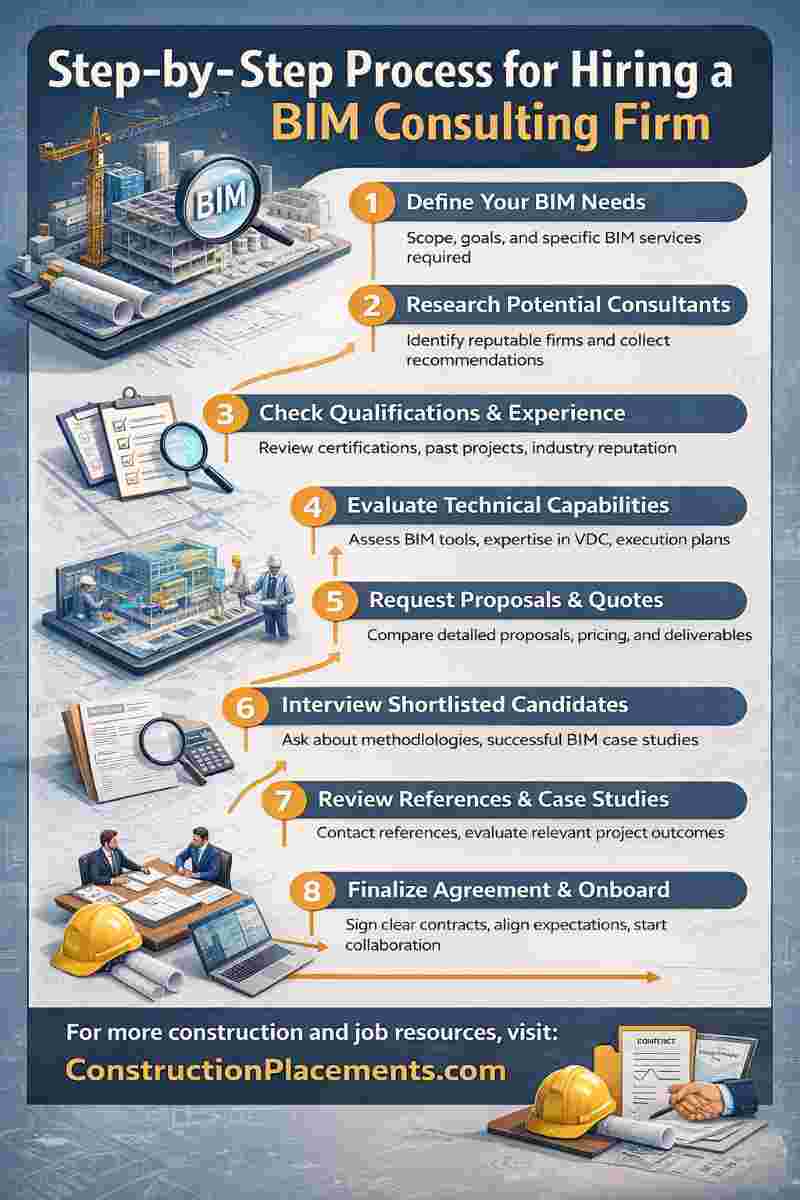
The ConstructionPlacements guide to hiring BIM consultants outlines a structured process that organizations can adapt to their specific needs.
Step 1 – Understand the Role: Familiarize yourself with the responsibilities of a BIM consultant, including assessment, planning, tool selection, training, data management, and compliance. This understanding shapes realistic expectations.
Step 2 – Identify Needs: Conduct an internal audit to define your BIM objectives and current capabilities. Document gaps between where you are and where you need to be.
Step 3 – Prepare RFP/RFQ: Draft a request for proposals outlining scope, deliverables, and evaluation criteria based on the selection factors detailed above. Include specific metrics for comparing submissions.
Step 4 – Screen Candidates: Review resumes and portfolios, focusing on project types, role involvement, and demonstrated innovations. Create a scoring matrix to compare candidates on expertise, experience, communication skills, and cultural fit.
Step 5 – Check References and Certifications: Contact references to obtain unbiased feedback on actual project performance. Verify certifications such as Autodesk Certified Professional or buildingSMART Professional, and confirm compliance with ISO standards.
Step 6 – Conduct Interviews: Assess communication skills, problem-solving abilities, and understanding of your specific project needs. Ask how candidates handled past challenges to evaluate their approach to difficulties.
Step 7 – Run a Pilot Project: Execute a small test project to evaluate performance, collaboration, and responsiveness in real working conditions before committing to larger engagements.
Step 8 – Negotiate Contract: Define scope, schedule, compensation, and IP ownership in detail. Ensure the contract addresses confidentiality, data security, dispute resolution, and deliverable milestones.
Step 9 – Manage the Relationship: Schedule regular reviews, track deliverables against milestones, and adjust resources as needed. Plan for training, knowledge transfer, and long-term support from the beginning.
Common Pitfalls to Avoid
Even with careful selection, projects can falter if certain pitfalls remain unaddressed. Awareness of these common mistakes enables proactive risk mitigation.
Focusing Solely on Cost: Cheaper services often lack expertise or adequate resources, leading to delays and rework that exceed any initial savings. Evaluate value and capabilities rather than price alone.
Ignoring Standards: Consultants unfamiliar with ISO 19650 or local codes may create models requiring significant rework. Standards compliance should be a threshold requirement, not an optional consideration.
Insufficient Communication: Poor coordination leads to misinterpretations and delays. Establish clear communication protocols and use shared platforms from project initiation.
Overlooking Data Security: Without clear IP and data ownership agreements, future disputes or data breaches become likely. Address security requirements contractually before work begins.
Neglecting Training: Failing to plan for staff training and handover leaves your team unprepared to maintain BIM workflows after the consultant departs. Include training provisions in your initial scope.
Inadequate References: Not contacting previous clients may hide issues such as poor quality or missed deadlines. Invest time in thorough reference checks.
Cultural Misalignment: A consultant with different values or communication styles may struggle to integrate with your team. Assess cultural fit alongside technical capabilities.
Recommended Courses and Resources
While working with a consultant, you can strengthen your team’s BIM competence through structured learning programs. These courses align with the needs of BIM professionals at various levels of experience.
The Construction Management Specialization offered on Coursera by the University of Michigan teaches project scheduling, cost estimation, and risk management. This program is ideal for project managers seeking to integrate BIM with broader construction management skills.
For designers seeking hands-on experience, Virtual Building Design for Engineers Using Autodesk Revit on edX focuses on Revit skills, parametric modeling, and interoperability across platforms.
The BIM Fundamentals for Engineers course provides a practical introduction to BIM workflows, enabling engineers to understand model creation, clash detection, and cost estimation applications.
These learning resources help professionals and organizations enhance their digital capabilities, enabling them to make more informed decisions when working with BIM consultants and build internal expertise for long-term success.
Related Posts:
- How to Become a Management Consultant [Updated Career Guide]
- Breaking into Construction Consulting: Career Paths and Skills Required
- Types of Consultants Involved in Construction Projects
- Tips on How to Become a Great Engineering Consultant
Conclusion: Securing the Right BIM Partner
Selecting the right BIM consulting firm is a decision that reverberates through the entire life cycle of your project. The ideal partner combines technical mastery with industry experience, strong communication skills, compliance knowledge, innovative capabilities, and cultural alignment with your organization.
By carefully defining your needs, assessing candidates against the criteria detailed in this guide, and conducting thorough evaluations including reference checks and pilot projects, you can secure a consultant who transforms your project outcomes rather than simply completing tasks.
Avoid common pitfalls by focusing on value rather than price alone, emphasizing standards compliance and clear communication, protecting data through contractual provisions, and planning for training from the outset.
As digital transformation accelerates across the AEC industry, BIM consulting firms will play an increasingly central role in delivering efficient, sustainable, and safe projects. Engage with your chosen consultant early in the project lifecycle, invest in your team’s BIM literacy, and embrace a collaborative mindset that maximizes the value of your digital investment.
Ready to advance your BIM journey? Explore additional resources on hiring BIM consultants, leveraging BIM in construction management, and our comprehensive BIM career resources. Share your experiences and questions in the comments—your insights help others make informed decisions.
FAQs About Choosing a BIM Consulting Firm
Examine projects similar in size and complexity to yours, with attention to industry-specific experience such as healthcare, infrastructure, or commercial construction. Request actual BIM outputs rather than marketing summaries, and ask about Level of Development (LOD) and documentation quality. Look for models built using open standards like IFC, and note whether the consultant handled both modeling and coordination responsibilities.
BIM provides a central platform for real-time data sharing and model updates accessible to all authorized stakeholders. Research indicates that implementing BIM can improve collaboration outcomes by up to 30%, as project participants gain immediate access to changes and coordinated information. This transparency reduces misunderstandings, enhances teamwork, and accelerates decision-making throughout the project lifecycle.
Certification isn’t legally required but indicates demonstrated competence and commitment to professional standards. Valuable qualifications include Autodesk Certified Professional, buildingSMART Professional, or membership in recognized professional bodies. You should also verify that the consultant complies with ISO 19650 and other applicable industry standards relevant to your project.
Yes, but consider time zone differences, communication challenges, and regulatory compliance for your project location. Ensure that overseas firms have experience with your market’s specific regulations and that data security and intellectual property protections are explicitly addressed. Conduct pilot projects and thorough reference checks to assess fit before committing to larger engagements.
Effective training should include hands-on workshops for your staff on chosen software platforms, guidance on naming conventions and information management protocols, and mentoring on collaborative workflows. Comprehensive documentation and post-project support help ensure a smooth transition to independent operation after the consulting engagement concludes.
