
Last Updated on April 10, 2026 by Admin
Choosing the right professional certification can reshape your construction career — but with two heavyweights competing for your attention, the decision is anything but simple. The Certified Construction Manager (CCM) from CMAA and the Project Management Professional (PMP) from PMI are both respected credentials, yet they serve fundamentally different career strategies.
ConstructionCareerHub App is LIVE — built ONLY for construction careers. Don’t apply with a weak resume.
Get ATS-ready Resume Lab + Interview Copilot + Campus Placement Prep (resume screening, skill gaps, interview readiness) — in minutes & Other advanced features.
Explore Smarter Construction Career Tools →Quick check. Big impact. Start now.
If you manage construction projects and want industry-specific recognition, CCM is purpose-built for you. If you want a globally portable credential that works across industries — from IT to infrastructure — PMP offers unmatched versatility. But the real answer depends on where you are in your career, what projects you manage, and where you want to go next.
This in-depth 2026 comparison breaks down eligibility, costs, exam structure, salary impact, career ROI, and strategic scenarios so you can make a confident, informed decision. Whether you are a mid-career site manager eyeing executive roles or a project engineer planning your next credential, this guide gives you the clarity you need.
Table of Contents
What Is the CCM Certification?
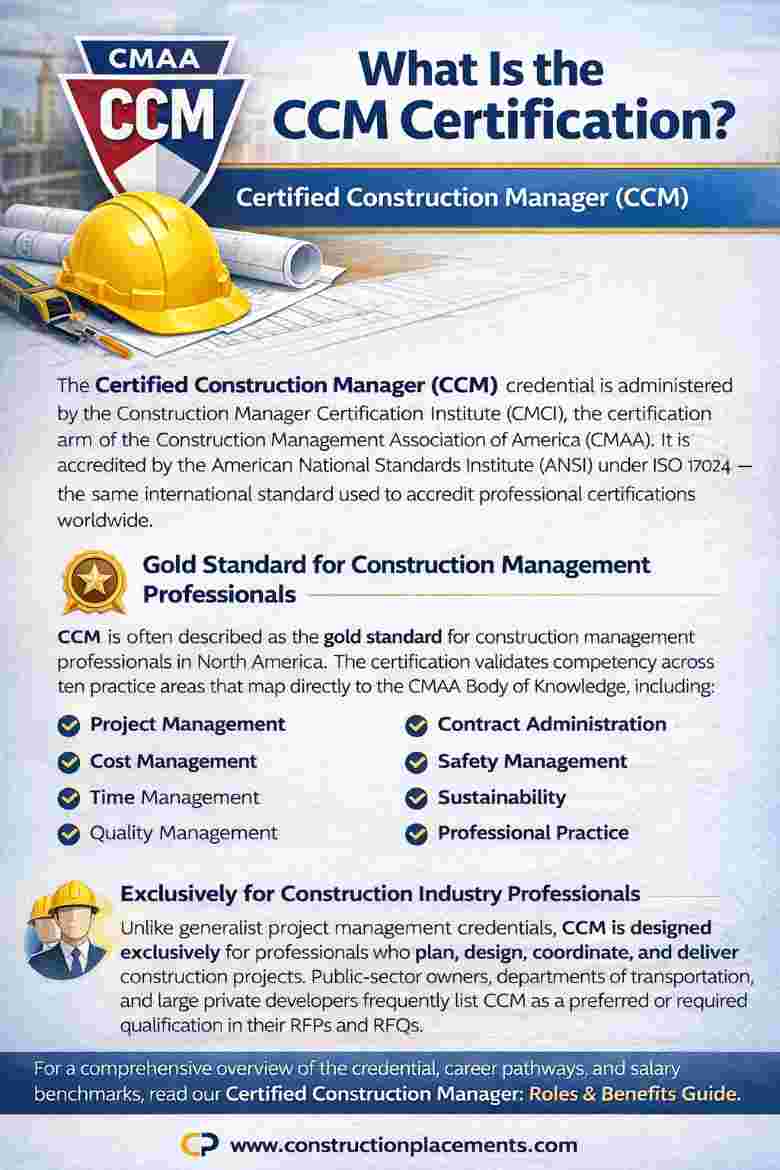
The Certified Construction Manager (CCM) credential is administered by the Construction Manager Certification Institute (CMCI), the certification arm of the Construction Management Association of America (CMAA). It is accredited by the American National Standards Institute (ANSI) under ISO 17024 — the same international standard used to accredit professional certifications worldwide.
CCM is often described as the gold standard for construction management professionals in North America. The certification validates competency across ten practice areas that map directly to the CMAA Body of Knowledge, including project management, cost management, time management, quality management, contract administration, safety management, sustainability, and professional practice.
Unlike generalist project management credentials, CCM is designed exclusively for professionals who plan, design, coordinate, and deliver construction projects. Public-sector owners, departments of transportation, and large private developers frequently list CCM as a preferred or required qualification in their RFPs and RFQs.
For a comprehensive overview of the credential, career pathways, and salary benchmarks, read our Certified Construction Manager: Roles & Benefits Guide.
What Is the PMP Certification?
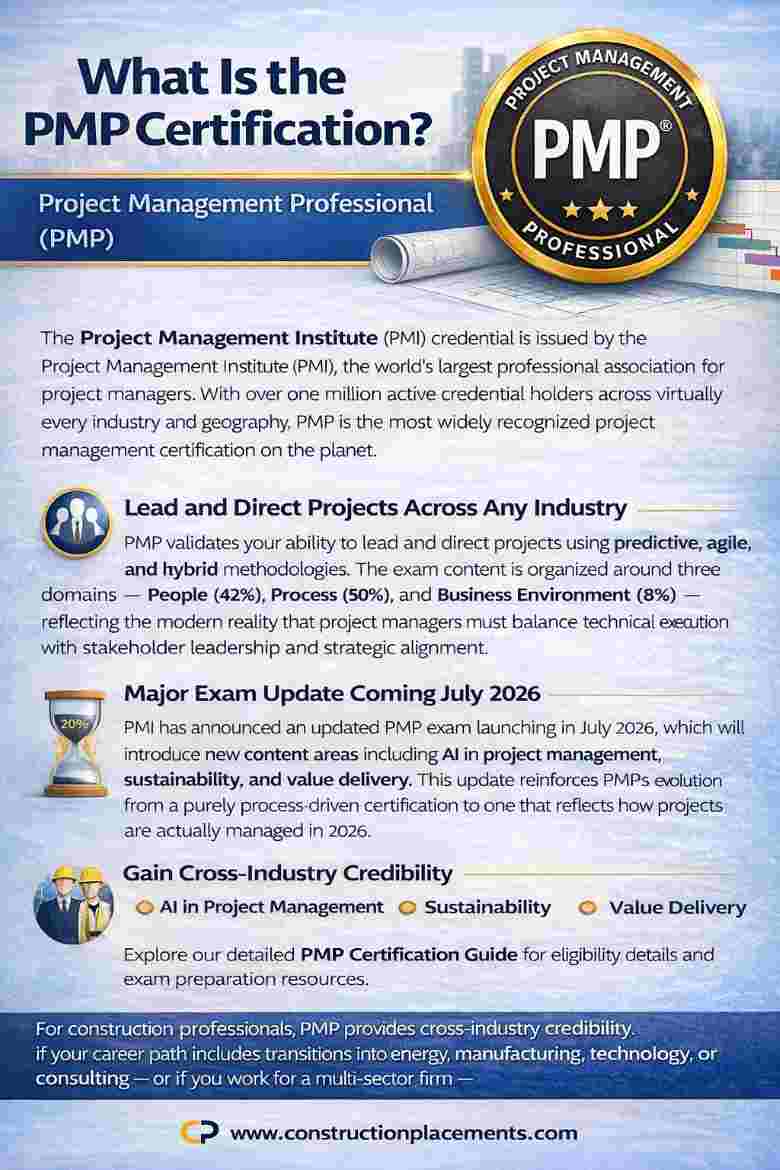
The Project Management Professional (PMP) credential is issued by the Project Management Institute (PMI), the world’s largest professional association for project managers. With over one million active credential holders across virtually every industry and geography, PMP is the most widely recognized project management certification on the planet.
PMP validates your ability to lead and direct projects using predictive, agile, and hybrid methodologies. The exam content is organized around three domains — People (42%), Process (50%), and Business Environment (8%) — reflecting the modern reality that project managers must balance technical execution with stakeholder leadership and strategic alignment.
PMI has announced an updated PMP exam launching in July 2026, which will introduce new content areas including AI in project management, sustainability, and value delivery. This update reinforces PMP’s evolution from a purely process-driven certification to one that reflects how projects are actually managed in 2026.
For construction professionals, PMP provides cross-industry credibility. If your career path includes transitions into energy, manufacturing, technology, or consulting — or if you work for a multi-sector firm — PMP gives you a credential that travels with you. Explore our detailed PMP Certification Guide for eligibility details and exam preparation resources.
CCM vs PMP: Side-by-Side Comparison Table
| Criteria | CCM (CMAA/CMCI) | PMP (PMI) |
|---|---|---|
| Issuing Body | Construction Manager Certification Institute (CMCI) under CMAA | Project Management Institute (PMI) |
| Industry Focus | Construction-specific | Cross-industry (applicable to construction, IT, healthcare, energy, etc.) |
| Accreditation | ANSI/ANAB accredited under ISO 17024 | ANSI accredited; globally recognized |
| Education Requirement | Bachelor’s degree (construction management, engineering, architecture, or related field) | Four-year degree + 36 months PM experience + 35 contact hours; OR high school diploma + 60 months PM experience + 35 contact hours |
| Experience Requirement | 48 months (4 years) of construction management experience | 36 months with a degree; 60 months without a degree |
| Exam Format | 175 multiple-choice questions; 4 hours | 180 questions (multiple choice + multiple response); 230 minutes |
| Exam Domains | 10 practice areas (project management, cost, time, quality, safety, sustainability, contracts, professional practice, etc.) | 3 domains — People (42%), Process (50%), Business Environment (8%) |
| Pass Rate | Approximately 60–65% | Approximately 60–65% (estimated; PMI does not officially publish) |
| Exam Fee | ~$375–$500 (application + exam registration) | $405 (PMI members) / $555 (non-members) |
| Total Certification Cost | ~$1,000–$1,500 (including study materials) | ~$700–$1,500 (including training for 35 contact hours) |
| Renewal Cycle | Every 3 years; 25 renewal points + $200 fee | Every 3 years, 60 PDUs + $60 (members) or $150 (non-members) |
| Salary Premium | 10–15% over non-certified peers | Up to 33% over non-certified peers (per PMI Salary Survey, 14th Edition, 2025) |
| Global Recognition | Strong in North America; growing internationally | Recognized in 200+ countries worldwide |
| Best For | Construction managers, owner’s reps, CM-at-risk firms, public-sector CM roles | Project managers across all industries, including construction |
Eligibility Requirements: CCM vs PMP
CCM Eligibility
To qualify for the CCM exam, candidates must hold a bachelor’s degree in construction management, engineering, architecture, or a related discipline, plus a minimum of 48 months (four years) of responsible-in-charge construction management experience. Candidates must also provide at least two professional references who can verify their construction management experience.
Alternative pathways exist for candidates without a traditional CM degree, but extensive field experience is required. The CMCI evaluates each application individually, considering equivalent education and experience combinations.
PMP Eligibility
PMP eligibility follows a two-tier structure. Candidates with a four-year degree need 36 months of project management experience and 35 contact hours of project management education. Those with a high school diploma or associate degree need 60 months of project management experience plus the same 35 contact hours.
Importantly, PMP does not require construction-specific experience. Your qualifying project management experience can come from any industry, which makes PMP accessible to a broader range of professionals.
For a deeper dive into certification eligibility and career pathways, see our guide on How to Become a Certified Construction Project Manager in 2026.
Exam Structure and Content
CCM Exam
The CCM exam consists of 175 multiple-choice questions administered over a 4-hour time limit. The exam covers ten practice areas aligned with the CMAA Standards of Practice, including program and project management (weighted at approximately 20%), safety management (10%), cost management, time management, quality management, contract administration, sustainability, technology, and professional practice.
Candidates must achieve an overall score of 70% or higher. The exam is available at Pearson VUE testing centers or following CMAA’s Professional Construction Manager (PCM) course. Most successful candidates report 3–6 months of dedicated preparation, often using the CMAA Standards of Practice publication and the CCM Study Guide as primary resources.
PMP Exam
The PMP exam includes 180 questions — a mix of multiple-choice, multiple-response, matching, hotspot, and limited fill-in-the-blank formats — to be completed in 230 minutes (3 hours, 50 minutes). Two optional 10-minute breaks are built into the computer-based exam.
Content is organized around three domains: People (42%), Process (50%), and Business Environment (8%). Questions blend predictive (waterfall), agile, and hybrid project management approaches. Approximately half of the exam content addresses agile or hybrid methodologies, reflecting PMI’s emphasis on adaptive delivery.
With the July 2026 exam update, PMI is incorporating new topics around artificial intelligence, sustainability, and value delivery — making the exam more aligned with how modern construction projects integrate technology and ESG considerations.
Salary Impact: CCM vs PMP for Construction Professionals
Both certifications deliver measurable salary premiums, but the magnitude differs based on role, employer type, and geography.
CCM Salary Data
Research consistently shows that CCM-certified professionals earn approximately 10–15% more than their non-certified construction management peers. According to current market data, CCM holders earn in the following ranges based on career stage: entry-level CCM professionals earn $85,000–$105,000 annually, mid-level professionals earn $105,000–$135,000, and senior-level CCM professionals command $135,000–$180,000 or more.
CCM holders are especially well-compensated in owner’s representative firms, public-sector agencies, and CM-at-risk organizations where the credential directly influences RFP qualifications and project awards.
PMP Salary Data
PMI’s 14th Edition Earning Power Salary Survey (published November 2025) reports that PMP-certified professionals earn a median of 33% more than non-certified project managers globally. In the United States, PMP holders in construction-related roles typically earn $95,000–$150,000+ annually, depending on experience and project complexity.
The PMP salary premium is particularly strong for professionals managing large-scale infrastructure, data center construction, semiconductor fabrication facilities, and multi-sector programs where cross-industry project management expertise commands top compensation.
For detailed salary benchmarks across construction management roles, explore our Construction Manager Salaries in the USA guide and the comprehensive Construction Management Degree Salary Breakdown.
Career Paths: Which Certification Opens More Doors?
CCM Career Trajectory
CCM positions you as a construction industry specialist. The credential is most impactful for professionals pursuing roles such as senior construction manager, director of construction, owner’s representative, program manager for public-sector infrastructure, and VP of construction at CM firms. Many federal, state, and municipal agencies — particularly departments of transportation — list CCM as a preferred or required qualification in project solicitations.
If you plan to build your career within construction and rise to executive-level roles at CMAA-member firms or public agencies, CCM provides the strongest industry-specific signal of competence.
PMP Career Trajectory
PMP positions you as a versatile project leader with credentials that transfer across industries. Construction professionals with PMP can pursue roles as project director, program manager, PMO lead, delivery manager, or engagement manager — not just in construction but also in energy, technology, consulting, and manufacturing.
PMP is particularly valuable for construction professionals working at large engineering-procurement-construction (EPC) firms like Bechtel, Fluor, or Jacobs, where projects span multiple sectors and geographies. If your career ambitions extend beyond pure construction into multi-sector project leadership, PMP provides the broadest optionality.
Read more about construction career progression in our Project Management Careers in Construction guide and What Can You Do With a Construction Management Degree.
When to Choose CCM Over PMP
CCM is the stronger choice if your career is firmly rooted in the construction industry and you want a credential that directly maps to how construction projects are managed. Consider CCM when:
You work primarily in construction management delivery — as a CM, owner’s rep, or construction program manager. Your employer or clients specifically request CCM in RFPs and RFQs. You are targeting senior leadership positions at CMAA-member firms or public agencies. Your day-to-day responsibilities center on construction-specific challenges: cost control, schedule management, safety compliance, contract administration, quality management, and sustainability in the built environment. You want a credential that demonstrates deep domain expertise in construction management rather than general project management knowledge.
When to Choose PMP Over CCM
PMP is the better investment if you want maximum career flexibility and a credential recognized across industries worldwide. Consider PMP when:
You work (or plan to work) at multi-sector firms where construction is one of several business lines. You want to keep your career options open for transitions into technology, energy, consulting, or other industries. Your organization uses PMI’s PMBOK framework, agile methodologies, or hybrid delivery approaches. You are targeting roles with global mobility — PMP is recognized in 200+ countries. You want the highest documented salary premium among project management certifications (33% per PMI’s 2025 data).
Can You Get Both CCM and PMP?
Absolutely — and for many construction professionals, holding both CCM and PMP is the optimal strategy. The two certifications complement each other rather than compete. CCM validates your construction-specific expertise, while PMP validates your cross-industry project management competence.
Professionals who hold both credentials are exceptionally well-positioned for senior leadership roles, executive positions, and consulting engagements where clients expect both industry depth and project management rigor. The dual-certification approach is increasingly common among construction directors, VPs of construction, and owners’ representatives managing billion-dollar programs.
One practical advantage: renewal activities can overlap. Continuing education credits earned for PMP renewal (PDUs) may count toward CCM renewal points, and vice versa — professionals who hold a PE license can use their PDH credits toward CCM recertification as well.
Review our comprehensive Top Construction Management Certifications guide to explore how CCM, PMP, and other credentials stack up.
PMI-CP: The New Construction-Specific PMI Credential
It is worth noting that PMI has introduced the PMI Construction Professional (PMI-CP) credential, designed specifically for construction industry project managers. PMI-CP bridges the gap between PMP’s generalist approach and the construction-specific focus of CCM.
As of 2026, PMI-CP is still building market recognition, but it represents PMI’s acknowledgment that construction project management requires specialized competencies beyond the standard PMP framework. For professionals evaluating their certification strategy, PMI-CP may be worth watching as the credential matures and gains wider industry adoption.
Study Resources and Preparation Tips
CCM Exam Preparation
The primary study resources for CCM include the CMAA Standards of Practice, the CCM Study Guide, and the CII Best Practices Guide (IR166-3). CMAA also offers the Professional Construction Manager (PCM) course and the Standards of Practice Distance Learning Course as structured preparation options.
Most successful candidates invest 3–6 months in preparation, focusing on the ten practice areas and applying their real-world construction management experience to exam scenarios. Joining a CMAA chapter for networking and study group opportunities can also accelerate preparation.
PMP Exam Preparation
PMP preparation centers on the PMBOK Guide (Seventh Edition, included free with PMI membership), PMI’s Agile Practice Guide, and structured training courses that deliver the required 35 contact hours. Popular preparation paths include PMI Authorized Training Partner (ATP) courses, online bootcamps, and self-paced platforms.
Most working professionals complete PMP preparation in 2–6 months. High-quality practice exams and simulators are critical for success — candidates who consistently score above 75% on practice tests typically pass the actual exam on their first attempt.
Browse our curated list of Best Project Management Online Courses for recommended training programs and platforms.
Recommended Online Courses
Here are a few highly rated courses to support your CCM or PMP preparation:
Google Project Management Professional Certificate — Coursera (qualifies for PMP 35 contact hours)
Project Management Principles — edX
Industry Trends Shaping CCM and PMP Value in 2026
Several macro-trends are increasing the value of both certifications in 2026 and beyond:
Infrastructure Investment: The continued rollout of U.S. federal infrastructure funding (IIJA and CHIPS Act) is creating unprecedented demand for certified construction managers and project leaders. Agencies awarding billions in contracts increasingly specify CCM or PMP as preferred qualifications.
AI and Digital Transformation: PMI’s July 2026 exam update incorporates AI in project management, reflecting the industry’s shift toward digital tools, predictive analytics, and agentic AI for scheduling and risk management. CMAA’s Standards of Practice also address technology integration, ensuring CCM holders stay current.
Sustainability and ESG: Both certifications now address sustainability — CCM through its dedicated sustainability practice area, and PMP through the upcoming exam’s sustainability domain. Construction professionals who pair CCM or PMP with a LEED credential position themselves at the intersection of project leadership and green building.
Workforce Shortage: With 78% of construction firms reporting hiring difficulties and 20% of the construction workforce over age 55, certified professionals command premium compensation and accelerated career progression. Credentials like CCM and PMP differentiate you in a talent-starved market.
Explore our Highest Paying Construction Jobs in the US to see how certifications impact compensation across roles.
CCM vs PMP: Decision Framework
To simplify your decision, consider these scenarios:
Choose CCM if: You are 100% committed to a construction career, your clients or employers value CMAA credentials, and you want the strongest possible signal of construction-specific expertise.
Choose PMP if: You want a globally portable credential, work in or plan to enter multi-sector organizations, and want the highest documented salary premium for project managers.
Choose both if: You aspire to executive-level construction roles (VP, director, program manager), work on billion-dollar programs, or want to maximize both depth and breadth of professional credibility.
Choose neither yet if: You have fewer than three years of experience — consider starting with the CAPM (PMI) or CACM (CMAA) as stepping-stone credentials.
Build Your Construction Career With the Right Tools
Certification is one pillar of career advancement — but you also need the right tools to land your next role. ConstructionCareerHub.com offers AI-powered career tools designed specifically for construction professionals:
Resume Lab — Build an ATS-ready resume tailored to construction management roles, optimized for keywords that hiring managers and applicant tracking systems look for.
Interview Copilot — Practice with AI-generated interview questions specific to construction project management, including CCM and PMP-related scenarios.
Career Planner — Map your certification pathway, identify skill gaps, and create a structured career development plan aligned with your goals.
Recommended eBooks
Supplement your certification journey with these career-focused resources:
Construction Job Interview Guide — 300 Interview Questions & Answers
BIM Job Interview Preparation Guide + 210 Interview Questions
Construction Career Resource Bundle — Complete Package
Remote Construction Job Search Guide
You might be interested in Project Management Career Guide 2026: Salary, Skills & Growth Path.
Frequently Asked Questions (FAQ)
Is CCM better than PMP for construction careers?
CCM is better if your career is exclusively in construction management and your employers or clients specifically value CMAA credentials. PMP is better if you want cross-industry flexibility and the highest salary premium. Many senior construction professionals hold both.
Which certification pays more — CCM or PMP?
PMP holders report a higher average salary premium (up to 33% per PMI’s 2025 data) compared to CCM’s 10–15% premium. However, in construction-specific roles — particularly owner’s representative and public-sector CM positions — CCM holders may command equal or higher compensation because the credential directly qualifies them for project awards.
Can I get CCM without a construction management degree?
Yes. The CMCI considers alternative education and experience combinations. However, a bachelor’s degree in construction management, engineering, or architecture is the most common and straightforward pathway. Candidates without a relevant degree typically need significantly more field experience.
How long does it take to get CCM vs PMP?
CCM typically takes 4–7 years from career start to certification (including the 48-month experience requirement plus 3–6 months of exam preparation). PMP can be achieved in 3–5 years with a bachelor’s degree (36 months of experience plus 2–6 months of preparation).
Is PMP recognized in the construction industry?
Yes. PMP is widely recognized and valued in construction, particularly at large EPC firms, international contractors, and organizations that manage projects across multiple industries. Many construction employers list PMP as a preferred qualification alongside CCM.
What is the PMI-CP certification?
The PMI Construction Professional (PMI-CP) is a newer credential from PMI designed specifically for construction project managers. It combines PMI’s project management methodology with construction-specific content. As of 2026, it is still building market adoption but may become a strong alternative or complement to CCM.
Do I need CCM or PMP for government construction projects?
Many U.S. government agencies — including state DOTs and federal entities — prefer or require CCM for construction management roles. PMP is also accepted but CCM carries more weight in public-sector construction procurement because it is construction-specific and ANSI-accredited.
Can PMP PDUs count toward CCM renewal?
In many cases, continuing education activities count toward both certifications. CCM renewal requires 25 points over three years, and professional development courses, conference attendance, and other qualifying activities can overlap with PMP’s 60-PDU requirement. Professionals who also hold a PE license can use their PDH credits toward CCM renewal as well.
For more career guidance, certifications, and construction industry insights, explore ConstructionPlacements.com — your trusted resource for building a successful construction career.
