


Last Updated on December 8, 2025 by Admin
While engineers worldwide treat BIM as optional software training, the global construction delivery system has moved on. From Dubai’s megaprojects to Singapore’s smart cities, BIM literacy is now baseline professional currency. But learning Revit alone won’t help. BIM functions as a career multiplier—a leverage system changing how projects are delivered. This article explains why BIM creates exponential career mobility that traditional construction experience cannot match, and how to position strategically before markets catch up.
ConstructionCareerHub App is LIVE — built ONLY for construction careers. Don’t apply with a weak resume.
Get ATS-ready Resume Lab + Interview Copilot + Campus Placement Prep (resume screening, skill gaps, interview readiness) — in minutes & Other advanced features.
Explore Smarter Construction Career Tools →Quick check. Big impact. Start now.
Table of Contents
Why BIM Is NOT “Just Another Software”
Most civil engineers approach BIM the same way they approached AutoCAD in the 1990s: as a drafting upgrade. This fundamental misunderstanding explains why so many professionals invest in BIM training but see minimal career acceleration.
BIM represents a paradigm shift in three dimensions that matter for career growth:
From Drawings to Data-Driven Decision Making
Traditional project delivery revolves around documentation. BIM fundamentally reorganizes project delivery around structured information. When a structural engineer models a beam in Revit, they’re not creating a drawing—they’re generating queryable data that feeds cost estimation, fabrication sequencing, energy analysis, and facility management systems.
According to Autodesk’s BIM adoption research, projects that use BIM see 40% fewer unbudgeted changes and 75% faster procurement cycles, specifically because information is available in structured, queryable formats rather than static representations.
This shift doesn’t just change project delivery—it changes which professionals employers value. The market increasingly rewards those who can extract, analyze, and act on project data rather than those who simply produce documentation.
Lifecycle Ownership Beyond Design Phase
Traditional project involvement ends at handover. BIM extends professional value through the entire asset lifecycle. The digital twin generated during design becomes the operational intelligence system for facility managers. Research from the
World Economic Forum’s construction digitization initiative demonstrates that facilities leveraging BIM data reduce operating costs by 20-30% and extend asset lifecycles by 15-20 years. This creates entirely new career pathways that didn’t exist in the drawing-based delivery model.
Engineers who understand BIM’s lifecycle implications position themselves for roles in digital facility management, smart infrastructure operations, and asset optimization—all higher-paying, less physically demanding than traditional site work.
Multi-Stakeholder Collaboration Across Borders
Perhaps most critically for career mobility, BIM standardizes communication across disciplines, companies, and countries. The
buildingSMART International ISO 19650 framework creates a common language for project delivery that transcends regional construction practices. An engineer fluent in ISO 19650 workflows can collaborate seamlessly on projects in London, Dubai, or Singapore without needing to relearn fundamental delivery processes.
This standardization is why BIM skills transfer internationally far more effectively than traditional construction experience, which remains heavily localized by building codes, procurement methods, and regional practices.
BIM as a Career Multiplier (The Strategic Framework)
The career multiplication effect of BIM operates across four distinct vectors that traditional construction experience cannot match. Understanding these vectors allows you to make strategic choices about which BIM competencies to develop and when.
Role Mobility: Vertical and Lateral Career Movement
BIM creates unprecedented role mobility because the same foundational knowledge supports multiple career trajectories. Consider these actual career paths we’ve observed across global markets:
1. Site Engineer → BIM Coordinator → BIM Manager → Digital Delivery Director
A civil engineer with 3 years site experience who develops BIM coordination skills typically moves into coordination roles within 12-18 months. With proven delivery on 2-3 major projects, progression to BIM Manager roles commanding $85,000-$120,000 globally becomes achievable within 5-6 years total experience. The same timeline in traditional site engineering might reach senior site engineer at $60,000-$75,000.
2. Architect → BIM Manager → Digital Construction Consultant
Architects with BIM management experience increasingly transition into consulting roles advising clients on digital delivery strategy. These positions offer project variety, international travel, and compensation packages 40-60% higher than traditional practice roles.
3. Quantity Surveyor → 5D BIM Cost Professional → Construction Technology Specialist
QS professionals who master 5D BIM workflows (cost linked to model geometry and scheduling) position themselves at the intersection of technology and commercial management. These hybrid roles are particularly scarce in Middle Eastern markets, commanding premium compensation.
The multiplication factor comes from BIM’s ability to support multiple parallel career moves. A BIM Coordinator with strong technical skills can pivot into VDC (Virtual Design & Construction), prefabrication coordination, or digital twin development—options that don’t exist in traditional delivery models.
Geographic Mobility: Working Anywhere Standards Apply
BIM competency unlocks international career mobility far more effectively than traditional construction credentials. Here’s why: while building codes, contracting approaches, and construction methods vary dramatically across countries, BIM delivery frameworks are increasingly standardized globally.
An engineer proficient in ISO 19650 workflows, COBie data standards, and IFC schema can apply these same competencies whether working on London’s Crossrail extension, Dubai’s new airport terminal, or Singapore’s infrastructure projects. The underlying information management principles remain consistent even as local building regulations change.
This explains why Middle Eastern contractors actively recruit BIM professionals from the UK, Australia, and Europe—they’re hiring process knowledge that transfers directly, not localized construction experience that requires adaptation.
According to recruitment data from major GCC markets, BIM-qualified professionals receive 30-40% higher relocation packages compared to traditional engineering roles, specifically because their knowledge translates immediately.
Compensation Ceiling: Breaking Traditional Salary Caps
Traditional construction career paths hit natural salary ceilings based on role specialization. Site engineers plateau around $70,000-$90,000 unless they move into project management. Structural designers face similar caps of around $80,000-$100,000.
BIM careers operate under fundamentally different economics because they create leverage across multiple projects simultaneously. A BIM Manager overseeing coordination across a $500M program touches every design discipline, every contractor package, and every major decision point. This organizational leverage justifies compensation that traditional site-based roles—even at senior levels—cannot command.
More importantly, BIM expertise enables consulting and freelancing models that break the employment salary ceiling entirely. Experienced BIM consultants billing at $120-$180/hour for specialized services (clash detection optimization, federated model reviews, ISO 19650 compliance auditing) can substantially exceed traditional employment income while maintaining schedule flexibility.
Discipline Mobility: Moving Between Technical Domains
Perhaps BIM’s most underappreciated career advantage is its ability to facilitate movement across technical disciplines. Traditional construction careers remain highly siloed—structural engineers rarely move into MEP, architects don’t typically transition into quantity surveying, and site engineers stay on the delivery side of project walls.
BIM coordination inherently requires cross-disciplinary literacy. A BIM Coordinator managing federated models must understand structural framing constraints, MEP routing logic, architectural intent, and construction sequencing simultaneously. This breadth of knowledge creates unusual career pathways:
- Civil engineers moving into architectural coordination roles
- MEP designers transitioning into construction planning
- Quantity surveyors evolving into VDC managers
- Architects becoming prefabrication specialists
These transitions happen because BIM shifts the professional value proposition from discipline-specific technical depth to cross-discipline coordination and information management—skills that transfer readily across traditional boundaries.
BIM Career Paths That Scale Faster
Not all BIM career paths offer equal multiplication effects. The following table maps high-leverage roles, their entry requirements, global market demand, and specific acceleration factors.
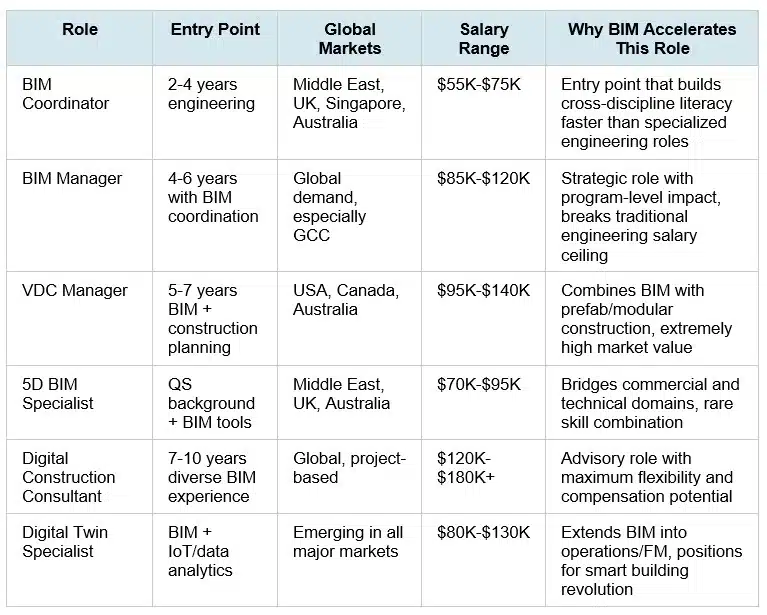
The acceleration factor becomes clear when comparing BIM career timelines to traditional paths. A motivated engineer can progress from entry-level to six-figure BIM leadership within 6-8 years. The same timeline in traditional site engineering might reach a senior site engineer or a junior project manager—roles that still operate within conventional salary ranges.
Why BIM Skills Travel Better Than Traditional Roles
International career mobility represents one of BIM’s most significant but least discussed advantages. While traditional construction experience remains heavily localized by regional practices, BIM competency operates at a fundamentally more portable level.
Global Standardization Through ISO 19650
The ISO 19650 series has created the first truly global framework for construction information management. Originally developed as the UK’s BS 1192 and PAS 1192 standards, ISO 19650 now provides internationally recognized protocols for BIM implementation across project lifecycles.
This standardization means professionals trained in ISO 19650 workflows can immediately contribute to projects in any market that has adopted these frameworks—which increasingly includes the UK, EU members, Australia, Singapore, and rapidly expanding Middle Eastern markets. The underlying principles of information requirements, delivery phases, and data drops remain consistent regardless of local building codes or construction methods.
Market Demand Transcends Geographic Boundaries
Every major construction market globally faces the same challenge: an acute shortage of professionals who can manage digital delivery workflows. Unlike traditional construction roles, where markets can source locally, BIM expertise requires active international recruitment.
Middle Eastern megaprojects actively recruit BIM professionals from Europe, the UK, and Australia. UK infrastructure programs source talent from across the EU and the Commonwealth. Australian contractors bring specialists from Singapore and New Zealand. This cross-border talent flow happens specifically because BIM knowledge transfers directly, while traditional construction experience requires substantial local adaptation.
Freelancing and Remote Work Opportunities
BIM’s digital nature enables consulting and freelancing models that don’t exist in traditional construction delivery. Specialized services like federated model coordination, clash detection optimization, COBie data validation, and BIM execution planning can be delivered remotely to clients globally.
Experienced BIM professionals increasingly structure careers around short-term project engagements rather than permanent employment. A six-month contract coordinating BIM for a major infrastructure program might generate more income than a full year in permanent employment, while providing schedule flexibility for skill development or personal priorities.
Future-Proof Career Resilience
Perhaps most importantly for long-term career security, BIM aligns with the irreversible digitization trend across global construction. As
McKinsey research on construction digitization demonstrates, the industry faces unprecedented pressure to improve productivity through digital adoption. Companies that resist this shift face competitive extinction. Professionals who resist face career stagnation.
BIM literacy won’t guarantee career success—but the absence of BIM competency will increasingly guarantee irrelevance as procurement specifications, client requirements, and project delivery standards make digital delivery non-optional.
BIM + Country Mobility Advantage
BIM competency unlocks specific geographic markets that offer both higher compensation and better career progression compared to many domestic markets. Understanding which markets prioritize BIM and why allows for strategic career positioning.
Middle East: Megaproject-Driven BIM Demand
UAE, Saudi Arabia, and Qatar have mandated BIM for major public works, creating sustained demand that far exceeds local supply. The scale of projects—new cities, airports, stadiums, transportation networks—requires coordination complexity that only BIM workflows can manage.
Compensation packages for BIM professionals in GCC markets typically include tax-free salaries 40-60% higher than equivalent roles in home markets, plus housing, transportation, and education allowances. More importantly, the project scale and complexity provide condensed career development that might require decades to accumulate in slower-moving markets.
UK & EU: Compliance-Driven BIM Adoption
The UK’s BIM Level 2 mandate for public projects and EU’s increasing adoption of digital delivery standards create steady, compliance-driven demand. Unlike megaproject markets where demand might fluctuate with economic cycles, regulatory requirements create baseline hiring needs that persist regardless of construction volume.
UK and European markets also emphasize formal qualifications and certifications, creating clear career pathways for professionals willing to invest in credential development. The combination of stable demand, recognized career structures, and quality of life makes these markets attractive for long-term career development rather than short-term income optimization.
Australia & Singapore: Public Infrastructure BIM Mandates
Australia’s infrastructure pipeline and Singapore’s smart nation initiatives both mandate BIM delivery for major public works. These markets combine regulatory requirements with sophisticated procurement approaches that reward innovation and efficiency.
Significantly, both markets actively recruit internationally due to persistent skills shortages. Visa pathways exist specifically for BIM professionals, and employers commonly sponsor qualified candidates. The combination of strong labor protections, high quality of life, and clear immigration pathways makes these markets particularly attractive for professionals seeking permanent relocation rather than temporary contracts.
USA: Digital Delivery Transformation
While the US lacks national BIM mandates, major clients and progressive contractors have adopted digital delivery as competitive strategy. The VDC (Virtual Design & Construction) approach pioneered by firms like DPR Construction has created demand for professionals who can integrate BIM with lean construction, prefabrication, and advanced planning methodologies.
US compensation for senior BIM and VDC roles frequently exceeds other markets, with total packages reaching $140,000-$180,000 for experienced managers. The market rewards proven delivery track records and innovation rather than formal qualifications, creating opportunities for entrepreneurial professionals who can demonstrate value through project outcomes.
Learning BIM the RIGHT Way (Strategic Skill Development)
Most professionals approach BIM learning backwards—they start with software training and hope career opportunities emerge. This tactical approach produces technicians who can operate tools but lack the strategic understanding that creates career leverage.
Effective BIM skill development follows a different sequence: understand delivery frameworks first, develop process knowledge second, and acquire tool proficiency third. This approach produces professionals who can contribute strategically to project delivery, not just execute assigned tasks.
Foundation: Information Management Frameworks
Start with understanding how BIM fits within project delivery frameworks. ISO 19650 series standards provide this foundation—specifically, how information requirements drive project phases, what deliverables are required when, and how different stakeholders collaborate through structured data exchange.
University-backed courses from platforms like edX offer this strategic perspective:
edX BIM and Digital Construction courses provide academic rigor covering information management principles, delivery standards, and strategic implementation—the knowledge that differentiates BIM managers from BIM technicians.
Process Knowledge: Coordination and Integration
Once you understand the strategic framework, develop coordination process knowledge. This means learning clash detection workflows, federated model management, design coordination workflows, and information exchange protocols.
Coursera’s Construction Project Management and BIM courses offer enterprise-level perspective on how BIM integrates with project controls, commercial management, and construction planning. These courses are taught by industry practitioners and university faculty, providing both theoretical foundation and practical application.
Tool Proficiency: Software as Implementation Medium
Only after understanding frameworks and processes should you develop deep tool proficiency. At this stage, you’re not learning software—you’re learning how to implement delivery strategies through specific platforms.
Udemy’s practical BIM tool courses provide hands-on training in Revit, Navisworks, BIM 360, and specialized coordination tools. These courses work best when you already understand what you’re trying to achieve—the software simply becomes the execution mechanism.
Key tool competencies to develop:
- Authoring: Revit (Architecture, Structure, MEP depending on discipline)
- Coordination: Navisworks, BIM 360, or equivalent platforms
- Analysis: Energy modeling, structural analysis, or cost integration, depending on career path
- Data Management: Understanding COBie, IFC schema, and information exchange formats
The key distinction: professionals who learn tools first become software operators. Those who learn delivery frameworks first become strategic contributors who happen to use software as implementation tools.
Before you invest time in the wrong skills or certifications — get clarity. Our Free AEC Career Assessment Tool analyzes your background and suggests future-ready career paths
Reality Check: BIM Is Not Optional Anymore
Let’s be direct about who benefits from BIM investment and who faces genuine risk from ignoring it.
Who Benefits Most from BIM
Early-career professionals (0-5 years) gain the most from BIM investment. You’re building foundational knowledge that will compound throughout your career. The earlier you integrate BIM literacy into your professional identity, the more natural your progression into coordination, management, and strategic roles becomes.
Mid-career professionals (5-15 years) seeking role transitions or international opportunities find BIM provides the credential that unlocks movement. If you’re stuck in a technical specialization with limited growth prospects or confined to a geographic market with poor opportunities, BIM competency creates exit options that traditional construction experience cannot match.
Professionals in markets with mandatory BIM requirements—UK, UAE, Singapore, Australia—have no choice. BIM literacy becomes baseline professional competency, like AutoCAD proficiency was 20 years ago. In these markets, the question isn’t “Should I learn BIM?” but “How quickly can I get to coordination or management level?”
Who Risks Stagnation Without BIM
Design professionals working in firms that haven’t adopted BIM face the highest risk. As clients increasingly mandate digital delivery, firms without BIM capability lose access to major projects. Professionals within those firms become progressively less employable in firms that have made the transition.
Site engineers and construction managers who view BIM as “office work” misunderstand how construction delivery is evolving. Prefabrication, modular construction, and digital fabrication—all the innovations improving productivity and site safety—require BIM coordination. Professionals who can’t engage with these workflows increasingly find themselves managing legacy projects that offer limited career development.
Senior professionals (15+ years) comfortable in traditional roles face a different calculus. If you’re 3-5 years from retirement in a stable position, BIM investment may not justify the effort. But if you’re planning 10+ more working years, particularly if you’re considering international opportunities or consulting work, BIM competency provides differentiation that experience alone cannot deliver.
Why Timing Matters (2025-2030 Window)
The construction industry is in a transition period where BIM competency still differentiates professionals. This won’t last. Within 5-7 years, BIM literacy will become baseline expectation—like computer proficiency or email communication is today.
Professionals who develop BIM expertise now position themselves ahead of this transition. Those who wait until BIM becomes mandatory will be competing with a much larger talent pool for the same opportunities. The early-mover advantage in this transition is substantial and temporary.
More critically, the career opportunities emerging from BIM—VDC management, digital twin specialists, prefabrication coordinators, and BIM consultants favor professionals with track records. These roles don’t go to recent BIM adopters. They go to professionals who can demonstrate 3-5 years of successful digital delivery across multiple project types.
The window for building that track record before these roles become highly competitive is narrowing. Professionals who start now have time to progress through coordination to management before the market normalizes. Those who wait another 2-3 years will find themselves competing for entry-level coordination roles against fresh graduates who learned BIM in university.
The Long Game: BIM as Strategic Career Asset
The fundamental mistake most professionals make with BIM is treating it as a skill acquisition challenge. Learn Revit, get certified, add it to the resume. This tactical approach misses the strategic opportunity entirely.
BIM represents a structural shift in how construction projects are conceived, delivered, and operated. Professionals who understand this shift can position themselves at leverage points that didn’t exist in traditional delivery models. The career multiplication effect comes not from software proficiency but from understanding where value concentrates in digital delivery workflows—and positioning yourself there before these roles become obvious to everyone.
Three to five years from now, the construction industry will operate fundamentally differently than it does today. Public procurement will mandate digital delivery. Major contractors will require BIM coordination on all projects. Facility owners will expect digital twins for asset management. The professionals who thrive in that environment won’t be those with the best software skills—they’ll be those who recognized the transition early and positioned themselves strategically.
The question isn’t whether BIM is worth learning. The question is whether you’re willing to invest in understanding how project delivery is fundamentally changing—and position yourself accordingly—while you still have time to build the track record that creates real career leverage.
For professionals who see construction as a 20-30 year career, BIM literacy isn’t a skill to acquire. It’s a strategic asset to deploy across multiple role transitions, geographic markets, and delivery models that haven’t fully emerged yet.
That’s the career multiplier effect. Not better software skills. Better positioning for a construction industry that’s still figuring out what it’s becoming.
Related Posts:
- FAQ: Which Civil Engineering Subjects Should I Focus on More to Excel in My Career?
- Top 50 Civil BIM Designer Interview Questions and Answers
- BIM Specialists, Tech Managers, and Drone Operators: The New High-Demand Construction Careers
- 11 Best Revit Alternatives for BIM Managers in 2025
