
Last Updated on December 21, 2025 by Admin
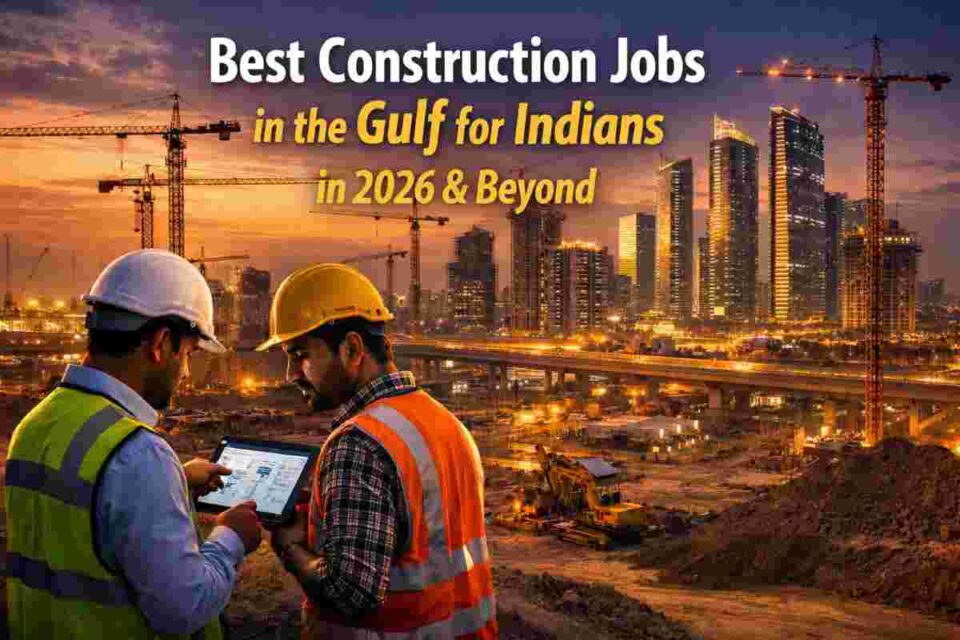
The Gulf Cooperation Council (GCC) region is experiencing its most significant construction expansion in decades. With Saudi Arabia’s $1.5 trillion project pipeline and the UAE’s continuous infrastructure development, 2026 presents extraordinary opportunities for Indian construction professionals across all skill levels.
ConstructionCareerHub App is LIVE — built ONLY for construction careers. Don’t apply with a weak resume.
Get ATS-ready Resume Lab + Interview Copilot + Campus Placement Prep (resume screening, skill gaps, interview readiness) — in minutes & Other advanced features.
Explore Smarter Construction Career Tools →Quick check. Big impact. Start now.
Table of Contents
Why the Gulf Construction Market Is Booming in 2026
The current construction surge is driven by several transformative factors that distinguish it from previous cycles:
Vision 2030 and Mega-Projects
Saudi Arabia’s Vision 2030 has unleashed a wave of ambitious giga-projects that are reshaping the regional construction landscape. NEOM, The Line, Red Sea Project, Qiddiya, and Trojena represent just a fraction of the developments requiring hundreds of thousands of workers across multiple disciplines.
In the UAE, mega-developments, including Abu Dhabi’s 8,000 residential units delivery by year-end, with 12,800 more planned for 2026, demonstrate the sustained construction momentum across the Emirates.
Infrastructure and Smart City Development
The GCC Railway Project, spanning over 2,177 kilometers and connecting all six Gulf nations by 2030, represents one of the largest infrastructure undertakings in modern history. The Landbridge project connecting Saudi Arabia’s Red Sea and Gulf coasts is expected to be completed by 2026, creating thousands of specialized engineering positions.
Cities like Masdar City, Expo City Dubai, and various smart city initiatives are incorporating cutting-edge technologies, creating demand for professionals skilled in digital construction, IoT integration, and sustainable building practices.
Post-Pandemic Economic Revival
Following COVID-19 delays, oil-based economies are accelerating previously stalled infrastructure projects. The GCC region is projected to create approximately 7 million new jobs by 2025, with construction, oil & gas, and healthcare sectors leading hiring activities.
Preparation for Major Events
Saudi Arabia’s hosting of EXPO 2030 and the 2034 FIFA World Cup has accelerated construction timelines, creating immediate demand for experienced professionals who can deliver complex projects under tight deadlines.
High-Demand Construction Jobs for Indians in 2026
The Gulf construction boom offers opportunities across the entire spectrum of construction roles. Here’s a detailed breakdown of the positions Indian professionals should target:
1. BIM Specialists and Digital Construction Professionals
Why This Role Is Critical: Government mandates in the UAE, Saudi Arabia, Qatar, and Oman now require Building Information Modeling (BIM) for all major public infrastructure projects. The adoption of ISO 19650 standards and BIM Level 2 workflows has made BIM literacy essential rather than optional.
Key Positions:
- BIM Modeler (Civil/MEP/Architectural): Entry to mid-level positions focusing on creating detailed 3D models using Revit, Navisworks, and BIM 360
- BIM Coordinator: Managing clash detection, model coordination, and facilitating communication between architecture, structural, and MEP teams
- BIM Manager/VDC Manager: Leading BIM strategy implementation, managing BIM execution plans, and overseeing digital delivery across projects
- Digital Twin Specialist: Creating and managing post-construction digital twins for facility management
- Scan-to-BIM Specialist: Converting laser scan data into accurate BIM models for renovation and heritage projects
Salary Ranges (2026):
- UAE: AED 5,000-9,000 (entry), AED 10,000-22,000 (mid-level), AED 22,000-35,000+ (senior/manager)
- Saudi Arabia: SAR 6,000-12,000 (entry), SAR 12,000-25,000 (mid-level), SAR 25,000-40,000+ (senior)
- Qatar: QAR 7,000-15,000 (entry), QAR 15,000-28,000 (mid-level), QAR 28,000-45,000+ (senior)
Required Skills: Proficiency in Autodesk Revit (Architecture/Structure/MEP), Navisworks Manage, BIM 360/ACC, Dynamo for automation, understanding of ISO 19650, ability to create BIM Execution Plans, and knowledge of common data environments.
Career Insight: According to industry analyses, BIM professionals in the Middle East often receive benefits including tax-free income, housing allowances, annual flights, and health insurance—making the total compensation package significantly higher than base salary alone.
2. Project Managers and Planning Engineers
Why This Role Is Critical: The complexity and scale of Gulf mega-projects require experienced project managers who can coordinate multinational teams, manage billion-dollar budgets, and deliver projects meeting international standards.
Key Positions:
- Construction Project Manager: Overall responsibility for project delivery, stakeholder management, and commercial success
- Project Engineer: Technical oversight of construction activities, quality control, and problem-solving
- Planning Engineer: Creating and maintaining project schedules using Primavera P6, monitoring critical paths, and reporting progress
- Project Controls Manager: Integrating cost, schedule, and risk management across complex projects
Salary Ranges (2026):
- UAE: AED 15,000-25,000 (Project Engineer), AED 25,000-45,000 (Project Manager), AED 45,000-70,000+ (Senior PM/Project Director)
- Saudi Arabia: SAR 18,000-30,000 (Project Engineer), SAR 30,000-50,000 (Project Manager), SAR 50,000-80,000+ (Senior PM)
Required Skills: PMP or equivalent certification, experience with Primavera P6 or MS Project, understanding of FIDIC contracts, budget management expertise, stakeholder communication skills, and familiarity with digital project management platforms like Procore or Aconex.
Career Pathway: Many Indian engineers successfully transition from site engineer positions to project management roles by gaining certifications, developing commercial awareness, and demonstrating leadership capabilities on progressively larger projects.
3. Site Engineers and Construction Superintendents
Why This Role Is Critical: Every construction project requires boots-on-the-ground technical supervision to ensure quality, safety, and adherence to specifications. The sheer number of active construction sites across the Gulf creates continuous demand for experienced site-level engineers.
Key Positions:
- Site Civil Engineer: Supervising earthwork, concrete work, structural activities, and site logistics
- Site MEP Engineer: Overseeing mechanical, electrical, and plumbing installations
- Construction Superintendent: Managing day-to-day site operations, worker coordination, and quality control
- Safety Officer/HSE Engineer: Ensuring compliance with safety regulations and implementing safety management systems
Salary Ranges (2026):
- UAE: AED 6,000-12,000 (Site Engineer), AED 12,000-20,000 (Senior Site Engineer/Superintendent)
- Saudi Arabia: SAR 7,000-14,000 (Site Engineer), SAR 14,000-24,000 (Senior/Superintendent)
Required Skills: Strong understanding of construction methods and materials, ability to read and interpret technical drawings, knowledge of local building codes and regulations, site surveying capabilities, and proficiency with mobile construction apps for daily reporting.
4. Quantity Surveyors and Cost Estimators
Why This Role Is Critical: With project values reaching billions of dollars, accurate cost management and commercial control are paramount. Gulf contractors and consultants actively recruit Indian quantity surveyors known for their strong analytical skills and attention to detail.
Key Positions:
- Quantity Surveyor: Preparing bills of quantities, conducting measurements, and managing variations
- Cost Estimator: Preparing detailed cost estimates for tenders and budget planning
- Commercial Manager: Leading commercial strategy, contract management, and dispute resolution
- Contract Administrator: Managing contract documentation, claims assessment, and change order processing
Salary Ranges (2026):
- UAE: AED 8,000-15,000 (QS), AED 15,000-28,000 (Senior QS), AED 28,000-45,000 (Commercial Manager)
- Saudi Arabia: SAR 10,000-18,000 (QS), SAR 18,000-32,000 (Senior QS), SAR 32,000-50,000 (Commercial Manager)
Required Skills: Proficiency in CostX, Candy, or similar measurement software, deep understanding of contract types (FIDIC, JCT, NEC), knowledge of local specifications and measurement standards, strong Excel and data analysis skills, and the ability to prepare professional cost reports.
5. Sustainability and Green Building Consultants
Why This Role Is Critical: Saudi Arabia’s Green Initiative aims to achieve net-zero emissions by 2060, while the UAE continues pushing for sustainable development aligned with its Net Zero by 2050 strategy. This environmental focus is creating entirely new job categories in construction.
Key Positions:
- LEED/BREEAM Consultant: Managing green building certification processes and ensuring compliance with sustainability standards
- Sustainability Engineer: Integrating sustainable design principles, optimizing energy performance, and implementing circular economy concepts
- Environmental Impact Assessor: Conducting environmental studies and ensuring regulatory compliance
- Carbon Management Specialist: Calculating carbon footprints, developing decarbonization strategies, and reporting on ESG metrics
Salary Ranges (2026):
- UAE: AED 12,000-20,000 (Consultant), AED 20,000-35,000 (Senior Consultant/Manager)
- Saudi Arabia: SAR 15,000-25,000 (Consultant), SAR 25,000-40,000 (Senior/Manager)
Required Skills: LEED AP, BREEAM Assessor, or equivalent certification, knowledge of Estidama (Abu Dhabi), Mostadam (Saudi Arabia), QSAS (Qatar) rating systems, understanding of renewable energy systems, proficiency with energy modeling software (IES VE, DesignBuilder), and familiarity with circular economy principles and green construction technologies.
Future Outlook: With Saudi Arabia committing to plant 10 billion trees, increasing renewable energy capacity to 50%, and achieve carbon neutrality in key sectors, sustainability professionals will see exponential demand growth through 2030 and beyond.
6. Specialized Trade Skills and Technical Roles
Why This Role Is Critical: Despite increasing automation, the Gulf construction sector still requires significant numbers of skilled tradespeople and technical specialists. Indian workers remain highly valued for their technical competence, work ethic, and adaptability.
High-Demand Technical Positions:
- Welders (6G/ASME certified): Critical for oil & gas, petrochemical, and heavy industrial projects
- HVAC Technicians: Installing and maintaining complex air conditioning systems in mega-developments
- Electrical Technicians: Working on power distribution, lighting systems, and building automation
- Plumbing Supervisors: Managing plumbing and drainage installations in high-rise buildings
- Formwork Carpenters/Steel Fixers: Essential for concrete construction in towers and infrastructure
- Construction Equipment Operators: Operating cranes, excavators, and specialized machinery
Salary Ranges (2026):
- Skilled Trades: AED 1,800-3,500 + overtime (can reach AED 5,000-6,000 monthly with OT)
- Supervisory Roles: AED 4,000-7,000
- Specialized Technicians (HVAC, Electrical): AED 3,500-6,500
Career Advancement: Many Indian workers successfully progress from trade positions to supervisory and technical coordinator roles by gaining certifications, developing English language skills, and demonstrating leadership capabilities.
7. Construction Technology and Innovation Specialists
Why This Role Is Critical: Gulf contractors are rapidly adopting construction technology faster than their workforce can absorb it. This creates opportunities for professionals who can bridge the gap between traditional construction and digital innovation.
Emerging Positions:
- Construction Technology Manager: Leading technology adoption, training teams, and implementing digital workflows
- Drone Survey Operator: Conducting aerial surveys, progress monitoring, and volumetric calculations
- 3D Printing Specialist: Operating and maintaining construction 3D printing equipment (growing rapidly in Saudi Arabia)
- Digital Construction Manager: Orchestrating the integration of BIM, IoT sensors, AI-based scheduling, and reality capture
- Robotics Coordinator: Managing automated systems for bricklaying, welding, and material handling
Salary Ranges (2026):
- UAE: AED 15,000-30,000 (Specialist), AED 30,000-50,000+ (Manager)
- Saudi Arabia: SAR 18,000-35,000 (Specialist), SAR 35,000-60,000+ (Manager)
Skills for Success: A Combination of construction domain knowledge and digital literacy, understanding of data analytics and visualization, change management capabilities, and a continuous learning mindset to stay current with emerging technologies.
Essential Skills for Gulf Construction Success in 2026
Beyond role-specific technical expertise, certain universal competencies significantly enhance career prospects and earning potential in the Gulf construction market:
Digital and Software Proficiency
The days of relying solely on paper drawings and manual calculations are over. Professionals who combine field experience with digital fluency command premium salaries and faster career advancement.
Critical Software Skills:
- BIM Platforms: Autodesk Revit, Navisworks, BIM 360/ACC, Solibri (for any design or coordination role)
- Project Management: Primavera P6, MS Project, Procore, Aconex (for planning and PM positions)
- Estimation & QS: CostX, Candy, PlanSwift, Bluebeam Revu
- CAD & Design: AutoCAD, Civil 3D, Tekla Structures (for detailing and fabrication)
- Analysis & Modeling: ETABS, SAP2000, STAAD Pro (for structural engineers)
- Data & Analytics: Advanced Excel, Power BI, basic Python (increasingly valued)
Strategic Advantage: According to recent industry surveys, engineers with BIM and digital construction skills earn 25-40% more than peers with equivalent experience but traditional skillsets.
Certifications That Open Doors
Professional certifications serve as standardized proof of competence and significantly improve visa approval rates and salary negotiations:
Project Management:
- PMP (Project Management Professional) – globally recognized, often required for senior positions
- Prince2 Practitioner – common in GCC projects following UK standards
- Certified Construction Manager (CCM)
BIM & Digital:
- Autodesk Certified Professional (Revit Architecture/Structure/MEP)
- ISO 19650 Information Management
- Certified BIM Professional (buildingSMART)
Sustainability:
- LEED AP (Accredited Professional) – critical for green building projects
- BREEAM Assessor/AP
- Mostadam Accredited Professional (Saudi Arabia)
- Estidama Pearl Rating System (Abu Dhabi)
Health & Safety:
- NEBOSH International General Certificate
- IOSH Managing Safely
- OSHA 30-Hour Construction
Cost & Commercial:
- RICS (Royal Institution of Chartered Surveyors) Chartership
- Certified Quantity Surveyor (IQSSL/AIQS)
Language and Communication Skills
While technical expertise is essential, career progression in Gulf construction requires effective communication:
- English Proficiency: Business-level English is mandatory. Technical discussions, report writing, and stakeholder presentations require fluency beyond basic conversation
- Arabic (Advantage): Basic Arabic phrases and technical terminology create rapport with local authorities and subcontractors
- Written Communication: Ability to prepare clear technical reports, RFIs, method statements, and commercial correspondence
- Cross-Cultural Competence: Understanding local customs, business etiquette, and working effectively with multinational teams
Adaptability and Continuous Learning
The construction industry is evolving faster than ever. Professionals who demonstrate learning agility and technological adaptability consistently outperform peers:
- Willingness to upskill in emerging areas (AI integration, digital twins, modular construction)
- Ability to work with new software and platforms with minimal training
- Openness to different construction methodologies and international standards
- Problem-solving mindset rather than rigid adherence to familiar approaches
Salary Comparison: India vs. Gulf Markets (2026)
Understanding the financial advantage of Gulf employment helps professionals make informed career decisions. Beyond higher nominal salaries, tax-free income and comprehensive benefits packages create significant wealth-building opportunities.
Sample Salary Comparisons (Monthly)
| Position | India (INR) | UAE (AED) | Saudi Arabia (SAR) | Multiplier |
|---|---|---|---|---|
| Site Engineer (3-5 years) | ₹40,000-60,000 | 8,000-12,000 | 8,000-13,000 | 4-5x |
| BIM Coordinator (4-6 years) | ₹60,000-90,000 | 12,000-18,000 | 12,000-20,000 | 4-5x |
| Project Manager (8-10 years) | ₹1,00,000-1,50,000 | 25,000-40,000 | 25,000-45,000 | 5-7x |
| Quantity Surveyor (5-7 years) | ₹50,000-80,000 | 10,000-18,000 | 12,000-20,000 | 4-6x |
| HVAC Technician (Skilled) | ₹25,000-35,000 | 2,500-4,000 | 2,800-4,500 | 2.5-3x |
Note: AED to INR ≈ 24, SAR to INR ≈ 23 (approximate conversion rates). Actual purchasing power and savings potential may vary based on lifestyle choices and family situation.
Total Compensation Package Benefits
Beyond base salary, Gulf employers typically provide comprehensive benefits that significantly increase total compensation value:
- Tax-Free Income: Zero income tax in UAE, Saudi Arabia, Qatar, and Oman means take-home pay equals gross salary
- Housing Allowance: AED 2,000-8,000 monthly (or company-provided accommodation)
- Transportation: Company vehicle, transport allowance, or fuel cards
- Annual Flights: Return tickets to home country for employee and family (senior positions)
- Health Insurance: Comprehensive medical coverage for family
- Education Allowance: School fees support for dependent children (senior positions)
- End-of-Service Gratuity: Lump sum payment upon contract completion (typically 21 days’ salary per year of service)
Savings Potential: With disciplined financial planning, Gulf construction professionals typically save 60-75% of their salary—a savings rate nearly impossible to achieve in India at equivalent career stages.
Visa Process and Legal Requirements for 2026
Gulf countries have streamlined visa and work permit processes to facilitate skilled worker recruitment. Understanding current procedures helps avoid delays and fraudulent schemes:
Saudi Arabia
Skill Verification Program (SVP): Now operating on a fast-track system. Indian workers must obtain skill verification certificates from authorized centers before visa processing.
Required Documents:
- Valid passport (minimum 6 months validity)
- Educational certificates with attestation (MEA/Embassy)
- Experience certificates from previous employers
- Medical fitness certificate (specific tests required)
- Police clearance certificate
- Trade test certificate (for skilled workers)
Processing Time: 4-8 weeks from job offer to visa issuance (faster for companies with pre-approved quotas)
Minimum Salary Recommendation: The Indian Embassy sets a minimum recommended salary at SAR 1,200 (₹26,400) for basic positions to protect workers’ interests.
United Arab Emirates
New E-Visa Options: Digital document verification systems have simplified the process significantly. Golden Visa and Green Visa programs offer longer-term options for skilled professionals.
Required Documents:
- Valid passport (6 months minimum validity)
- Attested educational and experience certificates
- Medical fitness test (conducted in UAE after arrival)
- Emirates ID application
- Offer letter and employment contract
Processing Time: 3-6 weeks typically
Salary Standards: Minimum AED 1,500 for blue-collar workers, higher for professional positions
Qatar and Oman
Streamlined Medical and Biometric Process: Both countries have simplified health screening and biometric data collection.
Key Requirement: Job offers must be from registered employers with valid recruitment licenses. Always verify company credentials through official government portals.
Avoiding Visa Fraud
Warning Signs of Fraudulent Recruiters:
- Requests for large upfront fees before job confirmation
- Promises of unrealistic salaries or immediate visa processing
- Reluctance to provide company details or direct employer contact
- Pressure to make quick decisions without proper documentation
Safe Recruitment Practices:
- Use only MEA-registered recruitment agencies
- Verify company existence through official company registries
- Ensure employment contracts specify salary, benefits, and working conditions clearly
- Never pay fees exceeding government-mandated limits
- Obtain written confirmation before leaving India
Career Development Strategy for 2026-2030
Strategic career planning maximizes the Gulf construction opportunity. Here’s a structured approach for different career stages:
For Fresh Graduates (0-2 Years Experience)
Immediate Focus:
- Gain 2-3 years of India experience in reputable firms working on large projects
- Develop software proficiency (AutoCAD, Revit basics, MS Office advanced)
- Obtain at least one relevant certification (NEBOSH, Revit Certified User)
- Build English communication skills to a business proficiency level
- Create a portfolio documenting project involvement and responsibilities
Gulf Entry Strategy: Target entry-level positions in large contracting firms or consultancies. Accept slightly lower initial salaries to gain international experience. Focus on learning and skill development in first Gulf assignment.
For Mid-Career Professionals (3-8 Years Experience)
Immediate Focus:
- Specialize in high-demand areas (BIM, sustainability, project controls)
- Obtain professional certifications (PMP, LEED AP, RICS)
- Develop commercial awareness beyond pure technical skills
- Build experience with international standards (FIDIC, BS, ASTM)
- Network with Gulf-based professionals through LinkedIn and industry groups
Gulf Advancement Strategy: Leverage India experience to negotiate better positions. Target roles with clear progression pathways. Consider 2-3 year contracts to maximize learning before moving to senior positions. Build relationships with recruiters specializing in Gulf construction.
For Senior Professionals (8+ Years Experience)
Strategic Positioning:
- Target leadership roles (Project Manager, Commercial Manager, BIM Manager)
- Highlight mega-project experience and complex project delivery
- Develop business development and client relationship skills
- Consider consulting or advisory roles with flexibility for multiple projects
- Build personal brand through technical publications and conference speaking
Long-Term Planning: Gulf assignments should align with career goals. Some professionals use Gulf experience to build savings and return to India for entrepreneurship. Others establish long-term careers in international construction. Plan accordingly from the outset.
Skill Development Priorities for 2026
Based on construction industry trends, prioritize these emerging capabilities:
- AI Integration Skills: Understanding AI-powered scheduling, design optimization, and safety monitoring
- Sustainability Expertise: Carbon calculation, circular economy principles, renewable energy integration
- Data Analytics: Interpreting project data, creating dashboards, using insights for decision-making
- Modular/Offsite Construction: Understanding DfMA (Design for Manufacture and Assembly) principles
- Digital Twin Management: Creating and maintaining post-construction digital assets
Country-Specific Opportunities and Considerations
Saudi Arabia: The Biggest Growth Market
Advantages:
- Largest number of mega-projects and hiring volumes
- Long-term growth trajectory through 2030 and beyond
- Competitive salaries with comprehensive benefits
- Tax-free income with lower cost of living than UAE
- Strong Indian expat community providing support networks
Considerations:
- More conservative social environment requires cultural adaptation
- Some remote project locations (NEOM, Red Sea) have limited amenities
- Weekend is Friday-Saturday (working week Saturday-Thursday)
- Higher focus on Saudization may affect long-term career progression
Best For: Professionals prioritizing maximum savings, long-term mega-project involvement, and willing to adapt to conservative cultural norms.
United Arab Emirates: Established Market with Diversity
Advantages:
- Most cosmopolitan environment with diverse expat community
- World-class amenities, entertainment, and lifestyle options
- Strong legal framework protecting worker rights
- Excellent connectivity to India with frequent flights
- Progressive visa policies (Golden Visa, remote work visas)
Considerations:
- Higher cost of living, especially housing and education
- More competitive job market with global talent pool
- Potentially slower salary growth compared to Saudi Arabia
- Increasing Emiratization pressures in certain sectors
Best For: Professionals with families seeking quality of life, those prioritizing work-life balance, and individuals who value urban lifestyle and cultural diversity.
Qatar: Niche Opportunities
Current Focus: Post-FIFA World Cup, Qatar is shifting from sports infrastructure to hospitality, residential, and commercial development.
Advantages:
- Competitive salaries (often higher than UAE for equivalent positions)
- Strong infrastructure and ongoing development projects
- Relatively smaller expat community creating tighter professional networks
- Good savings potential with moderate living costs
Best For: Mid-senior professionals in specialized roles (MEP, BIM, project controls) seeking quieter lifestyle with strong compensation.
Oman and Kuwait: Secondary Markets
Characteristics: Smaller construction markets with selective opportunities, typically requiring specialized skills or previous Gulf experience. Lower salaries than UAE/Saudi but also lower living costs. Good options for building initial Gulf experience.
Future Outlook: Construction in the Gulf Beyond 2026
Continued Growth Through 2030
Industry analysts project sustained construction activity in the Gulf through the end of this decade and into the 2030s. Key drivers include:
- Economic Diversification: GCC nations are continuing to reduce oil dependency through tourism, technology, and knowledge economy investments
- Population Growth: Continued demographic expansion requires housing, infrastructure, and services
- Climate Adaptation: Major investments in water security, renewable energy, and climate-resilient infrastructure
- Digital Economy: Data center construction, smart city expansion, and digital infrastructure development
Technology-Driven Transformation
The Gulf construction sector will increasingly differentiate between:
- “Hybrid Workers”: Professionals combining traditional construction knowledge with digital fluency—this group will command premium compensation and rapid advancement
- Traditional Practitioners: Workers relying solely on conventional methods will face salary stagnation and limited opportunities
According to construction recruitment specialists, roles integrating BIM, data analytics, and automation are seeing 25-30% salary increases, while traditional positions show only 1.5-3% annual growth.
Sustainability Becoming Standard
Green building requirements will shift from optional certifications to mandatory standards. Professionals lacking sustainability credentials will find opportunities increasingly limited. LEED, BREEAM, and regional rating systems (Mostadam, Estidama, Pearl) will become entry requirements rather than differentiators.
Modular and Offsite Construction Expansion
To meet aggressive timelines and address labor challenges, Gulf contractors are rapidly adopting prefabrication and modular construction. This creates demand for professionals understanding:
- Design for Manufacture and Assembly (DfMA) principles
- Factory-to-site logistics and coordination
- Quality control in manufacturing environments
- BIM-to-fabrication workflows
Practical Steps to Secure Gulf Construction Jobs in 2026
Step 1: Assess Your Current Position
Conduct honest self-evaluation:
- Technical skills inventory: What software can you use proficiently?
- Certifications gap analysis: What credentials do target positions require?
- Experience documentation: Can you prove project involvement with references?
- Language proficiency: Is your English adequate for professional communication?
- Financial readiness: Can you manage 2-3 months of expenses during job search and relocation?
Step 2: Build Your Digital Presence
LinkedIn Optimization:
- Professional photo and banner showcasing construction expertise
- Headline emphasizing key skills and target roles (e.g., “PMP-Certified Project Manager | BIM Specialist | Targeting Gulf Mega-Projects”)
- Detailed experience section with quantified achievements
- Skills section aligned with job posting keywords
- Recommendations from supervisors and clients
- Regular posting of professional content demonstrating industry knowledge
Portfolio Development:
- Create PDF portfolio showcasing project involvement, drawings, photos
- Highlight specific contributions and responsibilities
- Include before/after images, complex details solved, innovations implemented
- Keep file size manageable for email attachments
Step 3: Strategic Job Search
Multiple Channel Approach:
- Specialized Recruitment Agencies: Register with MEA-approved agencies focusing on Gulf construction (verify credentials thoroughly)
- Direct Company Applications: Apply through official websites of major contractors (Larsen & Toubro, Shapoorji Pallonji, CSCEC, Samsung C&T, Bechtel, etc.)
- Job Portals: Monitor Bayt.com, GulfTalent, Naukrigulf, LinkedIn Jobs, and company career pages daily
- Networking: Connect with professionals currently working in Gulf, join industry groups, attend virtual job fairs
- Social Media: Follow construction companies’ social media for hiring announcements
Application Best Practices:
- Customize resume for each application (keyword optimization)
- Address selection criteria specifically if provided
- Include concrete examples of problem-solving and achievements
- Provide contact information of referees who can be reached
- Follow up professionally 7-10 days after application
Step 4: Ace the Interview Process
Common Interview Formats:
- Initial phone/video screening (HR and technical basics)
- Technical interview with department head (project-specific questions)
- Final interview with senior management (cultural fit, salary negotiation)
Preparation Strategies:
- Research the company’s current projects thoroughly
- Prepare specific examples using STAR method (Situation, Task, Action, Result)
- Review fundamental technical knowledge in your discipline
- Practice common questions: “Why Gulf?”, “Describe a challenging project”, “How do you handle pressure?”
- Prepare intelligent questions demonstrating genuine interest
- Test video interview setup (lighting, audio, background)
Step 5: Salary Negotiation
Research-Based Approach:
- Know market rates for your role and experience level
- Understand total package (base + housing + transport + benefits)
- Consider location (accommodation costs vary significantly)
- Evaluate contract duration and end-of-service benefits
Negotiation Tactics:
- Express enthusiasm for the role before discussing compensation
- Provide salary range rather than fixed number (with research-based justification)
- If base salary is fixed, negotiate other components (housing, flights, vacation days)
- Get all promises in writing before accepting
- Understand visa/ticket costs responsibility (should be employer-covered)
Step 6: Pre-Departure Preparation
Document Checklist:
- Original and multiple attested copies of all certificates
- Experience letters with detailed job responsibilities
- Reference letters from previous employers
- Portfolio of work (digital and print)
- Medical reports (as per destination country requirements)
- Passport-size photographs (white background, formal attire)
Financial Planning:
- Maintain Indian bank account for salary transfers and family support
- Understand currency exchange mechanisms and fees
- Set up insurance for family members in India if relocating alone
- Budget for initial 2-3 months (accommodation deposits, setup costs)
- Plan tax compliance if maintaining income sources in India
Resources for Aspiring Gulf Construction Professionals
Learning Platforms
- BIM Training: Autodesk University, LinkedIn Learning, Udemy (Revit Architecture/MEP/Structure courses)
- Project Management: PMI.org (PMP preparation), AACE International (planning and cost engineering)
- Sustainability: USGBC (LEED training), BRE Academy (BREEAM courses)
- Technical Skills: Coursera, edX (construction management, structural analysis)
Industry Information Sources
- Construction Week Online: Latest Middle East construction news and project updates
- MEED (Middle East Economic Digest): Project intelligence and business analysis
- ConstructionPlacements.com: Career guidance, job listings, and industry insights for construction professionals
- Arab News Business: Economic developments and corporate announcements
Career Resources
- ConstructionCareerHub: The Only Career Platform Built Exclusively for Construction Professionals
- Ace Your Next Job Interview with Our Advanced Interview Preparation Timeline Calculator: A Step-by-Step Guide
- Technology Skills Checklist for Construction Professionals 2026 [Free PDF Download]
- Highest Paying Jobs in Construction AI Supervision (2026 Guide)
Professional Networking
- LinkedIn Groups: “Construction Professionals in the Middle East”, “BIM Middle East”, country-specific groups
- Industry Associations: RICS Middle East, PMI Arabian Gulf Chapter, buildingSMART Middle East
- Conferences: Big 5 Construction Exhibition (Dubai), Saudi Giga Projects Summit
Conclusion: Seizing the Gulf Construction Opportunity
The Gulf construction boom of 2026 represents a generational opportunity for Indian construction professionals. With $1.5 trillion in active projects, aggressive timelines for Vision 2030 goals, and acute skilled labor shortages, the demand for talented engineers, managers, and technical specialists has never been stronger.
The professionals who will thrive are those who:
- Combine traditional construction expertise with digital fluency
- Invest in continuous skill development and relevant certifications
- Demonstrate adaptability and cultural intelligence
- Approach Gulf assignments strategically as part of long-term career planning
- Maintain professional standards and ethical practices
Whether you’re a fresh graduate contemplating your first international move, a mid-career professional seeking accelerated growth, or a senior specialist targeting leadership roles, the Gulf construction market offers pathways aligned with your ambitions.
The window of maximum opportunity is now. Major projects are mobilizing, contractors are actively recruiting, and visa processes have been streamlined. By combining strategic preparation, targeted skill development, and persistent effort, Indian construction professionals can transform Gulf opportunities into career-defining experiences.
Start today by assessing your skills gap, updating your professional profile, obtaining key certifications, and connecting with the right opportunities. The Gulf construction boom isn’t just about building cities—it’s about building careers, financial security, and professional legacies that will last well beyond 2026.
About ConstructionPlacements.com: We help construction professionals navigate career transitions, develop in-demand skills, and connect with opportunities across global markets. Explore our construction career resources, including salary guides, skill assessments, and job market insights tailored to Global professionals.
Looking for personalized career guidance? Check out our Construction Career Assessment Tool to identify your optimal career path in BIM, site engineering, project management, or quantity surveying based on your skills and interests.
FAQs
Saudi Arabia offers the most opportunities due to its massive Vision 2030 projects and $180 billion annual construction spending. However, the UAE provides better lifestyle amenities and work-life balance. Choose Saudi Arabia for maximum savings and mega-project exposure; choose UAE for family-friendly environment and cosmopolitan living.
With disciplined financial planning, professionals typically save 60-75% of their salary due to tax-free income and employer-provided benefits (housing, transport, medical). A project manager earning AED 30,000 monthly can save AED 18,000-22,000 (₹4-5 lakhs) per month, compared to saving ₹30,000-50,000 in India from a ₹1.5 lakh salary.
For professional positions (engineers, managers, BIM specialists), 2-5 years of India experience is highly recommended and often required. However, skilled trades (welders, HVAC technicians, carpenters) can apply with ITI certificates and minimal experience. Fresh graduates face significant challenges securing direct Gulf positions without proven track record.
Saudi Arabia: 4-8 weeks, UAE: 3-6 weeks, Qatar: 4-6 weeks, Oman: 3-5 weeks. Processing is faster when employers have pre-approved visa quotas and all your documents are properly attested. Delays typically occur due to incomplete documentation or medical clearance issues.
No, English is the primary working language in Gulf construction. However, basic Arabic phrases help in daily interactions with local authorities, subcontractors, and site workers. Professional-level English is mandatory for engineering and management positions.
