

Last Updated on December 18, 2025 by Admin
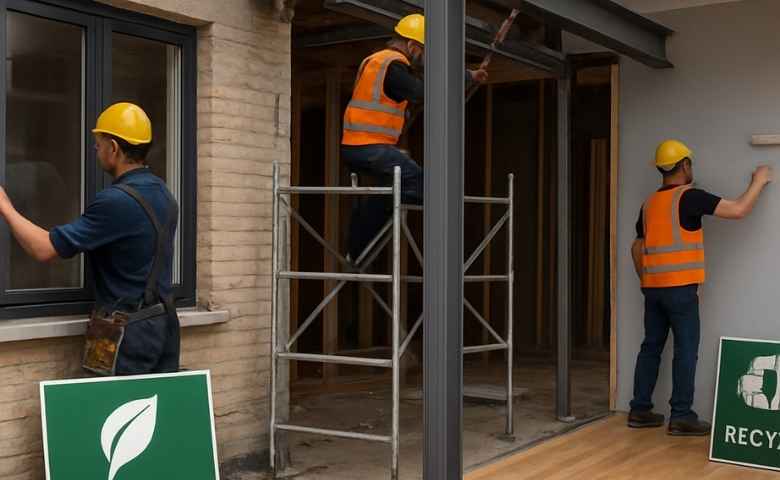
Under the pressure of economic downturn, the construction industry, which relies on incremental construction, faces multiple challenges: the growth of traditional businesses has stalled, with both operating revenue and net profit attributable to shareholders of constituent stocks of the CITIC Construction Index declining in the third quarter of 2025; tight capital chains overlap with labor shortages, leading to extended accounts receivable turnover cycles and soaring labor costs; transformation costs and environmental pressures have put small and medium-sized enterprises in a dilemma. As urbanization enters the middle and late stages, the demand for renovation of existing buildings continues to be released, and the trillion-yuan market has become the key to breaking the deadlock in the industry.
ConstructionCareerHub App is LIVE — built ONLY for construction careers. Don’t apply with a weak resume.
Get ATS-ready Resume Lab + Interview Copilot + Campus Placement Prep (resume screening, skill gaps, interview readiness) — in minutes & Other advanced features.
Explore Smarter Construction Career Tools →Quick check. Big impact. Start now.
Renovation Market: Core Opportunity in a Trillion-Yuan Blue Ocean
The stock of existing urban buildings in China exceeds 60 billion square meters. A large number of old buildings are in urgent need of renovation, and buildings constructed during the high-speed urbanization period from 1998 to 2010 have also entered a concentrated renovation phase, spurring rigid demand. At the policy level, the “14th Five-Year Plan” and “15th Five-Year Plan” clearly support urban renewal, with continuous increases in special subsidy funds and special bonds, and gradual improvement of regulatory standards. The market scale is expanding steadily, expected to exceed 2.5 trillion yuan in 2025, with a compound annual growth rate (CAGR) of over 12% in the next five years, becoming a core counter-cyclical track for the construction industry.
Breakthrough Practice of “Louzhang Xiulou”
“Louzhang Xiulou” has specialized in the renovation field for 24 years, building a “diagnosis-design-construction-maintenance” full-chain service system. Through standardized solutions and digital platforms, it achieves efficient response and cost optimization. In large-scale renovation projects such as industrial heritage renovation and comprehensive upgrading of old residential areas, links like the transportation of heavy components and the entry of large equipment often affect the construction progress, and reliable hoisting equipment is crucial to ensuring the smooth progress of such operations. Its integrated supply chain includes high-quality hoisting supporting products suitable for these scenarios — DGCRANE DRS wheel blocks. As a core wheel set component of cranes, it is easy to install and maintain, with a load capacity ranging from 2.75 tons to 40 tons. Equipped with laser calibration technology, it can accurately eliminate installation errors, provide stable support for heavy equipment operations in renovation construction, and help improve overall construction efficiency.
In diversified scenarios, “Louzhang Xiulou” accurately meets demands: the renovation of old residential areas improves residents’ satisfaction through Party building leadership and digital empowerment; the renovation of industrial heritage adheres to the concept of “protection + activation”. In an “industrial-to-commercial conversion” project of a textile factory, it not only preserves the original style but also ensures construction safety and efficiency with professional hoisting equipment. The FEM single girder gantry crane commonly used in such projects features lightweight, high-precision, and energy-efficient advantages, which can meet the material transfer needs in industrial transformation and adapt to various operating environments. Meanwhile, through the model of public welfare feedback and ecological co-construction, it achieves a win-win situation for enterprises and communities.
Core Paths for Industry Transformation
For construction enterprises to transform into the renovation business, they need to focus on segmented scenarios such as old residential areas and industrial heritage to build core capabilities; take technological upgrades such as waterproofing and leakage repair, structural reinforcement, and digital platform construction as the two-wheel drive to improve service quality; construct a diversified profit model of “construction + maintenance + value-added services”, and reduce market development costs through government-enterprise cooperation and community co-construction.
The economic downturn is a critical period for industry transformation. Construction enterprises need to shift from a “building-construction mindset” to a “building-renovation mindset”, relying on the scenario adaptability and low transformation costs of the renovation business to build core competitiveness in the stock competition. In the future, with the upgrading of refinement, digitalization, and greenization, the renovation business will reshape the industry ecology and enable the construction industry to glow with new vitality in the stock era.
Related Posts:
- Home Renovation vs. New Construction: Which Is Right for You?
- 10 Key IT and Digital Transformation Consultants in Construction
- What is Core Drilling?
- How Much Does House Renovation Cost?
